If you’ve ever stopped mid-sentence over Per Se or Per Say, you’re not alone. This mix-up happens in emails, essays, workplace notes, and everyday conversation because the spelling, pronunciation, Latin phrase, formal writing, sentence examples, and legal usage all overlap in a confusing way. In American English, people often hear the phrase long before they see it written. So they type what they hear. This guide clears that up fast. You’ll learn which form is correct, what it means, how to pronounce it, when it fits naturally, and when a simpler phrase works better.
Quick Answer
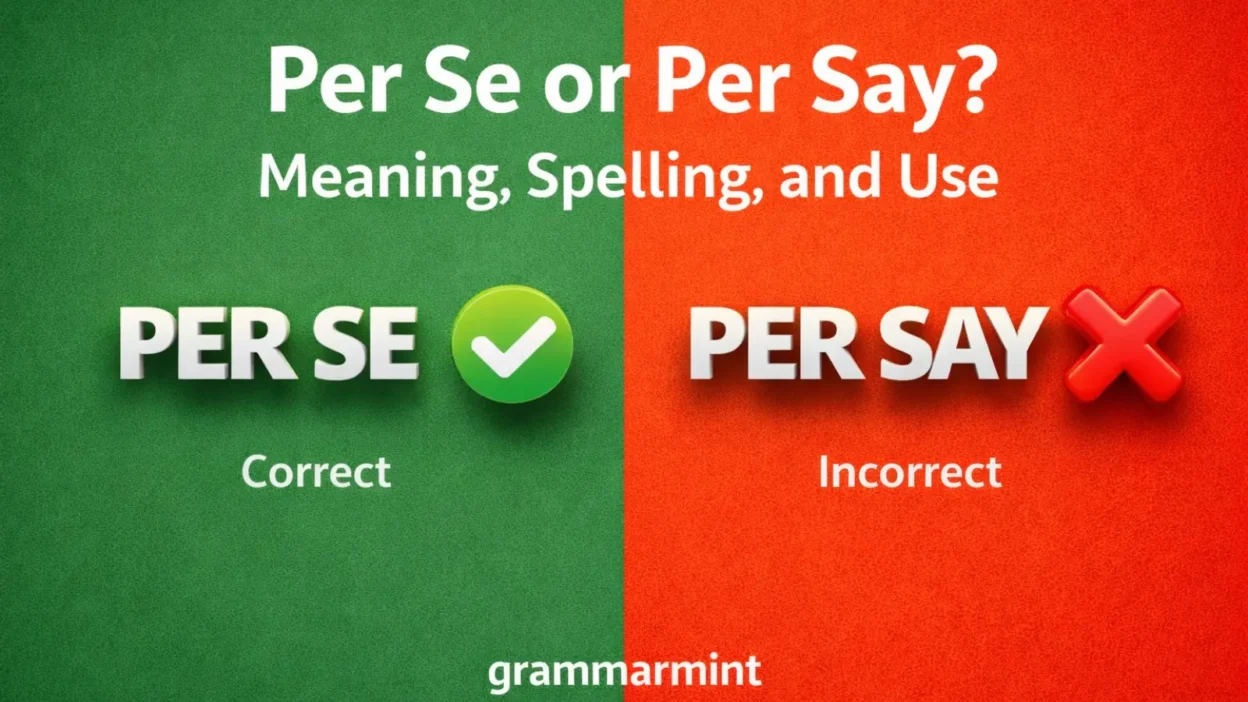
Per Se or Per Say: use per se. Per say is a misspelling based on how the phrase sounds when spoken. Per se means “by itself” or “in itself,” and you use it when you want to isolate one thing from the bigger picture.
TL;DR
• Per se is the correct form.
• Per say is not standard English.
• It means “by itself” or “in itself.”
• It often narrows or qualifies a statement.
• In casual writing, simpler wording may sound better.
Per Se Meaning
Per se is a Latin phrase that means by itself, in itself, or intrinsically. You use it when you want readers to focus on one thing alone, not the whole situation.
It often appears when a sentence draws a careful distinction. That’s why it can sound precise and slightly formal.
• It isolates one idea from others.
• It narrows the scope of a claim.
• It often softens broad statements.
• It signals a careful qualification.
• It does not mean “for example.”
• It does not mean “basically.”
• It usually points to inherent nature.
• It works best with contrast nearby.
• It often follows the key noun.
• It sounds precise, not flashy.
• It can feel formal in speech.
• It is common in edited writing.
Per Se Or Per Say
Here’s the simple rule: per se is the correct spelling, and per say is wrong. People write per say because that is close to how the phrase sounds in everyday speech.
This is a spelling mistake, not a regional variant. It is not accepted American English or British English.
• Write per se, never “per say.”
• Keep it as two separate words.
• Don’t treat “per say” as optional.
• Don’t assume speech spelling is valid.
• The error can hurt credibility.
• The mistake appears in casual typing.
• It also shows up in work emails.
• Spellcheck may not always catch it.
• Readers notice it quickly.
• Editors usually fix it immediately.
• The standard form stays unchanged.
• This rule is straightforward and stable.
Why People Write Per Say
Most people learn this phrase by hearing it, not by reading it. So the sound leads the spelling, and the spelling goes wrong.
That makes this a classic sound-based writing error. The phrase also feels less familiar because it comes from Latin.
• The phrase sounds like “per say.”
• Spoken exposure often comes first.
• The final word sounds fully English.
• Latin spelling feels less intuitive.
• Fast typing encourages phonetic guesses.
• Rarely seeing it in print matters.
• School lessons may skip this phrase.
• Autocorrect can miss the problem.
• Social media spreads sound-based forms.
• Many writers trust their ear.
• The error feels plausible at first.
• Reading more examples fixes it.
How To Pronounce Per Se
In everyday American speech, you’ll usually hear it as per SAY. The second word carries the clearer stress.
You may also hear a “per SEE” style in some dictionary coverage or careful speech. However, “per SAY” is the version most people expect.
• Say it like “per SAY.”
• Stress usually lands on “say.”
• Don’t pronounce it as one word.
• Keep the rhythm smooth and short.
• Avoid over-dramatic Latin styling.
• Natural speech sounds better here.
• The common sound causes the misspelling.
• Hearing it once can mislead writers.
• Reading it once usually fixes that.
• The phrase stays easy to say.
• It does not need a pause.
• Calm delivery sounds most natural.
How To Use Per Se In A Sentence
Use per se when you want to separate one element from a bigger judgment. It often works well in sentences that include contrast, nuance, or a gentle correction.
A common pattern is this: something is not bad, wrong, or the problem per se, but something related to it is.
• Place it near the idea narrowed.
• Use it to refine a point.
• Pair it with a contrast clause.
• Let it limit the claim.
• Keep the sentence structure simple.
• Use it after the main noun.
• Try it with “but” for clarity.
• Avoid piling on extra qualifiers.
• Don’t force it into every example.
• Make the distinction easy to hear.
• Read the sentence aloud afterward.
• Replace it if the line drags.
When Per Se Sounds Natural
This phrase sounds most natural when you’re drawing a distinction. You are not rejecting the whole category. You are separating the core thing from related problems, side effects, or context.
That is why per se fits best in careful explanation. It works less well in loose chatter.
• “Not wrong per se, just risky.”
• “Not expensive per se, just overpriced.”
• “Not rude per se, just abrupt.”
• “Not boring per se, just slow.”
• “Not harmful per se, just distracting.”
• “Not illegal per se, just restricted.”
• “Not weak per se, just untested.”
• “Not outdated per se, just clunky.”
• “Not unfair per se, just uneven.”
• “Not broken per se, just unreliable.”
• “Not formal per se, just polished.”
• “Not rare per se, just specific.”
When To Skip Per Se
Sometimes plain English is stronger. In a casual text, quick email, or beginner-facing explanation, per se can sound heavier than needed.
That does not make it wrong. It just means another phrase may sound smoother.
• Use “by itself” for clarity.
• Use “in itself” for flow.
• Use “inherently” for sharper tone.
• Use “exactly” only when accurate.
• Skip Latin in casual messages.
• Skip it with young readers.
• Skip it in rushed workplace chats.
• Skip it when tone feels stiff.
• Skip it if meaning stays fuzzy.
• Skip it when simpler wording wins.
• Skip it in friendly captions.
• Skip it in plain-language guides.
Per Se In Formal Writing
In professional, academic, and polished writing, per se can work very well. It signals precision and helps you limit a statement without sounding vague.
Still, formal writing values clarity more than fancy phrasing. So use it when it sharpens the sentence, not when it decorates it.
• It fits reports and essays well.
• It works in careful email writing.
• It suits analytical discussion.
• It can sharpen a limitation.
• It often sounds measured and controlled.
• It should not appear too often.
• Overuse makes prose feel affected.
• One clean use is enough.
• Simpler wording may still win.
• Precision matters more than sophistication.
• Readers should grasp it instantly.
• Formal tone still needs warmth.
Per Se In Legal Writing
Legal English uses per se more than everyday writing does. That’s why many people first notice it in phrases like negligence per se or per se rule.
In law, the phrase often points to something treated as inherently true or legally established on its own terms. Outside legal writing, though, that special meaning does not always carry over.
• Legal use is more specialized.
• “Negligence per se” is a set phrase.
• “Per se rule” is another example.
• Law often keeps older Latin phrases.
• Legal meaning can be narrower.
• Everyday meaning is broader.
• Don’t borrow legal tone carelessly.
• Don’t assume all readers know it.
• Explain it in public-facing copy.
• Avoid legal jargon in simple guides.
• Context changes the force here.
• Audience decides how much to explain.
Per Se Vs In Itself
In itself is often the closest plain-English substitute. In many sentences, it does nearly the same job and sounds more natural.
Still, the tone is not identical. Per se can sound more formal or more technical, while in itself usually sounds more conversational.
• Both can isolate one element.
• “In itself” sounds more natural.
• “Per se” sounds slightly more formal.
• Both can soften a judgment.
• Both work with contrast clauses.
• “Per se” feels more compact.
• “In itself” feels more direct.
• Choose based on audience comfort.
• Choose based on sentence rhythm.
• Choose the clearest option first.
• Don’t force a Latin phrase.
• Meaning matters more than style.
Per Se Synonyms That Sound More Natural
You do not need to use per se every time. Several alternatives can sound cleaner, especially in speech or reader-friendly writing.
The best substitute depends on the exact meaning. Some options are close, while others only work in certain sentences.
• Try “by itself” for simplicity.
• Try “in itself” for neutrality.
• Try “inherently” for stronger force.
• Try “as such” with caution.
• Try “essentially” only when accurate.
• Try “on its own” for speech.
• Try “strictly speaking” for precision.
• Try “technically” for narrow cases.
• Avoid “exactly” unless that’s intended.
• Avoid “literally” as a replacement.
• Avoid “basically” as a shortcut.
• Match the substitute to context.
Per Se Punctuation And Formatting
Mechanically, per se is simple once you know the basics. It is usually written as two words, without a hyphen.
Commas depend on sentence rhythm, not on a special fixed rule. Italics depend on style choice, audience, and house preference.
• Write it open, not closed.
• Don’t hyphenate it mid-sentence.
• Don’t capitalize it unnecessarily.
• Italics are often optional today.
• House style may prefer plain type.
• Some academic contexts still italicize.
• Commas are not automatically required.
• Use commas only when rhythm helps.
• Don’t isolate it with random pauses.
• Keep punctuation driven by syntax.
• Check consistency across the piece.
• Keep formatting decisions low-drama.
Per Se In American And British English
There is no major American-versus-British split here. Both varieties use per se, and both treat per say as a mistake.
That makes this easier than many spelling debates. The rule stays the same on both sides of the Atlantic.
• American English uses “per se.”
• British English uses “per se” too.
• The spelling does not switch.
• The core meaning stays constant.
• The formal feel stays similar.
• The error remains the same.
• Regional spelling rules do not apply.
• It is not like color/colour.
• It is not like organize/organise.
• Latin keeps this form stable.
• Readers in both regions recognize it.
• Consistency is easy here.
Common Mistakes With Per Se
Most mistakes fall into a few patterns. Writers either misspell it, overuse it, or choose it when another word would be clearer.
Once you know those traps, the phrase becomes much easier to handle.
• Writing “per say” instead of “per se.”
• Hyphenating it as “per-se.”
• Using it to mean “for example.”
• Using it to mean “exactly.”
• Dropping it into every paragraph.
• Making the sentence too crowded.
• Adding commas without a reason.
• Using it for dramatic effect.
• Choosing it over clearer English.
• Placing it far from its target.
• Assuming it sounds smarter automatically.
• Forgetting the audience’s comfort level.
Everyday Examples Of Per Se
The best way to learn this phrase is to see it in normal contexts. These examples sound like things real people might actually say or write.
Notice how the phrase usually narrows the point instead of carrying the whole sentence.
• “I’m not against meetings per se.”
• “The plan isn’t flawed per se.”
• “Coffee isn’t the issue per se.”
• “The app isn’t confusing per se.”
• “His tone wasn’t hostile per se.”
• “Remote work isn’t harder per se.”
• “That feedback wasn’t negative per se.”
• “The budget isn’t small per se.”
• “The class wasn’t difficult per se.”
• “Her reply wasn’t cold per se.”
• “The movie wasn’t long per se.”
• “The design isn’t bad per se.”
Easy Memory Tricks For Per Se
A good memory trick can stop the error before it happens. The easiest fix is to remember that the spelling does not follow the sound.
Think of se as part of an old Latin expression, not a normal English word.
• Hear “say,” but write se.
• Think “Latin,” not phonetic spelling.
• Remember it means “by itself.”
• Link it to careful distinction.
• Picture two words, not one.
• Recall legal phrases using it.
• Replace it mentally with “in itself.”
• Test whether that swap works.
• Save one correct example mentally.
• Reuse that model sentence often.
• Read it more than you hear it.
• Let the eye retrain the ear.
FAQs
Is It Per Say Or Per Se?
It is per se. Per say is a misspelling based on pronunciation, not a correct alternative.
What Does Per Se Mean In Simple Terms?
It means “by itself” or “in itself.” You use it when you want to talk about one thing alone, apart from other factors.
Is Per Say Ever Correct?
No. In standard English, per say is not accepted as the correct form of this phrase.
How Do You Use Per Se In A Sentence?
Use it when you want to narrow a point or separate the core issue from related details. It often works well in sentences with contrast, especially ones that include “but.”
Is Per Se Formal?
Yes, it usually sounds a bit formal. It works well in professional, academic, and legal contexts, but simpler wording may sound better in casual writing.
Should Per Se Be Italicized?
Usually, plain text is fine in modern everyday writing. In some academic or style-specific settings, italics may still be preferred, so consistency matters.
Conclusion
If you’re choosing between Per Se or Per Say, the right form is per se.
Use it when you mean “by itself,” and skip it when simpler wording sounds clearer.
Once you connect the sound to the correct spelling, this mistake gets much easier to avoid.