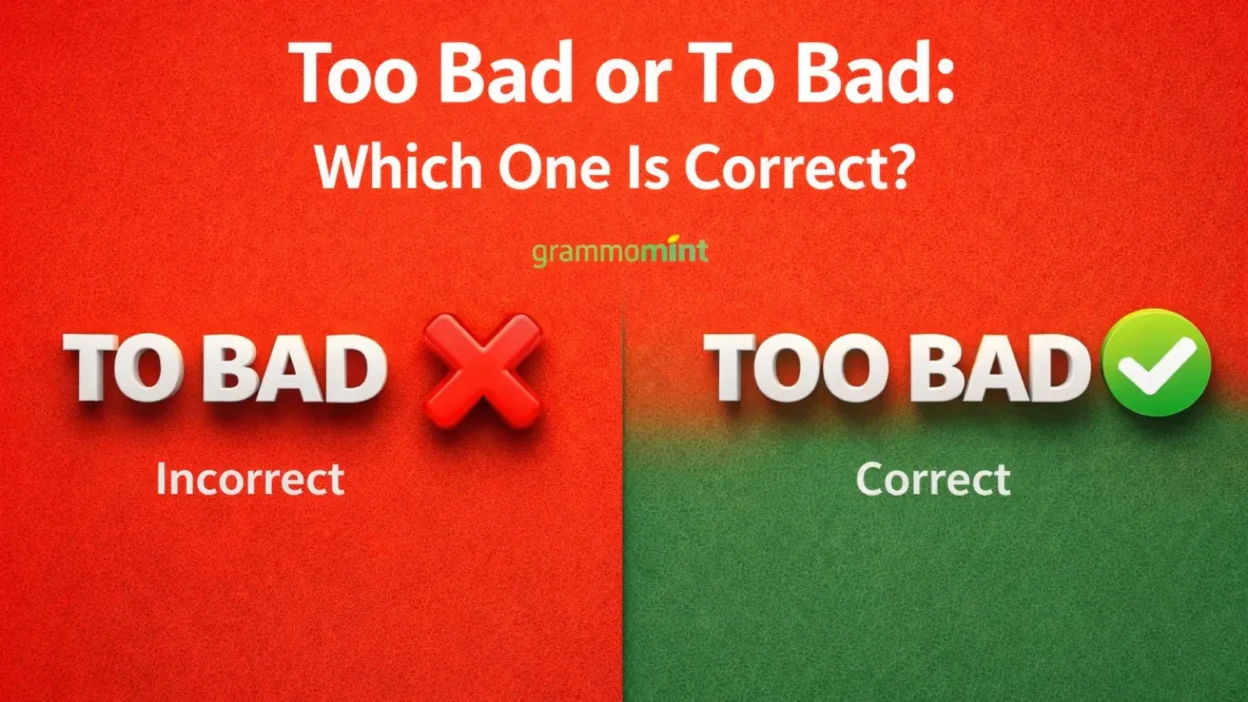
If you’ve ever paused over Too Bad or To Bad, you’re not alone. This small spelling choice shows up in texts, emails, school writing, captions, and everyday American English, especially when people type fast or write by sound. The confusion happens because too and to sound alike, while too bad can act like an idiom, a quick reaction, or a simple way to show regret, sympathy, or disappointment. That makes the phrase look easy, but the tone can change a lot depending on context. This guide clears up the spelling, explains what the phrase means, shows when it sounds kind or cold, and gives you natural examples you can actually use.
Quick Answer
Too Bad or To Bad? Use too bad. In standard English, to bad is usually a spelling mistake, while too bad is the normal phrase for something unfortunate, disappointing, or mildly sympathetic.
TL;DR
• Too bad is the correct phrase.
• To bad is usually a typo.
• Tone decides whether it sounds kind.
• That’s too bad feels warmer.
• Not too bad means fairly good.
• Formal writing prefers clearer alternatives.
Too Bad Vs To Bad
The main issue here is correct spelling, common typo, and phrase choice. Once you learn the pattern, the choice gets much easier.
• Pick too bad for standard English.
• Treat to bad as a typo.
• Link too with extra degree.
• Save to for direction or purpose.
• Say “Too bad, we missed it.”
• Write “That’s too bad” kindly.
• Swap in “unfortunate” as a test.
• Proofread fast texts twice.
• Watch for speech-based misspelling.
• Learn the pair once.
• Then your eye catches errors.
• Finally, your writing looks cleaner.
What Too Bad Means
At heart, the phrase carries sympathy, regret, and disappointment. Still, the exact feeling depends on the speaker and the moment.
• It can mean “that’s unfortunate.”
• It can show mild sympathy.
• It sometimes signals disappointment.
• Context decides the exact feeling.
• Tone changes everything fast.
• Facial expression matters in speech.
• Punctuation softens or sharpens tone.
• “Too bad about the rain” sounds natural.
• “Too bad you’re sick” sounds caring.
• “Too bad for them” feels cooler.
• Longer wording sounds gentler.
• Bare two-word replies sound harder.
Why To Bad Looks Wrong
This is where adverb, adjective, and homophone confusion matters. The words sound alike, but they do not do the same job.
• Too is an adverb here.
• Bad is the adjective.
• Together, they form a natural phrase.
• To rarely modifies bad alone.
• English expects a destination after to.
• Or it expects an infinitive.
• “To bad” leaves the sentence hanging.
• Readers notice the missing structure.
• Spellcheck may miss rushed typing.
• Homophones cause the error.
• Speech hides the extra o.
• Writing makes the difference visible.
That’s Too Bad Meaning
Adding sincere, empathetic, and standalone reply value changes the feel right away. In many cases, this version sounds more human than the shorter form.
• Add that’s for warmer delivery.
• It sounds more human.
• It usually feels less blunt.
• Use it after bad news.
• Pair it with a follow-up.
• “That’s too bad. Are you okay?”
• “That’s too bad. Maybe next week.”
• Keep your voice sincere.
• Avoid laughing right after it.
• Text can flatten the feeling.
• Emojis may soften casual chats.
• Work messages need restraint.
It’s Too Bad That
This pattern works with a full clause, a clear sentence frame, and more natural wording. Because of that, it often sounds fuller and smoother.
• Use it before a full clause.
• The pattern feels complete.
• It introduces the unfortunate fact.
• “It’s too bad that class ended.”
• “It’s too bad that she left.”
• This form sounds slightly fuller.
• It fits speech and writing.
• Don’t drop that in confusion.
• Keep verb tense clear.
• Add specifics after the clause.
• Short clauses read best.
• The phrase works well in emails.
Not Too Bad Meaning
Now the sense flips. Here, understatement, fairly good, and casual reply matter more than regret.
• It often means fairly good.
• Sometimes it means just okay.
• Often, it sounds understated.
• Brits and Americans both use it.
• “How’s work?” “Not too bad.”
• It can hide stronger praise.
• It can also hide fatigue.
• Stress and tone matter.
• Friendly settings make it natural.
• Formal reports rarely use it.
• Don’t confuse it with too bad.
• One small word flips meaning.
Too Bad In A Sentence
Real sample sentences, everyday English, and context make the pattern stick faster. So here are natural examples you can borrow.
• Too bad the tickets sold out.
• Too bad we started late.
• Too bad your phone died.
• Too bad the shop closed early.
• Too bad he missed the bus.
• Too bad the file vanished.
• Too bad our table got canceled.
• Too bad the cake burned.
• Too bad their flight was delayed.
• Too bad the game ended early.
• Too bad her laptop crashed.
• Too bad the plan fell apart.
Too Bad Vs Very Bad
This comparison hinges on reaction, severity, and description. Although the phrases can overlap, they do not usually do the same work.
• Too bad often reacts to news.
• Very bad describes quality directly.
• “That’s too bad” shows response.
• “That’s very bad” judges severity.
• One is conversational.
• The other is more literal.
• Use very bad for outcomes.
• Use too bad for regret.
• “Very bad weather” sounds precise.
• “Too bad about the picnic” sounds idiomatic.
• They are not perfect substitutes.
• Switching them changes tone.
Too Bad Vs So Bad
Here the contrast is degree, commentary, and tone shift. As a result, the phrases may sit near each other, but they aim at different meanings.
• So bad stresses degree.
• Too bad often signals pity.
• “So bad” can praise ironically.
• “So bad it’s good” differs completely.
• “Too bad” rarely praises anything.
• Use so bad for description.
• Use too bad for reaction.
• “The movie was so bad.”
• “Too bad we bought tickets.”
• One describes the thing.
• One comments on the situation.
• Therefore, context does the heavy lifting.
Too Bad Synonyms
Sometimes a different phrase fits better. That’s where what a shame, unfortunate, and disappointing can help.
• Try “that’s unfortunate” in meetings.
• Try “what a shame” conversationally.
• Try “that’s a pity” gently.
• Try “I’m sorry to hear that.”
• Try “that’s disappointing” at work.
• Try “what a bummer” casually.
• Try “that stinks” informally.
• Try “how frustrating” with empathy.
• Try “that’s regrettable” for formal notes.
• Pick the alternative by audience.
• Softer choices sound more supportive.
• Stronger slang sounds less polished.
When Too Bad Sounds Rude
This is mostly about sarcastic, dismissive, and blunt delivery. Even a correct phrase can land badly if the moment is sensitive.
• Two-word replies can feel cold.
• A flat tone sounds dismissive.
• Sarcasm makes it harsher.
• Conflict raises the risk.
• Online chats strip away warmth.
• Add context when someone is upset.
• Add help when help is possible.
• “Too bad.” alone may sting.
• “That’s too bad” feels safer.
• Timing also affects impact.
• Grief needs kinder wording.
• Small setbacks allow lighter phrasing.
Too Bad In Formal Writing
In business English, academic tone, and formal alternative settings, the best choice is often not the idiom itself. Instead, cleaner wording usually reads better.
• Formal prose prefers clearer alternatives.
• Academic writing avoids casual idioms.
• Business notes favor neutral wording.
• Use “unfortunate” in reports.
• Use “regrettable” in complaints.
• Use “disappointing” in feedback.
• Keep emotion measured at work.
• Avoid slang in client emails.
• Short formal sentences stay strongest.
• Replace blunt reactions with facts.
• Then state the consequence.
• Finally, offer the next step.
Too Bad In Texts And Social Posts
Digital writing changes chat tone, punctuation, and online context fast. So even a simple phrase can read softer or sharper than you meant.
• Casual messages use it often.
• Friends understand the shorthand quickly.
• Memes may use it playfully.
• Group chats reward brevity.
• Posts can sound sharper publicly.
• Add punctuation thoughtfully.
• “Aw, too bad” feels softer.
• “Too bad lol” can sound mean.
• Story captions need extra care.
• DMs allow warmer follow-up.
• Younger users may read irony faster.
• Older readers may prefer fuller wording.
Too Bad For Someone
This version highlights the affected person, sometimes with a detached tone or extra implication. Because of that, it can feel more pointed.
• This pattern names the affected person.
• It can sound less sympathetic.
• Sometimes it implies consequence.
• “Too bad for me” sounds self-aware.
• “Too bad for him” sounds detached.
• “Too bad for us” shares the loss.
• Use it carefully in public.
• It may feel judgmental.
• Humor can lighten it.
• Serious news makes it risky.
• Add context if you keep it.
• Better yet, name the problem.
Common Mistakes With Too, To, And Bad
Most errors come from to vs too, bad vs badly, and weak proofreading. Luckily, they are easy to fix once you know what to check.
• Mixing to and too.
• Writing from sound, not meaning.
• Forgetting too means extra.
• Confusing too bad with badly.
• Overusing it in serious moments.
• Using it where details matter.
• Choosing sarcasm by accident.
• Dropping needed punctuation in texts.
• Capitalizing randomly for emphasis.
• Repeating it too often.
• Pairing it with cold emojis.
• Skipping a final proofread.
Easy Memory Tricks For Too Bad
A good memory trick, the extra o, and a steady editing habit can stop this mistake for good. Once the pattern clicks, it stays.
• Two o’s mean extra feeling.
• Too carries “more than enough.”
• That extra letter saves meaning.
• To points somewhere else.
• Test it with “very unfortunate.”
• Test it with “also” never.
• Read the phrase backward slowly.
• Circle every homophone in drafts.
• Build one reminder sentence.
• Keep a tiny typo list.
• Practice with three examples daily.
• Soon the correction becomes automatic.
FAQs
Is it to bad or too bad?
The correct phrase is too bad. In standard English, to bad is usually just a spelling mistake caused by the fact that to and too sound alike.
What does “too bad” mean?
It usually means something is unfortunate, disappointing, or worth mild sympathy. Depending on tone, it can also sound indifferent or slightly sarcastic.
What does “not too bad” mean?
Not too bad usually means fairly good, okay, or better than expected. So even though it looks similar, it does not mean the same thing as too bad.
What is the meaning of “that’s too bad”?
That’s too bad is a fuller, warmer response to disappointing news. In conversation, it often sounds more caring than the shorter reply too bad.
Is the phrase “that’s too bad” meant sincerely?
Often, yes. Still, tone matters a lot, so a flat voice or cold text can make it sound less sincere than the speaker intended.
Does “too bad” sound mocking?
Sometimes it can. On its own, especially in a short reply, it may sound blunt or dismissive, while a longer response usually feels kinder.
What is the difference between “too bad” and “very bad”?
Too bad often reacts to a situation, while very bad describes how serious or poor something is. In other words, one is more idiomatic, and the other is more literal.
Conclusion
When you’re choosing between Too Bad or To Bad, the right answer is almost always too bad.
Use it for something unfortunate, and switch to a warmer or more formal phrase when tone matters more.
Once you remember that the extra o carries the extra meaning, this typo gets much easier to avoid.