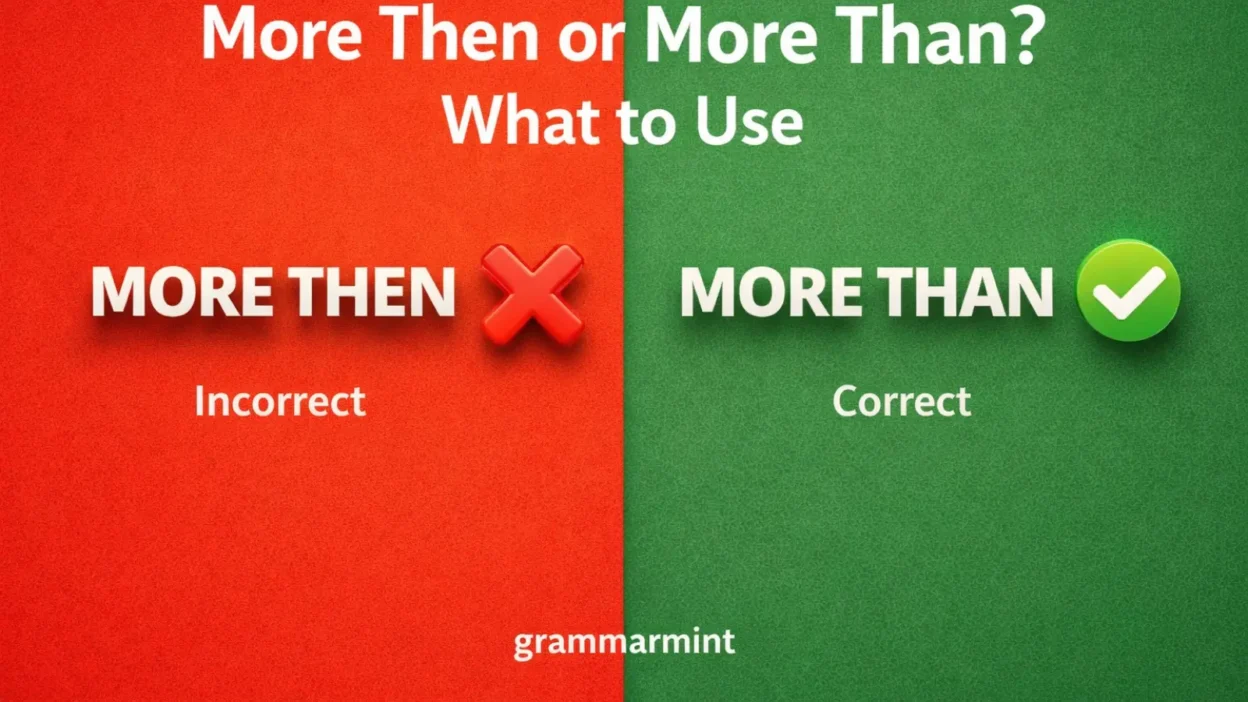
If you write emails, essays, captions, school papers, Google Docs notes, or Slack messages, More Then or More Than can trip you up fast because the words sound close and look almost alike. Still, they do different jobs. One points to comparison, quantity, and degree. The other points to time, sequence, and what happened next. That is why this mistake shows up in resumes, classroom writing, text threads, meeting notes, and casual posts. The good news is that the rule is simple once you see the pattern. This guide gives you the plain answer, the rare exception, practical examples, and easy checks you can use right away.
Quick Answer
More Then or More Than? In standard English, more than is almost always correct. Use than for comparisons, amounts, and degree; use then for time, order, or “at that time.”
TL;DR
• Comparisons almost always need than
• Time words usually point to then
• The safe phrase is usually more than
• Rare exceptions can be rewritten clearly
• Expand the sentence when pronouns confuse you
More Then Or More Than
Most readers want the fast answer first. In standard American English, more than wins whenever you are making a comparison or talking about quantity.
• More than is the standard written choice
• More then usually signals a typo
• Think bigger amount, degree, or number
• Write: more than ten students arrived
• Write: more than enough snacks remained
• Write: I care more than ever
• Skip then after more in comparisons
• The typo appears in rushed texting
• It also slips into email drafts
• Spellcheck misses context sometimes
• A quick reread catches it
• Most polished writing avoids the error
Then Vs Than
These two words sound close, but they do different work. Then handles time and sequence; than handles comparison.
• Then points to time or sequence
• Than introduces a comparison
• First we ate, then we left
• She is taller than her brother
• Call me then, not now
• This route is shorter than downtown traffic
• Then can mean at that time
• Than often follows comparative adjectives
• Their sound causes many mix-ups
• Context settles the spelling
• One word orders events
• The other measures difference
Why More Than Is Usually Correct
This phrase works because English naturally pairs than with comparatives, especially words showing degree and usage differences. That is why the form looks normal in clean, edited prose.
• Than follows words like more and less
• It also follows rather and other
• More than compares degree or extent
• We expected more than rain tonight
• They need more than luck here
• She works more than weekends
• The phrase can mean extremely
• She was more than ready
• Formal writing strongly favors this form
• Everyday writing favors it too
• Native readers expect this pattern
• It sounds natural on first read
When More Then Can Be Technically Correct
A rare sentence can place more beside then and still make sense. In that case, then means at that time, and a rewrite often makes the sentence clearer.
• More then can work in rare contexts
• Here, then means at that time
• The phrase is not the usual choice
• Example: I exercised more then
• Example: We traveled more then, before kids
• Example: She laughed more then, honestly
• Usually a rewrite sounds smoother
• Try: Back then, I worked more
• Try: I used to sleep more
• Readers may still pause awkwardly
• Clarity matters more than cleverness
• When unsure, rewrite the sentence
More Than For Numbers And Amounts
When you are talking about counts, prices, estimates, or totals, numbers, amounts, and totals usually pull in than. This is one of the easiest uses to remember.
• More than 50 tickets sold
• More than half the class passed
• More than three hours feels excessive
• More than enough water is packed
• More than one answer may fit
• More than a mile remained
• More than $20 seems steep
• More than two copies were missing
• More than several? Use a clearer number
• This pattern fits estimates too
• It appears in math-like writing
• The structure stays very stable
More Than For Emphasis
The phrase is not only about counting things. In everyday English, intensity, degree, and expression also use more than.
• I’m more than happy to help
• She was more than ready
• That joke was more than awkward
• The room felt more than quiet
• He sounded more than annoyed
• This shade is more than bright
• The phrase can mean very
• It can also mean extremely
• The tone feels natural aloud
• It works in polished prose
• Avoid stacking too much emphasis
• One strong phrase is enough
More Than Ever Or More Then Ever
This fixed phrase is extremely common. More than ever uses comparison, not time order, even though the word ever can make the sentence feel emotional.
• More than ever is the standard expression
• Ever compares now with earlier times
• Write: We need rest more than ever
• Write: She misses home more than ever
• Avoid more then ever in formal writing
• The phrase appears in speeches often
• It also fits headlines naturally
• Use it carefully for urgency
• Too much can sound dramatic
• Too little is rarely a problem
• Keep the context specific
• Let the sentence earn emphasis
No Later Then Or Than
This is a deadline phrase, so comparison is built in. Deadline, time limit, and schedule language nearly always needs than.
• No later than sets a limit
• Send it no later than Friday
• Arrive no later than noon
• Board no later than 7 p.m.
• Then does not compare deadlines well
• This phrase appears in contracts often
• It also shows in school notices
• Offices use it in scheduling emails
• Parents use it in pickup texts
• Keep it near the time
• That placement helps scanning
• It sounds crisp and exact
Better Then Or Better Than
When two choices are compared, better than is the normal form. Here, preference, quality, and contrast all point toward than.
• Better than compares quality or preference
• This plan feels better than guessing
• Tea tastes better than burnt coffee
• Her draft is better than mine
• Better then means better at that time
• Example: The lighting was better then
• Most writers never need that version
• Comparisons dominate normal usage
• So the safer choice is obvious
• Check whether two things are contrasted
• If yes, choose than quickly
• The pattern rarely breaks
Rather Then Or Rather Than
This phrase shows preference, choice, or substitution. Because of that, preference, replacement, and parallel structure make rather than the expected form.
• Rather than shows preference or replacement
• I’d walk rather than wait
• Choose soup rather than fries
• She whispered rather than shouted
• They stayed home rather than drove
• Rather then jars most readers
• It interrupts sentence rhythm
• The phrase works with nouns
• It also works with verbs
• Match forms on both sides
• Parallel structure sounds cleaner
• Keep the contrast easy to spot
Other Then Or Other Than
This phrase means except, besides, or apart from. So exception, exclusion, and apart from all push you toward other than.
• Other than means except or besides
• Other than Maya, everyone agreed
• Other than rain, the trip was great
• He drinks nothing other than water
• Then cannot carry that meaning
• This mix-up is common online
• Formal writing rejects it quickly
• The phrase can sound sharp
• Use it with clear intent
• It often trims wordy sentences
• Keep the excluded item obvious
• The sentence stays cleaner that way
Longer Then Or Than
Any sentence comparing length or duration wants than. In other words, length, duration, and measure naturally pair with comparative wording.
• Longer than compares length or duration
• The meeting ran longer than expected
• Her hair is longer than mine
• This route takes longer than usual
• Longer then fits only time-reference meaning
• Example: My hair was longer then
• That use stays genuinely rare
• Most sentences need comparison instead
• Read the line aloud once
• If lengths compete, pick than
• The rule stays consistent
• It is easy to apply
Earlier Then Or Than
Time comparisons can look tricky, but the rule stays steady. Earlier, timing, and comparison usually call for than.
• Earlier than compares times directly
• Earlier is already a comparison word
• We arrived earlier than planned
• Sunrise came earlier than usual
• She called earlier than promised
• Earlier then means earlier at that time
• Example: School started earlier then
• Again, that use feels marked
• Rewriting often sounds more natural
• Try: School used to start earlier
• Compare moments, and choose than
• Past-period meaning may justify then
Less Then Or Less Than
The same logic works in reverse. Because less marks a smaller amount or degree, English expects than right after it.
• Less than marks smaller amount or degree
• Less works like more here
• Less than an hour remained
• The bag weighs less than mine
• She seemed less than thrilled
• Less then is a common slip
• It rarely reflects intended meaning
• Price tags use this phrase often
• So do statistics and reports
• It can soften criticism too
• Example: less than ideal timing
• The comparison rule still applies
More Than Me Or More Than I
This is where grammar turns slightly more nuanced. Pronouns, ambiguity, and formality matter because the sentence can point to two different meanings.
• More than me and more than I differ
• Pronouns can shift meaning here
• Use more than I in formal comparisons
• Example: He studies more than I do
• Use more than me as an object
• Example: She annoys him more than me
• Informal speech often prefers me
• Formal prose often prefers I
• Ambiguity is the real problem
• Add the missing verb
• That removes confusion instantly
• Clarity beats tradition every time
Memory Tricks And Fast Self-Checks
When you are editing quickly, you need a short system. Let time, comparison, and sequence guide the choice every time.
• Then goes with time and order
• Than goes with comparison and contrast
• If it compares, pick than
• If events unfold, pick then
• Replace then with next or later
• If that works, keep then
• Check words like more or less
• Watch deadlines, limits, and counts
• Expand short clauses when unsure
• Read the sentence slowly once
• Scan for hidden comparison words
• One extra second saves embarrassment
FAQs
Is it more then or more than?
In standard English, more than is the correct choice almost every time. Use it when you compare amounts, degree, value, emotion, or emphasis.
Is “more then ever” correct?
Usually, no. The standard phrase is more than ever because it compares the present with earlier times.
Is it “no later then” or “no later than”?
Use no later than. The phrase compares an action to a time limit, so than is the correct word.
Is it “better then” or “better than”?
Use better than when comparing two things. Better then only works in the rare sense of “better at that time.”
Is it “earlier then” or “earlier than”?
Use earlier than when you compare one time with another. Earlier then is only possible when then means “at that time,” and even there a rewrite is usually clearer.
When do you use then vs than?
Use then for time, order, and what happened next. Use than for comparisons, contrasts, and phrases built on comparative words.
Conclusion
If More Then or More Than still slows you down, ask one question: am I comparing, or am I sequencing?
If you are comparing, choose than. If you are talking about time, choose then—and rewrite rare edge cases for clarity.