If you write for a U.S. audience, Practises or Practices can feel trickier than it should. The confusion usually starts when people mix American English, British English, noun forms, verb forms, plural nouns, third-person verbs, and everyday phrases like doctor’s practice or best practices. That’s why this guide keeps the answer simple and useful. You’ll see when practices is right, when practises belongs only to UK-style verb use, and how to handle school, sports, legal, medical, and workplace writing without second-guessing every sentence.
Quick Answer
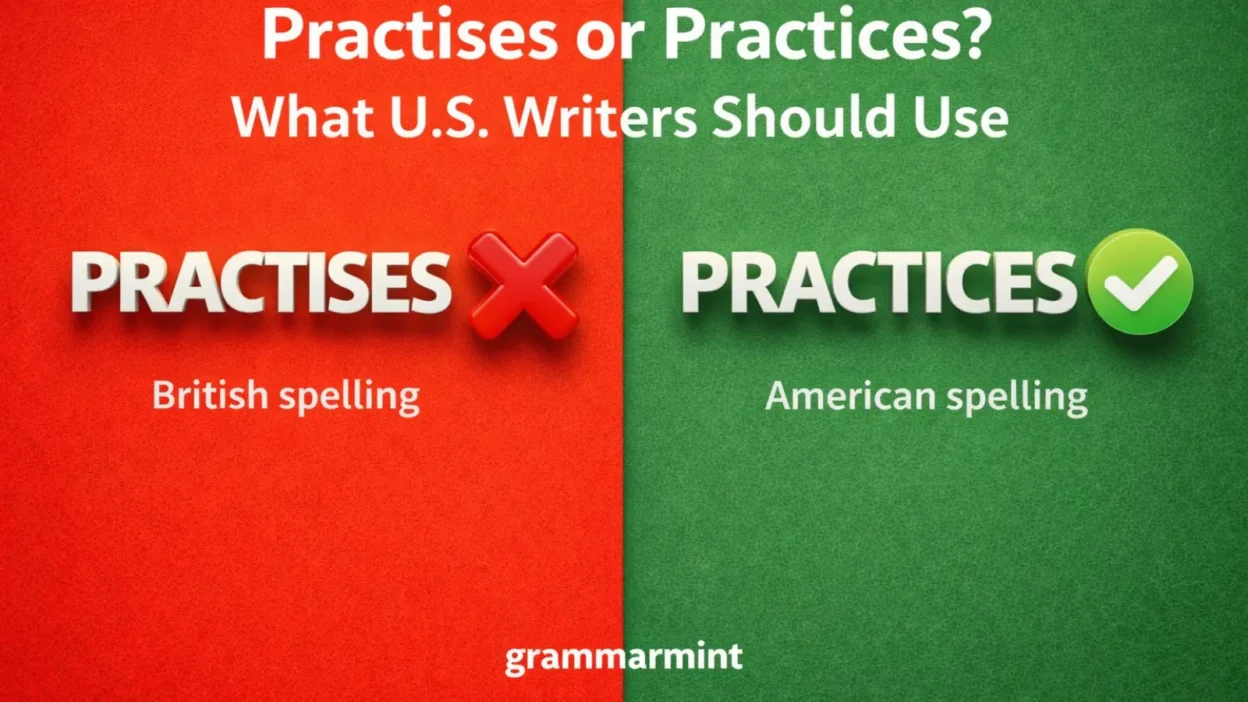
Practices is the correct choice for most U.S. writing. Use it for the plural noun, as in “company practices,” and for the present-tense verb with he, she, or it, as in “she practices piano.” Practises is mainly a British English verb form, not the standard U.S. spelling.
TL;DR
• U.S. English prefers practice and practices.
• UK English keeps practise for verbs.
• Practices can be noun or verb.
• Practises is not a U.S. default.
• Best practices is always correct.
• Check part of speech first.
Practice Or Practise
The base pair matters because it explains the plural and verb forms later. For U.S. readers, the safe rule is simple: practice covers both noun and verb jobs, while British English usually splits practice and practise by part of speech.
• American English uses practice for noun and verb.
• British English keeps practice for the noun.
• British English uses practise for the verb.
• Both forms sound the same aloud.
• The spelling change is visual, not phonetic.
• U.S. readers expect practice everywhere.
• UK readers may expect practise in verbs.
• “I need more practice” uses the noun.
• “I practise daily” is UK verb usage.
• “I practice daily” is U.S. verb usage.
• Mixing systems can look careless.
• Pick one variety and stay consistent.
Practices Or Practises
This is the exact question most U.S. writers want answered fast. In American English, practices is the standard form when you need either a plural noun or a third-person singular verb; practises belongs mainly to British-style verb use.
• Practices is correct for U.S. writing.
• It can be a plural noun.
• It can be a third-person verb.
• “Company practices” is a plural noun.
• “She practices piano” is a verb.
• “Good practices” is widely accepted.
• “Religious practices” is noun plural.
• “He practices law” is a verb.
• Practises is mainly British verb spelling.
• It does not work as a noun plural.
• U.S. sites should avoid practises.
• The sentence job decides the spelling.
To Practice Or To Practise
Infinitives make the regional split easy to spot. U.S. English uses to practice, while British English uses to practise, even though the meaning stays the same.
• Infinitives follow regional spelling rules.
• U.S. writers use to practice.
• UK writers use to practise.
• The meaning stays exactly the same.
• “To practice medicine” is U.S. standard.
• “To practise medicine” is UK standard.
• U.S. classrooms teach “to practice.”
• UK classrooms often teach “to practise.”
• Check the audience before editing.
• Keep the infinitive consistent sitewide.
• Don’t swap forms mid-article.
• The base verb matters here.
Best Practice Or Best Practise
This phrase shows up everywhere in business and technical writing. Because practice is the noun in this phrase, best practice is the standard form, and best practise is not.
• Best practice is always the noun phrase.
• Best practises is not standard.
• The head word is a noun.
• Nouns keep the “c” spelling.
• Use it in policy writing.
• Use it in manuals.
• Use it in workplace training.
• Use it in academic summaries.
• “It’s best practice to…” is normal.
• “That follows best practice” is normal.
• UK and U.S. both prefer it.
• The same rule drives the plural.
Best Practices Meaning
The plural phrase is common in modern workplace language. Best practices refers to preferred methods or procedures, and it stays spelled with a c because the word is still a noun.
• Best practices is a plural noun.
• It means preferred working methods.
• It appears in business writing often.
• It appears in tech writing too.
• It appears in healthcare language.
• It appears in education language.
• U.S. readers see it constantly.
• UK readers use it as well.
• The phrase is not a verb.
• So it never takes practises.
• It can sound formal.
• Still, it’s common and clear.
Practicing Or Practising
The same regional rule carries into the -ing form. So, U.S. English uses practicing, while British English uses practising for both verb use and adjective-like use, such as a practicing or practising doctor.
• The -ing form follows the same split.
• U.S. English uses practicing.
• UK English uses practising.
• Both forms function as verbs.
• Both can act like adjectives.
• “A practicing doctor” is U.S.
• “A practising doctor” is UK.
• “She is practicing violin” is U.S.
• “She is practising violin” is UK.
• U.S. brands should use practicing.
• UK brands should use practising.
• Don’t mix them in one page.
Practiced Or Practised
Past forms follow the same pattern too. In U.S. English, practiced is standard, while British English often prefers practised for the verb and adjective.
• Past forms also change by variety.
• U.S. English favors practiced.
• UK English often uses practised.
• Both mean repeated training happened.
• Both can describe experience.
• “A practiced response” is U.S.
• “A practised response” is UK.
• “She practiced daily” is U.S.
• “She practised daily” is UK.
• U.S. resumes usually prefer practiced.
• UK CVs may prefer practised.
• The meaning does not shift.
Exam Practice Or Exam Practise
This is one of the most useful school examples because it highlights the noun rule. Since exam practice names an activity or type of preparation, it uses the noun spelling practice in both U.S. and UK English.
• Exam practice is the correct noun phrase.
• The final word is a noun.
• So it keeps the “c.”
• This rule works in both systems.
• Use it for worksheets.
• Use it for revision sessions.
• Use it for prep books.
• Use it for mock tests.
• “Exam practise” looks wrong.
• “Practice exams” is also fine.
• Context decides word order.
• Noun phrases stay simple here.
Choir Practice Or Choir Practise
Music examples help because they show the difference between an event and an action. Choir practice names the rehearsal, so it uses the noun spelling, while the verb in British English would be practise.
• Choir practice is the standard noun phrase.
• It names the rehearsal itself.
• Therefore, it keeps the “c.”
• This holds in U.S. English.
• It also holds in UK English.
• “After-school choir practice” is clear.
• “Choir practise” mislabels the noun.
• “We practise choir pieces” is UK.
• “We practice choir pieces” is U.S.
• Event names usually use practice.
• Calendar entries usually use practice.
• Rehearsal language follows noun rules.
Sports Practice And Team Practices
Sports writing uses both singular and plural noun forms all the time. In U.S. English, you’ll normally see practice for one session and practices for multiple sessions, while the verb also stays practice/practices.
• Sports writing uses both singular and plural nouns.
• U.S. coverage favors practice and practices.
• “Football practice” names one session.
• “Spring practices” names several sessions.
• “The coach practices drills” is a verb.
• “The team practices daily” is a verb.
• “Morning practices” is a plural noun.
• “Basketball practices” is a plural noun.
• Schedules often use the plural.
• Headlines often use the singular.
• U.S. sports pages avoid practises.
• Verbs and nouns can sit together.
Medical Practice And Practises Medicine
Healthcare writing makes the noun-versus-verb difference especially clear. A doctor can have a medical practice, but in British English someone practises medicine, while U.S. English writes practices medicine.
• Medical practice is always a noun phrase.
• Practises medicine is UK verb usage.
• U.S. English writes “practices medicine.”
• A doctor can have a practice.
• A doctor can practice medicine.
• A clinic can follow best practices.
• A hospital can update practices.
• “Medical practise” looks off as a noun.
• “She practises medicine” is UK.
• “She practices medicine” is U.S.
• Professional editing needs consistency.
• Healthcare pages should match audience region.
Practice Law Or Practise Law
Legal writing follows the same pattern as medical writing. U.S. lawyers practice law, UK lawyers practise law, and the noun phrase law practice keeps the c spelling either way.
• Legal writing follows the same rule.
• U.S. lawyers practice law.
• UK lawyers practise law.
• A lawyer may own a practice.
• A firm may review its practices.
• Court style can be conservative.
• Still, region decides the spelling.
• U.S. bios usually say practice.
• UK bios often say practise.
• “Law practice” is the noun phrase.
• “Practise law” is only the verb.
• The noun never becomes practise.
Common Practice And Common Practices
These phrases appear a lot in policy, academic, and office writing. Because both common practice and common practices are noun phrases, they keep the c spelling in both major varieties of English.
• Common practice means a usual custom.
• Common practices means several usual customs.
• Both are noun phrases.
• Both keep the “c.”
• They work in U.S. English.
• They also work in UK English.
• The singular sounds broader.
• The plural sounds more specific.
• “Common practise” is not standard noun use.
• Business memos use this phrase often.
• Policy writing uses it often too.
• It sounds formal but clear.
Practice As A Noun
When the word names an activity, habit, business, or established way of doing something, it is a noun. In both U.S. and UK English, that noun stays practice, and the plural stays practices.
• Nouns name an activity, habit, or business.
• Practice keeps the “c” everywhere.
• “Dental practice” is a noun.
• “Daily practice” is a noun.
• “Hiring practices” is a plural noun.
• “Training practice” is a noun.
• “In practice” is a fixed phrase.
• “Into practice” is another fixed phrase.
• “Practice makes perfect” uses the noun.
• “Best practice” uses the noun.
• “Practice area” uses the noun.
• “General practice” uses the noun.
Practice As A Verb
When the word shows an action, it is a verb. U.S. English uses practice as the verb, while British English usually switches to practise, including the forms practises, practising, and practised.
• Verbs show action or repeated training.
• U.S. English uses practice as the verb.
• UK English often uses practise as the verb.
• “Practice piano” is U.S.
• “Practise piano” is UK.
• “Practice kindness” is U.S.
• “Practise kindness” is UK.
• “He practices law” is U.S.
• “He practises law” is UK.
• Present tense exposes the difference.
• Infinitives expose it too.
• The sentence role gives the answer.
U.S. Vs. UK Usage At A Glance
For fast editing, this is the simplest cheat sheet. The noun stays practice in both systems, but the verb changes only in UK-style spelling, which is why U.S. sites should almost always default to practice-based forms.
• U.S.: practice, practices, practicing, practiced.
• UK: practice, practises, practising, practised.
• The noun stays practice in both.
• The verb changes only in UK style.
• Plural nouns use practices everywhere.
• U.S. readers prefer simpler consistency.
• UK readers often expect the split.
• Brand voice should choose one system.
• School style guides may enforce one.
• Editors watch these spellings closely.
• Searchers confuse plural and verb often.
• Part of speech fixes the problem.
FAQs
What is the difference between practice and practise?
Practice is the noun in both U.S. and UK English. Practise is mainly the British English verb form, while American English uses practice as the verb too.
Is it to practice or to practise?
For a U.S. audience, use to practice. Use to practise only when you are intentionally writing in British English.
Is practices correct?
Yes. Practices is correct as a plural noun, like “safety practices,” and as a third-person singular verb, like “she practices piano,” especially in U.S. English.
Is practises correct?
Yes, but mostly in British English, where it works as a verb form, as in “she practises law.” It is not the standard choice for U.S. writing, and it is not the standard plural noun spelling.
Is it exam practice or exam practise?
Use exam practice. The word works as a noun there, so the c spelling is correct in both U.S. and UK English.
Is it best practice or best practise?
Use best practice or best practices. The phrase is built on the noun, so best practise is not the standard form.
Conclusion
For a U.S. audience, Practises or Practices has an easy answer: use practices when you need the plural noun or the he/she/it verb.
Then, keep practises for British-style verb use only, and your spelling will stay clean, consistent, and easy to trust.