If you’re writing emails, school papers, reports, or quick texts, Do To or Due To can feel annoyingly easy to mix up. The confusion usually comes from homophones, fast typing, and the fact that both forms look possible at a glance. Still, they do different jobs in real writing. One signals a cause or reason, while the other appears when do is a verb followed by to. That difference matters in resumes, class assignments, workplace updates, customer messages, and everyday conversations. This guide breaks it down in plain American English, so you can spot the right form fast, fix common mistakes, and sound more confident every time you write.
Quick Answer
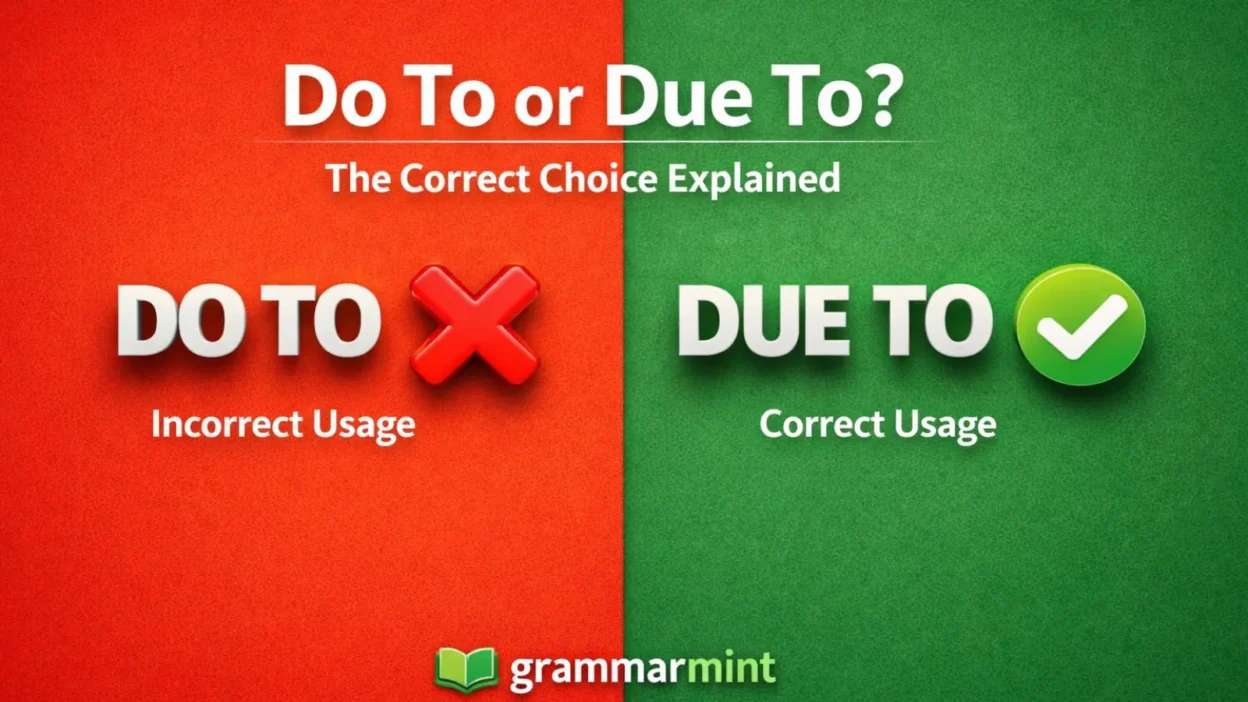
In do to or due to, due to is the correct choice when you mean “because of.” Use do to only when do is the verb, as in “What did you do to the file?” If you mean cause or reason, never write do to.
TL;DR
• Use due to for cause or reason.
• Use do to for action.
• Test with because of.
• “Due to the fact” is correct, but wordy.
• “What did you do to it?” is correct.
The Main Difference Between Do To And Due To
Most people only need one clean rule. If the sentence means “because of,” choose due to.
That’s the fast answer. Meanwhile, do to only works when you are talking about an action done to someone or something.
• Due to means because of.
• Do to does not mean cause.
• Use due to for reasons.
• Use do to for actions.
• “Late due to rain” is correct.
• “Late do to rain” is wrong.
• “What did you do to it?” works.
• “The delay was due to fog” works.
• “The damage was do to heat” fails.
• Cause points toward due to.
• Action points toward do to.
• That one split solves most cases.
Why Writers Mix These Up
The mistake is common for a simple reason. The two forms sound almost the same in normal speech.
Also, spellcheck may miss the problem because both words are real. So, your eyes may slide right past it.
• They are homophones in everyday speech.
• Fast typing makes the slip easier.
• Autocorrect doesn’t always save you.
• Both words look familiar alone.
• The error often hides in drafts.
• Short sentences make it less obvious.
• Tired writers skim instead of checking.
• Students often copy the sound first.
• Workplace writers rush status updates.
• Texting habits can leak into essays.
• The mistake feels visually believable.
• Proofreading aloud can catch it faster.
What “Due To” Really Means
At its core, due to gives a reason or cause. In plain English, it usually means “because of.”
You’ll often see it before a noun or noun phrase. That’s why it sounds natural in many formal and neutral sentences.
• Due to introduces a cause.
• It usually means “because of.”
• It often links result to reason.
• It commonly comes before nouns.
• “Due to traffic” is natural English.
• “Due to illness” sounds normal too.
• It fits reports and announcements.
• It also appears in daily speech.
• It can follow “is” or “was.”
• It works with delays and closures.
• It fits neutral cause-and-effect writing.
• It should not be misspelled “do to.”
What “Do To” Really Means
This part matters because many guides skip it. Do to can be correct, but only when do is a verb.
In those cases, to simply points toward a person, object, or purpose. So, the phrase is not a set expression about cause.
• Do is the verb here.
• The phrase shows action, not cause.
• It needs a target after to.
• “What did you do to me?” works.
• “What did you do to help?” works.
• “Don’t do that to the chair” works.
• “What will this do to sales?” works.
• The words just happen to touch.
• They are not one fixed phrase.
• The meaning depends on the verb.
• Remove action, and the form collapses.
• It never replaces cause-based due to.
Due To Vs Because Of
These two often overlap in meaning. However, they don’t always sit in the same place with the same rhythm.
In everyday writing, because of often feels lighter. By contrast, due to can sound more formal or compressed.
• Noun phrase checks often favor due to.
• Verb phrase rewrites often favor because of.
• “Her absence was due to illness.”
• “She missed work because of illness.”
• Both lines share the same reason.
• The structure changes the better choice.
• Because of often sounds more natural.
• Due to can sound slightly tighter.
• Headlines often like due to.
• Conversations often prefer because of.
• When stuck, rewrite instead of forcing.
• Clear rhythm matters more than habit.
Due To The Fact Or Do To The Fact
Here, the correct form is still due to the fact. But even when it is correct, it often sounds longer than needed.
That’s why many editors prefer a shorter rewrite. In most cases, because says the same thing more cleanly.
• Wordy phrases slow the sentence down.
• “Do to the fact” is incorrect.
• “Due to the fact” is correct.
• “Because” is usually cleaner.
• “Since” may also work well.
• “As” can work in context.
• “The meeting moved because of rain.”
• “The meeting moved because it rained.”
• Shorter writing usually feels stronger.
• Long cause phrases sound padded.
• Use the longer form sparingly.
• Pick clarity over extra wording.
Can You Start A Sentence With Due To?
Yes, you can start a sentence that way. Still, the result should sound smooth, not twisted.
Some sentence-opening uses feel natural. Others feel stiff, especially when the wording becomes backward or overly formal.
• A sentence opener with due to can work.
• “Due to weather, school closed early” works.
• “Due to illness, she stayed home” works.
• Start with it when clarity improves.
• Avoid it when the line sounds tangled.
• Rearranging can fix awkward openings.
• Short openers usually read best.
• Long openers can feel heavy.
• News updates often use this pattern.
• Notices and alerts use it often.
• Natural rhythm still matters most.
• Rewrite if the opener feels forced.
Is “Due To” Formal Or Informal?
Due to works in both formal and informal writing. The real issue is not formality alone, but fit.
In a business note, it can sound efficient. In a casual message, though, because of may feel warmer and more natural.
• Formal writing often accepts due to.
• It also appears in everyday English.
• It fits notices and reports well.
• It fits school writing when correct.
• It sounds neutral in many settings.
• It can feel stiff in chatty prose.
• Neutral tone makes it versatile.
• Casual texts may prefer “because of.”
• Work emails can use either option.
• Academic prose may keep it concise.
• Customer updates often use due to.
• Tone should match the audience.
“What Did You Do To…?” And Other Correct Action Uses
This is where many writers get tripped up. They learn “do to” is wrong, then start deleting correct action sentences too.
Don’t do that. When do names an action, the wording is fine.
• Questions often use correct do to.
• “What did you do to my mug?”
• “What did you do to fix it?”
• “What can we do to help?”
• “What will this do to prices?”
• “What did that noise do to him?”
• “Never do that to the laptop.”
• “Please don’t do this to yourself.”
• The object after to matters.
• The verb carries the whole meaning.
• No cause phrase appears here.
• These uses are fully normal English.
Common Places This Mistake Shows Up
This slip appears almost everywhere. Still, some contexts create it more than others.
The most common problem spots are fast, practical writing environments. That includes texts, school work, updates, and captions.
• Emails often hide this mistake.
• Text messages invite quick typos.
• School papers show it frequently.
• Office updates can rush the wording.
• Social captions skip final proofreading.
• Group chats normalize rough spelling.
• Class notes may capture sound only.
• Application materials need extra checking.
• Customer notices should avoid the error.
• Status reports often use cause phrases.
• Deadline messages use due to often.
• Quick edits prevent public mistakes.
Fast Fixes For Common Errors
You do not need a long grammar lesson every time. A few fast editing moves will solve most cases.
First, ask whether the sentence shows reason or action. Then test the phrase before you send or publish.
• Replace misspelling with due to for cause.
• Keep do to only with action.
• Swap in “because of” as a test.
• Read the sentence aloud once.
• Circle the word after to.
• Check whether a reason follows.
• Check whether an action follows.
• Watch for “do to the fact.”
• Fix headlines before body text.
• Slow down on common phrases.
• Final passes catch tiny errors.
• Proofread names, dates, and grammar together.
Stronger Alternatives When “Due To” Feels Heavy
Sometimes due to is correct but not ideal. The sentence may sound bulky, stiff, or repetitive.
That is a style issue, not a correctness issue. In those moments, a cleaner alternative helps.
• Because is often the cleanest rewrite.
• “Since” works in many cases.
• “As” can work in softer lines.
• “On account of” sounds more formal.
• “Owing to” can fit formal prose.
• “Thanks to” suits positive reasons.
• Use simpler wording in casual copy.
• Avoid repeating due to too often.
• Shorter phrasing improves reading speed.
• Strong verbs reduce cause clutter.
• One rewrite can fix the whole line.
• Style improves when logic stays clear.
The Best Memory Tricks For Choosing Fast
A good memory trick should work under pressure. You should be able to use it in a classroom, meeting, or inbox.
The best shortcuts are simple substitution tests. They help you decide without overthinking grammar terms.
• Use a memory trick you’ll remember.
• Try the “because of” swap first.
• Try the “action” check second.
• If cause appears, choose due to.
• If action appears, choose do to.
• Ask, “What happened because of what?”
• Ask, “Who did what to whom?”
• Link due with reason and result.
• Link do with verbs and actions.
• Test short sentences before long ones.
• Rewriting is faster than guessing.
• One clean shortcut beats memorizing exceptions.
American Vs British English Check
This is not a US-versus-UK spelling fight. The core choice stays the same.
In other words, English on both sides of the Atlantic still uses due to for cause. So, this mistake is not a regional spelling difference.
• US English uses due to normally.
• British English uses it normally too.
• The cause meaning does not change.
• “Do to” stays wrong for cause.
• No special regional spelling fixes this.
• Style preferences may vary slightly.
• The core rule remains stable.
• Readers in both markets understand it.
• Professional writing expects the same distinction.
• Headlines on both sides use it.
• The confusion is about wording, not region.
• Audience location does not rescue mistakes.
Formal Grammar Tests Editors Still Use
If you want the stricter editing view, there is a helpful test. Replace due to with attributable to.
If that rewrite still works, your original line is probably solid for formal writing. If it sounds broken, a rewrite may be better.
• Attributable to is a useful test.
• It helps in formal edit situations.
• “The delay was attributable to rain.”
• That means due to fits there.
• “We left attributable to rain” fails.
• That line needs a rewrite.
• Formal editors still like this check.
• It focuses on what gets modified.
• The test catches clunky structure fast.
• It helps in academic prose too.
• Not every reader needs this rule.
• But polished writing benefits from it.
Related Mix-Ups Writers Make Nearby
Once writers worry about due to, nearby errors often appear too. The most common one is make do versus make due.
That mix-up comes from the same sound-alike problem. So, it helps to learn both at once.
• Make do is the correct idiom.
• “Make due” is usually wrong now.
• Due date is another separate phrase.
• “Past due” is also unrelated.
• “Due” can mean expected or owed.
• “Do” usually names action.
• Similar sounds invite similar mistakes.
• Keep idioms separate from cause phrases.
• Don’t let one correction spread confusion.
• Learn the nearby traps together.
• Context decides everything with homophones.
• Small distinctions create cleaner writing.
FAQs
Which is correct: do to or due to?
Due to is correct when you mean “because of” or “caused by.” Do to is only correct when do is the verb, such as “What did you do to the chair?”
Is “do to” ever right?
Yes, but only in action-based wording. For example, “What did you do to help?” is correct because do is the verb and to introduces the target or purpose.
Can I start a sentence with “due to”?
Yes, you can. Just make sure the sentence sounds natural and clear, not stiff or backward.
Can I use “due to” instead of “because of”?
Often, yes. However, because of can sound smoother in everyday writing, while due to can sound tighter or more formal.
Is “due to” formal or informal?
It works in both. In professional or academic writing, it often sounds normal, while in casual writing, because of may feel more relaxed.
Is it due to the fact or do to the fact?
The correct form is due to the fact. Even so, many writers prefer because or because of because they are shorter and cleaner.
Is there a US vs UK spelling difference here?
No. This is not an American-versus-British spelling issue. The same core distinction applies in both varieties.
Conclusion
For Do To or Due To, the safest rule is simple: use due to for a reason and do to for an action.
When a sentence feels shaky, test it with “because of” or rewrite it for clarity.
That quick check will keep your writing clean almost every time.