If you write for US readers and keep pausing at Drier or Dryer, you’re not alone. This pair causes trouble because the words sound alike, look close, and show up in everyday places like weather reports, beauty copy, laundry labels, captions, emails, and classroom writing. The real choice usually comes down to comparative adjective, machine noun, weather wording, climate phrasing, hair dryer, and tumble dryer usage. Even so, dictionary entries add a little extra fog because some still record variant spellings in certain senses. So this guide keeps it simple: what modern American readers expect, where the overlap comes from, and how to choose the form that looks natural every time.
Quick Answer
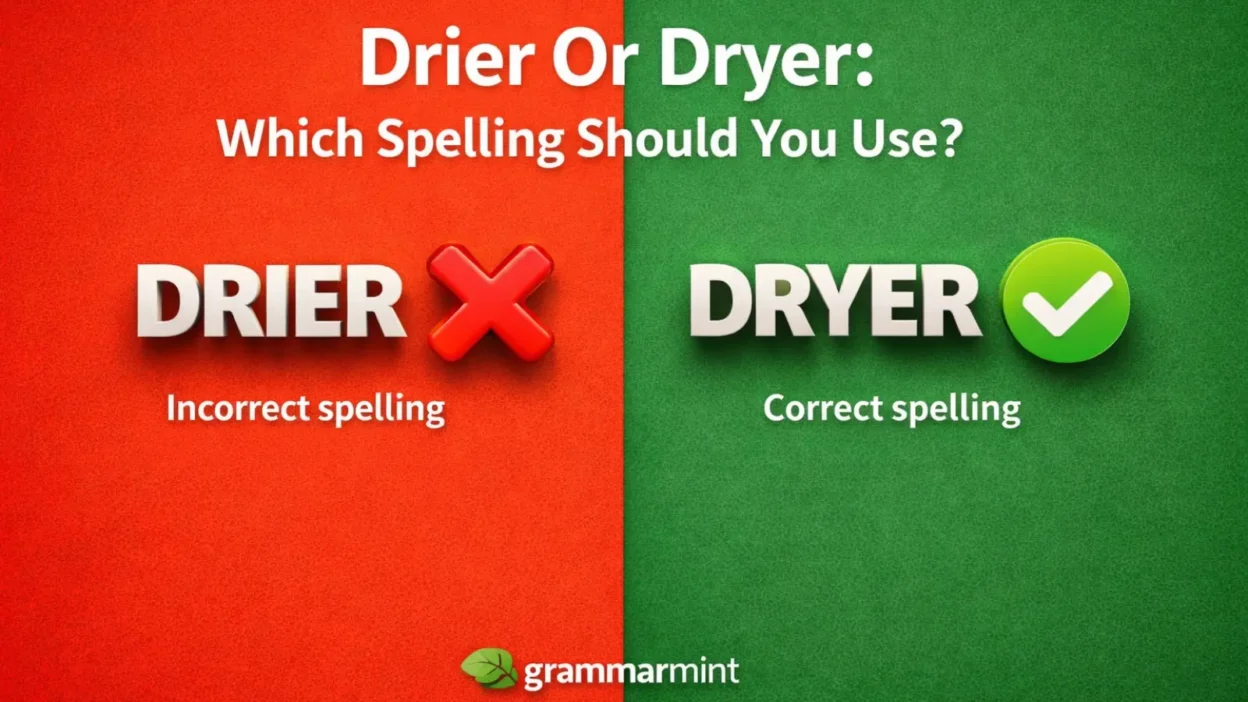
Drier or Dryer is easiest to solve this way: use drier when you mean more dry, and use dryer when you mean a machine. Some dictionaries still record overlap or variant spellings, but for modern US writing, this is the clearest and safest choice.
TL;DR
• Drier compares moisture levels
• Dryer usually names a machine
• Weather takes drier, not dryer
• Hair dryer looks most natural
• Modern US writing favors this split
The Core Difference
Here’s the clean rule most readers want. In everyday American usage, drier is the comparative form, while dryer is the noun people expect for an appliance or device.
• comparative adjective signals increased dryness
• machine noun names the drying device
• modern usage prefers this separation
• One compares conditions clearly
• One labels equipment directly
• Context settles the choice fast
• Sound alone won’t help
• Meaning does the heavy lifting
• Readers notice the distinction
• Editors prefer the cleaner split
• The safer default stays simple
• Start with the sentence job
Drier Meaning
Use drier when something is less wet than something else. That fits dictionary treatment of dry and the normal comparative pattern that modern style guides and teaching pages explain.
• more dry is the core idea
• less wet fits the comparison
• comparison is the key test
• Drier towels after sun
• Drier air after noon
• Drier soil by August
• Drier paint by evening
• Drier toast with time
• Drier cough in winter
• Drier wording in revisions
• Drier leaves after wind
• Drier conditions than yesterday
Dryer Meaning
Use dryer when you mean a thing that dries something. In American English, the everyday noun usually points to a household or grooming appliance, though dictionaries also include broader device meanings.
• appliance is the common signal
• hair dryer is the natural phrase
• clothes dryer fits laundry writing
• Dryer vent needs cleaning
• Dryer door won’t close
• Dryer sheet adds scent
• Dryer cycle runs hot
• Dryer rack saves knits
• Dryer drum spins loudly
• Dryer filter traps lint
• Dryer model looks efficient
• Dryer repair can wait
Drier Than Or Dryer Than
This is one of the most searched versions of the question. When you write a direct comparison with than, modern US readers expect drier than.
• sentence check starts with than
• grammar fix points to drier
• side-by-side wording needs comparison
• Drier than last week
• Drier than the coast
• Drier than before sunrise
• Drier than old firewood
• Drier than your first draft
• Drier than desert wind
• Drier than indoor heat
• Drier than a stale muffin
• Drier than morning laundry
Drier Weather Or Dryer Weather
Weather reports describe conditions, not machines. That’s why drier weather is the form that reads naturally in American newsy, academic, and everyday writing.
• forecast language favors drier
• humidity context needs comparison
• air conditions are descriptive
• Drier weather this weekend
• Drier weather by spring
• Drier weather inland first
• Drier weather after the storm
• Drier weather aids painting
• Drier weather cracks soil
• Drier weather reduces mildew
• Drier weather helps trails
• Drier weather feels sharper
Drier Climate And Air
Climate writing often needs comparison, especially when two regions or seasons are being contrasted. So drier works well with air, climate, season, region, and similar nouns.
• arid language leans descriptive
• seasonal contrasts invite drier
• regional comparisons read smoothly
• Drier climate in winter
• Drier air at altitude
• Drier season after harvest
• Drier region westward
• Drier pattern this year
• Drier breeze by sunset
• Drier valley than coast
• Drier spell after rain
• Drier atmosphere indoors
Hair Dryer Or Hair Drier
For product names, packaging, salon copy, and everyday American writing, hair dryer is the form that looks most natural. Some dictionaries note variant overlap, but the modern reader expectation strongly favors dryer here.
• salon wording prefers dryer
• styling tool signals the noun
• product copy should stay familiar
• Hair dryer on low
• Hair dryer with diffuser
• Hair dryer for travel
• Hair dryer cord length
• Hair dryer heat settings
• Hair dryer brush combo
• Hair dryer stand included
• Hair dryer broke again
• Hair dryer sounds natural
Tumble Dryer Or Tumble Drier
This one matters mostly in UK-facing writing. British dictionaries commonly show tumble dryer and sometimes also record tumble drier, but the main point for US readers is simple: the phrase refers to the machine, not a comparison.
• British English brings this phrase up
• laundry term points to equipment
• household meaning stays noun-based
• Tumble dryer in the flat
• Tumble dryer user guide
• Tumble dryer noise issue
• Tumble dryer safety label
• Tumble dryer vent hose
• Tumble dryer sale today
• Tumble dryer filter care
• Tumble dryer warranty terms
• Tumble dryer is standard
Drier Skin Or Dryer Skin
When you compare skin from one time, season, or routine to another, drier is usually the better fit. Dryer skin can appear in the wild, but it often feels less polished because readers may trip over the machine spelling first. That makes drier the safer editorial choice.
• skincare writing benefits from clarity
• symptom wording should read naturally
• natural phrasing favors drier
• Drier skin this winter
• Drier skin after retinol
• Drier skin than usual
• Drier skin around elbows
• Drier skin in flight
• Drier skin by morning
• Drier skin needs balm
• Drier skin from heaters
• Drier skin feels tighter
Drier Humor Or Dryer Humor
Figurative uses still follow the same comparison logic. Because dry humor already exists as a set phrase, many readers find drier humor more natural than dryer humor when you compare tone. Collins also records dry in the humor sense, which supports this figurative extension.
• dry humor is the base phrase
• tone comparison supports drier
• style matters more than sound
• Drier humor than before
• Drier joke in revision
• Drier wit on stage
• Drier tone in print
• Drier sarcasm after edits
• Drier banter between friends
• Drier delivery sells it
• Drier line lands better
• Drier style feels sharper
Professional Writing Choices
In polished US writing, the safest move is simple: use drier for comparisons and dryer for machines. Some dictionaries still record variant adjective overlap, but modern publications usually keep the forms separate because it reduces friction for readers.
• formal writing rewards clear separation
• edit choice should reduce hesitation
• reader expectation matters in practice
• Choose drier in reports
• Choose dryer in manuals
• Pick drier for research prose
• Pick dryer for product specs
• Avoid mixed signals in copy
• Prefer consistency across pages
• Let function guide spelling
• Favor the common reader path
• Keep proofing decisions repeatable
Everyday Examples That Sound Natural
The rule sticks faster when you hear it in normal sentences. These examples are short, modern, and easy to reuse in emails, captions, classroom work, and office copy.
• email: The air feels drier today
• caption: My curls survived the dryer
• report: The western zone stayed drier
• Text: These socks look drier now
• Note: Clean the dryer vent weekly
• Review: This dryer runs quietly
• Post: Winter makes my skin drier
• Memo: Conditions were drier inland
• Chat: Grab the hair dryer
• Draft: Her humor grew drier
• Label: Dryer safe on low
• Update: The towels are drier
British And American Usage
This pair is less about a US-versus-UK fight and more about what the sentence is doing. Major dictionaries on both sides still show some variant spellings, but modern reader expectation usually lands in the same place: drier for comparison, dryer for the machine. UK compounds like tumble dryer also reinforce the noun pattern.
• US English prefers dryer for appliances
• UK English also uses tumble dryer
• variant spelling notes explain the confusion
• The core split still holds
• Regional wording changes less here
• Appliance phrases stay noun-heavy
• Comparative phrases stay adjective-led
• Older overlap lingers in dictionaries
• Modern copy favors consistency
• Product pages choose dryer
• Climate lines choose drier
• Audience-first editing wins
Why The Spellings Get Mixed Up
The confusion makes sense. The words sound the same, some dictionaries still record overlap, and spellcheck may not flag the problem because both forms can be legitimate words. Grammarist also notes that the distinction became more solid over time rather than appearing all at once.
• pronunciation gives no visual clue
• dictionary overlap muddies certainty
• spellcheck may stay silent
• Both look almost identical
• Both come from dry
• Both can be legitimate words
• Only context reveals the role
• Fast typing invites swaps
• Laundry terms bias the eye
• Weather writing triggers second-guessing
• Older entries complicate rules
• Modern habits narrow the split
Common Mistakes To Fix
Most mistakes happen when writers choose by sound instead of sentence role. A fast edit pass can fix nearly all of them.
• typo pattern: dryer weather → drier weather
• noun/adjective mix: drier machine → dryer machine
• proofreading: hair drier → hair dryer
• Fix weather before posting
• Fix comparisons before filing
• Fix product copy before launch
• Fix captions before sharing
• Fix climate lines in reports
• Fix skincare claims in drafts
• Fix tone notes in reviews
• Fix repeated swaps globally
• Fix headings and body text
• Fix examples to match meaning
Easy Memory Tricks
A good memory trick should work in seconds. These shortcuts help because they match the job of the word, not just the spelling.
• shortcut: compare? choose drier
• test: machine? choose dryer
• recall: weather uses drier
• Laundry room points to dryer
• Beauty tool points to dryer
• Side-by-side points to drier
• Humidity notes point to drier
• Product labels point to dryer
• Climate charts point to drier
• Plug-in objects mean dryer
• Less moisture means drier
• Job first, spelling second
FAQs
What is the difference between drier and dryer?
Drier is the comparative form of dry, so it works when you mean more dry or less wet. Dryer is the noun most readers expect when you mean a device or appliance.
Which is correct: drier than or dryer than?
For modern US writing, drier than is the safer choice because the phrase is making a comparison. Dryer than is harder to read cleanly because dryer is strongly associated with the noun.
Is it drier weather or dryer weather?
Use drier weather. Weather describes conditions, so the sentence needs the comparative adjective rather than the machine noun.
Hair dryer or hair drier?
Hair dryer is the most natural choice for American readers and the form most people expect in product, salon, and everyday writing. Some sources note variant overlap, but dryer is the safer editorial pick here.
What spelling is used in the UK?
The same core distinction still works in the UK: drier for comparison, dryer for the machine. The big British phrase to know is tumble dryer, though some dictionaries also record tumble drier as a variant.
Do drier and dryer sound different?
Usually no. Dictionary pronunciation entries show the same basic sound, which is one reason the pair is so easy to mix up in writing.
Can dryer be an adjective?
Some dictionaries still record dryer as a variant comparative or adjective form, so it is not a fake word. Still, if you want the cleanest modern US choice, drier is the better spelling for adjective use because readers are less likely to misread it as the noun.
Conclusion
For most American readers, Drier or Dryer becomes easy once you ask one question: am I comparing dryness, or naming the machine?
Choose drier for the comparison and dryer for the device, and your sentence will look natural right away.