
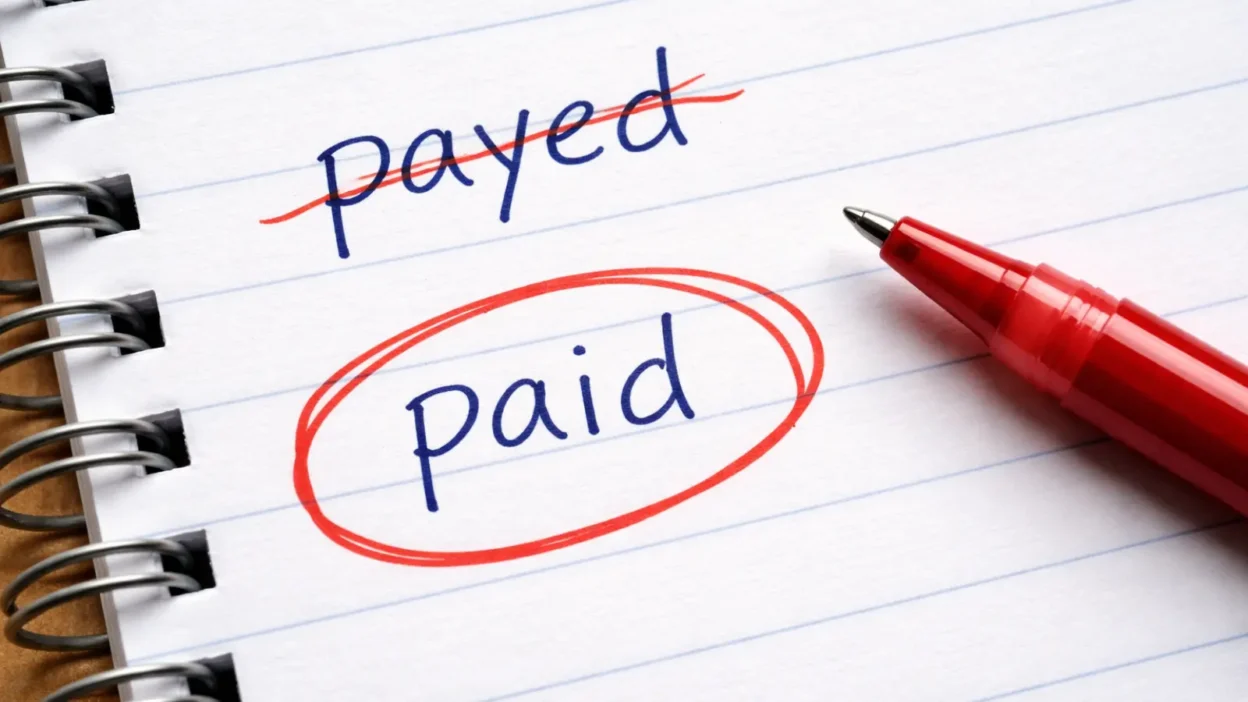
“Payed” and “paid” look like they should follow the same spelling pattern. After all, many verbs add -ed in the past tense. So it feels natural to write “payed” when talking about money.
You’ll see this confusion in texts, blog posts, school papers, and even business emails. It also pops up in common phrases like “paid attention.”
Getting it right matters. A small spelling mistake can make writing look careless, especially in professional settings. This guide explains the correct form, the rare exception, and how to choose the right spelling every time.
Quick Answer
“Paid” is the correct spelling in almost every situation. It is the past tense and past participle of “pay” when talking about money, attention, costs, or other everyday meanings.
“Payed” is a real word, but it is used only in specialized nautical contexts. Outside those technical meanings, it is usually a misspelling.
Key Differences at a Glance
Paid
- Past tense of “pay” for money
- Past participle used with has, have, or had
- Used in phrases such as “paid attention”
- Standard in everyday American English
- Correct for salaries, bills, debts, fees, and purchases
Payed
- Rare technical maritime term
- Can refer to treating parts of a ship with waterproof material
- Can appear in specialized uses involving rope or cable
- Rare in ordinary modern writing
- Not an alternative spelling of “paid”
Origin and Why Two Forms Exist
The base verb is “pay.” In its ordinary meanings, the past tense is irregular: “paid,” not “payed.”
English contains many verbs whose past forms do not follow the simple pattern of adding -ed. For example, we say “said” rather than “sayed” and “laid” rather than “layed” in standard uses.
The form “payed” survived in narrow maritime terminology. Because most English speakers rarely encounter these technical meanings, they may go their entire lives without needing to use “payed.”
The confusion is understandable because pay + ed appears as though it should naturally produce “payed.” English spelling, however, is shaped by historical development as well as modern grammatical patterns.
Paid as a Past-Tense Verb
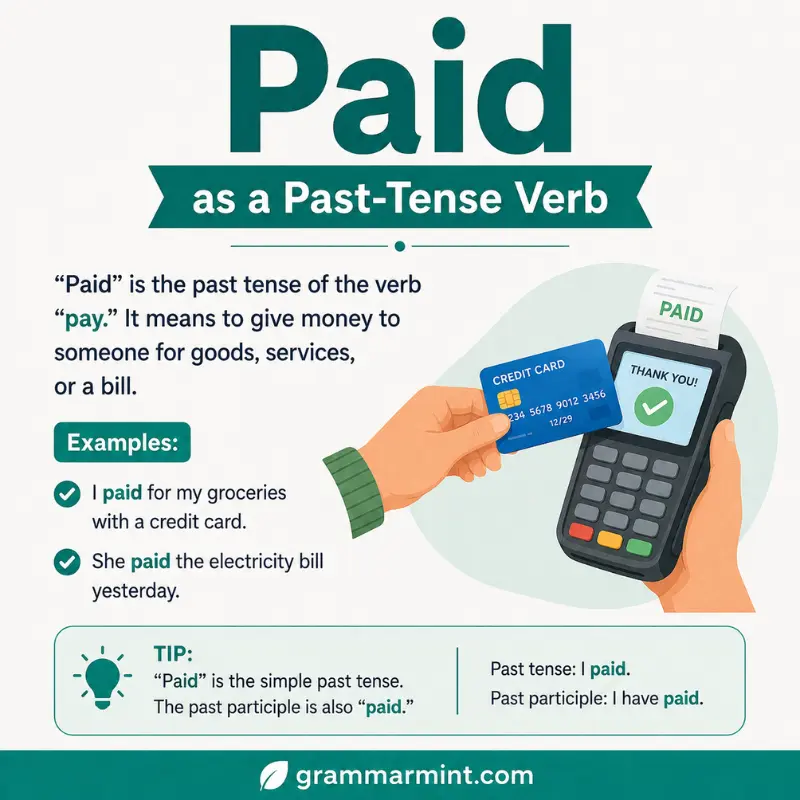
The most common use of “paid” is as the simple past tense of “pay.”
Use it when an action involving payment happened in the past.
Examples:
- I paid the electricity bill yesterday.
- She paid for lunch.
- We paid the contractor last Friday.
- He paid cash for the laptop.
- They paid a higher price than expected.
The timing can be yesterday, last week, several years ago, or any other completed point in the past. The spelling remains paid.
Incorrect:
- I payed the electricity bill.
Correct:
- I paid the electricity bill.
A useful rule is simple: if money changed hands, paid is almost certainly the word you need.
Paid as a Past Participle
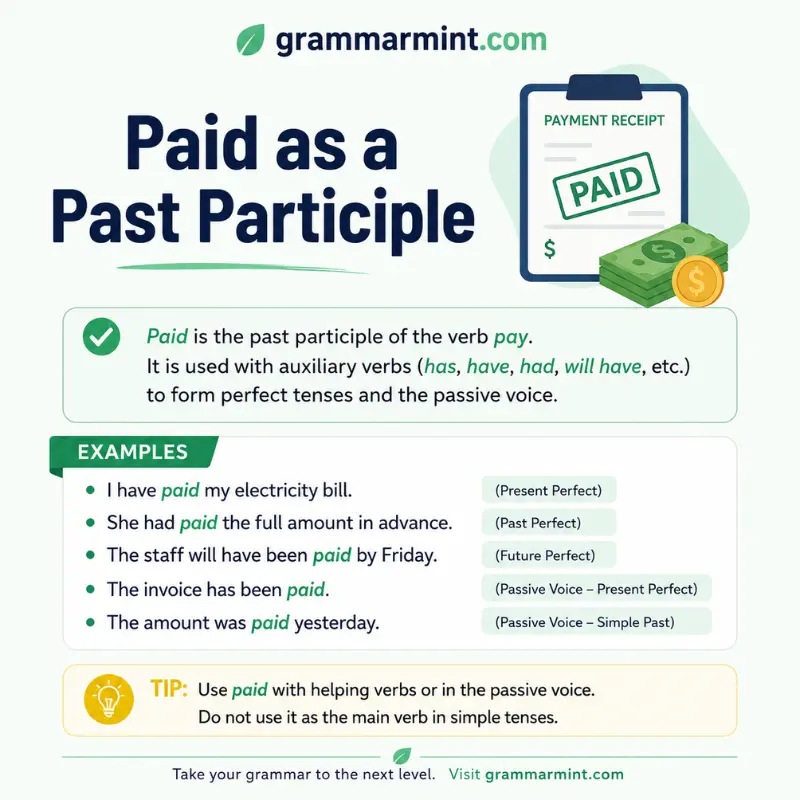
“Paid” is also the past participle of “pay.”
Past participles commonly appear with helping verbs such as has, have, had, and been.
Examples:
- I have paid the bill.
- She has already paid the fee.
- They had paid before we arrived.
- The employees have been paid.
- He has never paid for parking here.
This distinction matters because learners sometimes remember that “paid” is a past-tense form but become unsure when using perfect tenses.
You do not change the spelling.
Use:
- paid
- has paid
- have paid
- had paid
- was paid
- were paid
- has been paid
Do not use “payed” for any of these normal payment meanings.
Paid in Passive Sentences
“Paid” frequently appears in passive constructions, especially in workplace, legal, accounting, and business writing.
Examples:
- The invoice was paid on time.
- Employees are paid every two weeks.
- The balance must be paid by Friday.
- The supplier has been paid in full.
- All expenses were paid by the company.
Passive sentences focus on the person or thing receiving payment rather than the person making it.
For example:
Active:
- The company paid the consultant.
Passive:
- The consultant was paid by the company.
Both forms require paid, never “payed.”
Common Expressions That Always Use Paid
The word “paid” is not limited to literal financial transactions. It also appears in several common expressions.
Paid Attention
Use “paid attention” when someone listened, watched, or concentrated carefully.
- She paid attention during the lecture.
- I should have paid more attention to the directions.
- He barely paid attention during the meeting.
“Payed attention” is incorrect.
Paid Off
“Paid off” can refer to finishing repayment of a debt.
- We finally paid off the car loan.
- She paid off her credit card balance.
It can also mean that an effort produced a good result.
- Months of practice paid off.
- His hard work paid off when he received the promotion.
Even when no money is involved, the correct spelling remains paid off.
Paid a Visit
The expression “paid a visit” means visited someone or somewhere.
- We paid a visit to our grandparents.
- She paid the museum a visit during her trip.
Again, “payed a visit” is not standard.
Paid Respect
You may also see expressions such as “paid respect” or “paid tribute.”
- The community paid tribute to the retiring teacher.
- Hundreds of people paid their respects at the memorial.
These expressions use the ordinary irregular past tense paid.
Paid, Pay, and Paying
Understanding the full set of verb forms can make the spelling easier to remember.
| Verb Form | Correct Form | Example |
|---|---|---|
| Base form | pay | I pay my rent online. |
| Third-person singular | pays | She pays the bill monthly. |
| Present participle | paying | We are paying by card. |
| Simple past | paid | He paid yesterday. |
| Past participle | paid | They have paid already. |
Notice that only the past and past participle forms change significantly.
You write:
pay → paid → paid
Not:
pay → payed → payed
For everyday English, remembering those three forms solves most of the confusion.
Paid in Questions and Negative Sentences
A useful grammar detail involves sentences with did or didn’t.
When did is present, use the base form pay, not “paid.”
Correct questions:
- Did you pay the bill?
- Did she pay for dinner?
- How much did they pay?
- When did he pay the deposit?
Correct negatives:
- I didn’t pay yesterday.
- She didn’t pay the fee.
- They did not pay on time.
Compare:
- I paid yesterday.
- I did not pay yesterday.
This happens because did already carries the past-tense meaning.
A common mistake is writing:
- Did you paid the bill?
The correct sentence is:
- Did you pay the bill?
This issue is different from the “payed vs. paid” spelling confusion, but understanding it helps you use the verb correctly in a wider range of sentences.
Paid as an Adjective
“Paid” can also work as an adjective before a noun.
Examples include:
- paid leave
- paid vacation
- paid internship
- paid advertisement
- paid subscription
- paid membership
- paid employee
Examples in sentences:
- The company offers three weeks of paid leave.
- She accepted a paid internship for the summer.
- This article contains a paid advertisement.
- Premium users receive access through a paid subscription.
In these cases, “paid” generally describes something involving compensation or payment.
“Payed internship” and “payed vacation” would be incorrect.
Payed in Maritime Language
“Payed” should not be treated as a completely invented word. It does have specialized meanings connected with maritime terminology.
Historically, forms of the verb pay have been used for applying substances such as tar or pitch to parts of a wooden vessel to help seal or protect them.
In specialized contexts, you may therefore encounter sentences using payed rather than “paid.”
The key distinction is meaning.
If the sentence concerns:
- wages
- salaries
- bills
- prices
- debts
- fees
- attention
- purchases
- compensation
- subscriptions
use paid.
If the sentence is using a specialized nautical meaning of the verb, payed may be appropriate.
For most writers, however, this exception will rarely arise.
Why “Payed” Looks So Convincing
“Payed” is a particularly easy spelling mistake to make because it follows a productive English pattern.
Consider these regular verbs:
- play → played
- stay → stayed
- enjoy → enjoyed
- employ → employed
A writer may naturally assume:
- pay → payed
But the ordinary verb does not follow that pattern.
Instead:
- pay → paid
This is why spell-checking software often catches “payed” when it appears in sentences about money. However, depending on the software, it may not always flag the word because “payed” exists as a legitimate technical term.
That makes knowing the rule more reliable than depending entirely on autocorrect.
British vs American English
There is no major US-versus-UK difference here.
Both American and British English use “paid” as the standard past tense and past participle of “pay” in ordinary meanings.
For example:
American English:
- I paid the check.
British English:
- I paid the bill.
The vocabulary around payment may differ in some contexts, but the spelling paid does not.
“Payed” is therefore not a British alternative to “paid.”
If you are writing for an American audience, a British audience, or an international English-speaking audience, paid remains the standard choice for money and everyday expressions.
Which One Should You Use?
For everyday writing, use “paid.” That covers money, bills, salaries, invoices, fees, purchases, and expressions such as “paid attention” or “paid off.”
In school, business, academic, or professional writing, use paid whenever you mean the ordinary past form of “pay.”
Examples:
- I paid my tuition.
- The client paid the invoice.
- She paid close attention.
- Their investment paid off.
- The workers were paid yesterday.
You would normally use “payed” only when writing about specialized maritime practices.
If you are unsure which one belongs in your sentence, ask yourself:
Am I talking about money, attention, a debt, a cost, or an ordinary expression involving “pay”?
If the answer is yes, choose paid.
Common Mistakes and Quick Fixes
Mistake:
I payed my rent yesterday.
Fix:
I paid my rent yesterday.
Mistake:
She payed attention in class.
Fix:
She paid attention in class.
Mistake:
They haven’t payed the invoice.
Fix:
They haven’t paid the invoice.
Mistake:
He payed off his loan.
Fix:
He paid off his loan.
Mistake:
I was payed late this month.
Fix:
I was paid late this month.
Mistake:
The company payed bonuses in December.
Fix:
The company paid bonuses in December.
Mistake:
Did you paid for the tickets?
Fix:
Did you pay for the tickets?
Mistake:
She has payed all her bills.
Fix:
She has paid all her bills.
Everyday Examples in Real Contexts
Informal Text
“I paid for the tickets already.”
Social Media Caption
“Finally paid off my student loans!”
Parent Talking to a Child
“Did you pay for that snack?”
Later:
“Yes, I paid at the counter.”
Workplace Email
“We paid the vendor on February 10.”
More Professional Rewrite
“Payment was made to the vendor on February 10.”
Online Shopping
“I paid extra for next-day delivery.”
Restaurant
“She paid for dinner before we left.”
School
“He paid attention throughout the lesson.”
Freelance Work
“The client paid me after I submitted the final project.”
Subscription
“I canceled the service before the next paid billing period.”
Notice how paid works naturally across personal, professional, educational, and financial situations.
How to Remember Paid vs. Payed
One memory trick is to connect paid with other irregular forms ending in -aid.
Think of:
- say → said
- lay → laid
- pay → paid
They are not identical grammatical patterns in every respect, but the visual similarity can help you remember the spelling.
Another trick is to remember this short sentence:
“I paid what I owed.”
Both paid and owed deal naturally with money, making the sentence easy to recall.
You can also use a simple decision rule:
Money or attention = paid.
That rule will give you the correct spelling in nearly every situation an average writer encounters.
Editing Tips for Avoiding the Error
When proofreading your writing, search for the word “payed.”
If you find it, check the context.
Ask:
- Is the sentence about money?
- Is someone receiving wages?
- Is a bill, debt, fee, or invoice involved?
- Does the phrase say “attention,” “tribute,” “respect,” or “off”?
- Is this ordinary rather than specialized maritime writing?
If any of the first four apply, you almost certainly need paid.
This quick proofreading habit can be especially useful for:
- resumes
- business emails
- invoices
- blog posts
- school assignments
- reports
- cover letters
- professional profiles
Correct spelling strengthens clarity and makes polished writing look more credible.
Usage and Trends
Modern English overwhelmingly favors “paid” because the ordinary meaning of “pay” is used constantly in daily life.
“Payed” appears much less often because its legitimate uses are specialized. It may also appear when writers are discussing the spelling difference itself.
That means seeing “payed” somewhere online does not automatically make it correct for your sentence. Context determines whether the rare spelling is appropriate.
For normal American English, paid is the form readers expect.
Comparison Table
| Context | Best Choice | Why |
| Paying a bill | Paid | Correct past tense of pay |
| Salary or wages | Paid | Standard spelling |
| “Paid attention” | Paid | Fixed expression |
| Paying off debt | Paid | Standard verb form |
| Business email | Paid | Professional and correct |
| Academic paper | Paid | Recognized standard form |
| Paid vacation | Paid | Correct adjective |
| Paid internship | Paid | Correct adjective |
| “Has paid” | Paid | Correct past participle |
| Maritime technical writing | Payed | Possible specialized use |
FAQs
Is payed ever correct?
Yes. “Payed” can be correct in specialized maritime terminology. In normal writing about money, bills, salaries, or attention, however, use paid.
Why is paid spelled differently from payed?
“Pay” has an irregular past-tense form in its everyday meanings. Instead of simply adding -ed, English uses paid.
Is payed a typo?
In most everyday situations, yes. If someone writes “I payed the bill,” they almost certainly mean “I paid the bill.”
Is it paid attention or payed attention?
The correct expression is “paid attention.” “Payed attention” is incorrect in standard English.
Is payed used in British English?
Not as the normal past tense of “pay.” British English also uses paid for money, attention, bills, wages, and related meanings.
Is it paid or payed leave?
The correct expression is paid leave.
Example:
“Employees receive ten days of paid leave each year.”
Is it paid or payed off?
Use paid off.
Examples:
“She paid off her credit card.”
“All that studying paid off.”
Is it I have paid or I have payed?
The correct form is “I have paid.”
“Paid” functions as both the simple past tense and past participle of “pay” in ordinary English.
Mini Quiz
- She ___ her credit card bill yesterday.
- He ___ attention during the meeting.
- The employees were ___ on Friday.
- Have you ___ the registration fee?
- Their hard work finally ___ off.
Answer Key
- paid
- paid
- paid
- paid
- paid
In specialized nautical writing, payed may occasionally be appropriate, but ordinary sentences like those above always use paid.
Conclusion
When choosing between Payed or Paid, the answer is simple in almost every modern context. Use “paid” when referring to money, wages, bills, debts, fees, attention, or familiar expressions such as “paid off.”
“Payed” is not simply an alternative spelling. It survives mainly in specialized maritime language and is rarely needed in everyday communication.
Remember the pattern pay → paid → paid, and you can avoid this common mistake with confidence.
For schoolwork, emails, business writing, social media, and everyday conversation, paid is almost always the correct choice.


[…] that’s the case, everyday examples you can use, common mistakes, and simple ways to remember the correct spelling so you feel confident every time you […]