English speakers sometimes wonder whether to write Abley or Ably when describing how skillfully or competently someone does something.
Because abley looks as though it could be formed by simply adding -ly to able, the confusion is understandable. However, only one spelling is correct when you need the adverb form of able.
This distinction matters in emails, essays, reports, applications, academic assignments, and professional communication. Using the wrong spelling can make otherwise polished writing look careless.
The good news is that the rule is easy to remember once you understand how able changes into ably.
In this guide, you’ll learn the difference between ably and abley, why ably is the standard spelling, how to use it naturally in American English, and which common mistakes to avoid.
Quick Answer
Use ably.
Ably is the correct English adverb meaning “in a skillful, capable, or competent way.”
Abley is not the standard adverb form of able. You may occasionally see Abley as a proper name, such as a surname, but you should not use it as an alternative spelling of ably in ordinary English sentences.
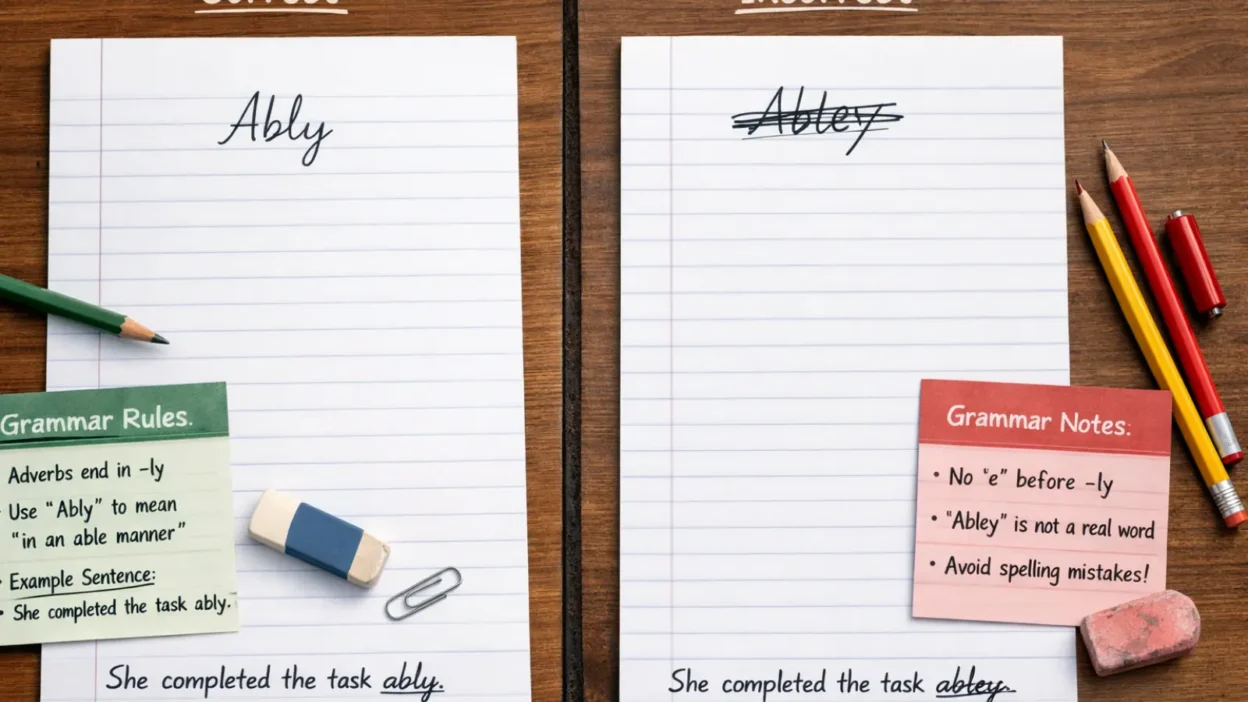
Correct: She ably handled the difficult situation.
Incorrect: She abley handled the difficult situation.
Abley vs Ably: Key Differences at a Glance
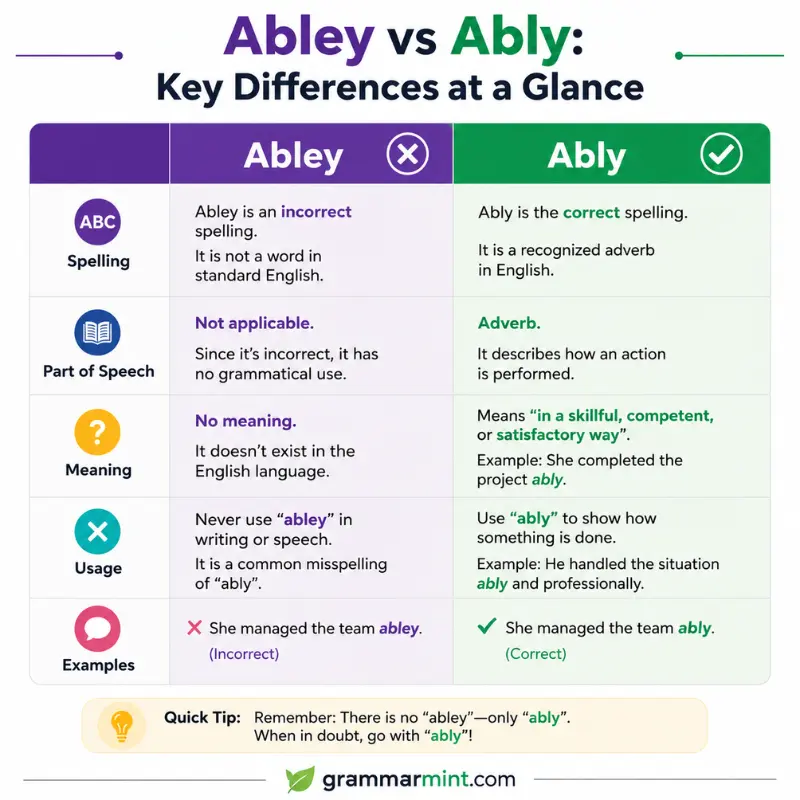
| Form | Correct? | Meaning or Use | Example |
|---|---|---|---|
| Ably | Yes | In a capable, skillful, or competent way | She ably managed the team. |
| Abley | No, as an adverb | May occur as a proper name | Abley may appear as a person’s name. |
The easiest rule to remember is simple:
If you mean “skillfully” or “competently,” use ably.
What Does Ably Mean?
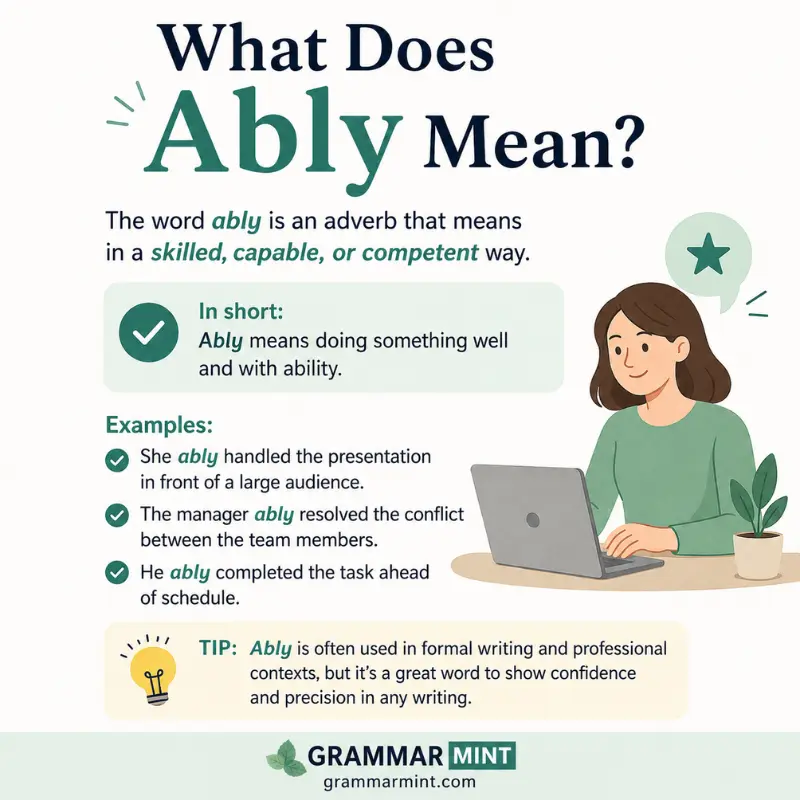
Ably is an adverb. It describes an action that is performed with skill, competence, intelligence, or effectiveness.
For example:
- She ably answered every question during the interview.
- The manager ably guided the team through the transition.
- He ably defended his position during the debate.
- The lawyer ably represented her client.
- They ably completed the project despite the short deadline.
In each example, ably tells us how someone performed an action.
Consider this sentence:
Maria led the discussion.
It tells us what Maria did.
Now compare it with:
Maria ably led the discussion.
The word ably adds information. It tells us that Maria led the discussion in a capable or skillful manner.
Why Is Ably the Correct Spelling?
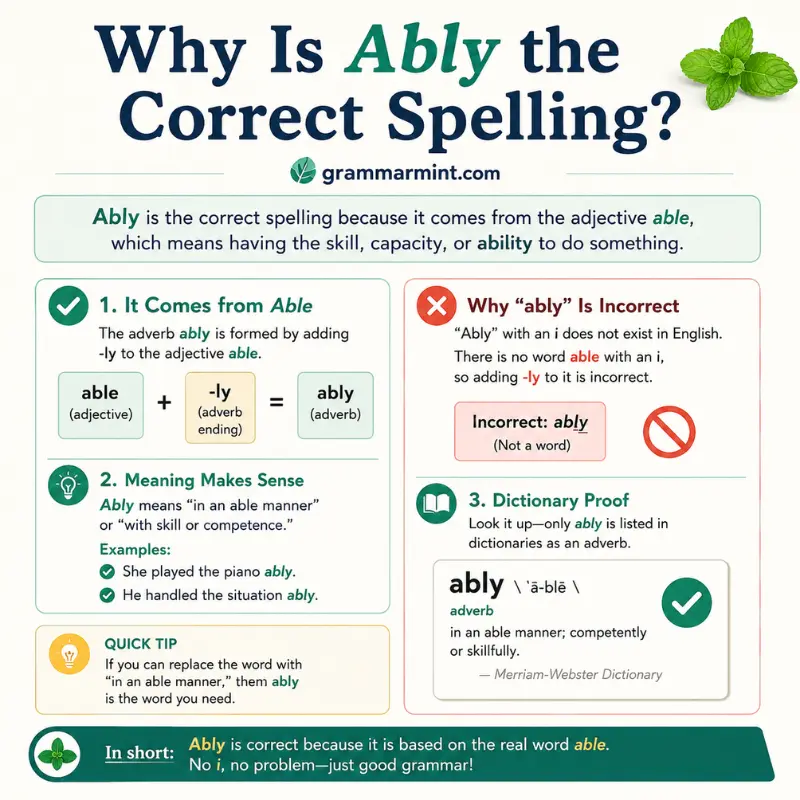
The word ably comes from the adjective able.
Able means having the skill, knowledge, opportunity, or capacity to do something.
For example:
- She is able to solve the problem.
- He is an able administrator.
- We were able to finish on time.
When able becomes the adverb ably, the spelling changes.
It does not become ablely or abley.
The correct transformation is:
able → ably
This same type of spelling change can be seen with several adjectives ending in -able or -ible:
- probable → probably
- possible → possibly
- comfortable → comfortably
- terrible → terribly
- reasonable → reasonably
- suitable → suitably
So, rather than thinking of ably as simply able + ly, it is better to remember it as the established adverb form of able.
Why Abley Looks Correct but Isn’t
The spelling abley can seem logical at first.
A learner may think:
able + ly = ablely
Then, because ablely looks awkward, they may shorten it to abley.
English spelling, however, does not always follow a simple “keep the whole adjective and add -ly” formula.
For able, the accepted adverb is ably.
That is why these sentences are incorrect:
- She abley completed the assignment.
- He abley managed the department.
- They abley handled the emergency.
They should be:
- She ably completed the assignment.
- He ably managed the department.
- They ably handled the emergency.
Is Abley a Real Word?
Abley is not the standard adverb form of able.
However, that does not mean the sequence of letters Abley can never appear in English.
It may occur as a proper name, particularly a family name or another type of name. When used as a proper noun, it normally begins with a capital letter.
For example:
Mr. Abley attended the meeting.
Here, Abley is a name, so it is perfectly acceptable.
Compare that with:
Mr. Abley ably answered the questions.
In this sentence:
- Abley is a proper name.
- ably is the adverb describing how he answered.
This example makes the distinction especially clear.
Ably vs Able
Another source of confusion is the difference between able and ably.
Although the words are closely related, they perform different grammatical jobs.
Able Is an Adjective
Able describes a person or thing.
Examples:
- She is an able leader.
- He is able to work independently.
- We need an able technician for the job.
Ably Is an Adverb
Ably normally describes how an action is performed.
Examples:
- She ably led the department.
- He ably completed the repair.
- The technician ably diagnosed the problem.
Compare these two sentences:
She is an able manager.
Here, able describes manager.
She ably manages the department.
Here, ably describes the verb manages.
This distinction can help you decide which form your sentence needs.
Ably vs Skillfully
Ably and skillfully can often express similar ideas, but they are not always identical in tone.
Ably emphasizes competence and capability.
Skillfully often places slightly more emphasis on technique, expertise, or the way something is performed.
For example:
She ably managed the crisis.
This suggests that she handled the crisis competently and effectively.
She skillfully managed the crisis.
This may place more emphasis on the particular skill she demonstrated.
In many contexts, either word can work.
Other possible alternatives to ably include:
- competently
- effectively
- capably
- successfully
- proficiently
- skillfully
The best choice depends on the exact meaning you want.
Is Ably Formal or Informal?
Ably works especially well in neutral, professional, academic, and formal English.
You may see it in:
- business reports
- news articles
- biographies
- recommendation letters
- academic writing
- performance reviews
- political commentary
- professional emails
For example:
Jordan ably coordinated the project’s final phase.
This sentence sounds natural in professional writing.
In casual conversation, speakers may be more likely to say:
Jordan did a great job coordinating the project.
Both are correct. The difference is mainly one of style.
American vs British English
There is no major American-versus-British spelling difference with ably.
In both major varieties of English, ably is the standard adverb form of able.
Therefore:
American English: ably
British English: ably
This differs from spelling pairs such as:
- color / colour
- favor / favour
- center / centre
With ably, you do not need to change the spelling depending on your audience.
For American English writing, simply use ably.
How to Pronounce Ably
Ably is generally pronounced like:
AY-blee
It has two syllables.
The pronunciation is closely related to able, with an -ee sound added at the end.
Knowing the pronunciation can also make the spelling easier to remember:
able → ably
Common Mistakes and How to Fix Them
Mistake 1: Writing Abley
Incorrect: She abley managed the task.
Correct: She ably managed the task.
Use ably whenever you mean “competently” or “skillfully.”
Mistake 2: Writing Ablely
Incorrect: He ablely handled the complaint.
Correct: He ably handled the complaint.
Do not keep the complete spelling of able before adding the adverb ending.
Mistake 3: Using Able Instead of Ably
Incorrect: She able completed the work.
Correct: She ably completed the work.
Because the sentence describes how she completed the work, an adverb is needed.
Mistake 4: Using Ably as an Adjective
Incorrect: She is an ably manager.
Correct: She is an able manager.
Use able before a noun when you need an adjective.
Mistake 5: Assuming Every Adjective Ending in E Follows the Same Rule
A common oversimplification is to say that every adjective ending in e drops the e before -ly.
That is not true.
For example:
- nice → nicely
- polite → politely
- complete → completely
English spelling patterns vary. Therefore, it is safer to learn able → ably as a specific standard formation and notice that similar patterns occur with words such as probable → probably and possible → possibly.
Everyday Examples of Ably
Here are natural examples showing how ably can appear in different situations.
At Work
- She ably supervised the new employees.
- Marcus ably managed several projects at once.
- The team ably responded to the client’s concerns.
- Our director ably guided the company through the transition.
In School
- The student ably defended her argument.
- Daniel ably explained the scientific concept.
- The group ably completed the research assignment.
- She ably answered the professor’s questions.
In Leadership
- The mayor ably handled the unexpected crisis.
- He ably led the committee for three years.
- The captain ably organized the team’s defense.
- She ably represented the organization at the conference.
In Creative Work
- The actor ably portrayed a complicated character.
- The writer ably combines humor with serious commentary.
- The musician ably performed the difficult passage.
- The director ably balanced drama and comedy.
Ably in Professional Writing
Because ably has a polished and concise tone, it can be particularly useful in professional communication.
Thanks for ably addressing the client’s concerns during yesterday’s meeting.
Performance Review
Jordan ably manages competing priorities and consistently meets deadlines.
Recommendation
She ably coordinated a team of employees across multiple departments.
Business Report
The department ably responded to unexpected changes in demand.
In each case, ably communicates competence without requiring a longer phrase such as “in a highly capable manner.”
Sentence Rewrites With Ably
Seeing incorrect and corrected versions side by side can make the difference easier to remember.
Incorrect: He abley led the workshop.
Correct: He ably led the workshop.
Incorrect: The team abley solved the problem.
Correct: The team ably solved the problem.
Incorrect: Maria able handled the negotiations.
Correct: Maria ably handled the negotiations.
Wordy: Maria handled the negotiations in a very capable way.
Concise: Maria ably handled the negotiations.
Wordy: The lawyer presented the argument in a skillful and competent manner.
Concise: The lawyer ably presented the argument.
When Should You Use Ably?
Use ably when you want to emphasize that someone performs an action with competence or skill.
It works particularly well with verbs such as:
- manage
- lead
- handle
- perform
- defend
- represent
- demonstrate
- guide
- respond
- explain
- coordinate
- administer
For example:
- ably managed
- ably led
- ably handled
- ably represented
- ably defended
- ably demonstrated
These combinations are especially common in professional and descriptive writing.
When Ably May Sound Too Formal
Although ably is correct, it may occasionally sound more formal than necessary in very casual conversation.
For example:
You ably fixed my phone.
This sentence is grammatically correct, but a friend might be more likely to say:
You did a great job fixing my phone.
Similarly:
You ably cooked dinner tonight.
sounds more formal than:
You cooked dinner really well tonight.
Therefore, correctness and naturalness are not always exactly the same thing. Ably is useful when a concise, polished tone fits the context.
Handy Spelling Tip
Remember this short pattern:
ABLE loses the E → ABLY
You can visualize it as:
able → abl + y → ably
Also compare:
- probable → probably
- possible → possibly
- terrible → terribly
Do not apply this as a universal rule to every word ending in e, however. English has exceptions and different spelling patterns.
The safest memory trick is simply:
Able person. Ably performed.
Comparison Table
| Context | Best Choice | Why |
| Standard English writing | Ably | Correct adverb |
| Academic writing | Ably | Standard and professional |
| Business communication | Ably | Concise way to express competence |
| Casual writing | Ably | Still correct, though alternatives may sound more conversational |
| Meaning “skillfully” | Ably | Correct meaning |
| Adjective before a noun | Able | An adjective is required |
| Proper name | Abley may occur | Proper names follow their own spelling |
| Adverb spelled “abley” | Incorrect | Not the standard English adverb |
Abley or Ably in a Sentence
If you’re still unsure, ask yourself one question:
Am I trying to say “in a capable or skillful way”?
If yes, choose ably.
For example:
She _____ managed the difficult conversation.
Because you mean she managed it competently, the answer is:
She ably managed the difficult conversation.
Another example:
The attorney _____ represented the defendant.
Correct:
The attorney ably represented the defendant.
This simple meaning test works in most situations.
FAQs
Is Abley ever correct?
Abley is not correct as the adverb form of able. It may appear as a proper name, but in normal grammar, use ably when you mean “competently” or “skillfully.”
Why do people spell ably as abley?
The mistake usually happens because people assume they can keep the full word able and simply attach an adverb ending. However, the established spelling is ably.
Is it ably or ablely?
The correct spelling is ably. Ablely is not the standard form.
What does ably mean?
Ably means in a competent, capable, or skillful manner.
For example:
She ably handled the negotiation.
Is ably a real word?
Yes. Ably is a standard English adverb formed from the adjective able.
Is ably formal?
It can be used in both general and formal English, although it is particularly common in professional, academic, journalistic, and descriptive writing.
Can I use ably in an email?
Yes. For example:
Thank you for ably handling the client’s concerns.
The sentence is grammatically correct and sounds professional.
Is the spelling different in British English?
No. Ably is standard in both American and British English.
What is the adjective form of ably?
The adjective is able.
Adjective: She is an able leader.
Adverb: She ably leads the team.
What are synonyms for ably?
Depending on the sentence, possible synonyms include skillfully, competently, capably, effectively, proficiently, and successfully.
Mini Quiz
1. Which is the correct adverb: ably or abley?
Answer: Ably
2. Which sentence is correct?
A. She abley handled the meeting.
B. She ably handled the meeting.
Answer: B. She ably handled the meeting.
3. Does abley work as the adverb in a formal essay?
Answer: No. Use ably.
4. What is the adverb form of able?
Answer: Ably
5. Which word belongs in this sentence?
The manager _____ resolved the conflict.
Answer: Ably
6. Which word is an adjective: able or ably?
Answer: Able
7. Complete the sentence:
She is an _____ administrator who _____ manages a large department.
Answer: able; ably
Full sentence:
She is an able administrator who ably manages a large department.
Conclusion
When deciding between Abley and Ably, choose Ably as the correct adverb meaning “in a competent or skilled way.”
Abley belongs to proper names, not grammar rules. Knowing this small detail helps your writing stay clear, confident, and correct.