If you have ever typed treet and paused to check the spelling, you are not alone. The words may look as though they should sound the same, but only one is accepted in standard English.
The confusion often appears in Halloween phrases, social media captions, children’s writing, text messages, and informal advertisements. In most cases, treet is simply a spelling mistake. Occasionally, a writer may use it intentionally to create a cute, childish, or humorous tone.
However, playful spelling is not the same as correct spelling. Choosing the standard form matters in school assignments, professional emails, printed materials, website content, and any situation where clear writing is important.
This guide explains the difference between treet or treat, why people confuse them, what treat means, and when the nonstandard form might appear.
Quick Answer
Treat is the correct spelling in American and British English.
Treet is not the standard spelling of the word. It usually appears as a typo, an invented spelling, or a playful attempt to imitate a child’s pronunciation.
Use treat in schoolwork, business communication, social media posts, advertisements, Halloween phrases, and everyday writing.
Correct: We bought a special treat for the children.
Incorrect: We bought a special treet for the children.
Treet or Treat: What Is the Difference?
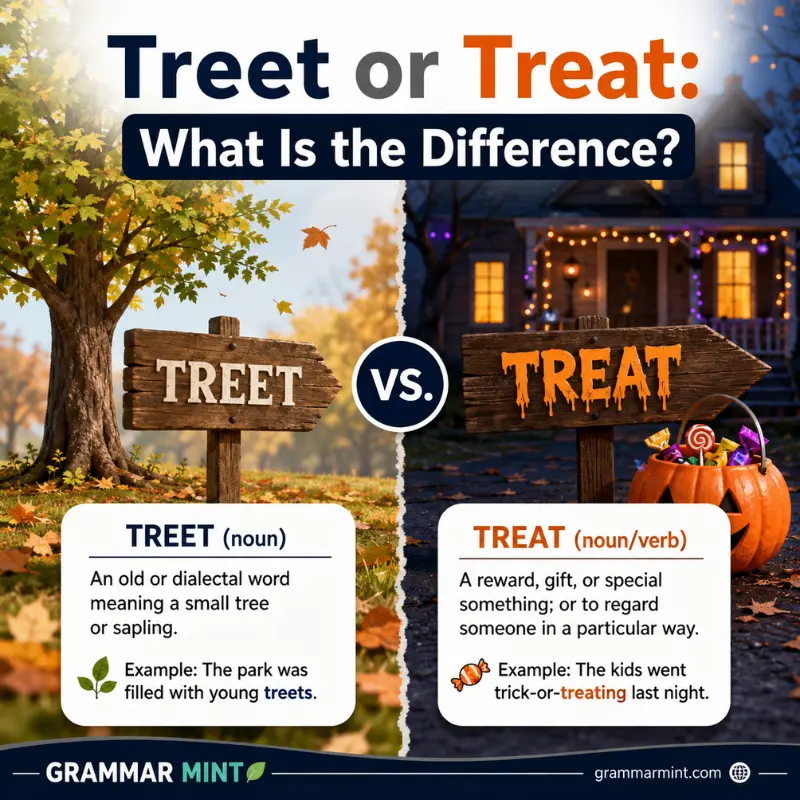
The difference is straightforward: treat is a standard English word, while treet is not an accepted alternative spelling of it.
| Word | Status | Meaning | Recommended Use |
|---|---|---|---|
| Treat | Standard English | A reward, enjoyable experience, way of behaving, or act of providing care | Use in all contexts |
| Treet | Nonstandard spelling | Usually intended to mean “treat” | Avoid unless deliberately used for humor or branding |
Even when treet appears in an informal post, readers may assume that the writer made a typing or spelling error. For that reason, treat remains the safer and clearer choice.
What Does Treat Mean?
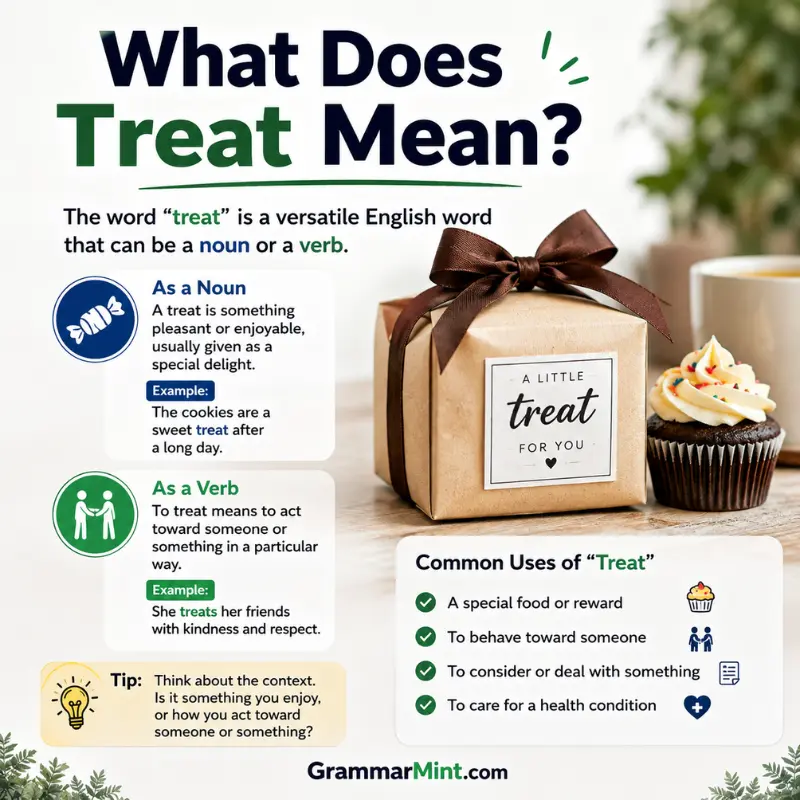
Treat can function as both a noun and a verb. Its meaning changes depending on how it appears in a sentence.
As a noun, a treat is usually something pleasant, enjoyable, or special.
Examples:
- The children received a treat after dinner.
- Seeing my old friend again was a real treat.
- We bought the dog a new treat.
- A quiet afternoon at home feels like a treat.
As a verb, treat can mean to behave toward someone in a particular way, pay for someone’s food or entertainment, provide medical care, or deal with a substance or subject.
Examples:
- Please treat everyone with respect.
- She treated us to lunch.
- The doctor treated the patient’s injury.
- The company treats the wood with a protective coating.
- The article treats the subject in detail.
Major English dictionaries list treat as both a noun and a verb, with meanings connected to handling, behaving toward, caring for, or providing enjoyment.
Why Do People Write Treet?
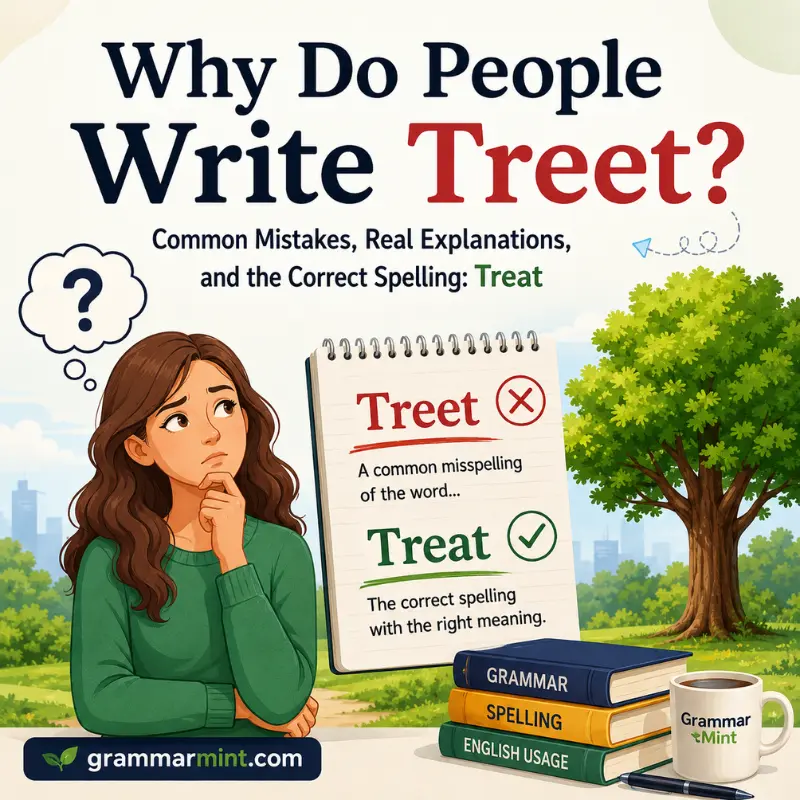
The mistake usually happens because of the long e sound in treat.
English represents the same sound with several different spelling patterns. Consider these examples:
- meet
- seat
- complete
- piece
- key
Because meet uses double e, a learner may assume that treat should follow the same pattern and write treet. English spelling, however, does not always follow one predictable rule.
In treat, the letters ea produce the long e sound:
- treat
- read
- clean
- dream
- speak
Remembering this spelling family can make the correct form easier to recognize.
The Origin of Treat
The word treat entered English through Middle English and Anglo-French forms related to handling, dealing with, or discussing something. Those forms ultimately developed from the Latin word tractare, which carried meanings connected to handling and dealing with something.
The verb appeared before the familiar noun meaning of something pleasant or enjoyable. Over time, English speakers began using treat for special food, entertainment, rewards, and pleasurable experiences.
Treet, by contrast, did not develop as a standard alternative spelling of treat. In ordinary writing, it should not replace the accepted form.
Is There an American and British English Difference?
There is no regional spelling difference between treet and treat.
American English uses treat.
British English also uses treat.
Unlike pairs such as color and colour or organize and organise, this word does not change spelling between the United States and the United Kingdom. British and American dictionary resources both use treat as the standard form.
Therefore, you should use treat regardless of whether you are writing for an American, British, Canadian, or Australian audience.
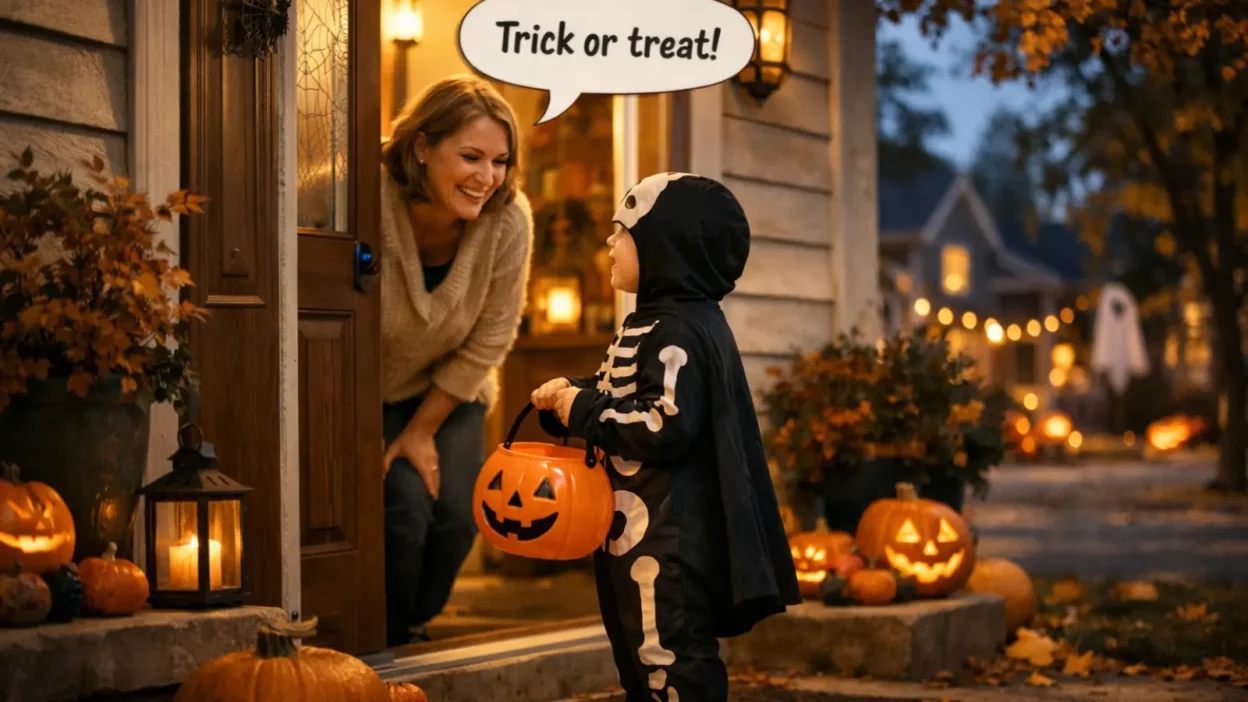
Is It Trick or Treet or Trick or Treat?
The correct Halloween phrase is:
Trick or treat
Never write trick or treet in standard English.
Children traditionally say “trick or treat” when visiting homes on Halloween and asking for candy or another small gift. The word treat refers to the candy, snack, or reward being requested.
Correct examples:
- The children shouted, “Trick or treat!”
- We bought candy for trick-or-treaters.
- The school is holding a trick-or-treat event.
- She carried a trick-or-treat bag.
Notice that trick-or-treat may be hyphenated when it works as an adjective before a noun.
Correct: a trick-or-treat event
Correct: a trick-or-treat bag
Correct: The children went trick-or-treating.
When Should You Use Treat?
Everyday Writing
Use treat when referring to a reward, snack, enjoyable activity, or special experience.
- Ice cream is my favorite summer treat.
- Finishing the project early was a welcome treat.
- We brought treats for the class.
Professional Writing
The word is acceptable in professional communication when the tone is friendly or informal.
- There are treats in the break room.
- The manager treated the team to lunch.
- We hope the event will be a treat for our guests.
In highly formal writing, another word may sometimes fit better.
Instead of:
- We put treats in the conference room.
You could write:
- Refreshments are available in the conference room.
Medical Contexts
As a verb, treat can describe providing medical care.
- The doctor treated the infection.
- This medicine may help treat mild symptoms.
- The hospital treated several injured passengers.
In this context, treat does not necessarily mean “cure.” Treatment may reduce symptoms, manage a condition, or support recovery without completely eliminating the problem.
Behavior Toward Others
Use treat when explaining how someone behaves toward another person, animal, object, or situation.
- Treat your classmates kindly.
- The workers were treated fairly.
- Please treat this information as confidential.
- He treats his pets like members of the family.
Can Treet Ever Be Used?
You may occasionally see treet used intentionally in humorous captions, fictional dialogue, usernames, product names, or child-directed writing.
For example:
- “Can I have a treet?” the toddler asked.
- Time for a spooky little treet!
Such uses are creative rather than standard. A reader may not realize that the spelling is intentional and may interpret it as a mistake.
Use playful spelling only when the context makes the joke obvious. Avoid it in:
- School assignments
- Professional emails
- Business websites
- News articles
- Formal advertisements
- Academic papers
- Printed event materials
Even in casual writing, treat usually looks clearer and more polished.
Common Mistakes and Corrections
Incorrect: Trick or treet!
Correct: Trick or treat!
Incorrect: I bought my dog a treet.
Correct: I bought my dog a treat.
Incorrect: We should treet everyone equally.
Correct: We should treat everyone equally.
Incorrect: The doctor will treet the injury.
Correct: The doctor will treat the injury.
Incorrect: This coffee is my morning treet.
Correct: This coffee is my morning treat.
Incorrect: The wood was treeted with oil.
Correct: The wood was treated with oil.
The spelling remains treat when endings are added:
- treat
- treats
- treated
- treating
- treatment
Do not change treat to treet in any of these forms.
Easy Way to Remember the Correct Spelling
Connect treat with the word eat:
You can eat a treat.
Both words contain eat:
- treat
- eat
This simple connection can help you remember that treat uses ea, not ee.
You can also remember the sentence:
A sweet treat is good to eat.
The repeated spelling pattern makes the correct form easier to recall.
More Examples of Treat in Sentences
- The vacation was a special treat for the family.
- Homemade cookies are always a welcome treat.
- Watching the sunrise was an unexpected treat.
- The teacher gave the students a small treat.
- Fresh fruit can be a healthy treat.
Treat as a Verb
- Treat other people the way you want to be treated.
- I will treat you to coffee this afternoon.
- The clinic can treat minor injuries.
- Workers treated the surface with a protective chemical.
- The report treats each issue separately.
Treat in Common Expressions
- My treat.
- Treat yourself.
- Trick or treat.
- Treat someone with respect.
- Treat something seriously.
- Treat someone like family.
- Treat a condition.
- Treat something as confidential.
Frequently Asked Questions
Is treet a correct English word?
Treet is not the standard spelling when you mean a reward, pleasant experience, way of behaving, or act of providing care. In those situations, use treat. It may appear as a creative spelling or proper name, but it is not interchangeable with the ordinary English word.
Why is treat spelled with “ea”?
English often uses ea to represent a long e sound, as in clean, dream, speak, and treat. English spelling developed from several languages, so similar sounds do not always follow the same spelling pattern.
Is it trick or treet?
The correct Halloween expression is trick or treat. Writing trick or treet is a spelling error unless the misspelling is being used intentionally for a joke.
What is the plural of treat?
The plural form is treats.
- We bought several treats for the party.
- The dog received two treats.
What is the past tense of treat?
The past-tense form is treated.
- She treated us kindly.
- The doctor treated his injury.
- They treated the team to dinner.
Can treat mean something other than food?
Yes. A treat can be any enjoyable experience, not only food.
- The concert was a real treat.
- Having a free afternoon was a rare treat.
- It was a treat to meet the author.
Should I capitalize treat?
Capitalize treat only when it begins a sentence or forms part of a title or proper name.
- Treat everyone fairly.
- The children received a treat.
- “Trick or Treat” appears in the event title.
Mini Quiz
Choose the correct spelling in each sentence.
- We bought a special treat/treet for the dog.
- Always treat/treet your coworkers respectfully.
- The children shouted, “Trick or treat/treet!”
- The doctor treated/treeted the wound.
- The trip was an unexpected treat/treet.
Answer Key
- Treat
- Treat
- Treat
- Treated
- Treat
Conclusion
When choosing between treet or treat, use treat in standard English.
Treat is the correct spelling for a reward, snack, enjoyable experience, method of handling something, way of behaving toward someone, or act of providing medical care. It is also the correct word in the Halloween expression trick or treat.
Treet usually results from confusion over the long e sound or appears as an intentional creative spelling. Because many readers will view it as a typo, avoid it in school, professional, academic, business, and general-purpose writing.
Remember the simple clue: You can eat a treat. When accuracy and clarity matter, treat is always the correct choice.