Many English speakers stop mid-sentence when faced with mistakingly versus mistakenly.
Both spellings may look plausible because they come from the familiar word mistake. However, only one form is accepted as standard in modern American English. The other appears occasionally but is usually marked incorrect or nonstandard in formal writing.
This confusion often appears in emails, school assignments, social media posts, and even professional reports. A writer may assume that adding -ly to mistaking creates a correct adverb. English word formation, however, does not always follow the pattern that seems most logical.
Knowing which spelling to use helps you avoid an obvious error and makes your writing more polished. This guide explains the correct form, why the incorrect version appears, how to use the word naturally, and which alternatives work in different contexts.
Quick Answer
Use mistakenly. It is the standard and widely accepted adverb meaning “in error,” “incorrectly,” or “by mistake.”
Mistakingly appears very rarely and is considered nonstandard in modern English. Avoid it in academic papers, workplace communication, published content, and other formal writing.
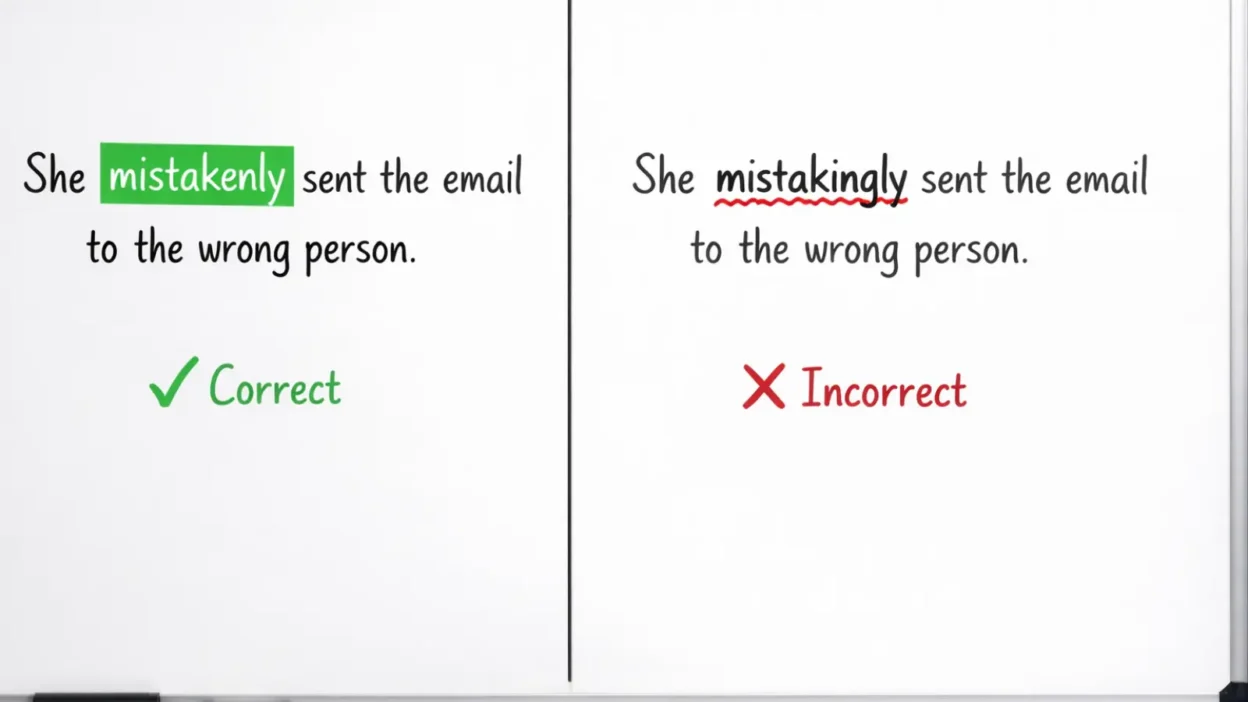
- Correct: I mistakenly deleted the document.
- Incorrect: I mistakingly deleted the document.
Key Differences at a Glance
Here is the simplest way to compare the two spellings:
- Mistakenly: The correct adverb used when someone does or believes something by mistake.
- Mistakingly: A rare and nonstandard formation that most editors and teachers reject.
- Formal writing: Use only mistakenly.
- Everyday writing: Mistakenly remains the natural choice.
- Alternative phrases: By mistake, incorrectly, and in error can sometimes replace it.
The safest rule is straightforward: whenever you need an adverb connected to the word mistake, choose mistakenly.
Meaning of Mistakenly
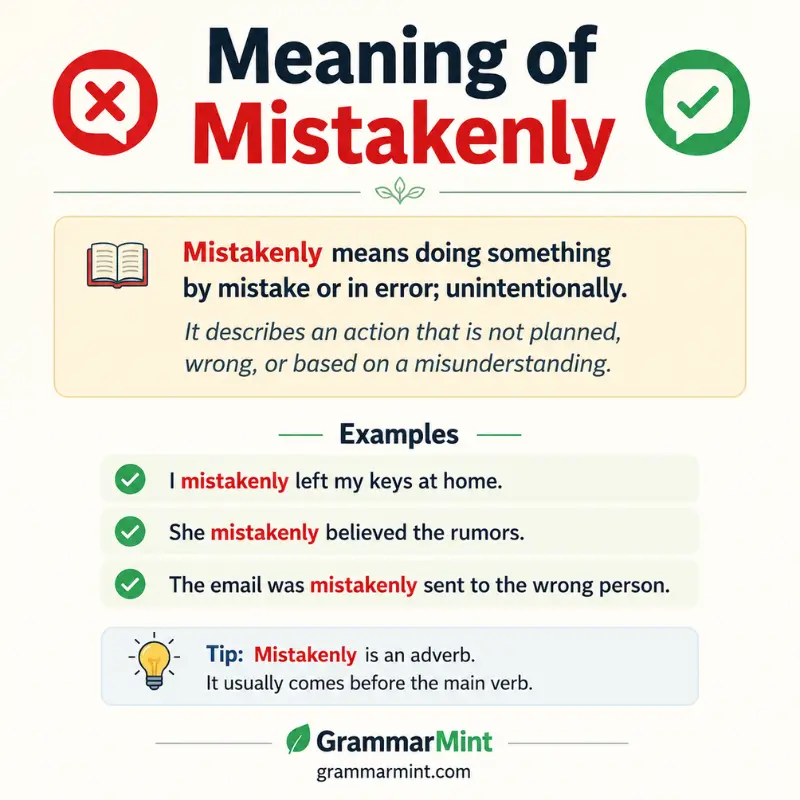
Mistakenly is an adverb. It describes an action, belief, statement, or decision that results from an error or misunderstanding.
Consider this sentence:
Maria mistakenly believed that the meeting began at noon.
The word mistakenly explains how Maria formed her belief. She believed something, but her belief was incorrect.
It can describe several kinds of errors:
- An incorrect belief
- An accidental action
- A false identification
- A misunderstanding
- An inaccurate judgment
- A wrong entry or calculation
Examples:
- I mistakenly assumed the store was open.
- The customer was mistakenly charged twice.
- He mistakenly identified the bird as an eagle.
- We mistakenly sent the invitation to an old address.
- The editor mistakenly removed an important paragraph.
In each sentence, the action happened because of an error rather than a deliberate choice.
Origin and Why Two Forms Exist
The adverb mistakenly comes from the adjective mistaken, which is also the past participle of the verb mistake.
English commonly forms adverbs by adding -ly to an adjective:
- quick → quickly
- careful → carefully
- sudden → suddenly
- unfortunate → unfortunately
- mistaken → mistakenly
This pattern explains why mistakenly is correct.
The form mistakingly likely develops when a writer starts with the present participle mistaking and adds -ly. Although that construction may look logical, it is not the established form used in standard English.
Compare the word family:
- Mistake: noun or verb
- Mistaken: adjective or past participle
- Mistaking: present participle
- Mistakenly: adverb
Examples:
- That was a mistake.
- I mistook him for his brother.
- She was mistaken about the date.
- He is mistaking friendliness for agreement.
- They mistakenly entered the wrong number.
Understanding this word family makes the correct spelling easier to remember.
Why Mistakingly Looks Correct
The incorrect form mistakingly feels believable because English contains many words ending in -ing. Writers regularly see words such as surprisingly, interestingly, and knowingly, so they may assume mistakingly follows a similar pattern.
However, those words do not all form in exactly the same way.
For example:
- surprising → surprisingly
- interesting → interestingly
- knowing → knowingly
The existence of these forms does not mean every verb ending in -ing can take -ly naturally.
English usage depends not only on a possible grammatical pattern but also on convention. Over time, English speakers accepted mistakenly as the standard adverb. Mistakingly never became widely established.
That is why a spelling checker, teacher, editor, or grammar tool will usually flag mistakingly as an error.
Spelling Breakdown
The correct spelling is:
m-i-s-t-a-k-e-n-l-y
A useful way to divide it is:
mistaken + ly = mistakenly
Do not begin with mistaking.
A simple memory trick is:
If a person is mistaken, they acted mistakenly.
You can also connect the word to this pair:
- He was mistaken.
- He mistakenly believed the rumor.
The adjective mistaken remains visible inside the adverb mistakenly.
Pronunciation of Mistakenly
Mistakenly is commonly pronounced as:
mi-STAY-kuhn-lee
It contains four main syllable sounds:
mis-tak-en-ly
The stress falls mainly on the second syllable, take.
The spelling may look long, but the pronunciation is usually smooth in ordinary speech. Speakers do not normally place a strong pause between mistaken and -ly.
Example:
I mistakenly took your notebook.
When spoken naturally, mistakenly functions as one continuous word.
Part of Speech
Mistakenly is an adverb.
An adverb can modify a verb, adjective, another adverb, or sometimes an entire clause. In most sentences, mistakenly modifies a verb.
- She mistakenly opened my package.
- They mistakenly believed the event was canceled.
- I mistakenly entered the old password.
It answers a question such as:
- How did she open the package?
- How did they form that belief?
- How did I enter the password?
The answer is: by mistake or in error.
Sentence Position
Mistakenly can appear in different positions depending on emphasis and sentence flow.
Before the Main Verb
This is the most common position.
- I mistakenly called the wrong number.
- She mistakenly selected the premium plan.
- We mistakenly assumed the office was closed.
Placing the adverb before the main verb sounds natural and immediately explains that the action involved an error.
After the Verb or Object
The adverb can sometimes appear later in the sentence.
- I entered the address mistakenly.
- He used the old form mistakenly.
These sentences are grammatically possible, but they may sound less natural than placing mistakenly before the verb.
More natural versions would be:
- I mistakenly entered the address.
- He mistakenly used the old form.
At the Beginning of a Sentence
Writers can place mistakenly at the beginning for emphasis.
- Mistakenly, I believed the deadline was Friday.
- Mistakenly, the team treated the draft as the final version.
This structure is possible, but it can sound formal or slightly awkward. In most cases, placing the word before the main verb creates a smoother sentence.
- I mistakenly believed the deadline was Friday.
- The team mistakenly treated the draft as final.
Mistakenly in Active and Passive Sentences
Mistakenly works in both active and passive constructions.
Active Voice
The subject performs the action.
- The employee mistakenly deleted the file.
- I mistakenly sent the email to everyone.
- The teacher mistakenly marked the answer wrong.
Active voice usually sounds direct and clear.
Passive Voice
The subject receives the action.
- The file was mistakenly deleted.
- The email was mistakenly sent to everyone.
- The answer was mistakenly marked wrong.
Passive voice can be useful when the action matters more than the person responsible for it.
However, avoid using passive voice merely to hide responsibility.
Less direct:
- The customer’s order was mistakenly canceled.
More direct:
- Our support team mistakenly canceled the customer’s order.
The second sentence clearly identifies who made the error.
British vs. American English
There is no major regional spelling difference for this adverb.
Both American and British English use mistakenly.
- American English: The package was mistakenly delivered next door.
- British English: The parcel was mistakenly delivered next door.
The surrounding vocabulary may change—such as package versus parcel—but the spelling mistakenly remains the same.
Mistakingly is not the preferred standard form in either variety.
Which One Should You Use?
Use mistakenly in every normal context.
Casual Messages
- I mistakenly thought you were coming tomorrow.
- Sorry, I mistakenly called you.
- I mistakenly took your charger.
Social Media
- I mistakenly uploaded the unedited photo.
- I mistakenly tagged the wrong account.
- We mistakenly posted the old event time.
Workplace Emails
- I mistakenly attached an earlier version of the report.
- The invoice was mistakenly sent to the wrong department.
- We mistakenly scheduled two meetings at the same time.
Academic Writing
- The researcher mistakenly classified the sample.
- Earlier studies mistakenly treated the two variables as identical.
- The data was mistakenly interpreted during the first analysis.
Customer Service
- Your payment was mistakenly processed twice.
- The order was mistakenly marked as delivered.
- We mistakenly applied the shipping fee to your account.
In all these contexts, mistakenly is clear, professional, and grammatically standard.
Mistakenly vs. By Mistake
Mistakenly and by mistake usually express the same general idea.
- I mistakenly deleted the message.
- I deleted the message by mistake.
Both mean that the deletion was accidental.
However, their sentence positions differ.
Mistakenly often appears before a verb:
- She mistakenly opened the wrong file.
By mistake usually appears after the action:
- She opened the wrong file by mistake.
The phrase by mistake may sound slightly more conversational, while mistakenly can sound more compact or formal.
Compare:
- I took your bag by mistake.
- I mistakenly took your bag.
Both are natural.
Mistakenly vs. Incorrectly
The words mistakenly and incorrectly overlap, but they are not always identical.
Mistakenly emphasizes that a person acted because of an error, misunderstanding, or false belief.
- I mistakenly believed the ticket included dinner.
Incorrectly emphasizes that something was done in the wrong way or produced an inaccurate result.
- The name was incorrectly spelled on the certificate.
Sometimes either word works:
- The answer was mistakenly marked wrong.
- The answer was incorrectly marked wrong.
In other situations, one sounds more natural.
Natural:
- The machine was incorrectly installed.
Less natural:
- The machine was mistakenly installed.
The second sentence may suggest that installing the machine itself was accidental, rather than that the installation method was wrong.
Mistakenly vs. Accidentally
Both mistakenly and accidentally can describe unintended actions, but they do not always express the same meaning.
The word mistakenly usually points to an error in belief, judgment, identification, or understanding. By contrast, accidentally describes an action that happens without intention.
- I mistakenly believed the meeting was canceled.
- I accidentally deleted the meeting invitation.
In the first example, the problem comes from an incorrect belief. In the second, the action was unintentional.al error in judgment rather than a simple accident.
Compare:
- I accidentally pressed the delete button.
- I mistakenly believed the button would save the file.
The first action was unintended. The second came from a false belief.
Useful Synonyms and Alternatives
Depending on the sentence, you can replace mistakenly with:
- By mistake
- In error
- Incorrectly
- Accidentally
- Wrongly
- Unintentionally
- Due to a misunderstanding
- Under the false impression that
Examples:
- I mistakenly entered the wrong date.
- I entered the wrong date by mistake.
- The date was entered in error.
- I incorrectly entered the date.
- I entered the date unintentionally.
These alternatives are not always interchangeable. Choose the phrase that best reflects the type of error.
Common Mistakes and Quick Fixes
Using Mistakingly
Incorrect:
- I mistakingly sent the wrong file.
Correct:
- I mistakenly sent the wrong file.
Treating Both Forms as Equal
Incorrect belief:
- Mistakingly and mistakenly are alternative spellings.
Correct rule:
- Mistakenly is standard; mistakingly is nonstandard.
Building the Adverb From Mistaking
Incorrect reasoning:
- Mistaking + ly = mistakingly
Correct reasoning:
- Mistaken + ly = mistakenly
Confusing Mistakenly With Accidentally
Awkward:
- I mistakenly tripped on the stairs.
Better:
- I accidentally tripped on the stairs.
Use mistakenly when an incorrect belief or judgment causes the action.
Using the Wrong Word Order
Awkward:
- I believed mistakenly that the office was open.
Better:
- I mistakenly believed that the office was open.
The second version follows the most natural adverb placement.
Everyday Examples in Real Contexts
Text Message
- Incorrect: I mistakingly thought we started at 5.
- Correct: I mistakenly thought we started at 5.
Social Media
- I mistakenly tagged the wrong friend in the post.
- We mistakenly shared last year’s announcement.
- She mistakenly uploaded the private version of the video.
Parenting
- He mistakenly believed bedtime was later tonight.
- I mistakenly packed his brother’s lunch.
- The child mistakenly took another student’s backpack.
Workplace
- Our system mistakenly assigned the wrong dates.
- I mistakenly attached the incomplete spreadsheet.
- The manager mistakenly approved an outdated request.
Education
- The student mistakenly used the past tense.
- I mistakenly wrote the wrong answer on the board.
- The professor mistakenly listed the exam for Thursday.
Technology
- The app mistakenly identified the photo as a duplicate.
- I mistakenly disabled the notification settings.
- The software mistakenly removed several valid entries.
Comparison Table
| Context | Best Choice | Reason |
|---|---|---|
| General writing | Mistakenly | Standard and widely accepted |
| Formal writing | Mistakenly | Expected in reports and essays |
| Workplace emails | Mistakenly | Clear and professional |
| Casual conversation | Mistakenly | Natural in everyday English |
| Social media | Mistakenly | Easy for readers to understand |
| Academic work | Mistakenly | Grammatically standard |
| Creative writing | Usually mistakenly | Nonstandard forms require a deliberate purpose |
| British English | Mistakenly | Same standard spelling |
| American English | Mistakenly | Same standard spelling |
Editing Checklist
Before publishing or sending your writing, check the following:
- Did you write mistakenly, not mistakingly?
- Does the word describe an actual error or false belief?
- Would accidentally be more accurate?
- Would incorrectly better describe a wrong method or result?
- Is the adverb placed naturally before the main verb?
- Can you simplify the sentence with by mistake?
- Have you clearly identified who made the error when responsibility matters?
This quick review can improve both grammar and clarity.
Practice Sentences
Choose mistakenly, accidentally, or incorrectly.
- I ______ believed the appointment was on Tuesday.
- She ______ knocked the cup off the table.
- The technician ______ connected the two cables.
- We ______ sent the message to the entire department.
- The article ______ stated that the event occurred in 2019.
Answers:
- mistakenly
- accidentally
- incorrectly
- mistakenly or accidentally, depending on context
- incorrectly
The fourth sentence can take two answers. Mistakenly suggests the sender selected the wrong recipients because of an error. Accidentally simply emphasizes that sending the message was not intentional.
FAQs
Is Mistakingly a Real Word?
Some historical or rare references may record mistakingly, but it is not standard in modern English. Most teachers, editors, style guides, and spelling tools recommend mistakenly instead.
Which Spelling Is Grammatically Correct?
Mistakenly is the correct standard spelling. It is formed by adding -ly to the adjective mistaken.
Can I Ever Use Mistakingly?
Avoid it in normal writing. A novelist or poet might use a nonstandard form intentionally to represent a character’s speech, but it should not appear accidentally in formal prose.
Is Mistakenly Formal or Informal?
It works in both formal and informal English. You can use it in conversation, text messages, academic papers, news reports, and professional emails.
Can By Mistake Replace Mistakenly?
Yes, in many sentences.
- I mistakenly opened your letter.
- I opened your letter by mistake.
Both versions are correct.
Does Mistakenly Mean Accidentally?
Sometimes, but not always. Mistakenly usually points to an error in belief or judgment, while accidentally refers more broadly to an unintended action.
Is Mistakenly Used in Both US and UK English?
Yes. Both American and British English use mistakenly as the standard form.
Mini Quiz
1. Which spelling is standard in modern English?
Answer: Mistakenly
2. Choose the correct phrase:
She ___ thought the test was today.
Answer: mistakenly
3. True or false:
Mistakingly is preferred in American business writing.
Answer: False
4. Can “by mistake” replace “mistakenly” in many sentences?
Answer: Yes
5. Which form fits professional reports?
Answer: Mistakenly
6. Complete the spelling rule:
Mistaken + ___ = mistakenly
Answer: -ly
7. Which sentence is correct?
- I mistakingly opened the wrong document.
- I mistakenly opened the wrong document.
Answer: I mistakenly opened the wrong document.
Conclusion
The choice between mistakingly and mistakenly is simple once you understand how the adverb is formed.
Mistakenly is the correct, standard spelling in both American and British English. It means that someone acted, believed, identified, or decided something because of an error. You can use it confidently in casual conversations, school assignments, professional emails, academic papers, and published content.
Mistakingly may look logical because it resembles the word mistaking, but it is not the accepted form in standard modern English. Avoid it unless you are deliberately using nonstandard language in creative writing.