If you write for US readers, students, teams, or clients, this guide is for you.
The question around standardised or standardized usually comes up in editing, academic writing, business documents, style guides, and web copy.
It also shows up in reports, questionnaires, product documentation, and standardized tests.
While both forms mean the same thing, they don’t look equally natural to every audience.
So, this article helps you pick the right spelling fast, stay consistent, and avoid mixed-style writing.
Quick Answer
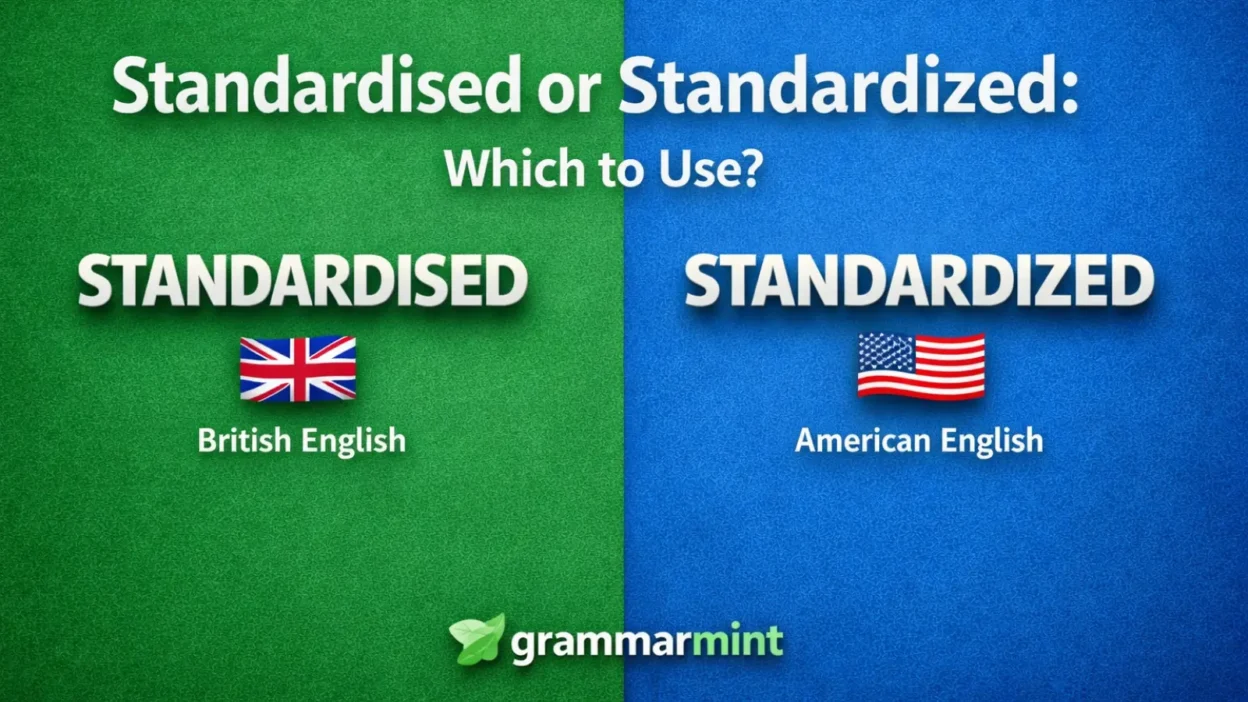
For a USA audience, standardized is the better choice. Standardised is also correct, but it fits British English more naturally.
TL;DR
• Use standardized for US readers.
• Use standardised for UK-style writing.
• Both spellings mean the same thing.
• Don’t mix both in one document.
• Match related forms too.
• Audience decides the best spelling.
What The Word Means
The word has one core meaning in both spellings. It describes something made more consistent, uniform, or aligned with a shared rule.
• Consistent in form, process, or use
• Uniform across items or systems
• A standard form for repeatable work
• Used for tests, methods, and formats
• Common in schools and workplaces
• Often appears in formal writing
• Helps show clear, fixed rules
• Suggests reduced variation or difference
• Fits technical and academic contexts
• Works as adjective or past verb
• Often signals organized procedures
• Usually sounds formal, not casual
Quick American Answer
For US English, one spelling feels more natural right away. That’s the version most American readers expect to see.
• American English strongly favors standardized
• It’s the usual US spelling choice
• It looks normal in US editing
• It fits American school materials
• It suits workplace documents well
• It reads naturally in US media
• It matches common US dictionaries
• It avoids a foreign-looking variant
• It helps keep tone locally familiar
• It’s safer for US client copy
• It supports a preferred form fast
• It’s the best default in America
British English Preference
UK-style writing usually leans the other way. That’s why this spelling can look more natural in British settings.
• British English often prefers standardised
• It follows the -ise spelling pattern
• It looks normal to UK readers
• It suits British academic writing
• It fits UK education materials
• It appears in Commonwealth contexts
• It may show up in reports
• It feels regionally consistent there
• It can match UK house style
• It helps local tone feel natural
• It reflects familiar regional usage
• It’s fine outside the US
Why Both Spellings Exist
This pair belongs to a larger spelling pattern in English. The meaning stays the same, but region and style shape the ending.
• The split comes from -ize and -ise
• It’s mainly a spelling pattern issue
• Meaning does not change at all
• Pronunciation stays nearly the same
• Region guides the written choice
• Style tradition shapes expectations
• Editors follow audience over preference
• Dictionaries may list both forms
• Schools teach local spelling habits
• Brands often pick one version
• Publishing style affects consistency
• It’s variation, not a mistake
Which One Should You Use
The best choice is usually simple once you know who will read the piece. Start with the audience, then stay consistent.
• Choose by reader expectation first
• Follow your house style always
• Keep strong consistency throughout
• Pick standardized for US readers
• Pick standardised for UK readers
• Match your client’s location
• Check existing site language first
• Review brand guidelines if available
• Use one spelling per document
• Align headings and body copy
• Match image text and captions
• Let audience outrank personal habit
Verb Form And Word Family
The comparison gets easier when you look at the base verb. Once you choose one pattern, keep the family matched.
• Standardize is the US verb
• Standardise is the UK variant
• Keep the verb form aligned
• Don’t pair standardise with standardization
• Don’t pair standardize with standardisation
• Match the ending across forms
• Check verbs in headings too
• Review forms in subheads
• Watch editable templates closely
• Fix copied text from mixed sources
• Keep grammar clean and matched
• One family choice reads better
Related Forms You Should Match
This spelling pair affects more than one word. So, once you choose a version, update the whole family.
• Standardization fits US style
• Standardisation fits UK style
• Keep the word family consistent
• Match noun, verb, adjective forms
• Check section titles carefully
• Review table labels and notes
• Fix forms in figure captions
• Keep templates internally aligned
• Watch software-generated text closely
• Update search snippets if needed
• Don’t leave mixed variants behind
• Final polish matters here most
Academic And Research Writing
Formal writing makes spelling differences more visible. That’s why academic work should follow the style of the school, journal, or audience.
• Use journal style before preference
• Follow the target research paper rules
• UK papers may use questionnaire with standardised
• US papers usually prefer standardized
• Match abstract and body text
• Check tables and appendices
• Align references if required
• Review survey wording carefully
• Keep methods section consistent
• Follow department style guidance
• Don’t switch mid-draft accidentally
• Final submission should look unified
Business And Technical Writing
Professional documents need clear, stable language. In these settings, consistency often matters as much as the spelling itself.
• Standardized suits US processes
• It fits technical documentation well
• It works in a fixed format
• Good for manuals and policies
• Good for SOP language
• Good for product comparison pages
• Strong in QA documents
• Useful in engineering workflows
• Natural in software instructions
• Clear in compliance writing
• Helpful in operations updates
• Best when teams share templates
Common Phrases And Collocations
Some phrases appear so often that readers expect one version right away. These common pairings make the regional choice easier.
• Standardized tests is common in US writing
• Standardized format sounds natural in America
• Standardized procedure fits business writing
• Standardized method is widely used
• Standardized process appears often
• Standardized training sounds formal
• Standardized language can feel technical
• Standardized reporting is common
• Standardized template works in operations
• Standardized system fits product teams
• Standardised questionnaire fits UK contexts
• Standardised method suits British style
Examples In Real Sentences
It helps to see the choice in real writing. These examples show how the spelling changes by audience, not by meaning.
• Our team standardized the reporting format.
• The school uses standardized testing rules.
• We need a standardized onboarding checklist.
• Please use standardized labels in charts.
• The UK draft used standardised terminology.
• Their paper described a standardised questionnaire.
• Keep all website forms standardized.
• The lab followed standardized procedures.
• This report needs standardized headings.
• Her editor changed it to standardised.
• The email used standardized project terms.
• The manual now reads in standardized language.
Common Mistakes To Avoid
Most problems here come from editing habits, not meaning. A few quick checks can prevent messy mixed-style copy.
• Avoid mixed spelling in one article
• Don’t skip final copyediting checks
• Use proofreading to catch leftovers
• Don’t mix noun families either
• Don’t trust pasted text blindly
• Watch reused templates closely
• Check headings, tables, and notes
• Review image text too
• Fix internal links if named
• Don’t follow personal habit only
• Match the client’s region
• Consistency beats guesswork every time
American Vs British Style At A Glance
This comparison is mostly about audience fit. The words mean the same thing, but each spelling feels more natural in a different setting.
• US audience expects standardized
• UK audience often prefers standardised
• Global audience needs one chosen style
• Meaning stays exactly the same
• Tone remains formal in both
• Reader familiarity changes most
• Editing standards vary by market
• Brand voice should stay steady
• Geography shapes first impressions
• Search behavior may reflect region
• Style guides settle most debates
• Consistency still matters most
How To Choose For Global Content
Global writing needs a practical decision, not a perfect one. Pick a style that serves the brand and keeps the reading experience smooth.
• Think about international readers first
• Protect your brand voice throughout
• Use a shared style sheet
• Choose one spelling sitewide
• Match landing pages and blogs
• Align app text too
• Update older articles gradually
• Keep download files consistent
• Brief freelancers on spelling rules
• Set defaults in templates
• Review mixed market campaigns carefully
• Prefer clarity over personal preference
Easy Memory Tricks
You don’t need a long rule every time. A simple cue can help you choose faster during editing.
• Remember: US usually wants -ized
• UK often leans toward -ised
• Edit faster by checking audience first
• Use a quick spelling cue list
• Pair US with standardize
• Pair UK with standardise
• Match the noun family too
• Search the full document once
• Add style notes to briefs
• Keep one example handy
• Build habit through repetition
• Let location guide the ending
Final Decision For Most USA Readers
If your audience is American, the choice is straightforward. Use the version that looks normal, polished, and regionally expected.
• Best choice for Americans is standardized
• It matches natural US usage
• It supports clean writing fast
• It looks right in US schools
• It fits business and technical work
• It works in editing tools
• It avoids UK-style distraction
• It’s safe for most US sites
• It reads smoothly to American eyes
• It keeps brand tone familiar
• It’s the easiest default choice
• Use standardised only for UK-style needs
FAQs
Is standardised or standardized correct?
Both are correct. The difference is regional spelling, not meaning.
Is standardized American or British?
Standardized is the usual American spelling. British writing more often uses standardised.
Is standardised used in the US?
It can appear in the US, especially in imported, quoted, or mixed-origin material. Still, it usually looks less natural for American readers.
What is the difference between standardise and standardize?
There’s no meaning difference. The change is only the spelling pattern, with US English favoring -ize and UK-style usage often favoring -ise.
Which spelling should I use in American English?
Use standardized. That choice fits US dictionaries, US readers, and most American editing expectations.
Are both spellings accepted in English?
Yes, both are accepted English spellings. The better choice depends on region, audience, and document consistency.
Should I switch spellings in the same document?
No. Pick one style and keep it across the full piece, including related forms like standardize and standardization.
Conclusion
For a USA audience, standardized is usually the right pick.
If your readers are British or your style guide says so, standardised also works.
Choose for your audience, then keep that choice consistent from start to finish.