If you write captions, emails, homework, or everyday posts, this is one grammar mix-up worth fixing. Laying or lying sounds simple, yet the confusion shows up because lay, lie, laid, lain, direct object, and present participle all overlap in ways that feel unfair at first. You’ll see the problem in sentences about a bed, a couch, the floor, a blanket, or a quick nap. Still, the rule is cleaner than it looks. Once you know whether the verb needs an object, most choices become easy, even in tricky tense forms.
Quick Answer
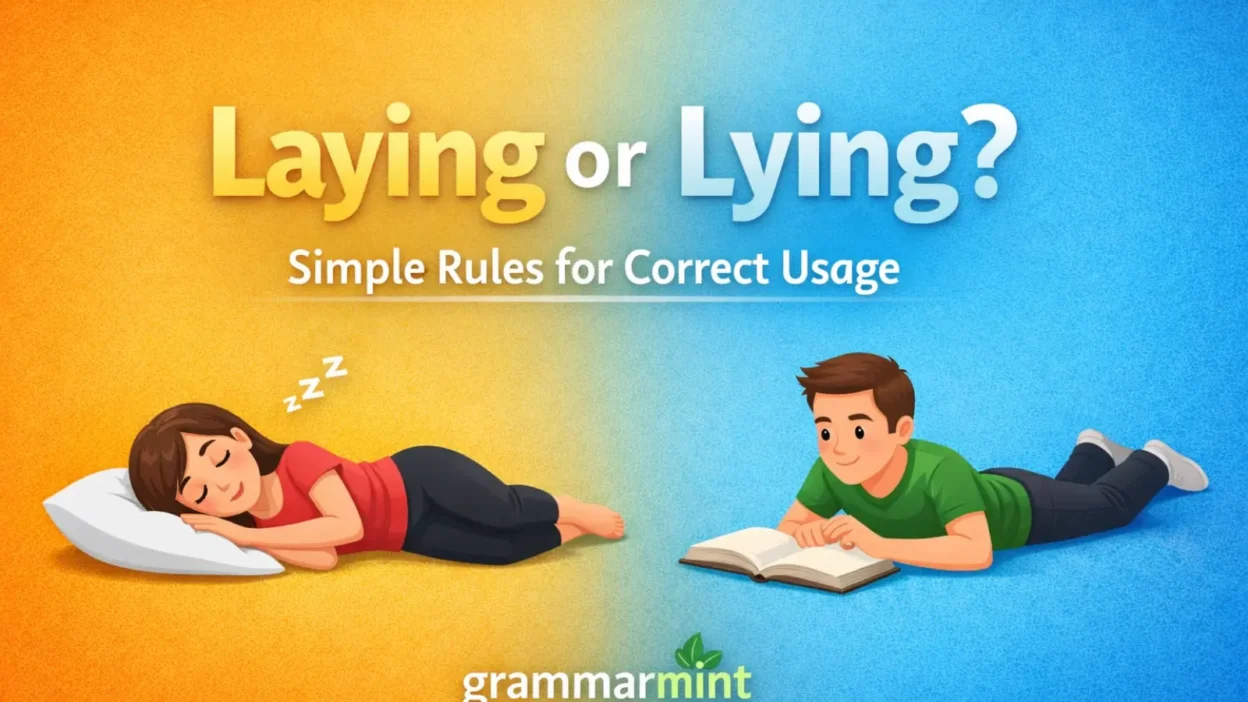
Laying or lying depends on one thing: are you placing something, or are you resting yourself? Use lying when someone is reclining and no object follows; use laying when someone is putting something down.
TL;DR
• No object? Use lie or lying.
• Object present? Use lay or laying.
• You lie down for rest.
• You lay a book down.
• Past of lie is lay.
• Past of lay is laid.
The One Rule That Solves It
The simplest fix is this: lay usually means “put something down,” while lie means “rest in a flat position.” Because of that, lay takes a direct object, and lie does not.
So, when you feel stuck, ask one short question: “Lay what?” If you can name the thing receiving the action, choose lay; if you cannot, choose lie.
• No object means use lie.
• A thing follows? Use lay.
• People lie down to rest.
• You lay a phone down.
• Dogs lie by the door.
• You lay keys on the desk.
• Babies lie in cribs.
• Parents lay babies down gently.
• Towels lie on the sand.
• You lay towels on chairs.
• He lies still after yoga.
• She lays the notebook flat.
When You Need Laying Vs Lying
Use lying for an action in progress when the subject is resting, reclining, or already flat. Use laying when the subject is actively placing something somewhere.
That means “She is lying on the couch” is standard, while “She is laying the blanket on the couch” is also standard because blanket is the object.
• He is lying on the rug.
• She is laying the rug down.
• They’re lying under the stars.
• We’re laying cards on the table.
• The cat is lying by the fire.
• Dad is laying logs near the grate.
• I’m lying here, not moving.
• I’m laying the folder aside.
• The book is lying open.
• She’s laying the book flat.
• We kept lying in silence.
• They kept laying tools outside.
Lying Down Or Laying Down
In standard English, a person is usually lying down, not laying down, unless that person is putting something else down. Current grammar guides keep this distinction clear.
This is one of the most searched phrase-level questions because everyday speech often blurs it. In careful writing, though, “I’m lying down” is the safer choice.
• I’m lying down for a minute.
• She’s lying down after lunch.
• He was lying down backstage.
• The toddler is lying down now.
• We were lying down on towels.
• Are you lying down already?
• Stop laying down excuses.
• Start laying down the tiles.
• She’s laying down the rules.
• He kept laying down markers.
• They’re laying down fresh sod.
• I’m not laying down myself.
Lay Down Or Lie Down
With the base form, standard usage prefers lie down when a person reclines. Use lay down when someone puts an object down, or in other meanings like “establish a rule.”
That’s why “Please lie down” works, while “Please lay down your bag” also works. The missing piece is still the object.
• Please lie down and rest.
• Go lie down if dizzy.
• I need to lie down soon.
• Let the baby lie down first.
• Don’t lie down there.
• Sometimes I just lie down outside.
• Lay down your coat here.
• Lay down the cards carefully.
• Lay down the groceries gently.
• Lay down that heavy box.
• She will lay down fresh sheets.
• They may lay down ground cover.
Lie In Bed Or Lay In Bed
In the present tense, standard English says lie in bed, not lay in bed, when you mean rest or remain in bed. Several current learner resources make this exact point plainly.
The form lay in bed can be correct only in the past tense, as in “Yesterday, I lay in bed until ten.” That tense overlap is the trap.
• I like to lie in bed late.
• She wants to lie in bed longer.
• They never lie in bed on weekdays.
• Do you lie in bed reading?
• He’ll lie in bed all morning.
• We sometimes lie in bed talking.
• Yesterday, I lay in bed sick.
• Last Sunday, she lay in bed late.
• After finals, they lay in bed half a day.
• He lay in bed listening quietly.
• The dog lay in bed beside me.
• I lay in bed during the storm.
Lying In Bed Or Laying In Bed
If the action is happening now, the standard phrase is lying in bed. That is because the verb is lie, and its present participle is lying, not laying, when no object follows.
So, for a caption or text, “Still lying in bed 😴” is standard. “Still laying in bed” is common in casual speech, but it is not the careful written choice.
• I’m lying in bed right now.
• She was lying in bed awake.
• He’s still lying in bed.
• We were lying in bed laughing.
• The child is lying in bed calmly.
• They’re lying in bed watching TV.
• She is laying the blanket on bed.
• He is laying clothes on the bed.
• Mom is laying pillows in place.
• I’m laying my phone beside me.
• We’re laying snacks on the tray.
• They were laying fresh sheets down.
On The Couch, Sofa, Or Floor
Place phrases don’t change the rule. A person is lying on the couch, lying on the sofa, or lying on the floor because the person is resting, not placing an object.
Meanwhile, laying works when the subject puts something onto that couch, sofa, or floor. The location changes, but the grammar test stays the same.
• She was lying on the couch.
• He is lying on the sofa.
• The dog was lying on the floor.
• I’m lying on the mat.
• They were lying near the pool.
• The towel is lying on the chair.
• She’s laying the coat on the couch.
• He’s laying books on the sofa.
• They’re laying mats on the floor.
• I’m laying cushions on the bench.
• We kept laying towels by the pool.
• Dad is laying wood on the ground.
The Past Tense Trap: Lie Becomes Lay
Here is the part that causes most mistakes: the past tense of lie meaning “recline” is lay. That means “Yesterday, I lay on the couch” is correct.
Writers often reach for laid or lied by mistake, but those belong to different verbs. Lied is only for falsehood, not for reclining.
• Yesterday, I lay on the grass.
• She lay awake for hours.
• He lay down after dinner.
• The cat lay by the window.
• We lay on beach towels.
• They lay on the gym floor.
• Not: I lied on the couch.
• Not: She layed on the bed.
• Better: He lay there silently.
• Better: The book lay unopened.
• Better: The jacket lay on the chair.
• Better: They lay under a tree.
The Past Tense Of Lay Is Laid
The verb lay keeps its object even in the past tense, and that past tense is laid. So you laid the book down, laid the blanket out, or laid the baby in the crib.
A useful check is to ask, “Laid what?” If you can answer that question, laid is probably right.
• I laid the keys on the shelf.
• She laid the baby down gently.
• He laid the file on my desk.
• We laid towels on the chairs.
• They laid mulch around the tree.
• Mom laid dinner plates out.
• Ask: laid what?
• Object present means laid fits.
• No object means stop and check.
• Laid never means “reclined” here.
• Laid still shows an action done.
• Laid works well with clear objects.
Lain Vs Laid
The past participle of lie meaning “recline” is lain, while the past participle of lay is laid. Current guides also note that lain is correct but less common in everyday speech.
That’s why “I have lain here all afternoon” is correct but a bit formal, while “I have laid the blanket out” is ordinary and clear.
• I have lain here long enough.
• She had lain awake all night.
• The cat had lain by the fire.
• We have lain in the sun before.
• He had lain still for minutes.
• They’ve lain low since noon.
• I have laid the papers out.
• She had laid the table already.
• We’ve laid fresh towels down.
• He had laid the plan aside.
• They’ve laid cards faceup.
• Mom has laid dinner out.
Why It’s Lying, Not Lieing
The standard -ing form is lying, not lieing. Current grammar references flag this exact spelling trap because writers often expect the base form to stay unchanged.
So, whether you mean “reclining” or “telling an untruth,” the present participle is still lying. Context tells you which meaning is intended.
• Correct: lying on the couch.
• Correct: lying to your friend.
• Wrong: lieing in bed.
• Wrong: lieing again.
• Trust the y in lying.
• Keep the spelling short and clean.
• Use lying for both meanings.
• Let context show the difference.
• The sentence decides the meaning.
• The spelling does not change.
• Captions need lying, too.
• Quick edit: search for lieing.
Lie Means Rest — And Lie Means Falsehood
English uses lie for two different verbs: one means “recline,” and the other means “say something false.” The forms split in the past tense, which is why context matters so much.
For the falsehood sense, the past tense is lied. For the reclining sense, the past tense is lay.
• She is lying on the rug.
• She is lying about her age.
• Yesterday, she lay on the rug.
• Yesterday, she lied about it.
• He lies in bed late.
• He lies when cornered.
• They were lying still outside.
• They were lying to everyone.
• I’ve lain there before.
• I’ve lied before, sadly.
• One meaning is physical rest.
• The other meaning is false speech.
Direct Object Check
The fastest editing trick is to look for the receiver of the action. If the verb acts on a thing, person, or object, lay-forms usually belong there.
Ask “what?” or “whom?” right after the verb. If the sentence answers cleanly, you probably need lay, laying, laid, or have laid.
• Lay what? The blanket.
• Laid what? The phone.
• Laying what? The cards.
• No answer? Use lie instead.
• “She is lying” needs no object.
• “She is laying towels” does.
• “He lay down” has none.
• “He laid it down” has one.
• “The book lay there” stands alone.
• “She laid the book there” does not.
• Objects make the choice easier.
• This test fixes most errors.
Common Mistakes And Fast Fixes
Most mistakes happen in short everyday lines, especially with down, bed, couch, and past-tense sentences. The fix is usually small once you know what the verb is doing.
Use these fast corrections as clean patterns for your own writing. They’re especially handy in posts, messages, and rushed drafts.
• Mistake: I’m laying in bed. Fix: I’m lying in bed.
• Mistake: He was laying down. Fix: He was lying down.
• Mistake: Yesterday I lied down. Fix: Yesterday I lay down.
• Mistake: She layed the book there. Fix: She laid the book there.
• Mistake: We have laid here all day. Fix: We have lain here all day.
• Mistake: Please lay down. Fix: Please lie down.
• Mistake: The dog is laying outside. Fix: The dog is lying outside.
• Mistake: I lay the keys there. Fix: I laid the keys there.
• Mistake: They were laying on towels. Fix: They were lying on towels.
• Mistake: She has lain the bag down. Fix: She has laid the bag down.
• Mistake: He likes laying by the pool. Fix: He likes lying by the pool.
• Mistake: The baby laid asleep. Fix: The baby lay asleep.
Casual Speech Vs Standard Writing
In casual speech, many people say lay down or laying in bed when careful written English would prefer lie down or lying in bed. Some dictionaries note this real-life usage, but style-focused writing still treats the distinction as standard.
So, for texts with friends, you may hear both. For school, work, publishing, and polished captions, it is smarter to keep the standard forms.
• Casual speech often relaxes the rule.
• Standard writing usually keeps it strict.
• Texts may tolerate laying in bed.
• Essays should prefer lying in bed.
• Dialogue can reflect natural speech.
• Formal prose should stay consistent.
• Editing mode needs the standard choice.
• Spoken habits are not always grammar rules.
• Your audience matters a lot here.
• Work writing rewards cleaner choices.
• Captions can still be polished.
• Safe writing beats risky shortcuts.
Better Rewrites When You Want Zero Risk
Sometimes the fastest fix is not choosing between lay and lie at all. If you want clean, natural writing, a simple rewrite can remove the trap completely.
This works well in emails, polished posts, school work, and brand copy. It also keeps the sentence sounding smooth instead of overcorrected.
• Use resting instead of lying.
• Use reclining for a formal tone.
• Use stretched out in casual copy.
• Use settled on the couch.
• Use put down instead of laid.
• Use placed instead of laid.
• Use set down for clarity.
• Use went to bed when simpler.
• Use was on the floor.
• Use left the book there.
• Use set the blanket out.
• Use took a quick rest.
FAQs
Is it laying or lying in bed?
The standard phrase is lying in bed because lie means to recline, and it does not take an object. Laying in bed is common in casual speech, but it is not the careful written form.
Do you say lay down or lie down?
In standard English, you lie down when you recline. You lay down something else, such as a bag, a book, or a rule.
What is the past tense of lie?
If lie means “recline,” the past tense is lay. If lie means “say something false,” the past tense is lied.
What is the past tense of lay?
The past tense of lay is laid. Because lay takes an object, laid usually appears with something being placed somewhere.
Why is it lying, not lieing?
The standard present participle is lying. Current grammar references specifically warn against lieing, which is a common misspelling.
Is “I’m going to lay down” ever acceptable?
You will hear it often in informal speech, and some dictionary notes acknowledge that real usage. Still, in standard edited writing, I’m going to lie down is the safer choice.
Conclusion
If laying or lying still trips you up, go back to one question: is something being placed, or is someone simply resting?
Once you check for an object, the right choice gets much easier.