English speakers sometimes wonder whether to write Abley or Ably when describing how something is done.
Because both forms look like they could be right, especially if you think of the adjective able, it’s easy to pause and question your choice.
This matters in emails, essays, reports, and schoolwork: choosing the wrong form can make a sentence look unpolished or incorrect.
In this article, you’ll get a quick, clear answer; learn why one spelling is standard and the other isn’t; and see real American English examples.
You’ll also find common mistakes and how to fix them so your writing sounds confident and professional.
Quick Answer
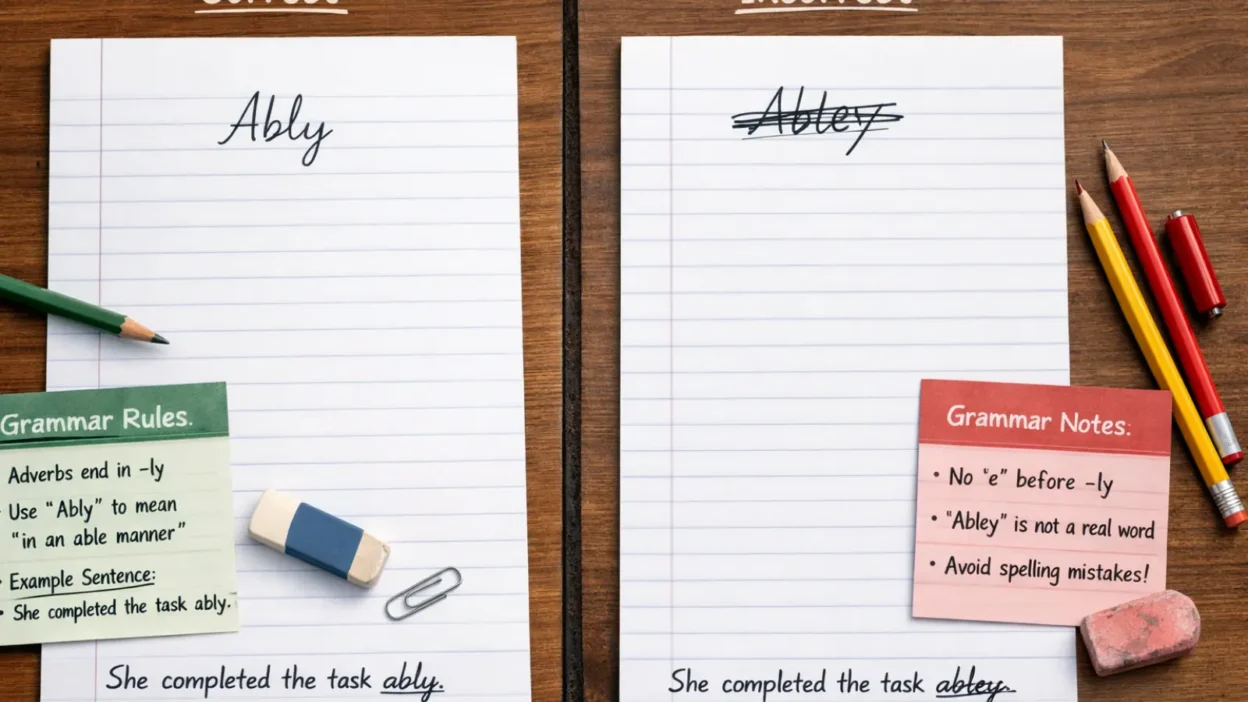
Use Ably. Ably is the correct adverb meaning “in a skillful or competent way.” Abley is not a standard English adverb and is generally a spelling error unless it’s part of a name.
Key Differences at a Glance
• Ably — correct adverb, follows English spelling rules
• Abley — not a valid adverb spelling; appears only as a proper noun (e.g., surname)
Why AblyIs the Right Choice
Most adverbs in English are formed by adding -ly to an adjective. With able, the final e drops before adding ly, giving you ably. This pattern is standard in both U.S. and U.K. usage. Multiple major dictionaries list ably as an adverb meaning “with skill, competency, or capability.”
Abley does appear in English — but only as a surname, not as a grammar form.
American vs British English
There’s no regional split here. Both American and British dictionaries agree: ably is the adverb form; abley is not used as a word. The difference seen in other spelling pairs (like color/colour) doesn’t apply to this pair.
Common Mistakes (and Quick Fixes)
• Mistake: She abley managed the task.
Fix: She ably managed the task.
• Mistake: He performed his job abley.
Fix: He performed his job ably.
• Mistake: They were abley guided through the process.
Fix: They were ably guided through the process.
• Mistake: Use abley in formal writing.
Fix: Use ably in formal writing; abley is incorrect.
• Mistake: Spelling ably as abally or abbly.
Fix: Only ably is correct for the adverb form.
• Mistake: Trusting spellcheck without checking context.
Fix: If spellcheck suggests ably, confirm meaning before accepting.
Everyday Examples
Quick message:
• You ably handled that presentation yesterday.
Email to a coworker:
• Thanks for ably addressing the client’s concerns last week.
Workplace report:
• The team ably completed the project ahead of schedule.
Professional rewrite:
• Original: He abley led the workshop.
Revised: He ably led the workshop.
Handy Spelling Tip
When forming adverbs from adjectives ending in -e, drop the e before adding -ly (big → bigly, nice → nicely, kind → kindly). Ably follows this common English pattern.
Comparison Table
| Context | Best Choice | Why |
| Standard English writing | Ably | Recognized adverb meaning skillfully |
| Professional/academic writing | Ably | Correct form in dictionaries |
| Texting or casual writing | Ably | Always spelled ably, even informally |
| Names and surnames | Abley | Valid as a proper noun only |
FAQs
Is abley ever correct?
In everyday English grammar, no. Abley is not an accepted adverb. It only appears as a surname.
Why do people write abley?
Because it looks like able + ly, but that’s not how this adverb is formed.
Is ably formal or informal?
Ably works in both formal and informal contexts.
Does pronunciation differ?
No. Both American and British pronunciations of ably are similar and widely accepted.
Can ably appear in dictionaries?
Yes. Major dictionaries list ably as a valid adverb.
Mini Quiz
- Which is the correct adverb: ably or abley?
Answer: Ably - Does abley work in a formal essay?
Answer: No - Form the adverb from able.
Answer: Ably
Conclusion
When deciding between Abley and Ably, choose Ably as the correct adverb meaning “in a competent or skilled way.”
Abley belongs to proper names, not grammar rules. Knowing this small detail helps your writing stay clear, confident, and correct.