You may see mid in texts, comments, reviews, videos, and everyday speech. You may also see it in words like mid-June, midair, or midterm.
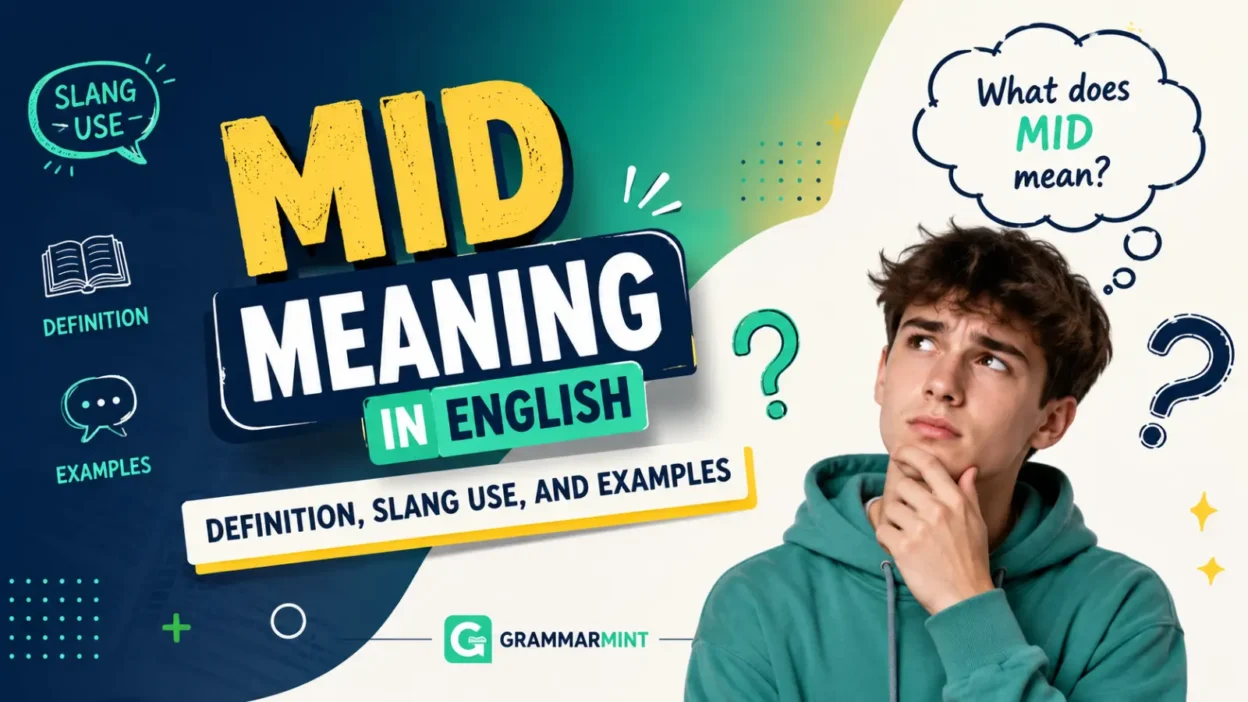
The word matters because it has more than one meaning. In standard English, mid means “middle.” In slang, it often means “average,” “not impressive,” or “disappointing.”
This guide explains mid in plain English. You will learn its definition, slang use, pronunciation, grammar role, examples, mistakes, and best contexts.
Quick Answer
Mid meaning is “middle” in standard English. In slang, mid means average, unimpressive, or not as good as expected.
Example: “That movie was mid” means the movie was just okay.
TL;DR
• Mid can mean “middle.”
• Slang mid means “average.”
• It can sound mildly negative.
• Use it in casual speech.
• Avoid it in formal writing.
What Mid Means in Plain English
Mid means something sits in the middle. It can describe time, place, level, quality, or position.
In casual slang, mid does not mean truly terrible. It means something feels ordinary, weak, or not worth the hype.
Examples:
• “We met in mid-March.”
• “The food was mid.”
• “That song is mid, but the chorus is catchy.”
The first example uses standard English. The second and third examples use slang.
Mid Meaning in Standard English
In standard English, mid means “in the middle of” or “near the middle.” It often appears before time words, places, or body parts.
Common examples include:
• mid-July
• midafternoon
• midair
• mid-level
• mid-size
You can say, “The meeting is in mid-April.” That means the meeting is around the middle of April.
In this meaning, mid is neutral. It does not show praise or criticism.
Mid Meaning in Slang
In slang, mid means average, mediocre, or not impressive. People use it when something feels less exciting than expected.
It often appears in quick opinions about entertainment, food, fashion, sports, or music.
Examples:
• “The new album is mid.”
• “That pizza was mid.”
• “Everyone loved the show, but I thought it was mid.”
This use can sound dismissive. It often means “not terrible, but not special.”
Pronunciation and Part of Speech
Mid is pronounced /mɪd/. It rhymes with kid, lid, and did.
Mid can work in a few ways. Its role depends on the sentence.
| Use | Role | Example |
|---|---|---|
| mid-June | prefix | We travel in mid-June. |
| mid level | adjective | She joined a mid-level class. |
| That game was mid. | adjective slang | The game was average. |
| mid the noise | preposition | This use sounds old-fashioned. |
Most modern readers see mid as a prefix or adjective. The preposition use sounds literary or old-fashioned.
How to Use Mid in Real Sentences
Use mid before a time, place, or level when you mean “middle.” Use it after a noun when you give a slang opinion.
Standard examples:
• “The flowers bloom in mid-May.”
• “He works in a mid-level role.”
• “The plane stopped in midair.”
Slang examples:
• “That burger was mid.”
• “Her outfit was not bad, just mid.”
• “The trailer looked great, but the movie was mid.”
A safe pattern is simple: “That was mid.” It means “That was just okay.”
Common Contexts and Best Choices
Mid changes tone based on where you use it. In casual speech, it can sound funny or honest.
In school or work writing, choose clearer words. Words like average, moderate, or unimpressive sound more precise.
| Context | Best Choice | Why |
| Texting a friend | mid | Casual and quick |
| School essay | average | Clear and formal |
| Work report | moderate | More professional |
| Product review | unimpressive | More specific |
Use mid when your audience knows slang. Use clearer words when meaning matters more.
When Not to Use Mid
Avoid mid when you need a respectful or formal tone. It can sound rude when aimed at a person.
Weak: “Your presentation was mid.”
Better: “Your presentation had clear points, but it needed stronger examples.”
Also avoid mid when the reader may not know slang. In that case, average or mediocre will be clearer.
Synonyms, Antonyms, and Related Terms
For the standard meaning, close synonyms include middle, central, halfway, and intermediate.
For the slang meaning, close synonyms include average, mediocre, okay, meh, and unimpressive.
Useful antonyms include excellent, amazing, outstanding, impressive, and top-tier.
Related terms:
• middle: the central part or point
• mediocre: not very good
• meh: not exciting
• average: ordinary or typical
Do not use all synonyms the same way. Mediocre sounds more formal and more negative than mid.
Common Mistakes With Mid
One common mistake is thinking mid always means bad. It usually means average or disappointing, not awful.
Mistake: “Mid means terrible.”
Correction: “Mid means ordinary, average, or not impressive.”
Another mistake is using mid in formal writing.
Mistake: “The results were mid.”
Correction: “The results were average.”
A third mistake is confusing mid and middle. Mid often works before another word. Middle often works as a noun or adjective.
Example: “She sat in the middle.”
Example: “We met in mid-June.”
Mini Quiz
- What does mid mean in “mid-August”?
A. Very late
B. Around the middle
C. Very bad
D. Very early
- What does “The concert was mid” mean?
A. It was perfect
B. It was canceled
C. It was just okay
D. It was in the middle
- Which sentence uses slang mid?
A. We met in mid-July.
B. The class starts midweek.
C. That sandwich was mid.
D. He stood in the middle.
- Which word is more formal than mid?
A. Average
B. Bruh
C. Kinda
D. Nope
Answer Key:
- B
- C
- C
- A
FAQs
What does mid mean?
Mid means “middle” in standard English, but it can also mean “average” in modern slang. The correct meaning depends on the sentence. If someone says “mid-June,” they mean around the middle of June. If someone says “That movie was mid,” they mean the movie was not very exciting or special. In casual speech, mid often describes something that feels ordinary, weak, or less impressive than expected. It usually does not mean something is completely terrible.
What does mid mean in slang?
In slang, mid means average, mediocre, unimpressive, or just okay. People often use it when something gets attention but does not meet expectations. For example, if a new song goes viral and someone says, “It’s mid,” they mean the song is not as good as people claim. The word is common in texts, comments, reviews, and social media posts. It can sound casual, funny, or dismissive, depending on the tone.
Does mid mean bad?
Mid does not always mean bad. It usually means something is ordinary, average, or disappointing. A mid movie may still have good scenes. A mid meal may still be edible. The word often sits between “good” and “bad.” However, people may still feel insulted if you call their work, outfit, or idea mid. That is because the word suggests the thing failed to impress you.
What does mid mean in text?
In text, mid usually means “not impressive” or “just okay.” People use it as a quick opinion. For example, “That show was mid” means the show was not amazing. It may also mean the person expected something better. In texting, mid is informal and direct. It works best with friends or people who understand slang. In formal messages, use clearer words like average, ordinary, or unimpressive.
Is mid an insult?
Mid can be an insult, especially when you use it to describe a person. Saying “That actor is mid” or “Your outfit is mid” can sound rude. Even when you only mean “average,” the word can feel dismissive. It is safer to use mid for things like movies, songs, food, games, or products. If you want to give respectful feedback, use specific comments instead. For example, say, “The idea is good, but it needs more detail.”
How do you use mid in a sentence?
You can use mid in two main ways. In standard English, use it before a time, place, or level. For example, “We moved in mid-April” means around the middle of April. In slang, use it after the thing you judge. For example, “The burger was mid” means the burger was average. The slang pattern is simple: subject + was + mid. It works in casual speech, but not in formal writing.
Is mid formal or informal?
The standard meaning of mid can appear in normal writing, especially in words like midterm, midair, and mid-July. The slang meaning is informal. You should avoid slang mid in school essays, work emails, reports, and professional reviews. Instead, use words like average, moderate, ordinary, or unimpressive. For example, write “The results were average,” not “The results were mid.” This keeps your writing clear and professional.
What is the difference between mid and middle?
Mid and middle are related, but they do not always work the same way. Mid often appears before another word, such as mid-June, mid-level, or mid-size. Middle can work as a noun or adjective. For example, “She sat in the middle” sounds natural. “She sat in the mid” does not sound natural in everyday English. Use middle when you mean the central point by itself. Use mid when it joins another word or phrase.
Can mid mean average?
Yes, mid can mean average in slang. When someone says something is mid, they usually mean it is not great, not terrible, and not memorable. It may also mean the thing was overhyped. For example, “The trailer looked amazing, but the movie was mid” means the movie did not match the excitement. This slang use is common in quick opinions about music, food, movies, games, fashion, and sports.
When should you not use mid?
Do not use mid when your reader may not understand slang. Also avoid it in formal writing, serious feedback, or polite criticism. The word can sound too casual or harsh. For example, “Your project was mid” may hurt someone’s feelings. A better sentence is, “Your project had a clear idea, but it needed stronger examples.” Use mid when talking casually with friends. Use more exact words when clarity and respect matter.
Conclusion
Mid meaning depends on context. It can mean “middle,” or it can mean “average” in slang.
Use mid in casual speech when the meaning is clear. For school or work, choose a more exact word.