You may see sus in texts, memes, games, comments, and casual posts. It is short, informal, and easy to use. Still, it can confuse learners because it does not look like a full word.
Sus usually points to something suspicious. A person, story, excuse, or situation can seem sus. That means it feels off, doubtful, or hard to trust.
This guide explains the sus meaning in plain English. You will learn how to pronounce it, how to use it, and when to avoid it. You will also see examples, related terms, common mistakes, and simple answers to common questions.
Quick Answer
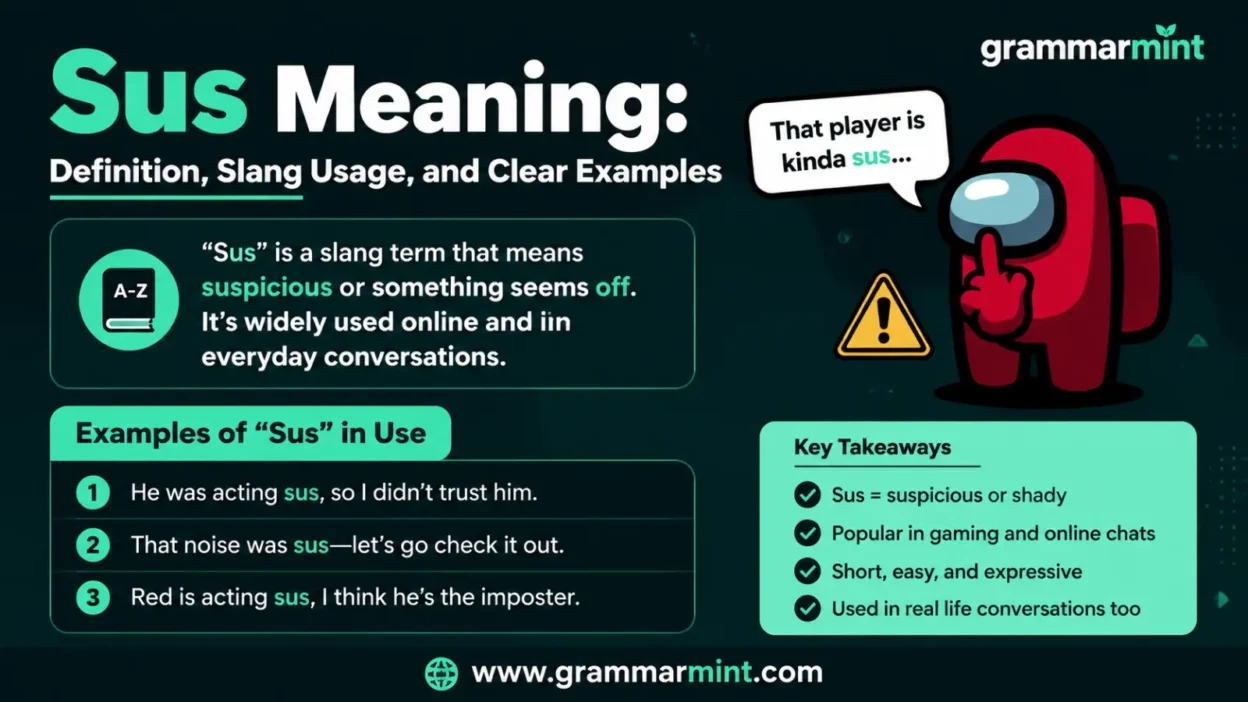
Sus meaning is “suspicious” or “suspect.” It is casual slang for someone or something that seems shady, doubtful, or not fully trustworthy.
TL;DR
• Sus means suspicious or suspect.
• It is casual slang.
• It often appears in texts.
• It can describe people or situations.
• Do not use it in formal writing.
• Pronounce it like “suhs.”
What Does Sus Mean?
Sus means suspicious, suspect, or questionable. Use it when something feels wrong, strange, or untrustworthy.
It does not always mean someone is guilty. It only means something gives you a reason to doubt it.
Examples:
• “That excuse sounds sus.”
• “He was acting sus after the meeting.”
• “This link looks sus. Do not click it.”
• “Her story changed twice, which felt sus.”
In simple English, sus means “I do not fully trust this.”
Sus Meaning in Slang
In slang, sus is a casual way to say suspicious. It is common in texting, memes, gaming, and everyday speech.
People often use it with friends. It can sound playful, joking, or mildly accusing.
Examples:
• “Why did you hide your screen? That’s sus.”
• “You skipped the group chat all day. Sus.”
• “That random email asking for money is sus.”
Sus works best in relaxed settings. It is not a strong legal claim. It is more like saying, “Something feels off.”
How to Pronounce Sus
Sus is pronounced “suhs.” It rhymes with “bus.”
It has one short syllable. Do not pronounce it like “soos” or “suss-ee.”
Simple guide:
• sus = suhs
• rhymes with: bus, fuss
• sounds like: “That seems suhs.”
The spelling is short, but the sound is simple. Say it quickly and casually.
What Part of Speech Is Sus?
Sus is most often an adjective in modern American slang. It describes a person, action, excuse, link, place, or situation.
Examples:
• “That guy is sus.”
• “The message looks sus.”
• “Her answer was sus.”
In some British uses, sus can also relate to suspicion or a suspect. You may also see suss or suss out as a verb.
For most US learners, remember this first: sus usually works like an adjective.
How to Use Sus in a Sentence
Put sus after a noun or after words like “seems,” “looks,” “sounds,” or “feels.” This makes your sentence sound natural.
Common patterns:
• “That seems sus.”
• “This looks sus.”
• “He is acting sus.”
• “The story sounds sus.”
• “Something feels sus here.”
You can also use it alone as a quick reaction.
Example:
Friend: “He deleted the message right away.”
You: “Sus.”
That one-word reply means the action seems suspicious.
Common Contexts for Sus
Sus appears most often in casual digital speech. You may see it in comments, chats, captions, and games.
It is also common when people joke about strange behavior.
Useful contexts:
| Context | Best Choice | Why |
|---|---|---|
| Texting a friend | sus | Casual and quick |
| School essay | suspicious | More formal |
| Work report | questionable | More professional |
| Gaming chat | sus | Fits the setting |
| Serious accusation | suspicious | Clearer and safer |
Sus can sound funny in light situations. It can sound careless in serious ones.
When Not to Use Sus
Avoid sus in formal writing. It is too casual for essays, reports, applications, and business emails.
Also avoid it when the topic is serious. A real accusation needs careful language.
Better choices:
• Instead of “His behavior is sus,” write “His behavior seems suspicious.”
• Instead of “This data is sus,” write “This data seems questionable.”
• Instead of “That employee is sus,” write “There are concerns about this behavior.”
These two expressions look similar, but they serve completely different purposes.
The word sus is used when something feels suspicious or untrustworthy. It signals doubt or a sense that something might not be right.
On the other hand, suss out means to figure something out or understand a situation after thinking or investigating.
For example:
• “That deal is sus.” (It feels shady or doubtful.)
• “I need to suss out what happened.” (I need to investigate or understand it.)
One expresses suspicion, while the other shows discovery. Because of this difference, they are not interchangeable even though they sound related. Suss out means to figure out, discover, or understand something.
Examples:
• “That email looks sus.”
• “I need to suss out what happened.”
• “He seems sus.”
• “She sussed out the answer.”
Sus describes doubt. Suss out describes understanding.
This difference matters because the meanings move in opposite directions. One shows suspicion. The other shows discovery.
Synonyms and Antonyms of Sus
Sus has close synonyms, but the best choice depends on tone.
Close synonyms:
• suspicious — clear and standard
• suspect — doubtful or questionable
• shady — casual and negative
• fishy — casual and slightly playful
• questionable — neutral and useful
• doubtful — softer and less slangy
Possible antonyms:
• trustworthy — easy to trust
• reliable — dependable
• honest — truthful
• aboveboard — open and proper
Do not use every synonym the same way. “Shady” can sound stronger than sus. “Questionable” sounds more careful.
Common Mistakes with Sus
One common mistake is using sus in formal writing. It is better for casual speech.
Mistake: “The company policy is sus.”
Better: “The company policy seems questionable.”
Another mistake is treating sus as proof. Sus means something seems suspicious, not that it is proven.
Mistake: “He is sus, so he did it.”
Better: “He seems sus, but we need proof.”
Some learners also confuse sus with suss out.
Mistake: “I sus the problem.”
Better: “I sussed out the problem.”
Mini Quiz
Choose the best answer.
- What does sus usually mean?
A. Happy
B. Suspicious
C. Expensive - Which sentence is natural?
A. “That link looks sus.”
B. “That link beautifully sus.”
C. “That link susly.” - Which word is more formal than sus?
A. Suspicious
B. LOL
C. Bruh - What does suss out mean?
A. To hide something
B. To figure something out
C. To accuse someone
Answer key:
- B
- A
- A
- B
FAQs
What does sus mean in text?
Sus means suspicious or suspect in text. Someone may use it when a message, excuse, link, or action feels doubtful.
Example: “That offer looks sus” means the offer may not be safe or honest.
Is sus a bad word?
Sus is not a swear word. It is casual slang.
Still, it can feel rude if you aim it at someone seriously. Use it carefully when trust matters.
What does sus mean in slang?
In slang, sus means shady, suspicious, or hard to trust. It often describes behavior that feels strange.
It can be serious, but friends also use it as a joke.
What does sus mean in Among Us?
In Among Us, sus describes a player who seems like the hidden imposter. Players use it when someone acts suspicious during the game.
The game helped make the word much more common online.
Is sus short for suspicious or suspect?
Yes. Sus is commonly short for suspicious or suspect.
In most modern use, it means “seems suspicious.”
Can I use sus in school writing?
Do not use sus in formal school writing. Use suspicious, questionable, or doubtful instead.
You can use sus in dialogue if a character would speak that way.
What is an example of sus?
A simple example is, “His story sounds sus.” That means his story seems doubtful or hard to trust.
Another example is, “This website looks sus.” That means the site may not be safe.
Conclusion
Sus meaning is simple: suspicious, suspect, or not fully trustworthy.
Use it in casual texts, jokes, games, and friendly talk. Choose suspicious or questionable when your writing needs a serious tone.