Complement vs compliment is a common word-choice problem because the words look alike and sound alike. The spelling changes by only one letter, but the meaning changes completely.
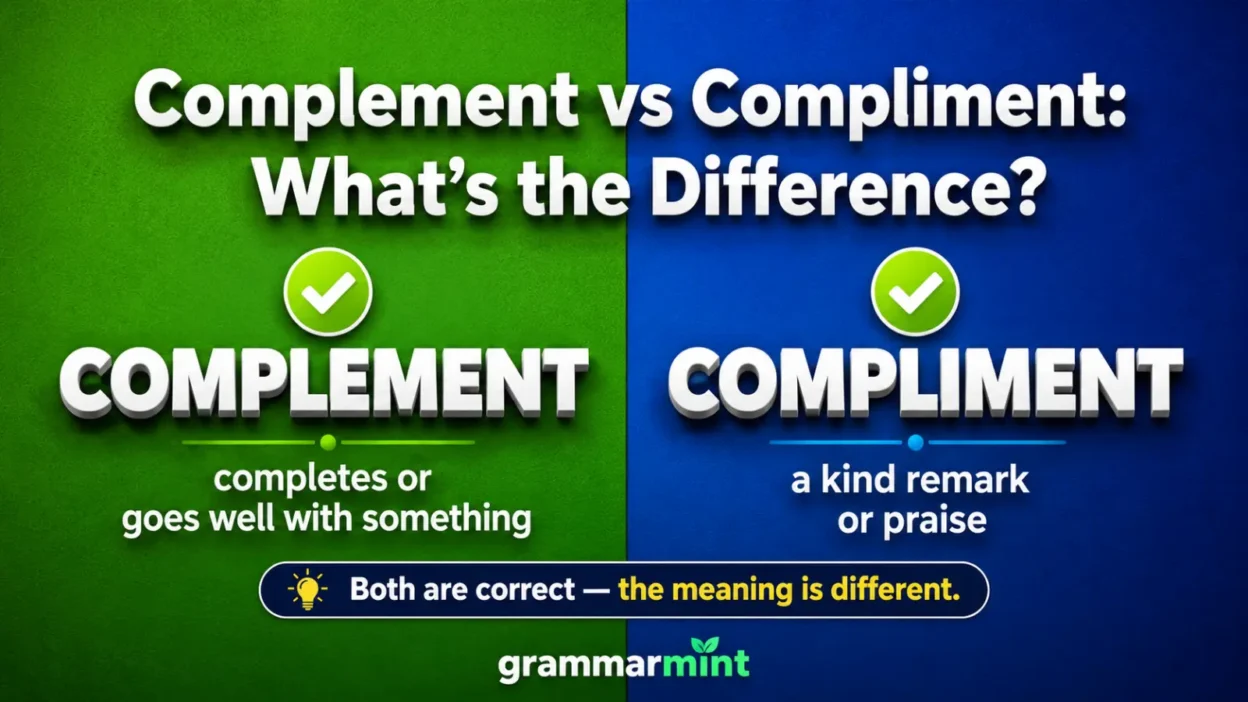
Use complement when something completes, improves, balances, or goes well with something else. Use compliment when someone gives praise or says something nice.
That is the main difference. A sauce can complement a meal. A coworker can give you a compliment.
Quick Answer
Complement means “to complete or enhance.”
Compliment means “praise” or “to praise.”
So, if you mean a good match, use complement.
Example:
The blue tie complements his gray suit.
If you mean a kind remark, use compliment.
Example:
She gave him a compliment on his presentation.
The words are pronounced the same in everyday American English: KOM-pluh-ment. Because they sound alike, the spelling has to come from the meaning.
Why People Confuse Them
People confuse complement and compliment for three main reasons.
First, they are homophones. That means they sound the same but have different spellings and meanings.
Second, both words often appear in positive situations. A color can complement a room, and a friend can compliment the room. Both sound nice, but they do different jobs.
Third, both can be used as nouns and verbs. That can make the choice feel harder than it really is.
The easiest check is this: Are you talking about a match or praise? A match takes complement. Praise takes compliment.
Key Differences At A Glance
| Feature | Complement | Compliment |
|---|---|---|
| Main meaning | Completes, improves, or goes well with something | Praise or a kind remark |
| Common use | Design, food, outfits, skills, grammar | Social praise, feedback, thanks, admiration |
| As a verb | One thing complements another | Someone compliments someone |
| As a noun | A thing that completes or improves another thing | A statement of praise |
| Memory cue | Complement has e, like complete | Compliment has i, like “I admire it” |
Both words are standard. The issue is not which word is “more correct.” The issue is which word fits your meaning.
Meaning and Usage Difference
Complement is about completion, fit, balance, or improvement.
Use it when one thing makes another thing better or more complete.
Examples:
The salad complements the pasta.
Her calm style complements his energy.
The new chairs complement the office design.
Compliment is about praise, approval, or admiration.
Use it when someone says something kind or respectful.
Examples:
He complimented her writing.
I got a compliment from my manager.
That was a thoughtful compliment.
There is also a grammar meaning of complement. In grammar, a complement is a word or phrase that completes the meaning of part of a sentence. For example, in “She became a doctor,” a doctor is a complement. This meaning is real, but it is not the everyday meaning most people need when choosing between these two words.
Tone, Context, and Formality
Both words work in casual, school, and professional writing. Neither one is slang.
Complement often sounds practical or descriptive. You may see it in writing about clothing, food, design, teams, products, and skills.
Examples:
The app’s clean layout complements the brand.
Their skills complement each other.
Compliment sounds social. It often appears when people talk about praise, feedback, manners, respect, or appreciation.
Examples:
Please accept my compliment.
The client complimented the team’s work.
In formal writing, be extra careful with compliment and complement because spellcheck may not catch the mistake. Both words are spelled correctly, but only one may fit the sentence.
Which One Should You Use?
| Context | Best Choice | Why |
|---|---|---|
| Someone says your report was clear | Compliment | It is praise |
| A red scarf looks good with a black coat | Complement | It completes or improves the outfit |
| Two coworkers have skills that work well together | Complement | The skills balance each other |
| Your boss praises your presentation | Compliment | A person is giving approval |
| A side dish goes well with dinner | Complement | The side dish improves the meal |
| Someone says your home looks beautiful | Compliment | It is a kind remark |
| A font matches a logo | Complement | The two design parts work well together |
| You thank someone for their kind words | Compliment | You are talking about praise |
Ask yourself one quick question:
Is this about praise or fit?
If it is praise, choose compliment.
If it is fit, choose complement.
When One Choice Sounds Wrong
Use compliment when a person gives praise.
Wrong:
She complemented me on my work.
Correct:
She complimented me on my work.
The sentence is about praise, not completion.
Use complement when one thing goes well with another.
Wrong:
The curtains compliment the wall color.
Correct:
The curtains complement the wall color.
The curtains are not praising the wall color. They match it or improve the room’s look.
Here is another common trap:
Wrong:
The new hire is a great compliment to the team.
Correct:
The new hire is a great complement to the team.
A person can give a compliment, but in this sentence the new hire completes or strengthens the team.
Common Mistakes (and Quick Fixes)
One common mistake is using compliment for clothes, colors, food, or design.
Wrong:
The shoes compliment the dress.
Correct:
The shoes complement the dress.
The shoes are a good match.
Another common mistake is using complement for kind words.
Wrong:
Thanks for the complement.
Correct:
Thanks for the compliment.
You are thanking someone for praise.
A third mistake is confusing complementary and complimentary. These are related, but they are not the main pair.
Complementary means things work well together.
Example: They have complementary skills.
Complimentary can mean praising or free.
Example: The hotel offered complimentary breakfast.
For the main words, keep the simple check: complement = complete or match; compliment = praise.
Everyday Examples
The lime complements the tacos.
Maya complimented Jordan on his new haircut.
The warm lighting complements the restaurant’s relaxed mood.
I appreciated the compliment, but I still wanted honest feedback.
His patience complements her quick decision-making.
The customer complimented the staff for being helpful.
A short jacket can complement high-waisted jeans.
That was not a compliment; it sounded more like sarcasm.
The music complements the scene without overpowering it.
My teacher gave me a compliment on my essay’s opening paragraph.
Confused by similar-looking words? Read our quick guide on capital or capitol to learn the difference.
Dictionary-Style Word Details
Verb
• Complement: To complete, enhance, balance, or go well with something.
Example: The garlic sauce complements the grilled chicken.
• Compliment: To praise someone or express admiration.
Example: Nina complimented the designer on the new logo.
Noun
• Complement: Something that completes or improves something else. It can also mean a full amount or, in grammar, a word or phrase that completes meaning.
Example: The fruit was a fresh complement to the dessert.
• Compliment: A statement, action, or expression of praise, admiration, or respect.
Example: His note included a kind compliment about her leadership.
Synonyms
• Complement: Closest plain alternatives include match, addition, partner, enhancement, and finishing touch. These are not always exact, so choose based on the sentence.
• Compliment: Common synonyms include praise, kind remark, admiration, approval, and commendation.
Helpful antonyms:
For compliment, a clear opposite is insult.
For complement, there is no single everyday opposite that fits every use. In some sentences, mismatch or clash may work.
Example Sentences
• Complement: The simple necklace complements the black dress.
• Complement: The new report complements the data from last quarter.
• Complement: In that sentence, the phrase after the verb is a complement.
• Compliment: I wanted to compliment you on your clear answer.
• Compliment: She smiled when she heard the compliment.
• Compliment: The coach complimented the team’s effort after the game.
Word History
• Complement: The word is tied to the idea of completion. That connection still helps explain its modern meaning.
• Compliment: The word developed into the sense of polite praise, respect, or admiration.
The history of these words is related, but modern usage keeps them separate. In current standard English, complement and compliment do not mean the same thing.
Phrases Containing
• Complement:
a perfect complement
a full complement
complement each other
subject complement
object complement
complementary skills
• Compliment:
pay a compliment
take it as a compliment
return the compliment
compliments to the chef
a backhanded compliment
complimentary remarks
Confused by similar-looking words? Learn the difference between <a href=”https://grammarmint.com/discrete-or-discreet/“>discrete and discreet</a>.
FAQs
Is it complement or compliment?
Use complement when something completes, improves, or goes well with something else.
Use compliment when someone gives praise or says something nice.
Example:
The red shoes complement the dress.
She gave me a kind compliment.
What is the main difference between complement and compliment?
The main difference is meaning.
Complement is about completion or fit.
Compliment is about praise or admiration.
A side dish can complement a meal. A guest can compliment the chef.
Are complement and compliment pronounced the same?
Yes. In everyday US English, complement and compliment are pronounced the same. That is one reason people mix them up in writing.
Can complement be a verb?
Yes. Complement can be a verb. It means to complete, enhance, or go well with something.
Example:
The new logo complements the brand colors.
Can compliment be a verb?
Yes. Compliment can also be a verb. It means to praise someone or say something nice.
Example:
My manager complimented me on the report.
Is “compliment your outfit” correct?
Yes, but only if you mean someone praised your outfit.
Example:
She complimented your outfit.
If you mean one part of the outfit goes well with another part, use complement.
Example:
The jacket complements your outfit.
Is “complementary” the same as “complimentary”?
No. Complementary means something works well with or completes something else. Complimentary often means praising, polite, or free.
Example:
The colors are complementary.
The hotel offers complimentary breakfast.
What does “my compliments” mean?
My compliments means praise, thanks, or polite good wishes.
Example:
Please give my compliments to the chef.
Do not use complements in this phrase.
What is a complement in grammar?
In grammar, a complement is a word or phrase that completes the meaning of part of a sentence.
Example:
She became a doctor.
Here, a doctor completes the meaning of became.
Other similar-sounding words can also cause confusion, such as <a href=”https://grammarmint.com/elude-or-allude/“>elude or allude</a>.
Conclusion
Use complement when you mean something completes, improves, balances, or goes well with something else.
Use compliment when you mean praise, admiration, or a kind remark.
The words sound the same, so the meaning has to guide the spelling. If it completes, it is complement. If it praises, it is compliment.