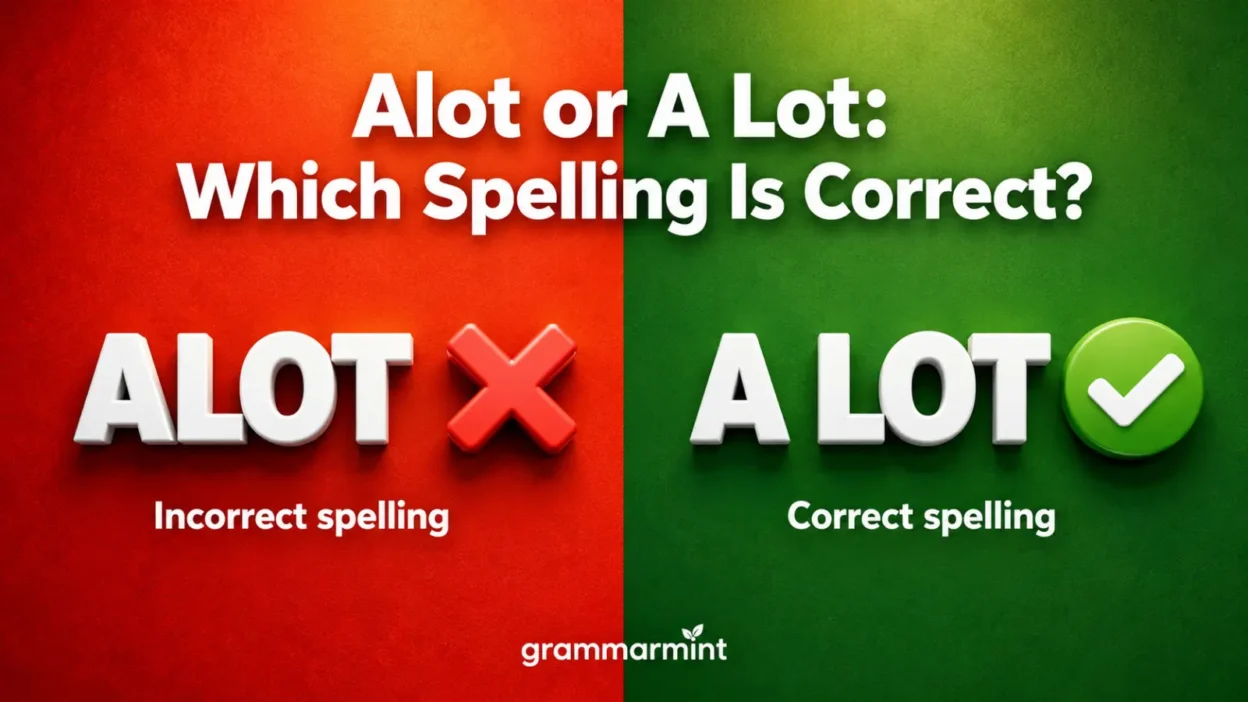
If you’ve ever paused while typing a message, this guide will help. Alot or A Lot is one of the most common spelling choices people question in English. The answer is simple, but the reason matters. You write “a lot” as two words when you mean many, much, a large amount, or often. Meanwhile, “alot” is not accepted in standard writing. Also, don’t confuse either form with “allot,” which means to assign or distribute something. So, whether you’re writing emails, essays, texts, captions, or work notes, this guide gives you easy rules and examples.
Quick Answer
Alot or a lot? Write a lot as two words. “Alot” is not correct in standard English, while “allot” means to assign something.
TL;DR
• “A lot” is the correct spelling.
• “Alot” is a spelling error.
• “Allot” means assign or distribute.
• Use “a lot” for many or much.
• Choose formal alternatives in serious writing.
• Check the space before publishing.
Alot Or A Lot
The correct spelling is “a lot.” It is always written as two words in standard English. That small space matters because “a” and “lot” are separate words.
• Use “a lot” when you mean many.
• Use “a lot” when you mean much.
• Keep a space after the letter “a.”
• Avoid “alot” in school writing.
• Avoid “alot” in professional emails.
• Write “thanks a lot,” not “thanks alot.”
• Write “a lot of,” not “alot of.”
• Treat “a lot” like “a little.”
• Remember that “lot” stays separate.
• Read the phrase slowly while editing.
• Check autocorrect before sending important messages.
• When unsure, choose “a lot.”
Is Alot A Word
“Alot” is a misspelling in normal English. It is not the real word you want when you mean many or much. Because it looks natural, this writing mistake spreads quickly.
• “Alot” should be changed to “a lot.”
• Spellcheck may catch it right away.
• Some apps may miss the error.
• Fast typing often creates this mistake.
• Speech can make it sound joined.
• The written form still needs space.
• Teachers usually mark “alot” wrong.
• Editors usually change “alot” immediately.
• Employers may notice the mistake too.
• Use “a lot” even in comments.
• Save “Alot” only for proper names.
• Lowercase “alot” is not standard.
A Lot Meaning
“A lot” means a large amount, many, or much. It can describe people, things, time, effort, feelings, or actions. Because it is flexible, people use it every day.
• “A lot of books” means many books.
• “A lot of water” means much water.
• “I laughed a lot” means often.
• “It helped a lot” means greatly.
• “A lot happened” means many things happened.
• “A lot changed” means much changed.
• “A lot of time” means much time.
• “A lot of friends” means many friends.
• “A lot of work” means much work.
• “A lot better” means much better.
• “A whole lot” adds extra emphasis.
• Context shows the exact meaning.
A Lot Vs Alot
The difference is simple. “A lot” is the two-word phrase you should use. “Alot” is the one-word form, and it is a common error.
• “A lot” is correct.
• “Alot” is incorrect.
• “A lot” has a clear space.
• “Alot” removes that needed space.
• “A lot” works in real sentences.
• “Alot” makes polished writing look careless.
• “A lot” can describe quantity.
• “A lot” can describe frequency.
• “Alot” should be fixed during editing.
• “A lot” sounds the same aloud.
• Writing decides the correct form.
• The safer answer is always “a lot.”
A Lot Vs Allot
“A lot” and allot sound similar, but they are different. “A lot” means many or much. “Allot” means to assign or distribute something.
• Use “a lot” for quantity.
• Use “allot” for giving shares.
• Teachers may allot time for tests.
• Managers may allot tasks to workers.
• Budgets may allot money to teams.
• Parents may allot chores at home.
• “A lot” is not a verb.
• “Allot” is always an action word.
• “Allotted” is the past-tense form.
• “Allotting” means assigning right now.
• Do not write “I allot tired.”
• Do write “I’m a lot tired.”
How To Use A Lot In A Sentence
You can use “a lot” in many sentence patterns. These sentence examples show how a lot of fits into daily writing. Notice that the spacing never changes.
• I have a lot of homework.
• She drinks a lot of coffee.
• We learned a lot today.
• They travel a lot in summer.
• He cares a lot about family.
• This class helped a lot.
• A lot of people waited outside.
• There was a lot of noise.
• I saved a lot of money.
• You improved a lot this month.
• The movie made us laugh a lot.
• A lot depends on timing.
A Lot Of Or Lots Of
“A lot of” and “lots of” are quantifiers. They both fit an informal style and can mean plenty. However, “lots of” usually sounds more casual.
• Use “a lot of” in everyday speech.
• Use “lots of” for a relaxed tone.
• Both can describe countable nouns.
• Both can describe uncountable nouns.
• “A lot of emails” sounds natural.
• “Lots of emails” sounds friendlier.
• “A lot of advice” sounds normal.
• “Lots of advice” sounds casual.
• Avoid “lots of” in serious papers.
• Choose “many” for countable formal nouns.
• Choose “much” for uncountable formal nouns.
• Match the phrase to your audience.
A Lot In Formal Writing
“A lot” is understandable, but it can sound casual. In formal writing, stronger choices often create precise wording. For academic writing, exact numbers are even better.
• Replace “a lot” with “many.”
• Replace “a lot” with “much.”
• Use “numerous” for countable things.
• Use “substantial” for large effects.
• Use “considerable” for measured impact.
• Use exact numbers when possible.
• Avoid vague wording in reports.
• Keep “a lot” for relaxed messages.
• Use “several” for smaller groups.
• Use “multiple” for clear variety.
• Use “frequently” instead of “a lot.”
• Choose tone based on purpose.
Synonyms For A Lot
Good synonyms make writing clearer. Some words mean numerous things, while others mean considerable size or degree. Pick the word that fits the noun.
• Use “many” for countable nouns.
• Use “much” for uncountable nouns.
• Use “plenty” for enough or more.
• Use “numerous” for formal countable groups.
• Use “substantial” for serious amounts.
• Use “significant” for important size.
• Use “considerable” for noticeable degree.
• Use “frequently” for repeated actions.
• Use “often” for everyday frequency.
• Use “greatly” for strong degree.
• Use “a great deal” for amount.
• Avoid fancy words that sound forced.
Common Mistakes With A Lot
The most common grammar mistake is the missing space. Therefore, it helps to proofread slowly. A small pause can save a sentence.
• Do not write “alot of fun.”
• Do write “a lot of fun.”
• Do not write “thanks alot.”
• Do write “thanks a lot.”
• Do not write “allot better.”
• Do write “a lot better.”
• Do not overuse the phrase.
• Do not use it for exact numbers.
• Do not mix it with “allot.”
• Do not trust every autocorrect suggestion.
• Do not copy mistakes from comments.
• Do a final spacing check.
Alot In Texting And Social Media
In texting, people often type quickly. On social media, speed can make “alot” appear often. Still, casual writing looks cleaner with “a lot.”
• Use “a lot” in captions.
• Use “a lot” in comments.
• Use “a lot” in direct messages.
• Fix “alot” before posting.
• Short posts still need clear spelling.
• Public profiles can shape impressions.
• Friends may understand the mistake.
• Readers may still notice it.
• Brands should avoid “alot” online.
• Students should avoid it in chats.
• Creators should proofread visible text.
• Clean writing feels more confident.
A Lot In American English
In American English, “a lot” is two words. The same spelling rule also applies in British English. So, this is not a regional spelling difference.
• Americans write “a lot.”
• British writers also write “a lot.”
• Canadian writers use the same spacing.
• Australian writers follow the same rule.
• “Alot” is not a US variant.
• “Alot” is not a UK variant.
• Regional spelling does not change it.
• School rules treat it consistently.
• Professional editors correct it everywhere.
• English learners can trust this rule.
• Travel does not change the spelling.
• The two-word form works worldwide.
A Lot As An Adverb
“A lot” can work like an adverb. It can mean often or very much, depending on the sentence. Usually, it comes after the action or description.
• She studies a lot.
• He smiles a lot lately.
• We talked a lot yesterday.
• They practice a lot together.
• I care a lot.
• This matters a lot.
• The weather improved a lot.
• Your answer helped a lot.
• Prices changed a lot recently.
• My dog barks a lot.
• The team improved a lot.
• Put it after the verb.
A Lot As A Pronoun
“A lot” can also work like a pronoun. Often, it appears as a noun phrase with the preposition “of.” Then it points to many things or much of something.
• A lot depends on your choice.
• A lot has changed since Monday.
• A lot of people agreed.
• A lot of milk spilled.
• A lot of ideas came up.
• A lot of time passed.
• A lot of noise followed.
• A lot of work remains.
• A lot of students improved.
• A lot of traffic appeared.
• Add “of” before a noun.
• Leave “of” out when no noun follows.
Examples Of A Lot And Allot
Good examples make the difference clear. “A lot” shows quantity or degree. Allotted shows something was assigned, giving each sentence a clear meaning.
• I have a lot of questions.
• The host allotted seats to guests.
• She reads a lot before bed.
• The coach allotted drills by group.
• We spent a lot of money.
• The board allotted funds carefully.
• He thinks about it a lot.
• The teacher allotted ten minutes.
• A lot of rain fell overnight.
• The planner allotted space for vendors.
• They laughed a lot at dinner.
• The city allotted land for parks.
Quick Practice For Alot Or A Lot
This practice section gives you a quick test. Choose the correct choice by checking the space and meaning. Then compare your instinct with the rule.
• I have a lot of notes.
• She likes you a lot.
• We need a lot more time.
• They brought a lot of snacks.
• He learned a lot from practice.
• This means a lot to me.
• A lot of birds flew south.
• The project changed a lot.
• We laughed a lot after dinner.
• A lot of cars filled the lot.
• The manager will allot shifts.
• The school allotted funds fairly.
FAQs
Is It A Lot Or Alot?
“A lot” is correct. “Alot” is a spelling error in standard English, so use the version with a space.
Is Alot A Real Word?
Lowercase “alot” is not the word you want in normal writing. Use “a lot” when you mean many, much, or often.
What Is The Difference Between A Lot And Alot?
“A lot” is the correct two-word phrase. “Alot” is the joined version, and it should be corrected.
What Is The Difference Between A Lot And Allot?
“A lot” means many, much, often, or very much. “Allot” means to assign or distribute something.
Can I Use A Lot In Formal Writing?
You can, but it may sound casual. In formal writing, use “many,” “much,” “numerous,” “substantial,” or exact numbers.
How Do You Use A Lot In A Sentence?
Use it to show amount, number, degree, or frequency. For example, “I learned a lot,” or “We have a lot of work.”
Conclusion
Now you know the simple rule for Alot or A Lot: always write “a lot” as two words. Use it for many, much, often, or very much, and save “allot” for assigning something. Before you publish, pause and check the space.