Many students, writers, teachers, and professionals confuse “roll call” and “role call” because the words sound identical. However, only one phrase is correct in standard American English. This guide explains the meaning, grammar, examples, history, and common mistakes behind roll call or role call using simple language and real-life situations.
You’ll also learn memory tricks, workplace examples, school usage, military traditions, and the difference between roll and role. By the end, you’ll never second-guess the phrase again.
Quick Answer
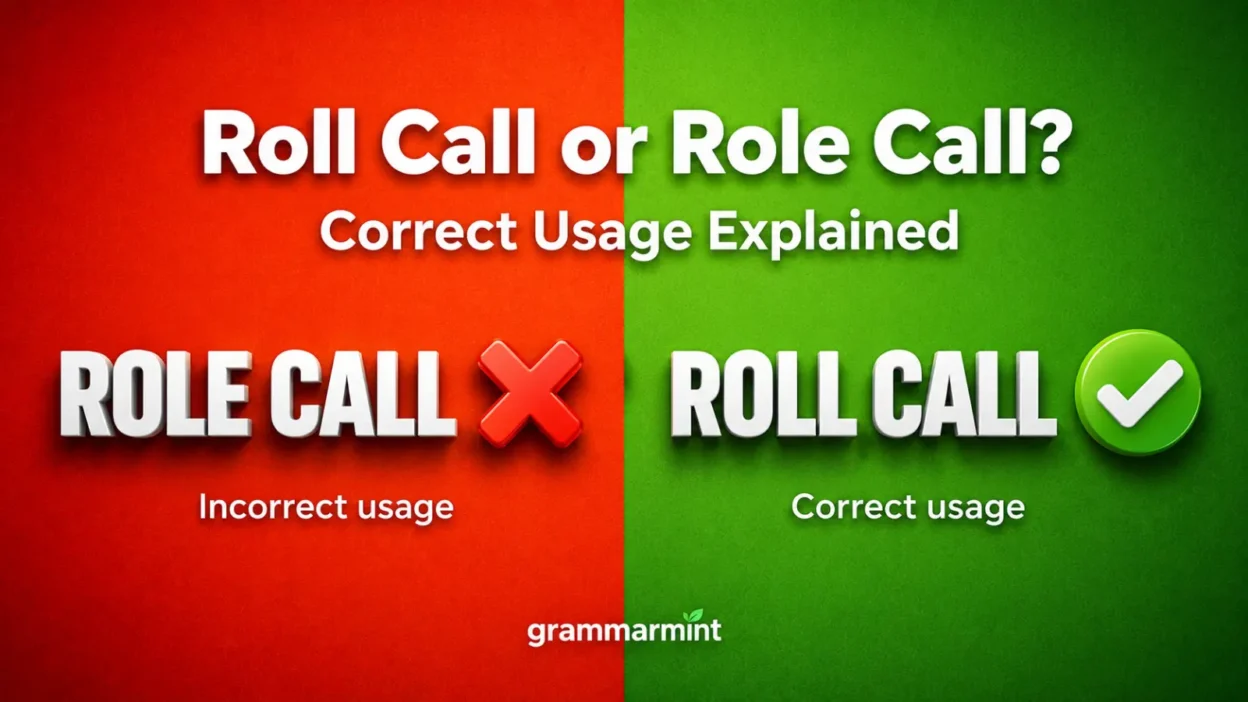
“Roll call” is the correct phrase for checking attendance by reading names from a list. “Role call” is usually incorrect because the word “role” refers to a duty, character, or job function rather than a roster of names.
TL;DR
• Roll call means checking attendance
• Role call is usually incorrect
• Roll refers to a list of names
• Role means a duty or character
• Schools and military use roll call daily
• Memory tricks make usage easier
Roll Call Vs Role Call
These phrases sound the same, so confusion happens often. However, their meanings are completely different. Understanding the difference helps your writing sound polished and clear.
Also, the correct phrase appears in schools, businesses, government meetings, and military settings across the United States.
• Attendance check confirms who is present
• Homophones sound alike but differ in meaning
• Grammar usage matters in formal writing
• Roll call tracks attendance from a list
• Role call creates confusion in communication
• Teachers regularly conduct morning roll call
• Businesses use roll call during meetings
• Military units rely on attendance checks
• Role refers to a duty or position
• Roll historically meant a written roster
• Correct wording improves professional credibility
• Native speakers confuse these phrases too
• Pronunciation makes the mistake common
• Roll call appears in dictionaries nationwide
Roll Call Meaning
The phrase “roll call” refers to reading names aloud to verify attendance. It’s commonly used in classrooms, meetings, and organized events.
Historically, a “roll” referred to a scroll or written list of names. That meaning still shapes the phrase today.
• Roster originally meant a written list
• Name list forms the basis of attendance
• Attendance checks happen in many settings
• Teachers call names every school morning
• Coaches verify players before games
• Conferences often begin with roll call
• Jury duty may include attendance verification
• Online meetings sometimes use verbal check-ins
• Legislatures conduct formal voting roll calls
• Emergency drills require accurate attendance
• Roll call improves accountability in groups
• Schools rely on daily attendance records
• Businesses track employee participation regularly
• Military officers confirm personnel presence
Role Call Meaning
“Role call” is not the correct phrase for attendance. The word “role” refers to a part someone plays, either professionally or theatrically.
Because “role” is common in everyday language, many people mistakenly use it instead of “roll.”
• Role definition relates to responsibilities or duties
• Job function differs from attendance tracking
• Character describes acting or theater parts
• Role can describe workplace responsibilities
• Actors memorize lines for their roles
• Managers assign roles during projects
• Role call rarely appears in dictionaries
• English learners often mix these words
• Role never means attendance verification
• The mistake spreads through casual writing
• Spellcheck tools sometimes miss the error
• Spoken English increases confusion frequently
• The phrase sounds correct to listeners
• Written grammar reveals the difference
Correct Spelling Of Roll Call
The correct spelling is always “roll call” when discussing attendance. That rule applies in schools, workplaces, military settings, and meetings.
Even though both words sound alike, only one fits the intended meaning.
• Correct phrase uses the word roll
• Common mistake swaps roll with role
• English usage follows historical definitions
• Roll means a list of names
• Role means a part or duty
• Attendance always uses roll call wording
• Teachers never conduct role call officially
• Formal documents prefer precise language
• Professional emails should avoid the error
• Grammar guides consistently support roll call
• Dictionaries define roll call clearly
• Editors frequently correct this mistake
• Students commonly confuse the spelling
• Careful proofreading prevents embarrassing errors
Roll Call Examples
Examples help make the difference easier to remember. You’ll notice that every attendance situation uses “roll call.”
Meanwhile, “role call” sounds awkward once you understand the meaning.
• Classroom examples often involve student attendance
• Meeting examples include workplace check-ins
• Daily speech sometimes shortens the phrase
• “The teacher started roll call early”
• “We completed roll call before training”
• “HR conducted a quick roll call”
• “The coach finished roll call quickly”
• “Congress began with a roll call vote”
• “The nurse checked attendance during roll call”
• “Everyone answered during morning roll call”
• “Roll call delayed the meeting briefly”
• “The officer performed evening roll call”
• “Volunteers responded during event roll call”
• “Attendance improved after daily roll call”
Difference Between Roll And Role
Although the words sound identical, their meanings differ completely. That’s why English learners often struggle with them.
Learning each definition separately makes future writing easier.
• Pronunciation remains identical in spoken English
• Word meaning changes completely between terms
• Homophone confusion affects native speakers too
• Roll can mean a written roster
• Roll also describes movement or turning
• Role refers to duties or functions
• Actors perform roles in productions
• Employees handle different workplace roles
• Rolls appear in attendance situations
• Roles appear in responsibility discussions
• Context determines the correct word choice
• Reading carefully improves grammar accuracy
• Word origins explain the distinction clearly
• Simple memory tricks help long-term recall
Is Role Call Wrong
In almost every attendance situation, “role call” is wrong. However, many people still type it accidentally.
The confusion mostly comes from pronunciation and automatic spelling assumptions.
• Grammar mistake appears frequently online
• Incorrect phrase causes writing confusion
• Writing errors reduce professional credibility
• Schools never officially use role call
• Corporate memos sometimes contain the error
• Social media spreads incorrect spellings rapidly
• Teachers usually correct this mistake immediately
• Grammar apps may miss contextual problems
• Reading aloud won’t reveal the error
• Writers should double-check homophones carefully
• Dictionaries reject role call for attendance
• Professional editors prefer accurate wording
• Role call sounds believable but remains incorrect
• Careful proofreading catches the mistake quickly
Roll Call In School
Schools use roll call daily to track attendance and student safety. Teachers usually perform it at the beginning of class.
Additionally, attendance records help schools monitor participation and absences.
• Teachers rely on accurate attendance records
• Students answer present during roll call
• Attendance sheet documents daily participation
• Morning attendance starts many classrooms
• Substitute teachers often use printed rosters
• Schools track tardiness through attendance systems
• Roll call improves classroom organization
• Emergency drills require updated attendance records
• Parents receive absence notifications regularly
• Digital systems now simplify roll call
• Teachers verify names before field trips
• Classroom management improves with consistent attendance
• Younger students learn routines through roll call
• Schools maintain legal attendance documentation
Military Roll Call
Military roll call has deep historical roots. Officers traditionally read names from a roster to confirm everyone’s presence.
Today, military units still use roll call during formations and accountability checks.
• Formation often begins with attendance verification
• Service members respond when names are called
• Morning check confirms personnel readiness
• Military traditions shaped modern roll call
• Officers track absences carefully each day
• Accountability remains essential in military operations
• Evening roll call verifies troop safety
• Training exercises require accurate attendance
• Barracks inspections may include roll call
• Discipline improves through structured routines
• Historical armies used scroll-style rosters
• Roll call supports communication within units
• Emergency situations require immediate accountability
• Military ceremonies sometimes include formal attendance
Roll Call Attendance
Attendance tracking matters in schools, workplaces, events, and emergency situations. Roll call remains one of the simplest methods.
Even digital systems still use traditional attendance language today.
• Presence check confirms who attended
• Headcount helps organize large groups
• Register records attendance information officially
• Teachers verify students before lessons begin
• Companies monitor attendance during conferences
• Events require accurate participation records
• Roll call supports safety procedures effectively
• Attendance records improve accountability overall
• Virtual meetings sometimes include verbal check-ins
• Coaches track athletes before competitions
• Emergency shelters conduct attendance checks frequently
• Camps rely on scheduled roll calls
• Group travel often requires attendance verification
• Attendance systems reduce organizational confusion
Roll Call Definition
The formal definition of roll call involves reading names aloud from a list to confirm attendance. Most dictionaries share nearly identical wording.
Still, everyday examples make the phrase easier to understand.
• Formal meaning centers on attendance verification
• List reading confirms participant presence clearly
• Verification helps maintain accurate records
• Roll call functions in organized settings
• Schools commonly use morning attendance routines
• Businesses may start meetings with attendance
• Governments hold roll call votes regularly
• Emergency teams conduct accountability checks quickly
• Roll call supports orderly communication systems
• Public institutions use attendance procedures daily
• Accurate records improve group management
• Historical usage dates back centuries
• Modern technology still uses traditional terminology
• Definitions remain consistent across dictionaries
Roll Call Synonyms
Several phrases share a similar meaning with roll call. However, “roll call” remains the most widely recognized term.
Different organizations may prefer slightly different wording.
• Roster check works in sports settings
• Attendance check sounds more modern today
• Headcount fits casual group situations
• Register review appears in schools occasionally
• Name check confirms group participation
• Attendance verification sounds more formal
• Sign-in process replaces verbal attendance sometimes
• Presence confirmation appears in workplaces
• Check-in procedures support event management
• Accountability check suits emergency situations
• Participant tracking helps conference organizers
• Team verification improves meeting accuracy
• Roll call remains the clearest phrase
• Synonyms depend on organizational context
Why People Confuse Roll And Role
People confuse these words because they sound exactly alike. English contains many homophones that create similar spelling issues.
Additionally, “role” appears frequently in workplace and entertainment conversations.
• Same pronunciation creates instant confusion
• English learners struggle with homophones often
• Spelling mix-up happens during fast typing
• Role appears often in modern workplaces
• Roll feels less familiar to writers
• Spellcheck tools may ignore context problems
• Spoken language hides spelling differences completely
• Social media increases grammar confusion sometimes
• People rely heavily on pronunciation patterns
• Reading habits affect spelling accuracy greatly
• Homophones challenge even experienced writers
• Visual memory improves long-term understanding
• Grammar lessons often highlight this confusion
• Practice helps writers remember the distinction
Roll Call In Meetings
Meetings often begin with roll call to confirm attendance and participation. This practice remains common in government, schools, and corporate settings.
Virtual meetings also use attendance checks frequently.
• Team meetings may start with attendance
• Zoom calls sometimes include verbal check-ins
• Corporate attendance helps track participation accurately
• Managers verify attendees before presentations begin
• Conferences require organized participant tracking
• Roll call prevents communication confusion later
• Online classes often begin with attendance
• Board meetings use formal attendance procedures
• Event organizers track speaker participation carefully
• Hybrid workplaces still use attendance systems
• Attendance records support meeting documentation
• Roll call ensures everyone receives updates
• Teams stay organized through attendance verification
• Accurate records improve workplace accountability
Role Vs Roll Grammar
Grammar rules become easier when you connect each word with its meaning. “Roll” links to lists and movement, while “role” connects to duties and characters.
That simple distinction solves most confusion immediately.
• Noun meanings shape proper word choice
• Language rules separate similar-sounding words clearly
• Word choice affects professional communication greatly
• Roll connects with attendance lists historically
• Role describes functions and responsibilities instead
• Grammar improves through repeated practice
• Reading examples strengthens language understanding
• Dictionaries clarify confusing homophones effectively
• Teachers often explain this distinction early
• Context clues reveal the correct spelling
• Writing carefully prevents embarrassing mistakes
• Proofreading catches many homophone errors
• English includes many confusing sound-alike words
• Learning roots improves vocabulary retention
Common Homophone Mistakes
“Roll” and “role” are just one example of confusing English homophones. Many similar pairs cause writing mistakes every day.
Fortunately, awareness and proofreading reduce most grammar problems.
• There vs their confuses many writers
• Your vs you’re appears incorrectly online
• Principal vs principle causes academic confusion
• Affect and effect create frequent mistakes
• To and too sound identical aloud
• Brake and break confuse beginning writers
• Its and it’s require careful punctuation
• Allowed and aloud share pronunciation patterns
• Then and than often get mixed
• Weather and whether confuse casual writers
• Homophones challenge both kids and adults
• Careful proofreading improves writing confidence greatly
• Reading regularly strengthens grammar awareness naturally
• Grammar habits improve through consistent practice
FAQs
The correct phrase is “roll call.” It means reading names from a list to check attendance. “Role call” is generally considered incorrect in standard English.
Roll call means calling names aloud to confirm who is present. Schools, military units, meetings, and government groups commonly use it.
People confuse the phrase because “roll” and “role” sound identical. Since “role” is a familiar word, many writers accidentally choose the wrong spelling.
In rare creative situations, someone could theoretically discuss “calling out roles.” However, that usage is unusual and unrelated to attendance.
“Roll” can mean a list or roster, while “role” means a duty, function, or character. Their pronunciation is the same, but their meanings differ completely.
Yes, roll call remains common in schools, military settings, meetings, conferences, and online classes. Many digital attendance systems still use the term.
Conclusion
Understanding roll call or role call becomes simple once you know the meanings behind each word. “Roll call” is the correct phrase for attendance, while “role call” is usually a spelling mistake caused by homophones.