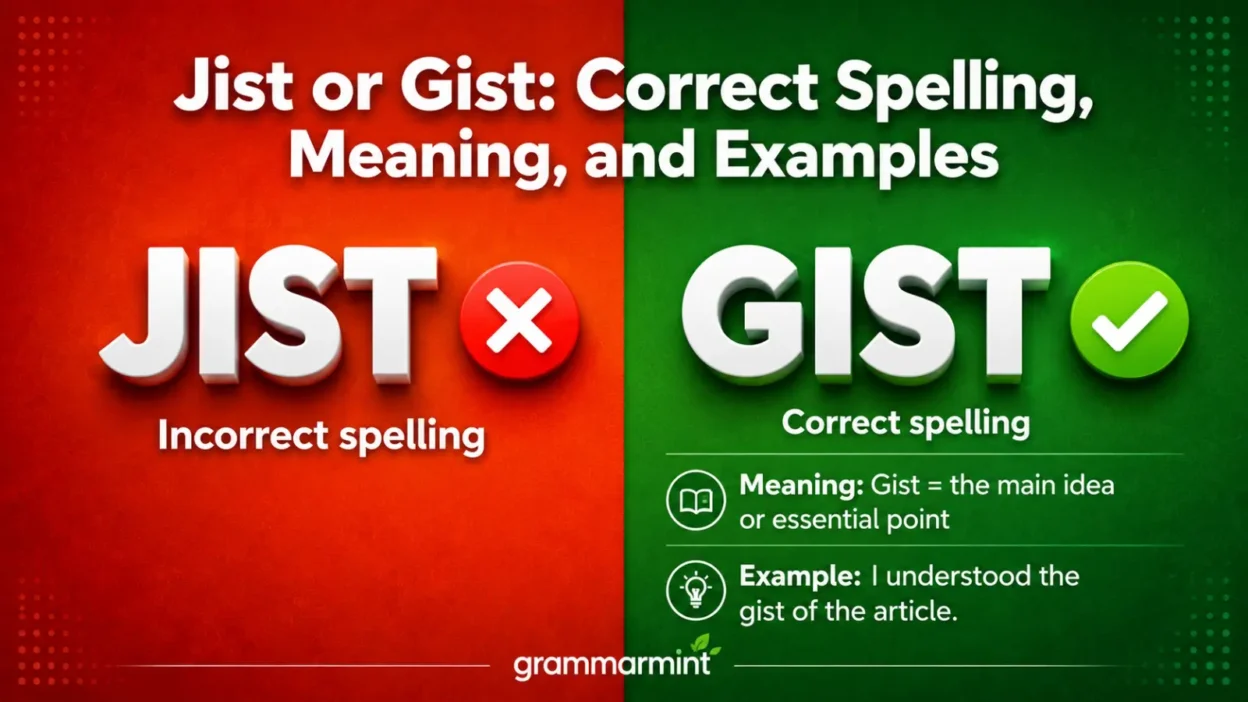
Jist or gist is easy: “gist” is the correct spelling. “Jist” is a common misspelling, while “gist” means the main point or essential meaning.
Quick Answer
If you’re writing an email, report, essay, caption, or meeting recap, one tiny letter can make you pause. Jist or Gist jist-or-gist is a common spelling question because the word sounds like it starts with “j.” However, the correct spelling is “gist,” and it means the main idea, essence, core meaning, key point, short version, or basic message. You’ll see it in schools, offices, news articles, books, and casual texts. So, whether you’re summarizing a conversation, explaining a story, or asking for the point of a long message, this guide will help you use the word with confidence.
TL;DR
• Use “gist” when you mean the main idea.
• Avoid “jist” in standard writing.
• “Gist” sounds like it starts with “j.”
• “Get the gist” means understand the point.
• “The gist of it” means the key message.
See More: Anticlockwise vs Counterclockwise: Key Usage Differences Explained
Jist Or Gist
The answer is simple, but the confusion is understandable. The correct spelling is “gist,” and it is the form used in standard English; “jist” is a common misspelling.
• Write “gist” in emails, essays, and reports.
• Avoid “jist” unless naming something specific.
• “Gist” means the main point.
• “Jist” usually comes from hearing the word.
• The first sound can trick your ear.
• The letter “g” makes a “j” sound here.
• Standard writing expects “gist,” not “jist.”
• Spellcheck may catch “jist” quickly.
• Some casual messages still use the wrong form.
• Formal work should always use “gist.”
• The phrase is “get the gist.”
• The safest rule is: choose “gist.”
Jist Meaning
Most people searching for “jist meaning” want to know if the word is valid. In regular English, “jist” is a spelling error, a nonstandard spelling, or a phonetic mistake.
• “Jist” does not mean “main idea.”
• It is usually a misspelled “gist.”
• It may appear in casual typing.
• It can look natural because of pronunciation.
• Still, it is not the right choice.
• Teachers usually mark “jist” as incorrect.
• Editors will normally change it to “gist.”
• Business writing should never use “jist.”
• Academic papers should avoid it completely.
• Text messages may include it by accident.
• Searchers often type it after hearing it.
• Replace every intended “jist” with “gist.”
Gist Meaning
“Gist” means the main idea, essential point, or core meaning of something. It helps you talk about the heart of a message without repeating every detail.
• The gist is the point that matters.
• It leaves out extra background details.
• It works for stories and speeches.
• It also fits reports and articles.
• You can ask for the gist politely.
• You can give the gist briefly.
• It often follows the word “the.”
• “The gist” sounds more natural than “a gist.”
• It points to meaning, not length.
• It can summarize a long conversation.
• It helps when time is limited.
• It keeps communication clear and quick.
Jist Vs Gist
The difference is not about meaning; it is about spelling. The right word choice is the accepted spelling, while the incorrect form only appears because the sound misleads people.
• “Gist” is correct in everyday English.
• “Jist” is incorrect in standard writing.
• Both may sound identical when spoken.
• Only one should appear in polished text.
• Use “gist” for the central message.
• Use “jist” only in special names.
• Do not treat them as synonyms.
• They are not two regional spellings.
• American English uses “gist.”
• British English also uses “gist.”
• The spelling stays the same worldwide.
• When unsure, remember “gist” begins with “g.”
Get The Gist Meaning
“To get the gist” means to understand the main point without knowing every detail. In other words, you catch the basic idea.
• “I got the gist” means “I understood.”
• It does not mean perfect understanding.
• It suggests enough meaning was clear.
• Use it after a long explanation.
• Use it after a fast conversation.
• It works well in casual speech.
• It can sound relaxed but clear.
• It may be too loose for contracts.
• It fits texts, chats, and recaps.
• It often softens a quick response.
• It shows you followed the message.
• It also admits some details were missed.
Gist Of Something Meaning
“The gist of something” means its general meaning, key information, or most important details. Therefore, it is useful when the full version is too long.
• The gist of a story is its point.
• The gist of a meeting is its outcome.
• The gist of an email is its request.
• The gist of a lesson is its takeaway.
• The gist of a speech is its message.
• The gist of a report is its finding.
• The gist of a movie is its plot.
• The gist of a debate is its issue.
• The gist of a policy is its effect.
• The gist of a complaint is its problem.
• The gist of a plan is its goal.
• The gist of a warning is its risk.
How To Spell Gist
The spelling rule is easy once you know the sound pattern. “Gist” starts with a soft g, which makes a j sound, but the spelling rule keeps the letter “g.”
• Spell it g-i-s-t.
• Do not start it with “j.”
• The first sound is not the clue.
• English often separates sound from spelling.
• Think of “giant” and “gentle.”
• Those words also start with soft “g.”
• “Gist” follows that same pattern.
• Say it once, then spell it slowly.
• The final three letters are “ist.”
• The word has only four letters.
• A memory trick is “general idea, short thought.”
• When editing, search for “jist.”
Is Jist A Word
For normal writing, “jist” is not the real word you want. A dictionary may list “JIST” as a proper noun or abbreviation in special cases, but that is different.
• “Jist” is wrong for “main idea.”
• “Gist” is the everyday English word.
• Some names may use “JIST.”
• Those names do not change the rule.
• A school or company may use initials.
• Music groups may also use unusual names.
• Still, your sentence likely needs “gist.”
• Context decides whether a name applies.
• Lowercase “jist” is usually a mistake.
• Uppercase “JIST” may be a title.
• Do not copy special names into grammar.
• For meaning, always choose “gist.”
Gist Synonyms
Sometimes another word may sound smoother than “gist.” Good options include essence, crux, and central idea, depending on tone.
• Use “main idea” for simple writing.
• Use “point” for casual conversation.
• Use “essence” for a polished tone.
• Use “crux” for the central issue.
• Use “core” for business messages.
• Use “takeaway” for lessons or meetings.
• Use “summary” when adding more detail.
• Use “meaning” for clear explanation.
• Use “heart” for emotional writing.
• Use “bottom line” for direct speech.
• Use “overview” for a broad look.
• Choose the word that fits your audience.
Gist Examples
Examples make the rule easier to remember. These show “gist” in meeting notes, an email summary, and a quick explanation.
• I got the gist of the meeting.
• Please send the gist by Friday.
• She explained the gist very clearly.
• The gist of the article was simple.
• He missed details but understood the gist.
• Here is the gist of our plan.
• The teacher asked for the gist.
• Can you share the gist quickly?
• The gist is that prices changed.
• I only need the gist today.
• Her reply captured the gist well.
• That sentence gives the gist perfectly.
Gist Pronunciation
“Gist” is pronounced with a starting sound like “j.” That pronunciation makes spoken English feel like a sound-alike trap.
• Say “gist” like “jist.”
• The spelling still starts with “g.”
• The vowel sounds short and crisp.
• It rhymes closely with “list.”
• It also rhymes with “mist.”
• The first sound matches “giant.”
• The ending sounds like “st.”
• Do not stretch it into two syllables.
• Most speakers say it quickly.
• Hearing it first causes spelling mistakes.
• Reading it often fixes the confusion.
• Pronunciation does not control correctness.
Gist In A Sentence
“Gist” is a noun, so it names an idea rather than an action. The usual sentence pattern gives clear context by pairing it with “of.”
• The gist of her message was clear.
• I understood the gist right away.
• Please give me the gist first.
• That paragraph contains the gist.
• We discussed the gist after lunch.
• His notes missed the gist completely.
• The gist of it sounded fair.
• She captured the gist in one line.
• I need the gist before dinner.
• The gist was easy to follow.
• Their update gave the gist quickly.
• This example shows the gist naturally.
Gist Vs Summary
“Gist” and summary are close, but they are not always equal. A gist is the short version, while an overview may include more structure.
• A gist is usually very brief.
• A summary can include several points.
• A gist focuses on the core message.
• A summary may follow the full order.
• A gist can fit one sentence.
• A summary may need a paragraph.
• A gist skips most supporting details.
• A summary may mention key evidence.
• A gist works well in conversation.
• A summary fits reports and assignments.
• Choose “gist” for quick meaning.
• Choose “summary” for fuller coverage.
Gist Origin
The history of “gist” is older than many people expect. It comes from Anglo-French legal language, where a legal phrase pointed to the foundation of a case.
• The word began in legal settings.
• It later moved into everyday speech.
• Its old sense involved legal grounds.
• Today, it usually means main point.
• The older meaning still appears sometimes.
• Most readers know the modern meaning.
• The legal history explains the word’s depth.
• It does not affect daily spelling.
• The modern use is simple and common.
• You do not need Latin to use it.
• The meaning became broader over time.
• Now it fits almost any explanation.
Gist In Formal Writing
“Gist” can work in professional writing, but tone matters. For academic writing or legal wording, more polished wording may sometimes be better.
• Use “gist” in clear business emails.
• Avoid it when exact details matter.
• Use “main finding” in research papers.
• Use “central claim” for essays.
• Use “key issue” in formal reports.
• Use “basis” for legal contexts.
• “Gist” sounds slightly conversational.
• It is still correct English.
• Match the word to the setting.
• Ask for the gist in quick updates.
• Provide details after the gist when needed.
• Revise “jist” before sending anything formal.
Common Mistakes With Gist
The most common problem is the common misspelling “jist.” However, a grammar mistake or usage error can also make a sentence feel awkward.
• Do not write “jist” for “gist.”
• Do not write “ijist” either.
• Avoid “a gist” in most sentences.
• “The gist” usually sounds better.
• Do not use “gist” as a verb.
• Say “summarize” when naming an action.
• Do not confuse gist with gossip.
• Avoid using it for tiny details.
• Do not overuse it in one paragraph.
• Check subject meaning before replacing synonyms.
• Keep the sentence short and direct.
• When editing, read the phrase aloud.
FAQs
Is it gist or jist?
The correct spelling is “gist.” Use it when you mean the main idea, main point, or essential meaning of something.
“Jist” is a common spelling mistake. It happens because “gist” sounds like it starts with “j.”
What does gist mean?
“Gist” means the main point or basic meaning. It leaves out extra details and focuses on what matters most.
For example, if you understand the point of a long meeting, you got the gist.
Is jist a word?
In regular English, “jist” is not the word you want. It is usually a misspelling of “gist.”
However, “JIST” can appear as a name or set of initials. That does not make lowercase “jist” correct for “main idea.”
What is the difference between gist and jist?
“Gist” is the correct word. “Jist” is the wrong spelling when you mean the main point.
They may sound the same, but only “gist” belongs in standard writing.
How do you spell gist correctly?
Spell it g-i-s-t. The first letter is “g,” even though the first sound is like “j.”
A quick memory trick is: “gist” gives the general idea in a short thought.
What does get the gist mean?
“Get the gist” means understand the main idea. It does not mean you caught every detail.
You can say, “I missed a few parts, but I got the gist.”
Conclusion
Jist or Gist jist-or-gist has one clear answer: use “gist.” It is the correct spelling, and it means the main point or essential meaning.