You’re here because a tiny space can change how polished your writing feels. Eachother or Each Other is a common grammar question for students, writers, professionals, and everyday texters who want clear, correct, confident English. This guide explains the correct spelling, meaning, grammar rule, examples, possessive form, one another, and common mistakes in plain language. Along the way, you’ll see simple sentence patterns, quick fixes, and memory tips you can use right away.
Quick Answer
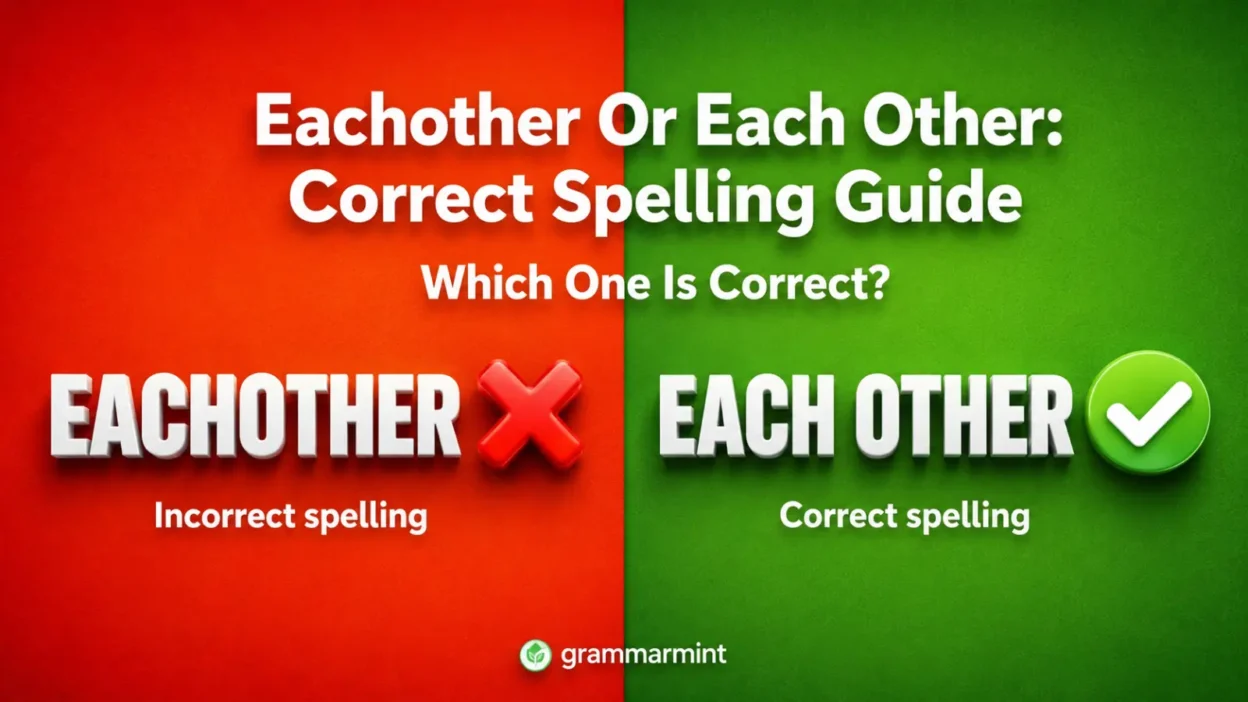
Each other is correct, and eachother is not standard English. Use two words when two or more people or things do something mutually.
TL;DR
• “Each other” is always two words.
• “Eachother” is a spelling mistake.
• It shows mutual action or feeling.
• “Each other’s” is the possessive form.
• “One another” often means the same thing.
• Use it after verbs or prepositions.
Eachother Or Each Other
The right choice is simple once you see it. Write correct spelling as “each other,” because it stays two words in standard English. Meanwhile, “eachother” is a misspelling, even though many people type it.
• Correct: We respect each other.
• Incorrect: We respect eachother.
• Keep a space between both words.
• Treat “each” and “other” separately.
• Use it for mutual actions.
• Use it for shared feelings.
• Use it for two people.
• Use it for larger groups too.
• Don’t join it in formal writing.
• Don’t join it in school essays.
• Don’t join it in work emails.
• Check autocorrect before sending.
• Remember: two people, two words.
• When unsure, add the space.
Each Other Meaning
“Each other” means that people or things do something back and forth. It points to a reciprocal action, a mutual relationship, or a shared action between members of a pair or group. So, everyone involved gives and receives in some way.
• Friends help each other study.
• Teammates support each other daily.
• Dogs chased each other outside.
• Neighbors greeted each other warmly.
• Partners trusted each other deeply.
• Students corrected each other kindly.
• The twins copied each other’s moves.
• Coworkers emailed each other updates.
• Cousins taught each other tricks.
• Players challenged each other fairly.
• Families looked after each other.
• The cats watched each other closely.
• Both sides understood each other better.
• The phrase shows a two-way link.
Each Other Spelling
The spelling rule is steady and easy. In standard English, “each other” uses separate words, so joining them creates a writing mistake. Although English has many joined compounds, this phrase has not become one.
• Spell it as “each other.”
• Never spell it as “eachother.”
• Add one space between words.
• Don’t use a hyphen between them.
• Don’t write “each-other” either.
• Keep the phrase visually open.
• Use the same spelling everywhere.
• Proofread it in long documents.
• Watch for fast typing errors.
• Fix it before submitting work.
• Grammar checkers may flag it.
• Teachers often mark the joined form.
• Editors expect the two-word form.
• Search your draft for “eachother.”
Eachother Meaning
“Eachother” usually means the writer intended “each other.” However, it is a nonstandard spelling, a common typo, and not accepted in careful writing. Therefore, the meaning is understandable, but the form still looks incorrect.
• “Eachother” points to a mistake.
• Readers may understand your intent.
• Still, the spelling looks unpolished.
• Use “each other” instead.
• Fix it in essays immediately.
• Fix it in resumes too.
• Avoid it in client messages.
• Avoid it in published content.
• Don’t rely on casual texting habits.
• Fast typing often creates it.
• Spellcheck may catch the error.
• Some apps may miss it.
• Replace every “eachother” with “each other.”
• The intended meaning stays unchanged.
Each Other Vs Eachother
The difference is not about style. “Each other” is the correct form, while “eachother” is the incorrect form. Because of that, the joined version is a grammar mistake in school, business, and edited writing.
• Use “each other” in every context.
• Avoid “eachother” in every context.
• Correct: They text each other.
• Incorrect: They text eachother.
• Correct: We trust each other.
• Incorrect: We trust eachother.
• Correct: Teams learn from each other.
• Incorrect: Teams learn from eachother.
• The space changes correctness.
• The meaning stays easy to guess.
• Still, correctness matters.
• Clean spelling builds trust.
• Small errors distract readers.
• One space solves the problem.
Each Other Grammar
In grammar, “each other” works as a reciprocal pronoun. It can be the object of a verb, as in “They hugged each other,” or the object of a preposition, as in “They talked with each other.” So, it usually receives the action.
• They helped each other.
• We called each other yesterday.
• The kids blamed each other.
• The sisters hugged each other.
• They listened to each other.
• We sat beside each other.
• The teams competed against each other.
• They learned from each other.
• The friends spoke with each other.
• Both apps connect to each other.
• The roads cross each other downtown.
• The ideas support each other well.
• The phrase follows many verbs.
• It also follows many prepositions.
Each Other Examples
Examples make the rule easier to remember. These example sentences use everyday English with clear context, so you can copy the pattern. As you read, notice that the phrase always stays two words.
• We see each other often.
• They know each other well.
• The boys pushed each other playfully.
• My parents support each other.
• The dancers followed each other’s timing.
• We gave each other advice.
• The branches rubbed against each other.
• Both companies depend on each other.
• The teachers encouraged each other.
• They waved at each other.
• The puppies slept near each other.
• We remind each other daily.
• The sisters borrow each other’s clothes.
• Good friends forgive each other.
Each Other In A Sentence
Use “each other” where the action points back between people or things. Its sentence placement feels natural when you place it after the verb or after a preposition. Also, watch the verb pattern because some verbs need a preposition before the phrase.
• We met each other in college.
• They smiled at each other.
• The players passed each other quickly.
• We spoke to each other calmly.
• They argued with each other briefly.
• The planets pull on each other.
• The partners rely on each other.
• Friends check on each other.
• Students learn from each other.
• The curtains touched each other lightly.
• The teams faced each other twice.
• They looked at each other silently.
• The twins copied each other perfectly.
• Clear placement keeps sentences smooth.
Each Other Or One Another
“Each other” and one another often overlap. In modern writing, they are usually interchangeable, though “one another” can sound slightly more formal. Still, “each other” feels common, direct, and natural in everyday American English.
• We helped each other.
• We helped one another.
• Both sentences sound correct.
• “Each other” feels more conversational.
• “One another” feels a bit formal.
• Use either for two people.
• Use either for groups.
• Choose one for consistency.
• Don’t overthink casual writing.
• Use “one another” for variety.
• Use “each other” for simplicity.
• Both show mutual action.
• Both can follow prepositions.
• Tone should guide your choice.
Each Other’s Or Each Others’
The possessive form is each other’s, with an apostrophe before the “s.” It shows shared ownership, connection, or responsibility between people or things. However, “each others’” is usually wrong because “other” stays singular in this phrase.
• Correct: We met each other’s families.
• Incorrect: We met each others’ families.
• Correct: They wore each other’s jackets.
• Incorrect: They wore each others’ jackets.
• Use one apostrophe before “s.”
• Keep “other” singular.
• Don’t add a plural ending.
• The phrase can show ownership.
• It can show shared responsibility.
• It can show personal connection.
• Friends read each other’s drafts.
• Partners respect each other’s time.
• Teams studied each other’s strategies.
• Proofread apostrophes carefully.
Reciprocal Pronouns
Reciprocal pronouns show a mutual action between two or more people, groups, animals, or things. English mainly uses “each other” and “one another” for this job. Therefore, these phrases are useful whenever action moves both ways.
• They congratulated each other.
• The birds called to one another.
• We helped each other move.
• The students tested one another.
• Both phrases show exchange.
• Both phrases need more than one participant.
• One person alone cannot use them.
• The action must go both ways.
• The relationship must involve members.
• Pairs can use reciprocal language.
• Groups can use it too.
• It prevents repeated names.
• It keeps sentences shorter.
• It makes relationships clear.
Each Other Synonyms
Sometimes, you can replace “each other,” but not always. Useful synonyms, alternatives, and rewrite options include “one another,” “mutually,” and “reciprocally.” However, the best choice depends on sentence shape and tone.
• Use “one another” for variety.
• Use “mutually” for formal tone.
• Use “reciprocally” in technical writing.
• Use “together” only when accurate.
• “Both” can sometimes help.
• “Between them” may fit context.
• “Among themselves” suits groups.
• “Back and forth” sounds casual.
• “In return” changes the focus.
• “Each” alone is not enough.
• Avoid forced replacements.
• Keep meaning two-way.
• Match the sentence rhythm.
• Choose clarity over fancy wording.
Meant For Each Other Meaning
The phrase meant for each other is an idiom. It means two people or things seem perfectly suited, especially in a relationship idiom about love, friendship, teamwork, or fit. Even here, “each other” still stays two words.
• They were meant for each other.
• The phrase often sounds romantic.
• It can describe close friends.
• It can describe perfect teammates.
• It can describe matching ideas.
• It suggests a natural fit.
• It can sound sweet.
• It can sound dramatic.
• Context controls the tone.
• Don’t write “meant for eachother.”
• Keep all three words separate.
• Use it in casual writing.
• Use it in captions carefully.
• Avoid it when tone feels too strong.
How To Use Each Other
Use “each other” when two or more sides act in return. Good practical usage starts with spotting the relationship, then proofreading the phrase, then checking whether the sentence sounds natural. Finally, keep natural sentences short and direct.
• Ask who performs the action.
• Ask who receives the action.
• Check whether both sides participate.
• Place it after the verb.
• Add a preposition when needed.
• Keep the words separate.
• Use “each other’s” for possession.
• Avoid “each others’” in most cases.
• Read the sentence aloud.
• Remove repeated names when possible.
• Keep your tone simple.
• Prefer clarity over cleverness.
• Use examples as templates.
• Edit fast messages before sending.
Each Other With Two People
“Each other” works perfectly for two people. It shows a paired action or mutual feeling between both sides. Because the phrase is direct, it fits relationships, friendships, family moments, and everyday actions.
• Maya and Leo trust each other.
• The brothers tease each other often.
• We called each other nightly.
• The couple respects each other’s space.
• Both friends missed each other.
• The neighbors helped each other move.
• The girls encouraged each other.
• The guys challenged each other.
• Partners should hear each other clearly.
• The two dogs followed each other.
• My parents understand each other well.
• The rivals studied each other carefully.
• Both players pushed each other harder.
• Two-sided action makes it work.
Each Other With Groups
“Each other” also works with group members, several people, and collective action. Older advice sometimes separates pairs and groups, but everyday English often uses “each other” for both. Therefore, groups can naturally support, teach, or affect each other.
• The students helped each other.
• Team members trusted each other.
• The kids chased each other outside.
• Volunteers encouraged each other all day.
• Employees shared ideas with each other.
• Classmates reviewed each other’s essays.
• The singers listened to each other.
• The players celebrated each other’s wins.
• Families supported each other after storms.
• Writers edited each other’s paragraphs.
• Friends protected each other online.
• The guests introduced themselves to each other.
• Several groups learned from each other.
• Shared action connects all members.
Common Mistakes With Each Other
Most common mistakes are easy to fix. Use these quick fixes as an editing checklist whenever “each other” appears in your draft. Then, your writing will look cleaner with almost no extra effort.
• Mistake: writing “eachother” as one word.
• Fix: write “each other” instead.
• Mistake: using “each-other” with hyphen.
• Fix: remove the hyphen.
• Mistake: writing “each others’.”
• Fix: use “each other’s.”
• Mistake: using it for one person.
• Fix: use it for two or more.
• Mistake: skipping needed prepositions.
• Fix: say “talk to each other.”
• Mistake: repeating names awkwardly.
• Fix: replace repetition with the phrase.
• Mistake: mixing forms in one article.
• Fix: stay consistent throughout.
FAQs
Is It Eachother Or Each Other?
“Each other” is correct. “Eachother” is not standard English, so keep the two words separate in every kind of careful writing.
Is Eachother One Word?
No, “eachother” is not a correct one-word form. The correct spelling is always “each other” with a space.
What Does Each Other Mean?
“Each other” means that two or more people or things act toward one another. It shows a mutual action, feeling, or relationship.
What Is The Difference Between Each Other And One Another?
They often mean the same thing in modern English. “Each other” sounds more common and conversational, while “one another” can sound a little more formal.
Is Each Other’s Correct?
Yes, “each other’s” is correct for possession. For example, write, “They borrowed each other’s notes.”
Is Each Others’ Correct?
“Each others’” is usually incorrect. In this phrase, “other” stays singular, so the apostrophe goes before the “s.”
How Do You Use Each Other In A Sentence?
Place it after a verb or after a preposition. For example, write, “They helped each other” or “They talked with each other.”
Conclusion
Now you know the answer to Eachother or Each Other: use “each other” as two words every time. When your sentence shows a mutual action, feeling, or connection, add the space and keep moving.