Choosing whomever or whoever can feel tricky, especially in emails, schoolwork, essays, and polished business writing. However, the choice gets easier once you learn the difference between subject pronoun, object pronoun, dependent clause, preposition, formal English, and natural English. These words both point to a person, yet they play different jobs in a sentence. Whoever usually does something. Whomever usually receives something. Still, the clause around the word matters more than the whole sentence. So, this guide gives you the fast rule, clear examples, common traps, and practice you can use right away.
Quick Answer
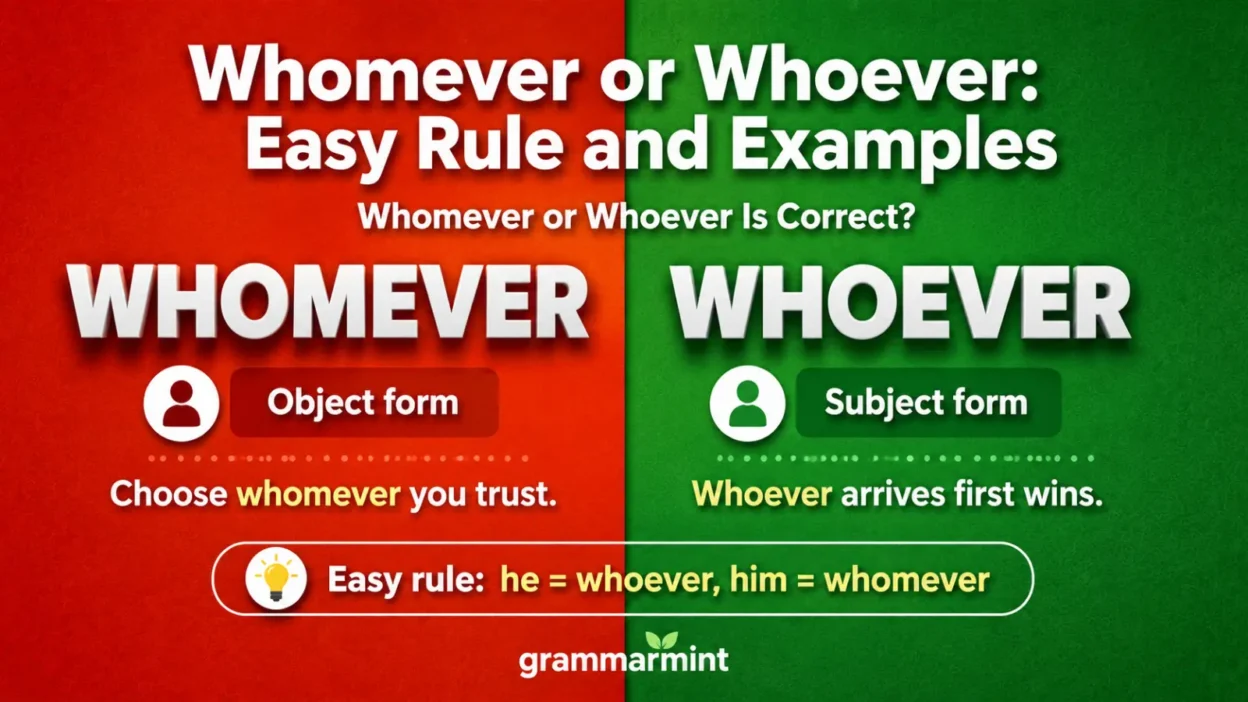
Whomever or whoever depends on the word’s job in its own clause. Use whoever when the person does the action, and use whomever when the person receives the action.
TL;DR
• Whoever does the action.
• Whomever receives the action.
• Test with they or them.
• Check the clause, not everything.
• Whomever often sounds formal.
• Whoever is more common today.
Whoever Vs Whomever
Whoever and whomever are both correct words. However, they don’t do the same job. The fastest answer is simple: subject pronoun for the doer, object pronoun for the receiver, and correct word only after checking the clause.
• Whoever calls first gets the seat.
• Whomever you choose may attend.
• Whoever works here needs training.
• Give the badge to whomever she picked.
• Whoever wins should thank the team.
• Send help to whomever needs it most.
• Whoever asks politely usually gets answers.
• The role goes to whomever they select.
• Whoever wrote this made a strong point.
• Invite whomever your manager approves.
• Whoever arrives early can set up.
• Trust whomever the board recommends.
Difference Between Whoever And Whomever
The difference is not about spelling. Instead, it’s about job and meaning. Whoever fits a grammar role as the doer in a clause, while whomever often changes the sentence meaning by pointing to the receiver.
• Whoever leads the meeting should prepare.
• Whomever the team supports may lead.
• Whoever made lunch deserves thanks.
• Thank whomever made lunch for us.
• Whoever drives must bring a license.
• Ride with whomever your parents trust.
• Whoever sent this knew the answer.
• Reply to whomever sent the note.
• Whoever studies daily improves faster.
• Help whomever the teacher assigns.
• Whoever edits last checks spelling.
• Credit whomever edited the final copy.
When To Use Whoever
Use whoever when the person is doing the action inside the clause. As a result, it often comes before a verb. Think does the action, subject of a verb, and any person who.
• Whoever answers first wins the point.
• Whoever knocks should wait outside.
• Whoever forgot this can claim it.
• Whoever studies tonight will feel ready.
• Whoever cooked dinner saved my evening.
• Whoever wants coffee can make some.
• Whoever signed up should bring supplies.
• Whoever teaches tomorrow needs the slides.
• Whoever parked there must move soon.
• Whoever opened the window helped everyone.
• Whoever joins late should mute audio.
• Whoever finds errors should mark them.
When To Use Whomever
Use whomever when the person receives the action. It also works after many prepositions. Watch for receives the action, object of a verb, and object of a preposition.
• Hire whomever you trust most.
• Choose whomever fits the role.
• Thank whomever helped backstage.
• Call whomever your doctor suggests.
• Ask whomever she invited yesterday.
• Support whomever the voters choose.
• Pay whomever completed the repair.
• Address whomever the letter names.
• Follow whomever the guide appoints.
• Contact whomever handles payroll issues.
• Reward whomever solved the problem.
• Include whomever the host approved.
Whoever Meaning
Whoever means “any person who” or “no matter who.” Therefore, it works well when the person is unknown or open-ended. Use anyone who, no matter who, and indefinite pronoun as your meaning clues.
• Whoever needs help may stay.
• Whoever wants dessert should speak up.
• Whoever calls can leave details.
• Whoever knows the answer may respond.
• Whoever feels ready can start.
• Whoever owns this bag should check it.
• Whoever disagrees may explain kindly.
• Whoever volunteers gets first choice.
• Whoever missed class should review notes.
• Whoever likes puzzles will enjoy this.
• Whoever finishes early can read quietly.
• Whoever cares about clarity will revise.
Whomever Meaning
Whomever means “any person whom” or “the person who receives something.” Because of that, it appears in more polished sentences. Think objective case, formal English, and receiver.
• Give access to whomever you approve.
• Send the file to whomever asks.
• I’ll support whomever you nominate.
• Please welcome whomever they bring.
• We can invite whomever you prefer.
• The prize honors whomever judges select.
• Share notes with whomever missed class.
• Assign tasks to whomever volunteers next.
• The policy protects whomever it covers.
• Credit whomever created the artwork.
• Notify whomever the list includes.
• Seat whomever the usher directs.
The He/Him And They/Them Test
This test keeps things quick. First, replace the word with he or they. Then, try him or them. Choose he or they for whoever, him or them for whomever, using the replacement test.
• They arrived first, so use whoever.
• Them arrived first sounds wrong.
• I chose them, so use whomever.
• I chose they sounds wrong.
• He called early, so whoever fits.
• Him called early sounds broken.
• We trusted him, so whomever fits.
• We trusted he sounds broken.
• They asked politely, so whoever works.
• The coach picked them, so whomever works.
• She recommends him, so whomever fits.
• They can attend, so whoever fits.
The Clause Rule That Solves Most Sentences
The key is the smaller clause, not the whole line. That’s why some sentences surprise people. Check the dependent clause, ignore the main clause for a moment, and find the verb inside the clause.
• Give it to whoever asks first.
• Whoever asks is the smaller clause.
• Asks needs a subject.
• Therefore, whoever is correct there.
• Hire whomever the panel likes.
• The panel likes whomever.
• Likes needs an object.
• Therefore, whomever is correct there.
• I’ll thank whoever helped you.
• Helped needs its own subject.
• Send this to whomever she named.
• Named needs its own object.
Subject And Object Roles
A subject does something. An object receives something. Once you spot the subject, the object, and any preposition, the choice becomes much clearer.
• Whoever called is the subject.
• Whomever I called is the object.
• Whoever waited showed patience.
• I thanked whomever waited outside.
• Whoever spoke answered clearly.
• The judge heard whomever spoke last.
• Whoever applied may interview today.
• Recruiters consider whomever applied early.
• Whoever complained had a fair reason.
• Managers met with whomever complained.
• Whoever designed it understood users.
• Clients praised whomever designed it.
Whoever Or Whomever In A Sentence
Examples make the rule stick. Also, they show why the same idea can change words. Study these sentence examples, notice correct usage, and aim for natural English.
• Whoever wants tickets should text me.
• I’ll text whomever wants tickets.
• Whoever baked these cookies is talented.
• Thank whomever baked these cookies.
• Whoever manages inventory should reorder pens.
• Ask whomever manages inventory today.
• Whoever painted this chose bright colors.
• We hired whomever painted this wall.
• Whoever forgot sunscreen learned quickly.
• Remind whomever forgot sunscreen tomorrow.
• Whoever handles returns can explain.
• Email whomever handles returns directly.
Whomever Or Whoever Examples
More examples help you hear the difference. However, don’t memorize them blindly. Use sample sentences, compare edited versions, and read the clear context around each word.
• Whoever trains hardest usually improves fastest.
• Coach whomever trains hardest tomorrow.
• Whoever ordered pizza should collect it.
• Pay whomever ordered pizza earlier.
• Whoever locked the door has keys.
• Find whomever locked the door.
• Whoever shared notes helped the class.
• Appreciate whomever shared notes today.
• Whoever built this app solved frustration.
• Interview whomever built this app.
• Whoever cleaned up deserves praise.
• Thank whomever cleaned up afterward.
Common Mistakes
Most mistakes happen because whomever sounds fancy. However, fancy doesn’t always mean correct. Avoid overcorrection, beware when a word sounds formal, and check the wrong clause trap.
• Wrong: Whomever calls should wait.
• Right: Whoever calls should wait.
• Wrong: Whoever did you invite?
• Right: Whomever did you invite?
• Wrong: Give it to whomever asks.
• Right: Give it to whoever asks.
• Wrong: Whomever arrives can help.
• Right: Whoever arrives can help.
• Wrong: Hire whoever she selected.
• Right: Hire whomever she selected.
• Wrong: Whomever wrote this wins.
• Right: Whoever wrote this wins.
Formal Writing
Whomever appears more often in polished writing. Still, it can sound stiff in casual notes. For business email, academic writing, and a polished tone, use it only when the clause needs it.
• Please forward this to whomever approves budgets.
• Notify whoever is leading onboarding.
• We’ll interview whomever the committee recommends.
• Whoever submits late needs approval.
• The award honors whomever judges select.
• Whoever reviews contracts should join.
• Address the envelope to whomever it concerns.
• Whoever manages security can reset access.
• The grant supports whomever qualifies first.
• Whoever signs must read carefully.
• Contact whomever HR assigned.
• Whoever responds first may confirm attendance.
American English Usage
In the United States, whoever is far more common in daily speech. Meanwhile, whomever survives in formal settings and careful writing. That makes American English, casual speech, and modern writing important style clues.
• Most speakers choose whoever naturally.
• Whomever can sound old-fashioned aloud.
• Formal letters still use whomever.
• Everyday texts usually prefer whoever.
• Teachers may expect the older rule.
• Editors may keep whomever for precision.
• Friends rarely say whomever casually.
• Lawyers may use whomever in clauses.
• News writing often avoids clunky phrasing.
• Clear rewrites can solve awkwardness.
• Whoever feels warmer in conversation.
• Whomever feels sharper in documents.
Who Vs Whom
Who and whom are the root pair. Whoever and whomever follow the same idea, just with “ever” added. Learn who, whom, and case first, and the longer pair gets easier.
• Who called you this morning?
• Whom did you call back?
• Who is coming tonight?
• With whom are you coming?
• Who wrote the report?
• Whom did the report mention?
• Who can answer this question?
• Whom should we ask next?
• Who leads the department?
• Whom does the department support?
• Who made the decision?
• Whom did they choose?
Whom Vs Whomever
Whom points to a specific object in many questions or clauses. Whomever points to any person receiving an action. Compare simple pronoun, compound pronoun, and object form.
• Whom did you invite?
• Invite whomever you like.
• Whom should I contact?
• Contact whomever is listed.
• Whom did she choose?
• Choose whomever seems qualified.
• Whom are they helping?
• Help whomever needs support.
• Whom does this affect?
• Protect whomever this affects.
• Whom can we trust?
• Trust whomever proves reliable.
“To Whoever Asks”
This phrase looks wrong to many people. However, “whoever” can be correct after “to” when it starts its own clause. In “to whoever asks,” asks needs a subject, even though to appears before the clause subject.
• Give copies to whoever asks.
• Whoever asks is doing asking.
• So, whoever is correct.
• Send help to whoever calls.
• Whoever calls is the subject.
• Offer guidance to whoever struggles.
• Whoever struggles receives guidance later.
• Bring forms to whoever waits.
• Whoever waits completes the clause.
• Give access to whomever she approves.
• She approves whomever, not whoever.
• The inner verb decides everything.
Practice Quiz
Try each sentence before checking the answer. Then, use the test again. This quick quiz includes an answer key and simple grammar practice.
• ___ arrives first should sign in.
• Answer: Whoever arrives first.
• Invite ___ your coach recommends.
• Answer: whomever your coach recommends.
• Give snacks to ___ wants them.
• Answer: whoever wants them.
• Thank ___ stayed late yesterday.
• Answer: whoever stayed late yesterday.
• Choose ___ you believe most.
• Answer: whomever you believe most.
• ___ wrote this note is kind.
• Answer: Whoever wrote this note.
FAQs
What Is The Difference Between Whoever And Whomever?
Whoever is used when the person does the action in the clause. Whomever is used when the person receives the action or follows a preposition as its object.
When Should I Use Whoever?
Use whoever when it can be replaced by he, she, or they. For example, “Whoever arrives first can start” works because “they arrive first” makes sense.
When Should I Use Whomever?
Use whomever when it can be replaced by him, her, or them. For example, “Choose whomever you trust” works because “you trust them” makes sense.
Is Whomever A Real Word?
Yes, whomever is a real word. It is the object form of whoever, but it often sounds formal in everyday conversation.
Is Whoever More Common Than Whomever?
Yes, whoever is much more common in regular American speech and writing. Still, whomever remains useful in formal sentences where an object form is needed.
Should I Write “Give It To Whoever Asks” Or “Give It To Whomever Asks”?
Write “Give it to whoever asks.” In that smaller clause, whoever is doing the asking, so it acts as the subject.
Does Whomever Sound Too Formal?
Sometimes, yes. If it makes your sentence sound stiff, you can often rewrite the sentence while keeping the meaning clear.
Conclusion
Whomever or whoever becomes much easier when you stop guessing by sound. Check the smaller clause, find the action, and decide whether the person does it or receives it. With that habit, your writing will sound clearer, cleaner, and more confident.