If you’ve ever paused while writing a text, email, essay, or caption, you’re not alone. Further or Farther confuses many careful writers because both words point beyond something. However, they don’t always point in the same way.
In simple terms, use farther for distance you can measure. Use further for ideas, progress, extra details, and deeper discussion. Still, English is flexible, so real use can overlap. This guide makes the difference easy with clear rules, common phrases, examples, and quick checks for American readers.
Quick Answer
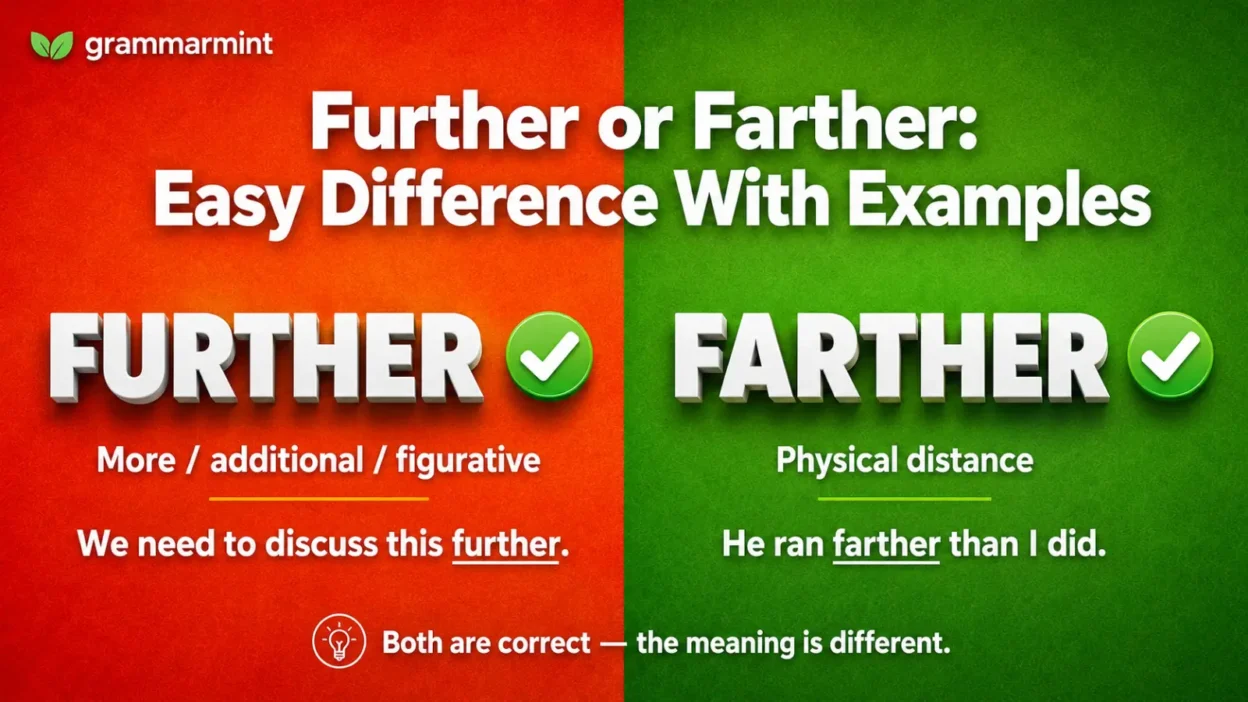
Further or farther depends on the kind of distance. Use farther for real, measurable distance, and use further for ideas, progress, or extra details.
TL;DR
• Farther usually means real distance.
• Further usually means extra or deeper.
• Use further for ideas and progress.
• Use farther for miles and places.
• In casual speech, they often overlap.
• For polished writing, keep them separate.
Further Or Farther
The easiest rule starts with distance. If you mean physical distance, farther is usually cleaner. If you mean figurative distance or added detail, further is the correct word.
• Farther fits roads, miles, and steps.
• Further fits ideas, plans, and details.
• Farther points across real space.
• Further moves a thought ahead.
• Use farther for measurable movement.
• Use further for extra explanation.
• Choose farther for maps.
• Choose further for meaning.
• Farther sounds more exact.
• Further sounds more flexible.
• Formal writing prefers the distinction.
• Casual talk often blends them.
Further Vs Farther
Further vs farther is really about the kind of distance involved. A measurable distance usually takes farther. An abstract meaning usually takes further, especially in American English.
• “Drive farther” means more road.
• “Discuss further” means more depth.
• “Walk farther” means more steps.
• “Study further” means deeper learning.
• “Farther from home” measures place.
• “Further from the goal” measures progress.
• Farther often answers “how far?”
• Further often answers “how much more?”
• Farther works well with numbers.
• Further works well with ideas.
• Use farther for physical comparison.
• Use further for added development.
Farther Vs Further
Farther vs further looks like the same question reversed, but the focus helps. Farther is stronger for literal distance. Further is safer in formal writing when the meaning is abstract, though everyday speech can be relaxed.
• Farther describes a longer route.
• Further describes a deeper reason.
• Farther compares visible places.
• Further extends a conversation.
• Farther suits sports distance.
• Further suits career growth.
• Farther can sound more precise.
• Further can sound more general.
• Farther rarely means “additional.”
• Further often means “additional.”
• Farther is not usually a verb.
• Further can work as a verb.
Farther Or Further
When choosing farther or further, pause and check the noun or action. The grammar rule is simple, but the best word choice depends on context clues around the sentence.
• Ask whether distance is measurable.
• If yes, choose farther.
• Ask whether meaning is abstract.
• If yes, choose further.
• Notice words like miles.
• Miles usually call for farther.
• Notice words like research.
• Research usually calls for further.
• “Any further” means any more.
• “Any farther” means any more distance.
• Context decides tricky cases.
• Clarity beats sounding fancy.
When To Use Further
Use further when something becomes additional, deeper, or more developed. It can also mean to advance something. At the start of a sentence, further can mean moreover.
• Use further for more information.
• Use further for extra questions.
• Use further for deeper discussion.
• Use further for added research.
• Use further for career growth.
• Use further for project progress.
• Use further to mean “also.”
• Use further as a verb.
• “Further the cause” is correct.
• “Further details” is natural.
• “Further notice” is standard.
• “No further action” sounds polished.
When To Use Farther
Use farther when you can picture miles, a real location, or physical space. It is the stronger choice for travel, running, driving, throwing, and moving.
• Use farther for road trips.
• Use farther for walking distance.
• Use farther for driving routes.
• Use farther for thrown objects.
• Use farther for seat placement.
• Use farther for hiking trails.
• Use farther for city comparisons.
• Use farther with map distance.
• Use farther with “from here.”
• Use farther with “away” physically.
• Use farther for real movement.
• Use farther when measuring space.
Further Or Farther Away
Further or farther away depends on whether “away” means real distance. If something is away from you by a greater distance, farther away is usually best. For travel, this sounds especially natural.
• The cabin is farther away.
• The airport is farther away.
• The noise moved farther away.
• The dog ran farther away.
• The boat drifted farther away.
• The seats were farther away.
• The town looked farther away.
• Further away can still appear.
• Farther away sounds more physical.
• Further away can sound broader.
• Pick farther for visible distance.
• Pick further for emotional distance.
Further Away Or Farther Away
Both phrases can be understood, especially in spoken English. However, written English often rewards clear meaning. So, use farther away when the sentence is about real space.
• “Farther away” fits geography.
• “Farther away” fits directions.
• “Farther away” fits seating.
• “Farther away” fits buildings.
• “Further away” can feel figurative.
• “Further away” can mean less likely.
• “Farther away” is more concrete.
• “Further away” is more flexible.
• Use farther for physical scenes.
• Use further for emotional distance.
• Both may pass in conversation.
• Precision helps readers trust you.
Further Or Farther From The Truth
The phrase is “further from the truth.” Here, truth is not a place on a map. It is a figurative phrase meaning something is not accurate.
• Use further from the truth.
• Don’t use farther here.
• Truth is not physical distance.
• The phrase means completely wrong.
• It often sounds emphatic.
• It fits arguments and corrections.
• It works in essays.
• It works in conversation.
• “Nothing could be further” is standard.
• “Farther from truth” sounds odd.
• Further carries the abstract meaning.
• This phrase is easy to memorize.
Further Or Farther Down The Road
This phrase changes with meaning. If down the road means real road distance, use farther. If it means the future, use further.
• The store is farther down the road.
• The gas station is farther down.
• The bridge is farther ahead.
• The issue may return further down.
• We’ll decide further down the road.
• Future meaning takes further.
• Physical meaning takes farther.
• Road signs point to farther.
• Planning points to further.
• Time makes the phrase abstract.
• Place makes the phrase physical.
• One phrase has two paths.
Further Or Farther Apart
Further or farther apart depends on what is separating. Physical apart usually takes farther. A relationship or emotional separation usually takes further.
• The chairs are farther apart.
• The houses are farther apart.
• The twins sat farther apart.
• The teams grew further apart.
• Their views moved further apart.
• The couple drifted further apart.
• Physical gaps take farther.
• Emotional gaps take further.
• Opinion gaps take further.
• Seating gaps take farther.
• Measurements favor farther apart.
• Feelings favor further apart.
Further Or Farther Along
Further along is often about progress. If along refers to a path, farther along can work. However, development usually sounds better with further along.
• She is further along now.
• The project is further along.
• The pregnancy is further along.
• The plan moved further along.
• Walk farther along the trail.
• Drive farther along the coast.
• Progress usually takes further.
• Real paths usually take farther.
• “Further along” sounds common.
• “Farther along” sounds spatial.
• Check whether movement is literal.
• Then choose the clearer word.
Further Or Farther In A Sentence
A good example sentence shows the word’s job. Both words can work as an adjective or adverb, but further has extra jobs that farther usually does not.
• The library is farther away.
• We need further details today.
• She ran farther than me.
• Let’s discuss this further tomorrow.
• The farther shore looked quiet.
• Further research may help.
• He drove farther north.
• This will further our mission.
• No further questions were asked.
• The hotel is farther downtown.
• Further, we should review costs.
• Farther cannot replace every further.
Farthest Or Furthest
Farthest and furthest are the superlative forms. Use farthest for the greatest physical distance when you want precision. Use furthest often for the greatest degree or extent.
• Farthest fits measurable distance.
• Furthest fits figurative extent.
• She ran the farthest.
• That idea went the furthest.
• The farthest star looked faint.
• The furthest plan felt bold.
• Both forms are widely understood.
• Farthest sounds more physical.
• Furthest sounds more flexible.
• American writing often likes farthest.
• British use may favor furthest.
• Context still matters most.
Further Meaning
The further meaning centers on more, extra, deeper, or onward. Further can be an adjective, adverb, or verb. It also appears in phrases like additional information.
• Further can mean additional.
• Further can mean more deeply.
• Further can mean farther in distance.
• Further can mean to advance.
• Further details means more details.
• Further discussion means continued discussion.
• Further education means more schooling.
• Further action means added action.
• Further notice means later notice.
• Further can start a sentence.
• Further can sound formal.
• Further has broader uses.
Farther Meaning
The farther meaning is narrower and clearer. Farther is a comparative form tied to “far.” It is mainly a distance word for places, movement, or measurable space.
• Farther means more far.
• Farther compares physical distance.
• Farther can describe a place.
• Farther can describe movement.
• Farther can modify a noun.
• Farther can modify a verb.
• Farther works with miles.
• Farther works with routes.
• Farther works with sports.
• Farther works with geography.
• Farther is not usually abstract.
• Farther is precise and simple.
FAQs
What Is The Difference Between Further And Farther?
Farther usually refers to real distance, such as miles, roads, or places. Further usually refers to more detail, more progress, or a figurative distance.
When Should I Use Farther Instead Of Further?
Use farther when the distance can be measured or pictured. For example, “The school is farther from my house” is clearer than “further” in careful American writing.
Can Further And Farther Be Used Interchangeably?
Sometimes they overlap in casual speech, especially when talking about distance. Still, polished writing is clearer when farther handles physical distance and further handles abstract ideas.
Is It Further Away Or Farther Away?
Use farther away for physical distance. Use further away if the meaning is emotional, figurative, or about possibility rather than location.
What Does Further Mean As A Verb?
As a verb, further means to help something move forward. For example, you can further your career, further a cause, or further a plan.
Which Is Correct: Further Information Or Farther Information?
Further information is correct. Information is not a physical place, so farther information sounds unnatural.
Conclusion
Further or Farther becomes simple once you ask one question: can you measure the distance? If yes, farther is usually best. If not, further usually gives your sentence the meaning you want.