If you’ve seen this phrase in class, online, or in conversation, you may want a simple answer fast. Fact or fiction is a common way to ask whether something is true, proven, or just imagined, exaggerated, or made up. People use it for stories, rumors, headlines, social posts, classroom tasks, and everyday claims. It often appears beside ideas like fact vs fiction, real vs imaginary, truth vs falsehood, media literacy, evidence, and source checking. So, once you understand the pattern, the phrase becomes easy to spot and easy to use.
Quick Answer
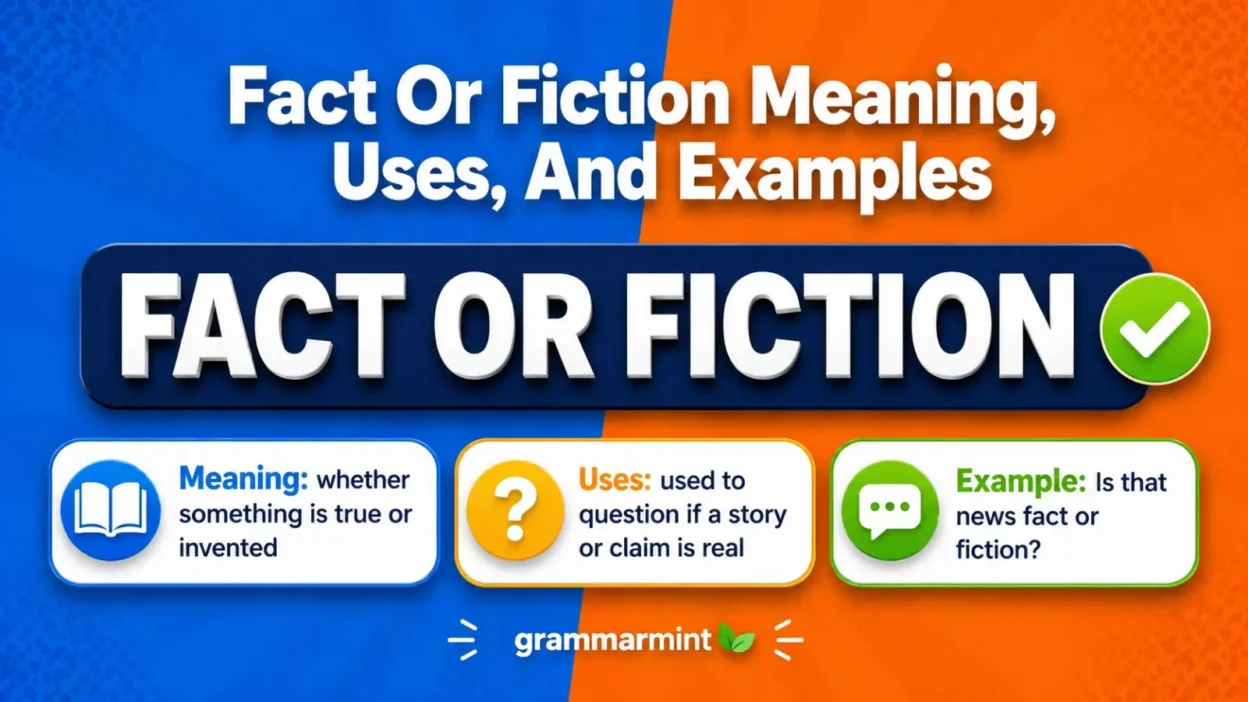
Fact or fiction means “is it true or made up?” People use it when they want to test a claim, story, rumor, or idea. It often introduces a comparison between what is real and what is imagined.
TL;DR
• It asks whether something is true
• It compares reality with imagination
• It works in speech and writing
• It often introduces rumors or stories
• It’s common in school and media
• Don’t confuse it with fact from fiction
What Fact Or Fiction Means
This phrase is short, direct, and easy to understand. It asks whether something belongs on the true side or the made-up side.
• Means true or made up
• Tests a claim quickly
• Works as a sharp contrast
• Often introduces a doubtful idea
• Useful for stories and rumors
• Can sound playful or serious
• Phrase meaning stays very direct
• Often works like an idiom
• Common in everyday usage
• Fits speech, titles, and lessons
• Usually appears after a topic
• Helps frame a clear choice
Fact Vs Fiction At A Glance
The contrast matters because the two words point in different directions. One points to reality, while the other points to imagination.
• Fact links to the real world
• Fiction points to imaginary events
• Facts need evidence or proof
• Fiction allows invented details
• Facts can be checked
• Fiction can be created
• Facts aim for accuracy
• Fiction aims for storytelling
• Facts stay tied to reality
• Fiction may borrow real elements
• The phrase highlights the contrast
• That contrast drives the meaning
When To Use Fact Or Fiction
You can use this phrase when a statement feels uncertain. It works best when you want to compare truth with invention.
• Use it with rumors
• Use it with surprising claims
• Use it with dramatic stories
• Use it with viral posts
• Use it before checking facts
• Use it when doubt appears
• The context should suggest uncertainty
• A claim should already exist
• It often introduces a question
• It fits discussion-based writing
• It works in class tasks
• It suits casual conversation too
Fact Or Fiction In Questions
This phrase often appears as part of a direct question. That makes it useful when you want a quick answer or discussion starter.
• Fact or fiction about aliens?
• Fact or fiction about that rumor?
• Is this fact or fiction?
• Was that report fact or fiction?
• Fact or fiction: sharks smell blood?
• Fact or fiction: sleep myths?
• Strong question form grabs attention
• Often used with a rumor
• The goal is finding truth
• Good for quizzes and hooks
• Easy to say out loud
• Easy to spot in titles
Fact Or Fiction In Statements
You can also use the phrase inside a statement. In that form, it sounds a little calmer and more descriptive.
• The article asks fact or fiction
• We debated fact or fiction
• She labeled it fact or fiction
• The lesson explored fact or fiction
• He framed the myth carefully
• They discussed the claim openly
• A statement pattern feels smoother
• It can describe an assertion
• It often shows uncertainty
• Good for summaries and recaps
• Useful in reviews and essays
• Helps organize a discussion
Fact Or Fiction In Headlines
Writers love this phrase because it creates instant curiosity. It signals that the reader will get a clear answer.
• Fact or Fiction: Winter Skin Myths
• Fact or Fiction: Can Cats Smile?
• Fact or Fiction: Study Habits
• Fact or Fiction: Movie Legends
• Fact or Fiction: Sleep Tips
• Fact or Fiction: Travel Claims
• A headline feels punchy here
• It creates a strong hook
• It names the topic fast
• Good for blogs and lessons
• Also works in newsletters
• Best with one clear subject
Fact Or Fiction In School Writing
Students often meet this phrase in reading lessons. It helps them sort real information from made-up content.
• Sort statements by truth
• Check clues in the text
• Ask what can be proven
• Mark invented details clearly
• Compare nonfiction and stories
• Look for source support
• Builds reading skill early
• Useful in school writing tasks
• Strong source habits matter
• Helps with reading comprehension
• Supports class discussion well
• Works across many grade levels
Fact Or Fiction In Everyday Conversation
In daily speech, the phrase can sound light and natural. People use it when they hear something surprising or hard to believe.
• Fact or fiction, be honest
• That sounds like fiction
• Is that actually true?
• I need proof first
• That rumor feels made up
• Let’s check before sharing
• Common in everyday speech
• Fits a casual tone
• Works in quick conversation
• Can sound skeptical
• Can sound playful too
• Best with shared context
Fact Or Fiction In Media And Online Posts
This phrase is especially useful online, where claims spread fast. It reminds readers not to accept every post at face value.
• Pause before reposting
• Check the original source
• Compare several reports
• Watch for missing evidence
• Notice emotional wording
• Read beyond the headline
• Strong media literacy helps
• Test each online claim carefully
• Use basic verification steps
• Screenshots can mislead people
• Viral posts aren’t proof
• Context changes meaning fast
Separate Fact From Fiction
This related idea focuses on the action, not just the choice. It means telling what is true apart from what is false or invented.
• Start with the source
• Look for solid proof
• Check dates carefully
• Compare trusted reports
• Notice missing context
• Ask who benefits
• Aim for truth from falsehood
• Always check evidence first
• Prefer a reliable source
• Don’t trust one post alone
• Be careful with dramatic claims
• Slow down before deciding
Fact Or Fiction Synonyms And Alternatives
Sometimes you may want a different phrase. A close substitute can fit better depending on tone and context.
• Real or made up
• True or false
• Truth or invention
• Reality or myth
• Proven or imagined
• Genuine or fake
• An alternative phrase may fit
• Use real or not informally
• Use made up for beginners
• Choose tone by audience
• Formal writing needs precision
• Conversation allows simpler wording
Common Mistakes With Fact Or Fiction
The phrase is simple, but a few mistakes still happen. Most of them involve tone, grammar, or confusion with related phrases.
• Don’t force it everywhere
• Don’t use it without context
• Don’t confuse fact with opinion
• Don’t treat rumors as proof
• Don’t overuse question marks
• Don’t stretch the phrase awkwardly
• A common mistake is vagueness
• Weak word choice causes confusion
• Basic grammar still matters
• Keep the subject clear
• Make the contrast obvious
• Use one topic at once
Fact Or Fiction Vs Fact From Fiction
These phrases are related, but they are not identical. One asks the question, while the other stresses the act of separating truth from falsehood.
• Fact or fiction asks which
• Fact from fiction stresses separation
• One frames a choice
• One describes a process
• Both involve truth testing
• Both work in explanation
• A related phrase may overlap
• The difference is still useful
• That small meaning shift matters
• Don’t swap them blindly
• Pick by sentence purpose
• Match the tone carefully
Fact Or Fiction For Kids And Beginners
For beginners, the easiest way to learn the phrase is through simple examples. Real things count as fact, while made-up things count as fiction.
• Dogs bark is fact
• Stars made of candy is fiction
• People need water is fact
• Dragons in my yard is fiction
• Birds can fly is fact
• Trees speak English is fiction
• Great for beginner English learners
• Use one simple example first
• Explain make-believe clearly
• Keep the contrast visual
• Ask what can happen
• Ask what sounds invented
Short Examples Of Fact Or Fiction
Quick examples help the phrase feel natural. Here are short lines you can copy, adapt, or study.
• Fact or fiction: lightning myths
• Fact or fiction: superfood claims
• Fact or fiction: study hacks
• We argued fact or fiction
• The show explored fact or fiction
• She asked if it was true
• Each example sentence stays clear
• A natural example sounds smooth
• Good usage sample beats theory
• Keep the topic specific
• Add a claim after it
• Let the context guide tone
How To Remember Fact Or Fiction
A simple memory rule can make the phrase stick. Think of fact as checked reality and fiction as imagined storytelling.
• Fact equals checked truth
• Fiction equals imagined story
• Proof points toward fact
• Imagination points toward fiction
• Evidence beats guesswork
• Storytelling allows invention
• Use a memory trick daily
• Follow one quick rule always
• Build a strong word link
• Think real versus invented
• Think proof versus pretend
• Repeat the contrast aloud
FAQs
What does “fact or fiction” mean?
It means “is it true or made up?” People use the phrase when they want to test a claim, rumor, story, or idea and decide which side it belongs on.
How do you use “fact or fiction” in a sentence?
You can use it as a question or a title. For example, “Fact or fiction: drinking coffee stunts growth?” or “The lesson asked students to sort each statement into fact or fiction.”
Is “fact or fiction” an idiom?
It works like a fixed phrase in everyday English, even though the meaning is still clear from the two words. Most people understand it right away as a contrast between reality and invention.
What is the difference between fact and fiction?
A fact is something presented as real and checkable. Fiction refers to imagined or invented material, especially in stories, though it can borrow details from real life.
What does “separate fact from fiction” mean?
It means telling truth from falsehood. In practice, that usually involves checking evidence, reviewing sources, and looking for context before accepting a claim.
Can something be both fact and fiction?
Yes, in some cases. A story can mix real events with invented details, so part of it may reflect reality while other parts are shaped for drama, style, or entertainment.
Conclusion
Now you know that fact or fiction is a simple way to ask whether something is true or made up. Use it when you want a clear contrast, a quick check, or an easy discussion starter.