If you’ve ever paused over awhile or a while, you’re not alone. This pair confuses students, bloggers, office writers, and everyday texters because both forms sound the same, show up in common phrases, and often appear in casual English. The good news is that the choice gets easier once you know the basic split: one form acts like an adverb, and the other acts like a time noun phrase. In this guide, you’ll see the rule in plain English, learn the fixed phrases people mix up most, and get examples you can copy with confidence.
Quick Answer
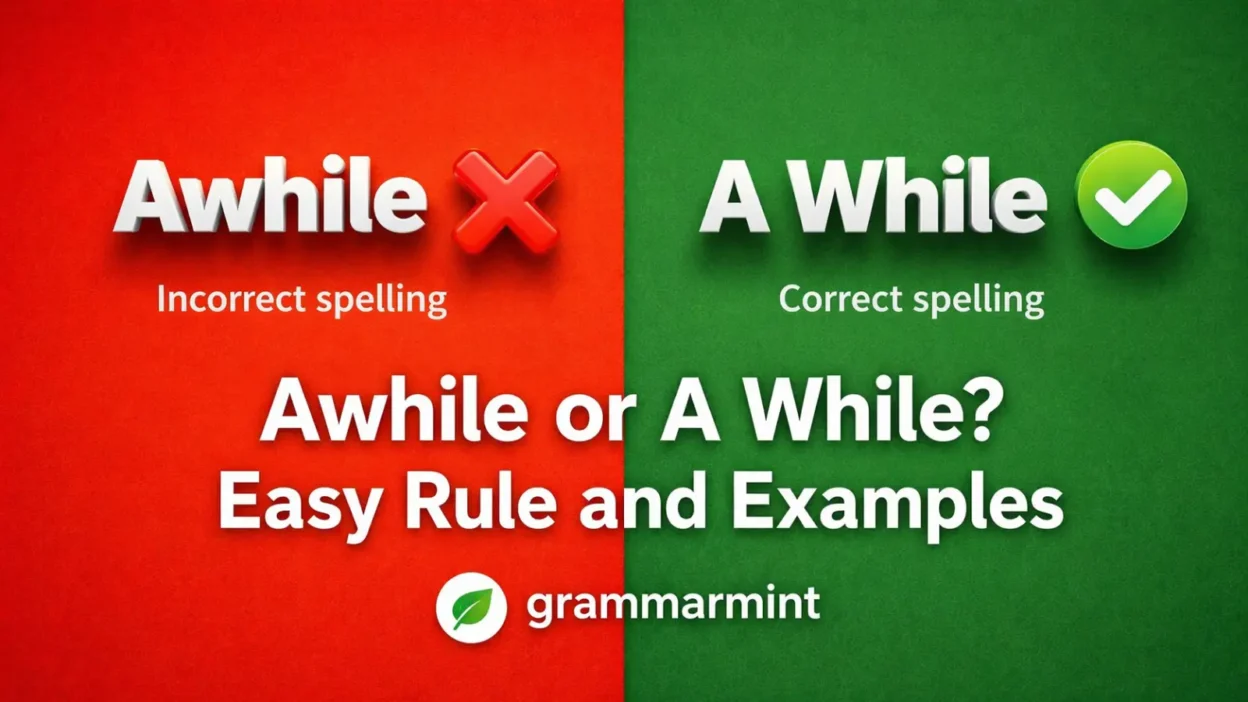
Awhile or a while depends on how the phrase works in your sentence. Use awhile when it means “for a short time” and directly describes an action. Use a while when you need a noun phrase, especially after words like for, in, and after.
TL;DR
• Awhile = for a short time
• A while = a period of time
• Use awhile after action verbs
• Use a while after prepositions
• Write it’s been a while
• Write once in a while, not one word
Quick Rule To Remember
This is the fastest way to remember the difference. First, ask whether you need a word that describes an action or a phrase that names time.
• Adverb use points to awhile
• Noun phrase use points to a while
• Period of time usually needs two words
• Directly after many verbs, one word works
• After prepositions, pick two words
• If for is already there, use two words
• If ago appears, use two words
• If back appears, use two words
• Fixed idioms often prefer a while
• Fast test beats memorizing every phrase
• Sound won’t help; structure will
• Check the job, not the spelling
What Awhile Means
Awhile is the one-word form. It usually means “for a short time” and works like an adverb.
• For a short time is the core meaning
• Direct modifier is its main job
• It usually follows an action verb
• It often sounds natural in speech
• It keeps the sentence compact
• It already carries the idea of for
• That’s why for awhile looks off
• It fits brief, smooth time references
• It works well in simple sentences
• It often appears after commands
• It feels lighter than longer phrases
• Think: action first, duration second
What A While Means
A while is the two-word form. Here, while works like a noun meaning a period of time.
• Time expression is the key idea
• Noun status makes grammar easier
• It can follow many prepositions
• It can pair with linking verbs
• It often appears in fixed phrases
• It can take modifiers like quite
• It can stretch to a little while
• It can mean an unspecified span
• It works in past, present, or future
• Use it in worth your while
• Use it in quite a while
• Think: naming time, not describing action
Use Awhile After Action Verbs
This section covers the cleanest pattern. When a verb can naturally take “for a short time,” awhile often fits.
• Stay awhile and chat
• Wait awhile before replying
• Rest awhile after lunch
• Sit awhile by the window
• Pause awhile before deciding
• Sleep awhile on the couch
• Talk awhile before dinner
• Wander awhile through the park
• Read awhile before bed
• Listen awhile and learn
• Linger awhile near the door
• Smile awhile, then leave
Use A While After Prepositions
Prepositions are one of the biggest clues. Words like for, in, and after strongly point to the two-word form.
• For a while means duration
• In a while means later
• After a while means later on
• Prepositions usually need the noun phrase
• Don’t write for awhile here
• Don’t write in awhile here
• Don’t write after awhile here
• The pattern stays very stable
• This is the safest editing rule
• It helps in both casual and formal writing
• Time phrases read clearer this way
• Two words win after prepositions
Fixed Phrases That Need A While
Some expressions are so common that it helps to learn them whole. These usually prefer the two-word form.
• Quite a while is standard
• Been a while is standard
• Worth your while is standard
• A little while feels natural
• A long while appears less often
• All the while is separate again
• Every once in a while stays fixed
• Once in a while stays fixed
• A while ago is standard
• A while back is standard
• After a while is standard
• In a while is standard
It’s Been A While
This is one of the most searched phrases, and it’s the one many writers second-guess. The standard form is two words.
• Present perfect often appears here
• Common expression favors two words
• Elapsed time is the idea
• Write: It’s been a while
• Write: It has been a while
• Don’t write: It’s been awhile
• The sentence names a span of time
• That makes the noun phrase fit
• The same pattern works in emails
• It also works in texts
• It sounds natural and polished
• This is worth memorizing whole
For A While, In A While, And After A While
These three phrases cause a lot of confusion because they sound close but do different jobs. Even so, they all take the two-word form.
• Duration belongs to for a while
• Future time belongs to in a while
• Later often fits after a while
• I stayed for a while
• I’ll call in a while
• After a while, we left
• Each phrase uses a preposition
• That’s why two words fit
• These are strong everyday patterns
• They work in speech and writing
• Keep their meanings separate
• Learn them as ready-made units
A While Ago And A While Back
These phrases refer to an unspecified time in the past. Because they name a time span, the two-word form is the standard choice.
• Past reference is the main function
• Informal tone fits both phrases
• Unspecified time keeps them flexible
• Write: a while ago
• Write: a while back
• Don’t write: awhile ago
• Don’t write: awhile back
• Both sound natural in conversation
• Ago often feels slightly more neutral
• Back can feel a bit looser
• Both work well in storytelling
• Both are easy to overthink
Once In A While And Every Once In A While
These are idioms about frequency, not duration. Because they contain the noun phrase, they stay as two words.
• Occasionally is the closest meaning
• Idiom status keeps the spelling fixed
• Frequency matters more than duration
• Write: once in a while
• Write: every once in a while
• Don’t write: once in awhile
• Don’t write: every once in awhile
• These phrases feel friendly and common
• They fit speech, blogs, and messages
• They suggest irregular repetition
• They are easy to scan in prose
• Treat them as memorized chunks
Try The Swap Test
When you’re unsure, don’t guess. Use a quick substitution test and let the sentence tell you what it needs.
• Replace with an hour for noun use
• Replace with for a while for adverb use
• Use the edit check before publishing
• For an hour sounds fine
• So for a while is right
• Wait for a while can equal wait awhile
• If both fit, compare structure
• If a preposition appears, choose two words
• If the verb stands alone, test one word
• Read the sentence out loud
• Then check grammar, not rhythm
• One swap can save time
Common Mistakes To Avoid
Most errors happen in a few predictable spots. Once you spot them, they become much easier to fix.
• For awhile should be for a while
• In awhile should be in a while
• Awhile ago should be a while ago
• Awhile back should be a while back
• It’s been awhile usually needs two words
• Once in awhile usually needs two words
• Don’t let sound trick you
• Don’t trust autocorrect blindly
• Don’t force one rule everywhere
• Watch linking-verb structures carefully
• Watch fixed phrases even more carefully
• Proofread short sentences too
Everyday Sentence Examples
Seeing the pattern in real sentences helps the rule stick. These examples are simple, modern, and easy to reuse.
• Texting: Wait awhile, I’m parking
• Conversation: Stay a while and eat
• Natural English makes both forms common
• I sat awhile and watched
• We talked for a while outside
• She’ll be here in a while
• After a while, the noise stopped
• I met him a while ago
• It’s been a while, friend
• Once in a while, I bake
• Rest awhile if you’re tired
• This may take a while
Workplace And Academic Writing
In professional writing, clean choices matter more because readers notice small grammar slips. The safest path is to follow the traditional distinction.
• Polished tone favors careful choices
• Clear wording helps the sentence scan
• Style choice should reduce friction
• Use a while in reports
• Use a while in school essays
• Use awhile sparingly in formal work
• Fixed phrases should stay standard
• Edit captions and headings too
• Business emails benefit from consistency
• Academic prose prefers predictable grammar
• Clear time phrases feel more precise
• Formal readers expect cleaner patterns
Style Flexibility And Real-World Usage
Real English is messy, and you will see both forms used loosely. Still, the traditional rule remains the safest choice for edited writing.
• Traditional rule still guides careful writing
• Modern usage sometimes blurs the line
• Reader expectation still favors the standard split
• Casual posts may mix the forms
• Songs and slogans may bend rules
• Edited prose should usually not
• Familiar phrases deserve extra attention
• Context affects how noticeable errors feel
• Some readers won’t mind the mix
• Other readers will notice quickly
• Safe writing beats clever shortcuts
• Consistency makes you look sharper
Final Practice Checklist
Use this section as a last pass before you hit publish or send. It turns the rule into a quick editing habit.
• Quick edit: scan every time phrase
• Sentence scan: look for prepositions first
• Choice guide: ask what the phrase does
• If you see for, use two words
• If you see in, use two words
• If you see after, use two words
• If you see ago, use two words
• If you see back, use two words
• If it follows an action verb, test one word
• If it names time, pick two words
• Memorize the common fixed phrases
• When stuck, use the swap test
FAQs
Which is correct, awhile or a while?
Both can be correct, but they do different jobs. Awhile works as an adverb, while a while works as a noun phrase that usually names a period of time.
Is it it’s been awhile or it’s been a while?
It’s been a while is the standard form. Here, the sentence refers to a span of time, so the two-word noun phrase fits better.
Is it for awhile or for a while?
Use for a while. The preposition for points to the two-word form, and awhile already carries the sense of “for a short time.”
Is it once in a while or once in awhile?
Use once in a while. It’s a fixed idiom meaning “occasionally,” and the standard spelling keeps a while as two words.
Is it awhile ago or a while ago?
Use a while ago. This phrase refers to an unspecified time in the past, so the noun phrase is the correct choice.
How do I quickly test whether awhile or a while is right?
Try a substitution. If for a while fits, awhile may work after a verb; if an hour fits, a while is probably the better choice.
Conclusion
The choice between awhile or a while gets much easier once you stop listening to the sound and start checking the job in the sentence. Use the quick tests, memorize the common phrases, and your next draft will read much more smoothly.