Loose or Lose can trip up anyone who writes emails, school papers, captions, comments, or quick texts. These two words look close, sound similar, and show up in everyday writing about pronunciation, meaning, lose weight, loose clothing, loose change, lost keys, sports, and common phrases. That’s why the mistake shows up so often in messages, classwork, workplace notes, and social posts. The good news is that the fix is simple. One word usually describes a condition, while the other shows an action. This guide walks you through the difference, the sound, the grammar role, the most common phrases, and easy examples you can use right away.
Quick Answer
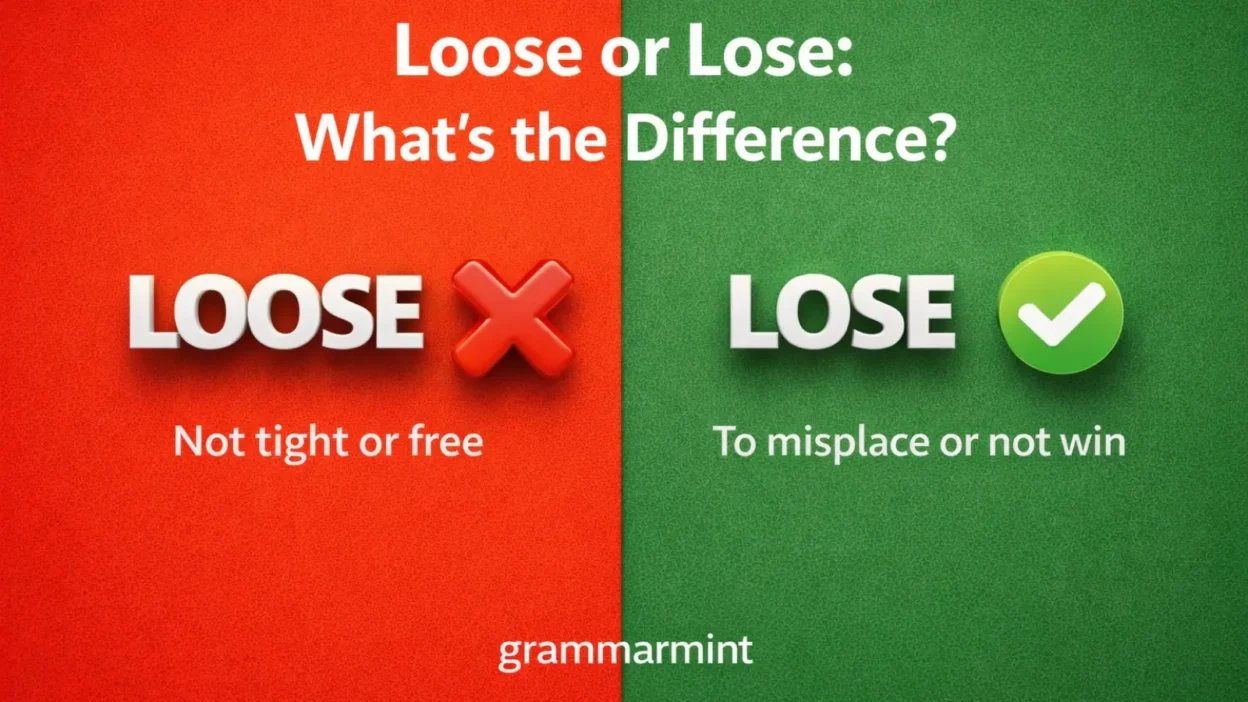
Loose or Lose is simple once you split meaning and grammar. Loose usually means not tight, free, or not firmly fixed. Lose means to misplace something, fail to win, or stop having it.
TL;DR
• Loose usually describes fit, freedom, or slack.
• Lose usually shows misplacing, failure, or loss.
• Use lose with weight, games, keys, and focus.
• Use loose with clothing, screws, knots, and change.
• Loose ends with s; lose ends with z.
Loose Vs Lose Quick Difference
These words look almost the same, but they do different jobs. One usually describes a state. The other usually shows an action.
• Loose describes something not tight.
• Lose means fail to keep.
• Loose often answers what kind.
• Lose answers what happened.
• A belt can feel too loose.
• You can lose your wallet.
• Teams lose games, not loose them.
• Buttons can come loose.
• You lose focus during stress.
• A knot may stay loose.
• You can lose respect fast.
• Start with grammar, then meaning.
What Does Loose Mean
Loose usually works as an adjective. It often means not tight, not fixed, or free to move.
• not tight is the core idea.
• not secure fits many contexts.
• Shirts, screws, and teeth get loose.
• Hair can hang loose naturally.
• Rules can feel loose too.
• Papers may be loose in folders.
• Soil can stay loose after rain.
• A dog might break loose.
• Coins in pockets are loose change.
• Plans can use loose language.
• A knot may sit loose.
• Loose never means misplace something.
What Does Lose Mean
Lose is a verb. It covers misplacing, failing to win, or no longer having something.
• misplace something is one common use.
• fail to win is another meaning.
• stop having also works here.
• People lose keys and passwords.
• Teams lose matches and series.
• Drivers lose control on ice.
• Writers lose track mid-draft.
• Friends can lose contact over time.
• Patients may lose weight gradually.
• Investors can lose money quickly.
• Parents lose sleep with newborns.
• Lose never describes fit.
How To Pronounce Loose And Lose
Sound helps this pair stick. Both words share the long oo sound, but the ending changes.
• Loose ends with a soft s.
• Lose ends with a z sound.
• Loose sounds like moose.
• Lose sounds like snooze.
• Say loose with a crisp hiss.
• Say lose with a buzzing finish.
• The final sound changes meaning.
• Pronunciation helps memory stick.
• Read both aloud twice daily.
• Pause before typing either word.
• Audio learners catch this faster.
• Sound first, spelling second.
Lose Weight Or Loose Weight
This is the most common phrase error. The correct phrase is always lose weight.
• lose weight is always correct.
• loose weight is a misspelling.
• Weight is something you stop having.
• Clothes may become loose later.
• You lose pounds, not loose them.
• The scale tracks weight lost.
• Your jeans may fit looser.
• Doctors discuss losing weight safely.
• Captions often repeat this typo.
• Spellcheck may miss the error.
• Check health posts carefully.
• Remember action first, condition second.
Is Loose Ever A Verb
Yes, but it is rare in everyday American writing. When used as a verb, it means release or set free.
• release is the key verb sense.
• set free is another gloss.
• Archers may loose arrows.
• Sailors may loose a knot.
• Older wording uses this more.
• Modern writing usually prefers loosen.
• Let loose stays very common.
• Set loose also sounds natural.
• Don’t use loose for misplace.
• Rare verb use causes confusion.
• Context usually makes meaning clear.
• In plain prose, choose simpler verbs.
Loose In Common Expressions
Loose shows up in many everyday phrases. These phrases keep the idea of freedom, slackness, or weak control.
• let loose means allow freedom.
• on the loose means roaming free.
• loose change means small coins.
• A loose cannon seems unpredictable.
• Loose ends still need attention.
• A loose fit feels roomy.
• Loose talk spreads carelessly.
• Break loose means escape restraint.
• Hang loose sounds relaxed.
• A loose tooth can wiggle.
• Loose wiring needs repair.
• Loose soil shifts easily.
Lose In Common Expressions
Lose builds many common phrases too. Most of them involve losing control, direction, respect, or calm.
• lose sight of means forget focus.
• lose sleep over means worry too much.
• lose face means lose respect.
• Lose track means stop following details.
• Lose heart means feel discouraged.
• Lose touch means drift apart.
• Lose your temper means get angry.
• Lose your cool means crack emotionally.
• Lose your way means get lost.
• Lose your nerve means feel afraid.
• Lose interest means stop caring.
• Lose out means miss a benefit.
Looser Or Loser
This pair adds a second confusion. One compares fit. The other names a person or side that lost.
• looser means more loose.
• loser means one who loses.
• A looser shirt fits roomier.
• A loser finishes without the win.
• Spellings differ for a reason.
• Pronunciation gets very close here.
• Context saves you again.
• Compare adjectives with looser.
• Name outcomes with loser.
• Never write looser for winner’s opposite.
• Never write loser for better fit.
• Read the full sentence twice.
Losing, Lost, Loose, And Loosen
Nearby forms can blur together fast. Sorting the family makes writing quicker and cleaner.
• losing is the present participle.
• lost is the usual past form.
• loosen means make less tight.
• Losing streak describes repeated defeats.
• Lost keys were once possessed.
• Loosen your tie before dinner.
• Loose is not a tense.
• Lose becomes lost, never loosed here.
• Loosen differs from loose clearly.
• Losing weight changes clothing fit.
• Lost focus can hurt quality.
• Word families reduce mix-ups.
Common Mistakes In Fast Writing
This error usually appears when people type quickly. Because both words are real, a basic checker may let the wrong one slide.
• I loose my keys is wrong.
• My shoes are lose is wrong.
• Use lose for games and goals.
• Use loose for fit and freedom.
• Fix errors during final review.
• Watch captions, comments, and emails.
• Typos spread in copied text.
• Similar-looking pairs trick tired writers.
• Read verbs against the subject.
• Check adjectives near nouns.
• Slow down around double o spellings.
• Keep a personal error list.
Common Sentences With Loose And Lose
Side-by-side examples make the contrast stick. These sentence patterns cover the uses most people actually need.
• The handle feels loose today.
• Don’t lose the receipt again.
• My bracelet came loose yesterday.
• We might lose by halftime.
• Her braids stayed loose all day.
• I never want to lose that photo.
• The dog got loose at dusk.
• He could lose his place in line.
• This hinge seems loose now.
• Try not to lose your notes.
• Their rules feel loose lately.
• She may lose patience soon.
Loose Vs Lose In School And Work
This mix-up looks small, but it can weaken clarity. In class and at work, the wrong word makes polished writing look rushed.
• reports should use the right form.
• emails deserve a final check.
• Teachers notice this confusion quickly.
• Managers may flag it in edits.
• Meeting notes should say lose contact.
• Lab write-ups may mention loose wires.
• Résumés need clean spelling everywhere.
• Assignments lose marks for avoidable errors.
• Professional tone rewards precision.
• Subject lines should stay clean.
• Presentation slides need consistency.
• Shared documents spread mistakes fast.
Loose Vs Lose In Texts And Social Posts
Casual writing moves fast, so the typo appears often. Still, choosing the right word keeps posts and chats cleaner.
• texts often skip careful proofreading.
• captions get posted too quickly.
• Don’t write loose my mind.
• Do write lose my mind.
• Outfit posts may mention loose jeans.
• Sports posts should say lose again.
• Viral jokes repeat common misspellings.
• Auto-correct won’t always rescue you.
• Quick edits help before posting.
• Friends may understand, but notice.
• Clean captions feel more confident.
• Casual doesn’t mean careless.
Similar-looking word pairs can create the same kind of confusion in polished writing. For another easy mix-up, see our clear guide to discrete or discreet so you can choose the right word with confidence.
British And American English Check
This is not a US-versus-UK spelling split. Both varieties use loose and lose for the same core meanings.
• American English uses both normally.
• British English does too.
• Loose keeps the same spelling.
• Lose keeps the same spelling.
• This pair is about meaning.
• It is not a regional swap.
• Dictionaries match on the basics.
• Pronunciation differences stay minor.
• Your audience still expects precision.
• Don’t blame dialect for the typo.
• US editors correct it quickly.
• UK editors correct it too.
Another easy mix-up happens with breath or breathe, where one word is a noun and the other is a verb. If you want cleaner everyday writing, review that pair too so small spelling mistakes do not weaken your message.
Easy Memory Tricks And Practice
A short memory hook can stop repeated mistakes. Practice works best when you tie meaning, sound, and context together.
• Loose has extra room inside it.
• Lose lost an o already.
• Loose goes with room and slack.
• Lose goes with loss and defeat.
• Think moose for loose.
• Think snooze for lose.
• Ask action or description first.
• Test the sentence aloud.
• Replace loose with tight’s opposite.
• Replace lose with misplace or fail.
• Save your favorite trick.
• Practice three pairs every week.
Still confused by the extra “o”? Read our simple guide on loosing or losing to learn when “losing” is correct and why “loosing” is only used for releasing or setting something free.
FAQs
What is the difference between loose and lose?
Loose usually describes something that is not tight, not secure, or free. Lose is a verb that means to misplace something, fail to win, or stop having it. A simple way to check is this: if the sentence needs an action, you probably want lose.
Is it lose weight or loose weight?
The correct phrase is lose weight. You use lose because weight is something you stop having. After that, your clothes may become loose.
Is loose ever a verb?
Yes, but it is uncommon in everyday American writing. As a verb, loose means release or set free, as in loose the dogs or loose an arrow. In most modern sentences, loosen is the clearer choice.
How do you remember lose vs loose?
Use sound and shape together. Loose has extra room because it has an extra o, while lose sounds like snooze and connects to loss or failure. Also ask whether the sentence needs a description or an action.
Is lose always a verb?
In standard everyday use, yes. Lose works as a verb in phrases like lose a game, lose your keys, lose focus, and lose weight. It does not describe something like a shirt or a screw.
How do you use loose and lose in a sentence?
Use loose for condition or fit: The bolt is loose. Use lose for action: Don’t lose the bolt. Putting them side by side helps the difference settle quickly.
Conclusion
Loose or Lose gets much easier once you remember the job each word does.
Use loose for fit, freedom, or slack, and use lose for loss, defeat, or misplacing something.
When you’re unsure, read the sentence aloud and ask whether you need a description or an action.