On To or Onto trips up students, writers, teachers, and anyone drafting emails, essays, slide decks, road directions, or app instructions. The confusion happens because the words sound the same, but they do different jobs. One usually points to movement, direction, and a surface. The other often keeps a phrasal verb intact and leads to a next step or destination. So, if you’ve paused over phrases like move on to, jump onto, log on to, or onto something, this guide will make the choice feel much easier.
Quick Answer
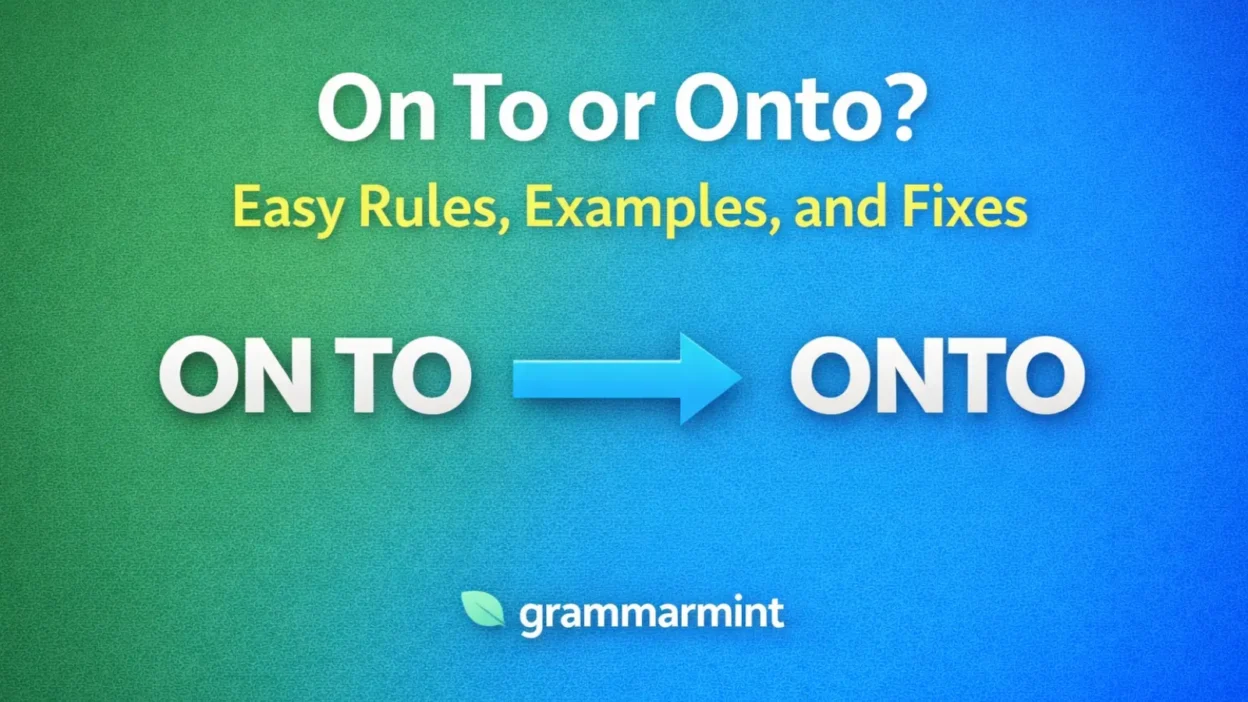
On To or Onto comes down to function. Use onto when something moves to a surface or when the idiom means being aware of something. Use on to when on belongs to a verb phrase, as in move on to, go on to, or log on to.
TL;DR
• Onto usually means movement to a surface.
• On to often follows a phrasal verb.
• Use on to for next-step phrases.
• Use onto for roads, stages, and roofs.
• In formal tech writing, prefer log in to.
• When unsure, try the on/upon test.
On To Vs. Onto At A Glance
These forms look almost identical. Still, the space often changes the meaning.
The fastest way to decide is to ask what the sentence is doing. Is something moving to a surface, or is the sentence continuing an action?
• Onto usually shows movement to a surface.
• On to usually keeps a phrasal verb together.
• Think arrival versus continuation.
• Jump onto the box.
• Move on to the next box.
• Turn onto Maple Street.
• Read on to page ten.
• Step onto the stage.
• Go on to discuss budgets.
• Be onto a secret.
• Switch it on to start it.
• Keep the space when to has work.
What Onto Means
Use this form when movement ends on a surface. That surface can be literal or, sometimes, idiomatic.
In other words, onto is usually a preposition showing direction to a position.
• Onto points toward a surface.
• It often follows movement verbs.
• Climb onto the roof.
• Toss the jacket onto the chair.
• Step onto the platform.
• Roll onto your side.
• Spill juice onto the floor.
• Drive onto the bridge.
• Load boxes onto the truck.
• Move the icon onto the toolbar.
• She was onto the surprise.
• He thinks he’s onto something.
What On To Means
Use the two-word form when on belongs to the verb and to belongs to what follows. The words sit together, but they do not fuse.
That’s why on to shows up so often after a phrasal verb or in a phrase about a next step.
• On to keeps the verb phrase intact.
• It often signals sequence or continuation.
• Move on to chapter two.
• Go on to college.
• Read on to the final page.
• Hold on to your receipt.
• Log on to the portal.
• Pass it on to Maya.
• Turn it on to test power.
• Carry on to the next slide.
• Walk on to the lobby.
• Come on to the hard part later.
Is It On To The Next Or Onto The Next?
This is one of the biggest trouble spots. In most writing, on to the next is the safer choice when you mean continue.
That’s because move on or go on is already doing part of the job.
• On to the next fits continuation.
• Use it for topics, tasks, and pages.
• Move on to the next lesson.
• Let’s go on to the next point.
• Scroll on to the next screen.
• Continue on to the next clue.
• Read on to the next paragraph.
• Shift on to the next case.
• We went on to dessert.
• She moved on to grad school.
• He went on to become mayor.
• Save onto for actual surfaces nearby.
Is It Move On To Or Move Onto?
Both can appear, but they mean different things. That’s the real trap.
Use move on to for progression. Use move onto only when something moves onto a physical surface.
• Move on to means continue forward.
• Move onto means shift onto a surface.
• Move on to the next topic.
• Move on to step three.
• Move on to another question.
• Move onto the marked square.
• Move onto the sidewalk.
• Move onto the loading ramp.
• We moved on to hiring.
• The knight moved onto the board’s edge.
• She moved on to another school.
• The cat moved onto the blanket.
Is It Go On To Or Go Onto?
This pair works much like move on to and move onto. One points to progression, while the other points to a surface.
So, the meaning changes even though the sound barely does.
• Go on to means proceed or later become.
• Go onto means move to a surface.
• Go on to page twelve.
• Go on to discuss pricing.
• She went on to medical school.
• They went on to win.
• Go onto the deck carefully.
• Step onto the dock, then stop.
• The performer went onto the riser.
• We went on to the final round.
• He went on to teach law.
• They went onto the wet grass.
Is It Hold On To Or Hold Onto?
This one is messy because both forms appear in real life. Still, in careful writing, hold on to is usually the safer choice when hold on acts as the verb phrase.
Use hold onto when you truly mean fastening or latching onto something, or when the joined form feels fixed and natural in your sentence.
• Hold on to is the safer formal choice.
• It often means keep or grip.
• Hold on to your ticket.
• Hold on to the railing.
• Hold on to hope.
• Hold on to that email.
• Hold on to your keys.
• Hold onto the ledge tightly.
• The magnet latched onto the fridge.
• The child grabbed onto the bar.
• Writers often split the phrase deliberately.
• In editing, prefer the clearer meaning.
Is It Log On To Or Log Onto?
In formal writing, log on to and log in to are usually preferred. The split form keeps the verb phrase clear.
In casual tech writing, you may still see log onto. Even so, the spaced version reads cleaner.
• Log on to is usually the formal pick.
• Log in to is also widely preferred.
• Log on to the system.
• Log in to your account.
• Sign in to the app.
• Log on to the dashboard.
• Never write login to as a verb.
• Login is usually a noun or adjective.
• Casual copy sometimes uses log onto.
• Edited copy usually splits the phrase.
• Keep manuals and help text consistent.
• Choose one formal pattern and stay steady.
Is It Turn Onto A Street Or Turn On To A Street?
For road directions, turn onto is usually the natural choice. You are moving your car onto a road or street.
By contrast, turn on to can suggest switching something on for a purpose, which is a different idea.
• Turn onto fits road-direction language.
• It signals movement to a roadway.
• Turn onto Pine Avenue.
• Merge onto the freeway.
• Pull onto the shoulder slowly.
• Step onto the path after rain.
• Turn on the light to read.
• Turn it on to check sound.
• Don’t split the road example unnecessarily.
• GPS wording often favors onto.
• Streets behave like destination surfaces here.
• Use the joined form for directions.
Is It On To Something Or Onto Something?
These can both be correct, but the meaning changes fast. So, context matters more than sound.
Use onto something when the idiom means becoming aware or closing in on an idea. Use on to something when on belongs to a verb phrase.
• Onto something often means sensing a clue.
• On to something may stay split by grammar.
• I think you’re onto something.
• She’s onto our plan already.
• The police were onto the scam.
• He put me on to that podcast.
• That teacher turned me on to jazz.
• We moved on to something easier.
• Don’t merge the idiom automatically.
• Ask what meaning the sentence needs.
• Awareness idioms usually favor onto.
• Verb phrases may still need the space.
Using Onto With Roads, Stages, And Platforms
These are some of the clearest physical examples. You can picture the movement, which helps the choice feel obvious.
If a person or object ends up on a surface, onto is usually the better fit.
• Roads can take onto after movement verbs.
• Stages often take onto too.
• Walk onto the stage quietly.
• Hop onto the platform edge carefully.
• Roll onto the court.
• Pull onto the driveway.
• Step onto the porch.
• Slide onto the bench.
• Drive onto the ferry ramp.
• The path leads onto the main road.
• The actor rushed onto the stage.
• The bag dropped onto the platform.
Using Onto With Buses, Trains, And Other Transport
Transport phrases can feel tricky because English sometimes treats vehicles like enclosed spaces and sometimes like surfaces or boarding targets.
Still, when the focus is the motion of boarding, onto often works well.
• Onto often fits the act of boarding.
• Focus on the movement, not the seat.
• Climb onto the bus quickly.
• Step onto the train carefully.
• Load luggage onto the plane.
• Wheel the cart onto the shuttle.
• Push the bike onto the rack.
• Drive onto the ferry.
• Lift the stroller onto the tram.
• The crowd spilled onto the bus.
• Move on to the bus stop next.
• Don’t confuse boarding with later continuation.
The Easy On Or Upon Test
This is the fastest trick for many sentences. It won’t solve every edge case, but it helps often.
If on or upon fits naturally, onto may be right. If the swap breaks the sentence, you likely need on to.
• Try the swap test first.
• Replace onto with on or upon.
• “Jump onto the bed” still works.
• “Move on to the next point” breaks.
• “Turn onto Oak Street” still makes sense.
• “Go on to become famous” cannot swap.
• “Step onto the mat” passes.
• “Hold on to your wallet” fails the merge.
• “Log on to the site” stays split.
• The test helps with road examples.
• It also helps with stage examples.
• Use it after checking the verb phrase.
Common Mistakes And Quick Fixes
Most errors come from hearing the phrase, not seeing the structure. That’s why these mistakes show up in essays, captions, and slides.
The fix is usually simple once you know what the verb is doing.
• Mistake: move onto the next slide Fix: move on to the next slide
• Mistake: go onto page five Fix: go on to page five
• Mistake: log onto your account Fix: log on to your account
• Mistake: hold onto your receipt Fix: hold on to your receipt
• Mistake: turn on to Main Street Fix: turn onto Main Street
• Mistake: step on to the box Fix: step onto the box
• Mistake: onto the next point Fix: on to the next point
• Mistake: I’m on to your trick Fix: I’m onto your trick
• Mistake: put me onto that book Fix: put me on to that book
• Mistake: walk on to the stage Fix: walk onto the stage
• Mistake: go on to the platform Fix: go onto the platform
• Mistake: login to the app Fix: log in to the app
Everyday Examples For School, Work, And Messages
Real examples make this rule stick faster. So, here are short lines you can copy or adapt.
Notice how the meaning shifts as soon as the sentence changes from sequence to surface.
• In class: Move on to question four.
• In notes: Read on to the final section.
• In slides: Let’s go on to the chart.
• In email: I’ll move on to pricing next.
• In chat: Go on to the next thread.
• In a hallway: Step onto the scale.
• At rehearsal: Walk onto the mark slowly.
• At the curb: Pull onto the side street.
• In tech support: Log in to continue.
• In advice: Hold on to that thought.
• In a clue hunt: You’re onto something.
• In directions: Turn onto Cedar after the light.
Formal Writing Tips For Cleaner Sentences
Formal writing rewards clarity. So, when a phrase can look ambiguous, choose the form that makes the sentence easiest to scan.
That usually means preserving the split form after verb phrases and using the joined form for physical movement.
• In careful prose, favor the clearest structure.
• Split verb phrases when grammar calls for it.
• Prefer move on to in reports.
• Prefer log in to in manuals.
• Prefer turn onto in directions.
• Prefer onto something for the idiom.
• Don’t merge just because it sounds smoother.
• Don’t split just because a space looks safer.
• Read the sentence aloud once.
• Then identify the main verb.
• Next, test for surface movement.
• Finally, choose the form by function.
FAQs
What Is The Difference Between Onto And On To?
Use onto for movement to a surface and for the idiom meaning “aware of.” Use on to when on belongs to the verb, as in move on to or go on to. The space matters because the grammar changes.
Is Onto One Word?
Yes. Onto is a single word when it works as a preposition or part of an idiom like onto something. It is not just a casual spelling of on to.
Is It On To The Next Page Or Onto The Next Page?
Use on to the next page when you mean continue reading. Use onto the page only when something physically moves to the page, like ink or a sticker.
Is It Onto The Bus Or On To The Bus?
When the focus is boarding, onto the bus usually works well. When the sentence is really about continuing, you may still need on to, as in move on to the bus stop.
Can I Write Hold Onto In Casual English?
You may see it in casual writing, and many readers will accept it. Still, hold on to is often the safer choice in careful, edited prose because hold on acts like the verb phrase.
Is Log Onto Wrong?
It appears often in casual use, but log on to and log in to are usually better in formal writing. They keep the verb phrase and the following preposition separate, which makes the structure clearer.
Conclusion
On To or Onto gets easier once you stop listening only to sound and start checking function.
Use onto for movement to a surface or the awareness idiom, and use on to when the verb phrase needs the space.
When you pause, test the sentence, then pick the version that makes the meaning obvious.