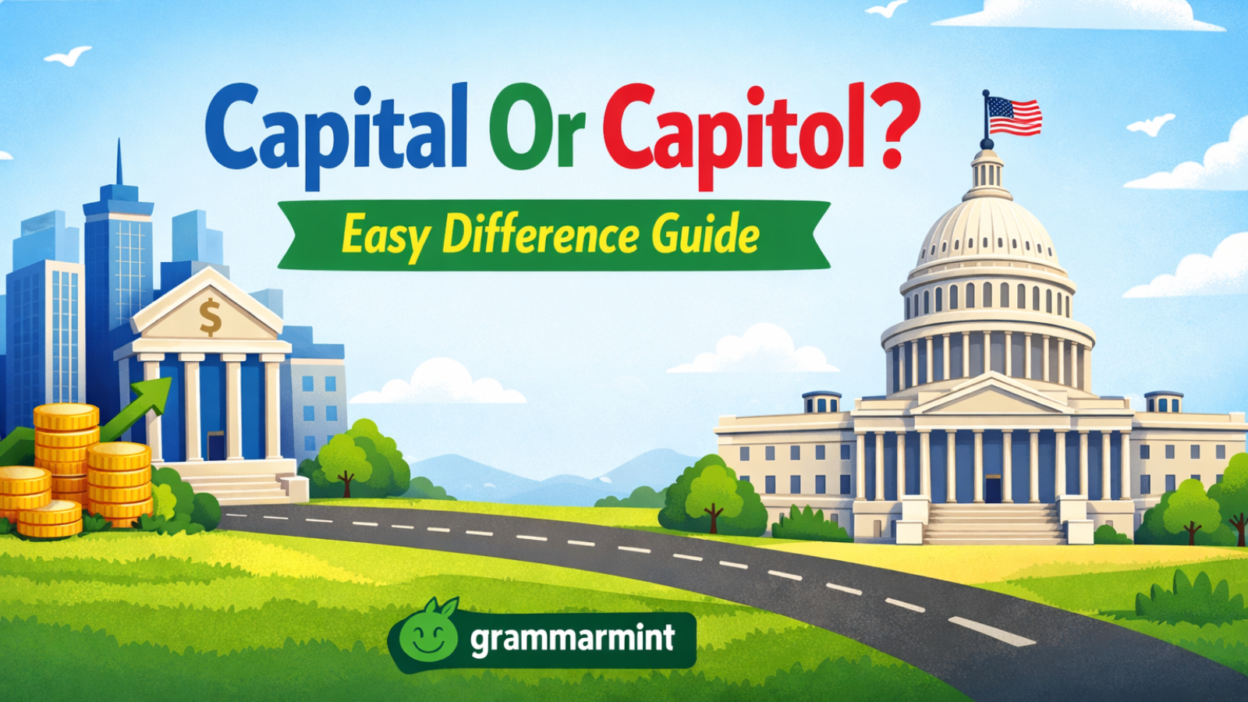
Capital Or Capitol can trip up students, writers, travelers, and even strong editors because the words sound the same but point to different ideas. In everyday English, you might mean a capital city, a state capitol, the U.S. Capitol, a capital letter, Capitol Hill, or even money used as financial capital. That’s why the mix-up keeps showing up in schoolwork, office writing, headlines, and social posts. The good news is that the rule is simple once you tie each word to its job. This guide shows the difference, gives quick memory tricks, and uses clear examples from Washington, D.C., Congress, Albany, and Austin so the choice feels easy next time.
Quick Answer
Capital Or Capitol depends on whether you mean a city or a building. Use capital for a city, money, uppercase letters, or something main. Use capitol only for a legislative building, especially the U.S. Capitol or a state capitol.
TL;DR
• City, money, letters, and “main” use capital.
• Government building use takes capitol.
• Washington, D.C. uses both words correctly.
• Capitol has one narrow meaning.
• The O can remind you of a dome.
What Capital Means
Capital is the broad word. Because it covers several meanings, context matters most.
• capital city means the government seat.
• capital letter means an uppercase letter.
• financial capital means money or assets.
• It can also mean main.
• It sometimes means most important place.
• It can describe major influence.
• It often works as a noun.
• It also works as an adjective.
• Context usually reveals the meaning.
• This is the broader spelling.
• Most uses end with -al.
• Default to capital unless building.
What Capitol Means
Capitol is much narrower. In nearly every normal case, it points to a lawmaking building.
• state capitol names a lawmaking building.
• legislative building is its clearest meaning.
• U.S. Capitol is the famous example.
• It does not mean a city.
• It does not mean money.
• It does not mean uppercase letters.
• It usually appears as a noun only.
• The spelling with O is narrow.
• Many capitols have domes.
• Some states use capitol in official names.
• Generic capitol can stay lowercase.
• Think building whenever you see capitol.
Capital City Or Capitol Building
This is the comparison most readers need first. Once you lock this in, the rest gets much easier.
• capital city is always the correct phrase.
• capitol building names the lawmaking structure.
• seat of government points to the city.
• Albany is New York’s capital.
• New York’s capitol stands in Albany.
• Austin is Texas’s capital.
• The Texas Capitol stands in Austin.
• City equals capital.
• Building equals capitol.
• One place can use both words.
• Don’t write capitol city.
• Don’t write capital building.
Washington, D.C.: One Place, Both Words
Washington, D.C., is the best real-world memory aid. The city uses one spelling, while the famous building uses the other.
• Washington, D.C. is the national capital.
• the Capitol houses Congress.
• Congress meets in that building.
• One city uses both spellings.
• Tourists visit the Capitol.
• Officials work across the capital.
• The capital is larger than one building.
• The Capitol is one landmark.
• Headlines often use both nearby.
• Read the noun after each word.
• D.C. makes the contrast memorable.
• This pair confuses many readers.
State Capital And State Capitol
The same rule works in every state. So, the city and the building can sit together without using the same spelling.
• state capital names the government city.
• state capitol names the legislature’s home.
• legislature points you toward capitol.
• Sacramento is California’s capital.
• California’s capitol is in Sacramento.
• Juneau is Alaska’s capital.
• Alaska’s capitol sits in Juneau.
• Many school quizzes test this pair.
• Maps ask for capitals.
• Civics tours visit capitols.
• Same state, different reference.
• City and building often coexist.
Capital Letters In Everyday Writing
Here, capital has nothing to do with government. Instead, it means uppercase letters in regular writing.
• capital letter means uppercase form.
• proper noun often needs a capital.
• uppercase is another easy clue.
• Monday starts with a capital M.
• Washington starts with a capital W.
• Capitol never means an uppercase letter.
• Grammar class usually teaches this use.
• Text editors flag missing capitals.
• Sentences usually begin with capitals.
• Titles use capitals by style.
• Here, the O spelling never fits.
• Think letters, then choose capital.
Capital As Money Or Resources
Capital also appears in business and economics. In this sense, it means funds, assets, or resources used to build and grow.
• business capital means money for operations.
• start-up capital funds early growth.
• investment language uses capital often.
• The company raised more capital.
• She lacks capital for expansion.
• Venture capital is another common phrase.
• Human capital appears in economics.
• Political capital appears in news.
• Capitol never works in finance.
• Money meanings always take A.
• Business writing favors capital here.
• Read for money-related clues.
Capital As Main, Chief, Or Important
Capital can also work like an adjective. In that role, it often means principal, chief, or very important.
• capital importance means great importance.
• chief is a close meaning.
• principal also fits this sense.
• It can describe the main issue.
• It can describe the leading city.
• Older British English uses capital for excellent.
• “A capital idea” sounds old-fashioned today.
• Capitol never means chief.
• Adjective use often surprises learners.
• Here again, choose the A spelling.
• The context feels abstract, not physical.
• Ask whether a building is involved.
Capital Crime And Capital Punishment
This meaning is serious, but it still follows the same spelling rule. In legal language, capital relates to the death penalty.
• capital crime means punishable by death.
• capital punishment uses the same adjective.
• death penalty explains the idea clearly.
• Legal writing still uses this term.
• Capitol never belongs in criminal law.
• The meaning is serious and specific.
• It connects to penalty, not place.
• News reports still use this wording.
• Students often forget this meaning.
• Here, capital is never a city.
• Still, the spelling remains A-L.
• Law context makes the choice easy.
Capitol Hill And Other Proper Names
This phrase shows why spelling matters in names. It also helps with news reading, because Capitol Hill often stands for Congress itself.
• Capitol Hill refers to the D.C. area.
• Congress is often shorthand there.
• metonym means a name standing for an institution.
• Reporters say Capitol Hill reacted quickly.
• The hill name keeps the O spelling.
• Capital Hill is usually an error.
• The phrase can mean neighborhood or lawmakers.
• Context tells which one fits.
• Headlines use this shortcut often.
• The spelling follows the building’s name.
• Proper names deserve extra attention.
• When in doubt, check the official name.
When To Capitalize Capitol
Spelling and capitalization are related, but they are not the same issue. First choose the right word, then decide whether the name is specific.
• proper noun use often takes capitals.
• lowercase capitol works for generic buildings.
• official building name keeps the uppercase C.
• the Capitol names the U.S. building.
• the Texas Capitol keeps both capitals.
• a state capitol can stay lowercase.
• capitol police often stays lowercase in generic mention.
• Specific agencies may capitalize official titles.
• capital city usually stays lowercase mid-sentence.
• Don’t confuse spelling with capitalization.
• One issue is meaning.
• The other issue is naming.
Common Mistakes And Quick Fixes
Most mistakes come from moving too fast. So, pause and ask one question: do you mean a city or a building?
• common error: writing capitol city.
• edit check: ask city or building.
• context clue: look for lawmakers or maps.
• Wrong: “Paris is the capitol.”
• Right: “Paris is the capital.”
• Wrong: “We toured the capital building.”
• Right: “We toured the capitol building.”
• Wrong: “Use a capitol letter.”
• Right: “Use a capital letter.”
• Wrong: “The firm needs capitol.”
• Right: “The firm needs capital.”
• One question fixes most mistakes.
Easy Memory Tricks That Stick
Memory tricks help because the spellings differ by only one letter. Fortunately, this pair has a very simple one.
• dome trick: the O looks rounded.
• one meaning helps narrow the choice.
• O in capitol can mean one building.
• City, cash, and capitals use A.
• O points to office domes.
• A handles almost every other meaning.
• Memory tricks work best with examples.
• Repeat one city-building sentence daily.
• Pair Albany with its capitol.
• Pair Washington with the Capitol.
• Quick contrasts build long memory.
• Use whichever trick sticks fastest.
Sentence Examples You Can Borrow
Examples make this pair feel natural. Read them out loud, and the pattern becomes easier to remember.
• example sentence practice makes the difference stick.
• sentence pair learning shows contrast clearly.
• usage pattern gets clearer with repetition.
• “Denver is the capital of Colorado.”
• “We visited the capitol after lunch.”
• “Please use a capital letter.”
• “The founders needed more capital.”
• “Housing is a capital concern.”
• “The rally moved toward the Capitol.”
• “Her startup burned through capital quickly.”
• “That was a capital mistake.”
• “The senator returned to the capitol.”
Formal, School, And Workplace Use
This mix-up stands out in polished writing. Because both spellings are real words, spell-check may not save you.
• school writing needs precise word choice.
• formal writing should avoid guesswork.
• workplace email benefits from clean usage.
• Teachers often mark this pair.
• Editors catch it fast.
• Spell-check may miss the error.
• Proofread government references twice.
• Double-check geography homework carefully.
• Use capital for non-U.S. city seats.
• Use capitol for named U.S. legislative buildings.
• Outside the U.S., building names vary.
• Official local names always win.
Mini Practice Check
A quick test helps lock the rule in place. Try each clue, then match it to the right spelling before you look back.
• quick practice helps you self-test.
• self-check starts with one question.
• answer logic comes from context clues.
• The city of France?
• The building in Washington, D.C.?
• Money needed for expansion?
• An uppercase first letter?
• Home of a state legislature?
• The main issue in a report?
• A death-penalty offense?
• If you answered, you already know.
• Match meaning before you spell.
FAQs
What is the difference between capital and capitol?
Use capital for a city, money, uppercase letters, or something main. Use capitol only for a legislative building, especially the U.S. Capitol or a state capitol.
Is Washington, D.C. a capital or capitol?
Washington, D.C., is the capital of the United States. The Capitol is the building in Washington where Congress meets, so both words can be correct in the same sentence.
Is it capital city or capitol city?
The correct phrase is capital city. Capitol refers to a building, not a city, so capitol city is a mistake.
Is Capitol always capitalized?
Not always. Use a capital C when it is part of a specific name, such as the Capitol or the Texas Capitol, but lowercase capitol can work for a generic building reference.
Does capital mean money?
Yes. In business, finance, and economics, capital can mean money or resources used to start, run, or grow something.
How can I remember capital vs capitol?
The easiest trick is the O in capitol. Many people link that O to a rounded dome, while capital handles almost every other meaning.
Conclusion
Capital Or Capitol gets easier once you tie each word to its job.
Use capital for city, money, letters, or “main,” and use capitol for the lawmaking building.
Next time, ask one quick question: city or building?