If you’re writing for U.S. readers and pausing over Mecca or Makkah, you’re really choosing between long-settled English usage and a closer Arabic transliteration. Both forms point to the same holy city in Saudi Arabia, home to the Kaaba, Masjid al-Haram, Hajj, and Umrah, but they don’t carry the same tone on the page. Dictionaries, official Saudi sources, travel copy, religious writing, and everyday English often make different choices. So this guide shows when Mecca still fits, when Makkah is better, and why lower-case mecca is a different word altogether.
Quick Answer
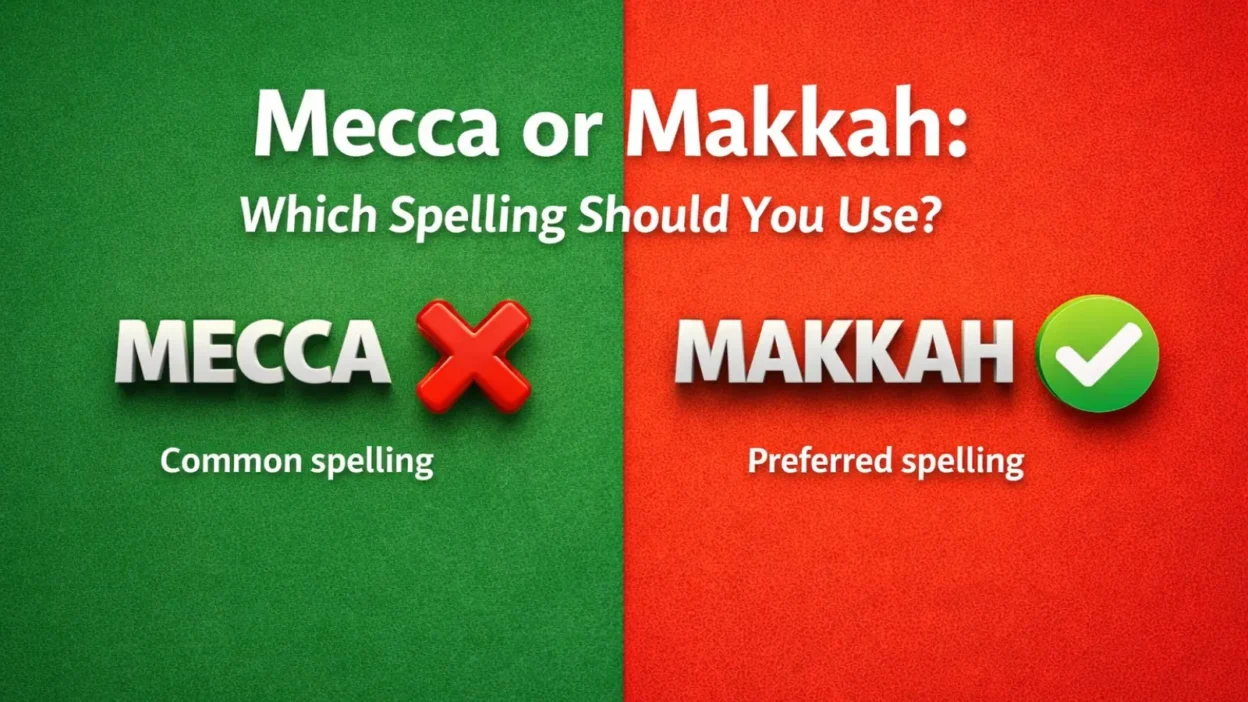
Mecca or Makkah both refer to the same city. Use Makkah in official, religious, or Saudi-linked contexts, and use Mecca when following established English dictionary or general-reference style. Use lower-case mecca only for the figurative noun, as in “a mecca for art lovers.”
TL;DR
• Both forms name the same city.
• Makkah fits official and religious contexts.
• Mecca remains common in English dictionaries.
• Lower-case mecca is figurative, not geographic.
• Pick one form and stay consistent.
Is It Mecca Or Makkah
Start with audience, transliteration, and usage context. Both forms point to the same city, but they signal slightly different writing choices.
• Same city, different English spellings.
• Makkah matches modern Arabic transliteration more closely.
• Mecca remains common in English dictionaries.
• Official Saudi pages use Makkah consistently.
• Religious contexts often favor Makkah now.
• General reference writing still uses Mecca.
• Don’t treat them as separate places.
• Choose by audience, source, and tone.
• For respect-first writing, pick Makkah.
• For older English references, Mecca fits.
• Lower-case mecca changes the meaning.
• The key word is context, not correctness.
Difference Between Mecca And Makkah
At base, this is about general English, official form, and same place. The meaning does not change, but the writing signal does.
• Meaning stays the same in both forms.
• Spelling changes, location does not.
• Makkah mirrors Arabic consonants more closely.
• Mecca reflects older English convention.
• One signals official transliteration.
• The other signals established English usage.
• Muslim audiences may notice the distinction.
• Casual readers often see them as identical.
• Search results still show both forms.
• Maps and books may mix spellings.
• Neither form creates a new city.
• Your audience decides the better pick.
Why Is Mecca Called Makkah
This section is really about Arabic spelling, modern transliteration, and older convention. Over time, English kept one older form while official usage pushed another.
• Makkah comes from Arabic spelling conventions.
• Saudi institutions promote the closer transliteration.
• The doubled k reflects the Arabic sound.
• The final h shows the Arabic ending.
• Older English simplified the spelling earlier.
• Maps, atlases, and encyclopedias shaped Mecca.
• Later official usage pushed Makkah harder.
• Religious organizations helped spread Makkah.
• Writers adopted it for accuracy and respect.
• So both spellings now circulate widely.
• The shift is linguistic, not symbolic alone.
• It’s a transliteration update, not a renaming.
Official Spelling Of Makkah
Here, Saudi government, official transliteration, and Makkah al-Mukarramah matter most. If your source is official Saudi English, the choice is already made for you.
• Saudi government pages write Makkah.
• Official tourism pages write Makkah.
• Municipal pages write Holy Makkah Municipality.
• Royal commission pages use Makkah too.
• The full official form is Makkah al-Mukarramah.
• Hajj and Umrah materials often prefer Makkah.
• Embassy-style or state materials lean official.
• Government documents rarely switch back to Mecca.
• Use Makkah when citing Saudi institutions.
• Use Makkah in pilgrimage logistics copy.
• Use Makkah in formal religious notices.
• Official context is the clearest case.
Mecca Meaning In English
In dictionaries, proper noun, common noun, and dictionary usage all matter. That double life is exactly why this keyword confuses so many writers.
• Dictionaries list Mecca as the city.
• Dictionaries also list mecca figuratively.
• The city sense is a proper noun.
• The figurative sense is a common noun.
• That double meaning drives modern confusion.
• Readers may recognize Mecca instantly.
• Makkah usually signals the city only.
• Mecca can mean place of attraction.
• Context tells readers which sense applies.
• Capital letters matter in this form.
• Dictionary habit keeps Mecca visible.
• English usage widened the word’s range.
Mecca Figurative Meaning
Now the issue shifts to figurative noun, a mecca for, and metaphor. In ordinary English, lower-case mecca has an extended meaning that is separate from the holy city.
• A mecca for jazz fans.
• A mecca for vintage shoppers.
• A mecca for ski lovers.
• A mecca for comic collectors.
• A mecca for food tourists.
• This use is metaphorical, not geographic.
• It usually takes a lower-case m.
• It often needs an article first.
• The phrase means central gathering place.
• It doesn’t literally name Saudi Arabia.
• Some readers still dislike the metaphor.
• Use another phrase when sensitivity matters.
Can Mecca Be Lowercase
This is mostly a lowercase mecca, proper noun, and capitalization problem. One small letter can change the whole meaning.
• Lowercase mecca means the figurative noun.
• Uppercase Mecca means the city name.
• Lowercase Makkah is usually wrong.
• Proper nouns stay capitalized in running text.
• Headlines may use title case instead.
• “A mecca” works better than “the Mecca.”
• Don’t lowercase the city by accident.
• Don’t capitalize the metaphor automatically.
• Capitalization signals meaning before context.
• One letter changes the whole reading.
• Proofread headlines for this specific trap.
• Style consistency matters across one piece.
How To Pronounce Makkah
Writers also worry about Arabic pronunciation, English pronunciation, and sound-spelling. In practice, the spelling you choose often hints at the pronunciation you expect.
• English speakers usually say MEK-uh for Mecca.
• Makkah is often said MAK-uh.
• The Arabic sound sits closer to Makkah.
• Both forms sound familiar in English.
• Don’t over-Anglicize Makkah in religious settings.
• Don’t mock either pronunciation.
• Listen to official audio when needed.
• Copy the source spelling aloud.
• Public readers understand both versions.
• Formal speakers may prefer Makkah.
• Pronunciation choice can signal audience awareness.
• Spelling and sound often travel together.
Mecca And Makkah Same Place
Yes, and that’s the easiest part. Whether you write holy city, Kaaba, or Masjid al-Haram, you are still referring to the same place.
• Yes, they name the same city.
• Both point to Islam’s holiest city.
• Both refer to the Kaaba’s location.
• Both refer to Masjid al-Haram.
• Both appear in English-language discussion.
• Neither describes a nearby district.
• Neither means a separate holy site.
• One city, two common English forms.
• Confusion comes from spelling, not geography.
• Travel routing stays exactly the same.
• Historical writing may favor Mecca.
• Official pilgrimage writing may favor Makkah.
Mecca In The Quran
Here, 48:24, Arabic Makkah, and translation matter. So be precise and don’t flatten everything into one form.
• One translation at 48:24 uses Mecca.
• The Arabic there is Makkah.
• Another verse, 3:96, uses Bakkah.
• Bakkah is treated as related.
• Many translators gloss Bakkah as Makkah.
• So scripture discussion needs precision.
• Don’t say the Quran only uses Mecca.
• Don’t say Bakkah means another country.
• Use verse numbers when nuance matters.
• Religious articles should explain both names.
• General articles can keep the note brief.
• The key point is context again.
Bakkah Vs Makkah
This is where 3:96, Bakkah, and sacred site become important. Still, most everyday writers don’t need to make the distinction unless the discussion is explicitly scriptural.
• Bakkah appears in Qur’an 3:96.
• Makkah appears in Qur’an 48:24.
• Many writers treat Bakkah as an older name.
• Some explain Bakkah more narrowly.
• Bakkah is not a third spelling fad.
• It belongs to scriptural discussion specifically.
• Don’t swap it into ordinary travel copy.
• Don’t use it as a trendy replacement.
• Readers may know it from translation notes.
• Scholars often explain the overlap carefully.
• Everyday English usually stays with Mecca or Makkah.
• Use Bakkah only with clear purpose.
Should I Use Mecca Or Makkah
This is the practical section. Think reader expectation, house style, and consistency, then make one clear choice.
• Pick Makkah for official Saudi references.
• Pick Makkah for pilgrimage materials.
• Pick Makkah for mosque or Islamic education contexts.
• Pick Mecca for general dictionary-style English.
• Pick Mecca when matching older source titles.
• Pick Mecca for broad U.S. readership.
• Avoid mixing forms without reason.
• Match the primary source whenever possible.
• Explain the choice once if needed.
• Then stay consistent throughout.
• Consistency builds clarity for readers.
• Respect and readability can coexist.
Mecca Or Makkah In Formal Writing
In formal prose, citation, transliteration, and style choice should be settled early. After that, the real job is staying consistent.
• Academic religion papers often prefer Makkah.
• History courses may still assign Mecca.
• Citation style may preserve source spelling.
• Your introduction can note both forms.
• After that, choose one house style.
• Formal writing rewards early clarification.
• Footnotes can preserve original titles.
• Body text should stay consistent.
• Religious studies audiences notice transliteration choices.
• General humanities readers recognize Mecca faster.
• Formal prose should avoid casual switching.
• Consistency matters more than fashion.
Mecca Or Makkah In Journalism
Journalists juggle house style, headline clarity, and copy editing. Because of that, the best answer often depends on the outlet, not the writer alone.
• Newsrooms often follow house style.
• Breaking news favors reader recognition.
• Feature writing may prefer source fidelity.
• Quotes should keep the speaker’s form.
• Headlines need the clearest reader cue.
• Travel journalism may lean official.
• International desks may lean Makkah.
• U.S. general news may keep Mecca.
• Copy editors should standardize early.
• One explainer note can prevent confusion.
• Avoid needless alternation in one story.
• Match the outlet’s stylebook first.
Mecca Or Makkah In Travel Writing
Travel copy leans on pilgrimage guidance, official naming, and traveler clarity. So practical writing usually benefits from the official form.
• Use Makkah on official itineraries.
• Use Makkah on booking-related guidance.
• Use Makkah with pilgrimage instructions.
• Use Mecca when summarizing old guidebooks.
• Airport and hotel content may mix forms.
• Map searches may accept both spellings.
• Official attraction names often favor Makkah.
• Traveler FAQs should mention both once.
• Then direct readers with one consistent form.
• Respectful travel copy avoids figurative jokes.
• Sacred-site writing needs extra care.
• Clarity helps visitors more than tradition.
Is Mecca Offensive
This is the most sensitive part, so respect, reader sensitivity, and figurative use matter more than hard rules. The safest answer is nuanced, not absolute.
• Some Muslim readers prefer Makkah strongly.
• Some see Mecca as older English, not insult.
• The figurative noun can feel disrespectful.
• Context changes how the word lands.
• Religious writing should choose carefully.
• Official writing should avoid the debate.
• Makkah is the safer respect-first option.
• Mecca still appears in major dictionaries.
• So offense is not universal.
• Still, sensitivity is worth the effort.
• When unsure, use Makkah for the city.
• Then avoid casual metaphors nearby.
FAQs
Is Mecca the same as Makkah?
Yes. Both forms refer to the same city in Saudi Arabia. The difference is not geography but English convention versus a closer Arabic transliteration.
Why do some people write Makkah instead of Mecca?
They want a spelling that follows official Saudi English and sits closer to the Arabic name. For many readers, it also feels more careful and respectful.
Which spelling is officially used today?
Official Saudi government, municipal, and tourism pages use Makkah. So when you follow official naming, Makkah is the clear choice.
Is Mecca incorrect in 2026?
No. Mecca still appears in major English dictionaries and general reference writing. It is older English, not automatically a mistake.
Can mecca be lowercase?
Yes, but only when you mean the figurative noun, such as “a mecca for collectors.” The city name stays capitalized.
What is the difference between Bakkah and Makkah?
Bakkah usually appears in Quran-focused discussion, while Makkah is the current city spelling used in official English sources. For most everyday writing, your real choice is still Mecca or Makkah.
Conclusion
Mecca or Makkah is not a two-city problem. It’s a context problem.
Use Makkah when you want the safer official or respect-first choice, and use Mecca when you’re following established English reference style. Then stay consistent from the first line to the last.