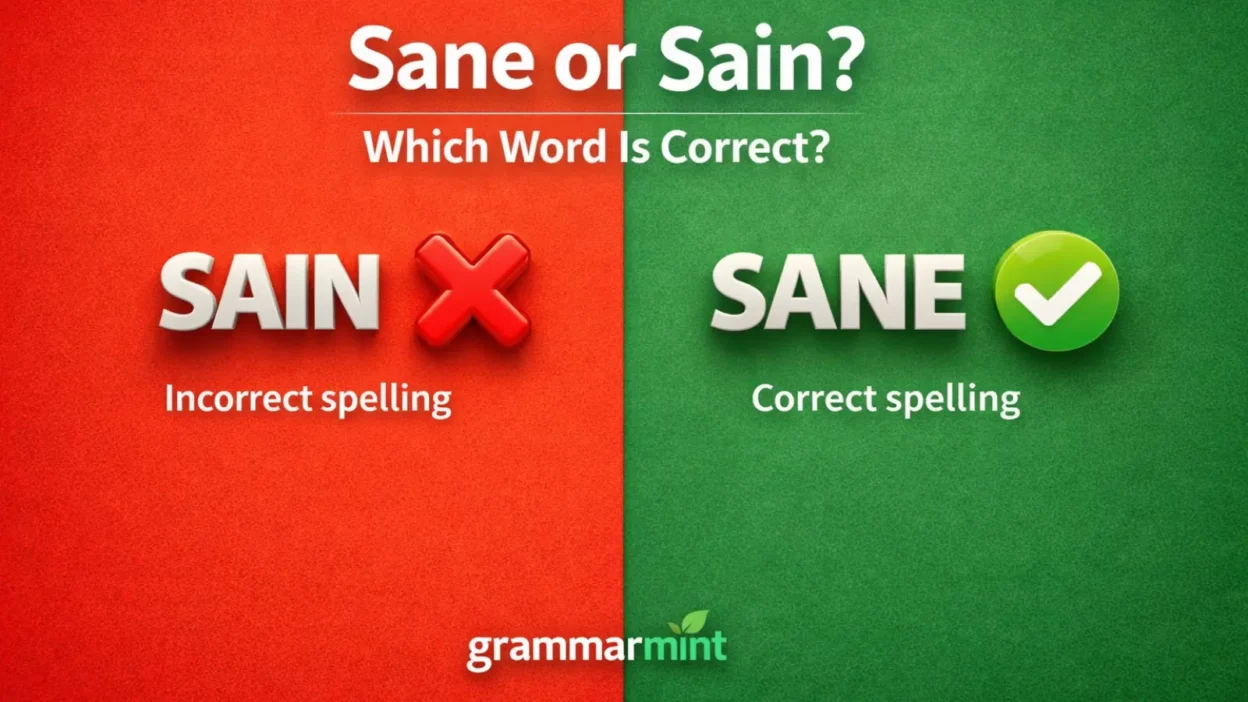
If you want clean, natural American English, Sane or Sain is the kind of spelling choice that can slow you down fast. The words sound alike, but their meaning, usage, pronunciation, grammar role, and tone do not match. One is a standard adjective used in everyday English for someone rational or mentally sound. The other is an archaic, literary, and dialectal verb tied to blessing or making the sign of the cross. So this is not a small spelling tweak. It is a real word-choice split, and modern writing almost always wants one side of it.
Quick Answer
Sane or Sain: use sane in modern English when you mean mentally sound, reasonable, or sensible. Sain is a real but rare old verb meaning to bless or make the sign of the cross, so it is almost never the right choice in everyday American writing.
TL;DR
• Sane is the normal modern spelling.
• Sain is old and uncommon.
• Sane is usually an adjective.
• Sain is usually a verb.
• They sound alike, not mean alike.
• Most writers should choose sane.
Sane Meaning
Sane is a modern adjective in standard English. It usually means mentally sound or simply reasonable in judgment and behavior.
It works in daily speech, school writing, journalism, and professional copy. So this is the word most readers expect.
• Means mentally healthy and clear-minded.
• Also means sensible in judgment.
• Common in modern English.
• Fits casual and formal contexts.
• Often describes a person.
• Also describes plans or choices.
• Can modify advice or policy.
• Frequently appears before nouns.
• Sometimes follows linking verbs.
• Opposite word is often insane.
• Related adverb is sanely.
• Related noun is saneness.
Sain Meaning
Sain is an archaic verb that means to bless or make the sign of the cross. Modern dictionaries also tie it to older dialectal British and Scots use.
So yes, it is real. However, it is far outside ordinary modern American writing.
• Means bless in old usage.
• Can mean mark with the cross.
• Usually functions as a verb.
• Rare in present-day American prose.
• More likely in old stories.
• May appear in folklore writing.
• Can show up in Scots material.
• Sometimes appears as sained.
• Sometimes appears as saining.
• Not a modern spelling swap.
• Many readers won’t know it.
• Use it only intentionally.
Sane Or Sain: The Core Difference
The key split is simple: spelling changes the usage because the words belong to different parts of English. In modern English, sane is the everyday choice, while sain belongs mostly to older, ritual, or literary contexts.
That means this is not like a US-versus-UK variation. Instead, it is a meaning change.
• Sane describes sound judgment.
• Sain names an old blessing act.
• Sane feels current and normal.
• Sain feels historical and marked.
• Sane fits everyday readers.
• Sain fits niche old-style contexts.
• Sane is usually the correction.
• Sain is rarely intended.
• One is common.
• One is specialized.
• One belongs in daily prose.
• One belongs in selected old contexts.
Which Spelling Should You Use
In nearly all everyday cases, the correct form is sane. That is the common word for emails, essays, captions, and everyday writing.
Choose sain only when you truly mean the old blessing sense. Otherwise, readers will assume it is a mistake.
• Pick sane for normal writing.
• Pick sane for modern speech.
• Pick sane in school papers.
• Pick sane in workplace copy.
• Pick sane in text messages.
• Pick sane in headlines.
• Pick sane in blog posts.
• Pick sane in social captions.
• Pick sain only for old meanings.
• Pick sain in deliberate period style.
• Pick sain in ritual discussion.
• Pick sane when unsure.
Is Sain A Real Word
Yes, sain is a real word. Still, dictionaries mark it as dialectal, literary, archaic, or tied to Scots and older British use.
So the better answer is not “fake or real.” It is “real, but rarely the word you want.”
• It appears in major dictionaries.
• It has a long history.
• It predates modern everyday English.
• It survives in older-style sources.
• It can carry religious shading.
• It may sound unfamiliar today.
• It is not internet slang.
• It is not trendy shorthand.
• It is not a typo-only invention.
• It is not common newsroom English.
• It is not standard classroom choice.
• It is real but niche.
Why The Words Sound The Same
These words are a homophone problem. Their pronunciation is effectively the same, so they sound alike even though their meanings differ.
That is why many writers pause when spelling them. The ear alone will not save you here.
• Both are pronounced like “sayn.”
• Sound does not reveal meaning.
• Context must guide the spelling.
• The ear hears no warning.
• The page shows the difference.
• Homophones often confuse writers.
• Fast typing increases the risk.
• Spellcheck may miss intent.
• Pronunciation alone isn’t enough.
• Meaning decides the final spelling.
• Sentence tone gives a clue.
• History explains the split.
Part Of Speech Check
A fast grammar check fixes this mix-up. Sane is usually an adjective, while sain is usually a verb, so the part of speech often decides the answer instantly.
If your sentence needs a describing word, you almost certainly want sane. If it names an old act of blessing, only then does sain fit.
• Sane describes a noun.
• Sain names an action.
• Sane modifies person or thing.
• Sain takes an object more naturally.
• Sane fits after “seems.”
• Sain fits before older ritual objects.
• Sane works with decision.
• Sain works with child or house.
• Sane answers “what kind?”
• Sain answers “what action?”
• Grammar position matters here.
• Label the word before choosing.
Sane In Everyday Sentences
Modern sentence examples show how sane behaves in everyday English. It sounds natural in ordinary, direct, and natural usage.
These short examples reflect how readers usually meet the word today.
• She made a sane choice.
• He seems perfectly sane today.
• That was the sane option.
• We need a sane plan.
• Her reply sounded sane.
• Let’s take a sane approach.
• No sane adult would agree.
• I’m trying to stay sane.
• They offered a sane solution.
• The policy feels sane now.
• His advice was sane.
• We finally reached a sane compromise.
Sain In Historical Or Literary Sentences
Old-style historical writing gives ritual or literary life to sain. In modern prose, though, these uses feel marked and deliberate.
That is why examples with sain usually sound like folklore, poetry, or translated older material.
• They sained the doorway at dusk.
• The mother sained the child.
• He sained the field before planting.
• The poem says she sained them.
• Villagers sained the boats yearly.
• She was saining the cradle.
• The chapel was sained in silence.
• They hoped to sain the house.
• An elder sained the travelers.
• The story mentions sained animals.
• The rite began with saining.
• The ballad preserves that old verb.
Sane Vs Insane
This nearby contrast helps many readers. Sane often works as the opposite side of insane, especially in the broad contrast around judgment or mental state.
Still, everyday writers also use sane more loosely to mean balanced, practical, or sensible.
• Sane and insane form a pair.
• Sane marks the reasonable side.
• Insane marks the opposite extreme.
• Not every contrast is clinical.
• Everyday use often feels broader.
• Sane can mean levelheaded.
• Insane can mean wildly irrational.
• Writers use the pair rhetorically.
• Context affects seriousness and tone.
• Choose neutral wording when needed.
• Balanced can replace sane sometimes.
• Sensible is another softer option.
Sane, Sain, And Seine
Search results also surface a three-way homophones trap: sane, sain, and seine. So the extra word seine can widen the look-alike mix-up for learners and fast writers.
The first means reasonable. The second is old and ritual. The third names a net or the river in France.
• Sane means rational or sound.
• Sain means bless in old English.
• Seine names a fishing net.
• Seine also names the Paris river.
• Sane is the modern adjective.
• Sain is the rare old verb.
• Seine belongs to another meaning set.
• Only sound connects them.
• Context separates all three.
• Spelling carries the burden.
• Don’t guess from pronunciation.
• Read the whole sentence.
Common Mistakes With Sane And Sain
Most mistakes come from hearing the word first and choosing a misspelling later. That turns a basic word choice issue into an avoidable error.
The fix is simple: match the meaning before you type.
• Writing sain for reasonable decisions.
• Using sain in essays by accident.
• Assuming sain is stylish spelling.
• Treating sain like a regional form.
• Forgetting sane has two core senses.
• Missing the adjective-versus-verb split.
• Confusing sain with seine.
• Trusting sound over context.
• Leaving the typo in captions.
• Repeating the error after autocorrect.
• Copying a mistaken post online.
• Ignoring the sentence role.
Formal Writing And School Writing
For formal writing, an essay, or professional material, the safest choice is almost always sane. That is the word educated readers expect in modern edited English.
Using sain by accident can make polished writing look careless. So clarity matters even more here.
• Use sane in academic papers.
• Use sane in business emails.
• Use sane in resumes.
• Use sane in cover letters.
• Use sane in reports.
• Use sane in application essays.
• Use sane in polished website copy.
• Use sane in press statements.
• Avoid accidental sain in headlines.
• Avoid rare forms without purpose.
• Keep wording reader-friendly and clear.
• Edit by checking intended meaning.
British Vs American English
There is no real US spelling versus UK spelling split here. Major entries show the same form for sane in British and American English, while sain remains a separate old word.
So this is not like color/colour. The confusion comes from sound, not regional spelling.
• American English uses sane.
• British English also uses sane.
• Neither standard variety swaps in sain.
• Sain is not a UK default.
• Sain survives in older traditions.
• Region does not change the rule.
• Modern editors expect sane worldwide.
• The spelling answer stays stable.
• Don’t blame the mix-up on dialect.
• This is not a transatlantic split.
• Same modern word on both sides.
• Old word remains separate.
Memory Tricks That Help
A quick memory trick can help you remember the right form before you hit publish. So build a quick cue around meaning, not just spelling shape.
That way, the right word becomes automatic faster.
• Sane starts like sanity.
• Sanity points straight to sane.
• Sain feels ancient because it is.
• Think sain equals sacred old verb.
• Think sane equals sensible now.
• Link sane with sound judgment.
• Link sain with sign of the cross.
• Picture sane in modern emails.
• Picture sain in old ballads.
• Ask which meaning you intend.
• Choose by role, not sound.
• Pause once, then decide.
Final Usage Checklist
Before you publish, run one last checklist. This last check makes “when to use which word” much easier.
If the sentence is modern and ordinary, the answer is usually immediate.
• Do you mean reasonable? Choose sane.
• Do you mean mentally sound? Choose sane.
• Do you mean bless? Choose sain.
• Does the sentence need an adjective? Choose sane.
• Does the line sound historical? Consider sain.
• Is the context everyday? Stay with sane.
• Is the tone literary? Recheck carefully.
• Would most readers know sain? Probably not.
• Are you writing for class? Use sane.
• Are you writing for work? Use sane.
• Are you imitating folklore? Sain may fit.
• Still unsure? Sane is safest.
FAQs
What does sain mean?
Sain means to bless or to make the sign of the cross over someone or something. Modern dictionaries mark it as archaic, dialectal, or tied to older British and Scots use, so most everyday writers do not need it.
Is sain a real word?
Yes, it is real. However, it is rare, old-fashioned, and usually outside normal modern American writing, which is why many people never meet it in daily reading.
What does sane mean?
Sane means mentally sound, or more broadly, reasonable and sensible. In everyday English, the broader “practical” or “levelheaded” sense is very common.
How do you use sane in a sentence?
Use it as an adjective: “That was a sane decision” or “She seems sane.” It works naturally for people, plans, choices, advice, and policies.
How do you pronounce sane and sain?
They are pronounced alike for normal English use, which is why writers confuse them. Because sound will not help much, the sentence meaning has to decide the spelling.
Is sain the British spelling of sane?
No. Standard British English and American English both use sane for the modern adjective. Sain is a separate old word, not a regional spelling variant.
Conclusion
For modern writing, Sane or Sain usually has one clear answer: choose sane.
Use sain only when you truly mean the old blessing sense.
When in doubt, pick the word your reader will understand right away.