If you’re trying to choose between Kurt or Curt, you probably want a fast answer, a few clear examples, and a rule you can trust.
This mix-up happens because Kurt, Curt, and curt sound alike in American English, yet they do different jobs on the page.
One is usually a male name, one can also be a given name, and one is a common word that describes a brief, blunt tone.
So, this guide clears up the spelling, meaning, pronunciation, and real-life use in emails, school writing, name research, and everyday sentences.
Quick Answer
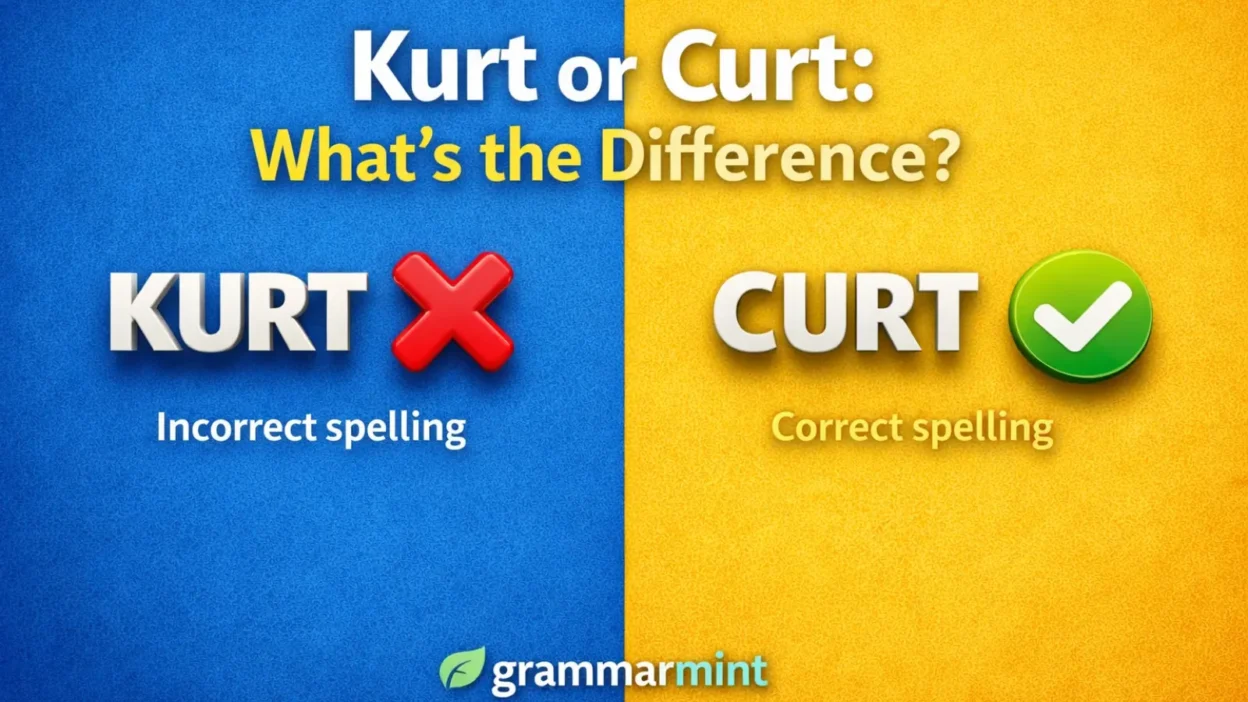
Kurt or Curt depends on what you mean. Kurt is usually a person’s name, Curt can be a person’s name too, and curt is the adjective for speech that feels short or abrupt.
TL;DR
• Kurt is usually a first name
• curt describes a blunt tone
• Curt can also be a name
• All three sound alike in US speech
• Use context, not sound, to choose
• Names get capitals; curt does not
Kurt As A First Name
Kurt is most often a person’s name. So, when you’re talking about someone called Kurt, this spelling is the right choice.
It usually appears with a capital letter. Also, it belongs in name lists, bios, forms, and introductions.
• Male name used for real people
• Given name with a capital K
• Often linked to Conrad roots
• Common in bios and name fields
• Works as a first-name spelling
• Not used for blunt tone
• Seen in family trees
• Fits contact lists and forms
• Appears in signatures
• Used in introductions
• Read as a personal name
• Best when context is a person
Curt As An Adjective
The lowercase word curt is not a person. Instead, it describes speech or behavior that feels brief, sharp, or a little rude.
Sometimes it simply means short. More often, though, it suggests a clipped tone.
• Brief reply with little warmth
• Rude tone caused by shortness
• Close in sense to terse
• Used for speech and behavior
• Often sounds abrupt
• Can describe a nod
• Can describe an email
• Can describe an answer
• Lowercase in normal writing
• Not a substitute for Kurt
• Often negative in tone
• Best for style description
Curt As A First Name
Here’s the part many pages rush past: Curt can also be a real first name. In that case, it is capitalized and treated like any other name.
That means Curt is not always wrong. Instead, it may be a Curtis short form, a name variant, or the exact spelling a person uses.
• Curtis can shorten to Curt
• Name variant used by real people
• Capital C shows name use
• Not automatically a typo
• Can appear on resumes
• Can appear in signatures
• Can appear in family records
• Can be the preferred spelling
• Different from lowercase curt
• Needs respect in personal names
• Must match the person’s spelling
• Works in contact entries
The Simple Rule
Here’s the easiest way to decide. If you mean a person, use Kurt or Curt based on that person’s actual spelling.
If you mean someone’s tone, use curt. So, the choice is really about role, not sound.
• Person equals Kurt or Curt
• Tone equals curt
• Check whether it’s a name
• Check whether it’s descriptive
• Capitals help you decide
• Lowercase usually signals the adjective
• Sound alone won’t help
• Context solves the question
• Read the whole sentence
• Names belong to people
• Adjectives describe behavior
• One quick scan usually fixes it
Pronunciation And Sound
In American English, these forms usually share the same sound. That is why the mix-up happens so often.
On the page, they look different. In speech, however, the ear may not tell you which spelling the speaker means.
• Same sound in common US speech
• American English often merges them
• Not a reliable sound clue
• Listening won’t settle spelling
• Names and adjectives can match
• Writing needs context support
• Homophone-style confusion is common
• Voice notes can mislead spelling
• Dictation may choose wrong
• Auto-correct may guess badly
• Pronunciation stays simple
• Spelling carries the meaning
Meaning And Origin
The meanings split once you look at origin. Kurt is tied to Conrad, while Curt as a name may connect to Curtis or act as a spelling variant.
Meanwhile, the adjective curt comes from a different history tied to shortness. So, the sound overlaps, but the word histories do not.
• Conrad links to Kurt
• Curtis often links to Curt
• Kurt has name-history roots
• Curt can share name-family ties
• The adjective has separate roots
• Similar sound, different paths
• Name history is not tone history
• Origin helps explain confusion
• Spelling signals the role
• Family-name lines can differ
• Names travel across languages
• Meanings stay context-based
When You Mean The Person Kurt
Use Kurt when the sentence clearly points to a proper noun. A capital letter is the first sign that you’re dealing with a person.
This is common in introductions, captions, guest lists, and biography lines. It also shows up in emails when you’re addressing someone by name.
• Proper noun for a named person
• Capital letter marks name use
• Kurt sent the file yesterday
• Kurt joined the meeting early
• I called Kurt after lunch
• We thanked Kurt in person
• Kurt signed the card
• Ask Kurt for the draft
• Kurt is on the guest list
• Kurt liked the final design
• Kurt answered right away
• Use when identity is personal
When You Mean A Short Reply
Use curt when the point is the tone. This is where curt reply and abrupt wording matter.
The sentence is usually about how someone sounded, not what their name was. As a result, lowercase is the safe choice here.
• curt reply describes the tone
• abrupt speech feels clipped
• Her answer sounded curt
• His email felt curt
• The manager gave a curt nod
• She made a curt remark
• The text came off cold
• His response was too short
• The message lacked warmth
• The reply felt impatient
• The tone seemed stiff
• Use for style, not identity
When Curt Is A Person’s Name
This is the easiest exception to miss. When Curt is someone’s real name, it stays capitalized and should never be “corrected” without proof.
So, don’t assume every first name spelling with C is a mistake. In many cases, it is exactly right.
• Real name should stay unchanged
• First name may be Curt
• Not every C spelling is wrong
• Check the person’s profile
• Check the email signature
• Check official documents
• Match the name exactly
• Respect chosen spelling
• Don’t force Kurt onto Curt
• Capitalization matters here
• Context beats guessing
• Editing needs name awareness
Sentence Examples That Make It Clear
Examples help more than rules alone. Once you see the words in full sentences, the contrast gets much easier.
So, read these as pattern guides. After that, the right spelling usually stands out fast.
• Correct usage shows the role
• Context clues do the heavy lifting
• Kurt brought coffee for everyone
• Curt called before the meeting
• Her curt answer ended discussion
• The note sounded curt and cold
• Kurt booked the table
• Curt thanked the host
• His curt text felt dismissive
• The teacher disliked the curt tone
• Kurt waved from the hallway
• Curt smiled and left early
Common Mix-Ups
Most errors happen because people hear the word first and write it later. That leads to misspelling, especially with names and dictation.
Another common issue is assuming Curt must always be wrong. It isn’t. You just need to know whether the sentence is about a person or a tone.
• misspelling by sound alone
• confusion from identical pronunciation
• Writing Kurt for the adjective
• Writing curt for a person
• Lowercasing a real name
• Capitalizing the adjective by mistake
• Trusting auto-correct too much
• Editing without context
• Guessing from memory alone
• Mixing Curt with Curtis carelessly
• Treating every C form as wrong
• Skipping a quick proofread
In Emails And Work Writing
This is where the choice matters most. In professional writing, a wrong spelling can look careless, while a genuinely curt message can sound impolite.
So, slow down with names and tone words in email. A small check can save an awkward impression.
• professional writing needs exact names
• email tone should stay warm
• Kurt approved the budget
• Curt asked for the update
• The reply sounded curt
• Short emails can feel colder
• Add a greeting when needed
• Add thanks for warmth
• Avoid clipped one-line refusals
• Double-check names before sending
• Keep criticism calm and clear
• Brevity should not sound harsh
In School Writing And Editing
In school work, the fix is usually simple: ask what job the word is doing. During proofreading, that one question catches most mistakes.
If it names a person, capitalize it. If it describes speech in an essay or story, use curt.
• proofreading starts with word role
• essay context makes choices easier
• Identify name versus description
• Circle capitalized names first
• Watch dialogue tags closely
• Check character lists carefully
• Fix dictation mistakes early
• Keep adjective forms lowercase
• Review captions and headings
• Ask what the sentence means
• Read the line aloud once
• Then verify on the page
In Baby Name Research
If you’re looking at baby names, the question changes a bit. Here, both Kurt and Curt may be valid, but they do not feel equally common to every reader.
A variant spelling can affect style, familiarity, and how often people ask for clarification. So, this choice is more about taste and identity than grammar.
• baby names bring a different goal
• variant spelling changes the feel
• Kurt may look more familiar
• Curt may feel sharper visually
• Families may prefer one tradition
• Name history can guide choice
• Pronunciation stays mostly stable
• Spelling may need repeating
• Forms should match legal records
• Nicknames may grow from either
• Search both before deciding
• Pick the one you love
Regional And Style Notes
For this topic, there is no big US English rule that says one spelling always beats the other in every case. Instead, the right choice depends on whether you mean the adjective or a person’s exact name.
So, this is more a style note than a regional battle. There is no broad rule where Britain gets one and America gets the other for the core distinction.
• US English keeps the same core rule
• style note beats regional guessing
• Names follow personal spelling
• The adjective stays curt
• No major regional split here
• Capitals remain important
• Context still leads the choice
• Dictionaries agree on curt
• Name sources allow both forms
• Readers expect exact names
• Tone words stay lowercase
• Practical use matters most
Easy Memory Tricks
A quick memory hook can save time. So, use these when you need a fast remember rule.
Think of Kurt and Curt as name tags. Then think of curt as the clipped word for clipped speech.
• remember the role, not sound
• name tag means Kurt or Curt
• Lowercase points to the adjective
• Capitals often mean a person
• curt ends like short, clipped text
• Kurt looks like a contact name
• Curt can sit in a name badge
• Tone words describe behavior
• Names belong in introductions
• Adjectives belong in descriptions
• Ask who or what
• Then choose the spelling
FAQs
Is there a difference between Kurt and Curt?
Yes. Kurt is usually a first name, while Curt can also be a first name. The lowercase word curt is the adjective for speech that feels brief or blunt.
What does curt mean in English?
It means short in a way that can sound abrupt or rude. In everyday writing, it often describes replies, remarks, emails, or gestures.
Is Kurt a real name?
Yes. Kurt is a well-established masculine given name. It is commonly treated as a form connected with Conrad in name references.
Is Curt a name or just an adjective?
Both forms exist, but they are different on the page. Curt with a capital C can be a real name, while curt in lowercase is the adjective.
How do you pronounce Kurt and Curt?
In American English, they are usually pronounced the same way. That shared sound is a big reason people confuse the spellings.
Is Curt short for Curtis?
Often, yes. Curt can work as a short form of Curtis, though some people simply use Curt as the full first name.
Conclusion
Kurt or Curt gets easy once you check the sentence job.
Use Kurt or Curt for a person, and use curt for a short, blunt tone.
When in doubt, look for capitals, context, and the writer’s intended meaning.