“Effect” and “affect” confuse almost everyone at some point. They look similar, sound alike, and both relate to results or influence. So when people write the phrase “to that effect,” it’s easy to second-guess and type “to that affect” instead.
You’ll see this phrase in casual messages, blog posts, school essays, workplace emails, and even news quotes. The mix-up usually happens because writers remember the common “affect vs effect” rule but aren’t sure how it applies to this set phrase.
This guide explains which version is correct, why only one works, how the phrase is used in American English, and how to avoid common mistakes in both casual and professional writing.
Quick Answer
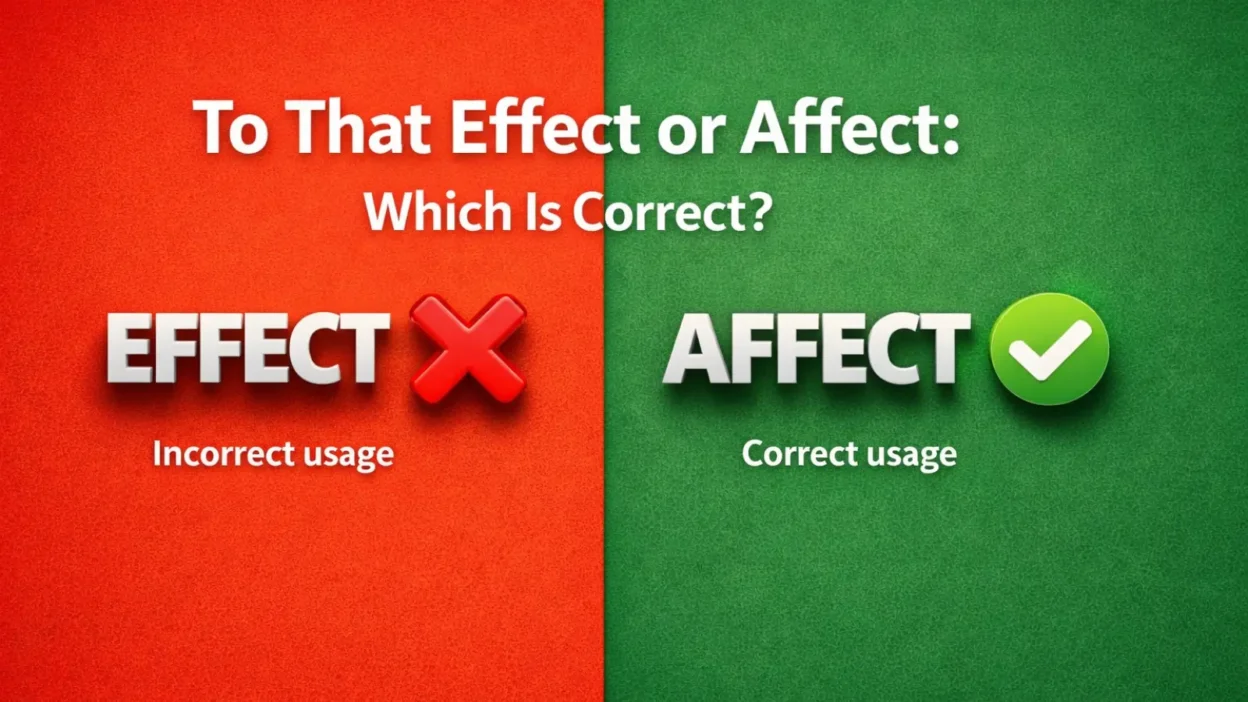
The correct phrase is “to that effect.”
“To that affect” is incorrect in standard American English. In this expression, “effect” is a noun meaning result or meaning. The phrase is fixed, and only “effect” fits.
Key Differences at a Glance
• “To that effect” is a standard idiomatic phrase.
• “To that affect” is a spelling error in this context.
• “Effect” here means meaning, result, or intent.
• “Affect” is usually a verb meaning to influence.
• The phrase does not change between US and UK English.
Origin and Why Two Forms Exist
The confusion comes from the broader “affect vs effect” problem.
In American English, “affect” is most often a verb. It means to influence something. For example: “Lack of sleep can affect your mood.”
“Effect” is usually a noun. It refers to a result or outcome. For example: “The new policy had a positive effect.”
The phrase “to that effect” uses “effect” as a noun. It means “with that meaning” or “producing that result.” The phrase has long been used in formal and informal writing.
“Affect” can be a noun in psychology, where it refers to emotional expression. But that meaning does not apply in this phrase. That’s why “to that affect” doesn’t work.
British vs American English
There is no regional difference here.
Both American and British English use “to that effect.” Neither variety accepts “to that affect” as standard.
If you see “to that affect,” it’s almost certainly a typo or misunderstanding, not a regional variation.
Which One Should You Use?
For everyday casual use
Use “to that effect.” It works naturally in speech and writing.
For child-directed or simplified language
You can use “to that effect,” but you might simplify the wording. For example: “He said something like that.”
For professional or academic contexts
“To that effect” is acceptable, especially when summarizing what someone said. Still, in formal writing, you may prefer clearer alternatives such as:
• “meaning that…”
• “indicating that…”
• “stating that…”
These options often sound more direct and precise.
Common Mistakes (and Quick Fixes)
• Mistake: Writing “to that affect” in an email.
– Fix: Replace “affect” with “effect.”
• Mistake: Assuming both are correct spellings.
– Fix: Remember the phrase is fixed. It always uses “effect.”
• Mistake: Confusing the verb “affect” with the noun in this phrase.
– Fix: Ask yourself: Is this about influence, or about meaning/result?
• Mistake: Overusing the phrase in formal reports.
– Fix: Consider clearer wording like “which means that…”
• Mistake: Writing “to the affect of.”
– Fix: The correct form is “to the effect of.”
• Mistake: Mixing up “effect” and “affect” in nearby sentences.
– Fix: Check each word’s role separately before submitting.
Everyday Examples (Real Contexts)
Informal message
“He said he might quit, or something to that effect.”
Social media post
“The coach hinted at changes, or words to that effect.”
Parenting context
“She told her brother to stop, or something to that effect.”
Workplace email
“The manager mentioned budget cuts, or something to that effect.”
More professional rewrite
“The manager indicated that budget reductions may be necessary.”
Usage and Trends
Across modern grammar references and writing guides, “to that effect” is consistently presented as the correct form. The version with “affect” is flagged as an error.
Search suggestions and writing tools commonly highlight “to that effect” as the standard phrase. The incorrect version often appears in correction articles, showing that people frequently make the same mistake.
This pattern suggests the confusion is ongoing, but the rule itself is stable and clear.
Comparison Table
Context | Best Choice | Why
Casual conversation | To that effect | Standard idiom; sounds natural
Text message | To that effect | Common spoken-style phrase
Work email | To that effect | Acceptable when summarizing
Academic paper | Usually avoid | Clearer phrasing is often better
Legal or formal writing | Often avoid | Direct wording is preferred
Correcting a typo | To that effect | Only standard form
FAQs
Is it something to that effect or affect?
The correct phrase is “something to that effect.” The version with “affect” is incorrect in standard English.
What does “to that effect” mean?
It means “with that meaning” or “producing that result.” It’s often used when paraphrasing what someone said.
Can “to that affect” ever be correct?
No, not in standard usage. Even though “affect” can be a noun in psychology, it does not fit in this phrase.
Is “to the effect of” correct?
Yes. “To the effect of” is also correct and means nearly the same thing.
Why do people confuse affect and effect here?
Because both words sound similar and are often mixed up. Many people remember the general rule but apply it incorrectly to this fixed phrase.
Mini Quiz
- He said he was busy, or something to that ______.
- The notice was posted to that ______.
- Is “to that affect” standard English?
Answer Key
- effect
- effect
- No
Conclusion
When choosing between To That Effect or Affect, the answer is simple: only “to that effect” is correct.
The confusion comes from the broader affect vs effect problem. But this phrase is fixed and does not change.
When in doubt, think meaning or result — and choose “effect.” If you want to be extra clear, rewrite the sentence directly.