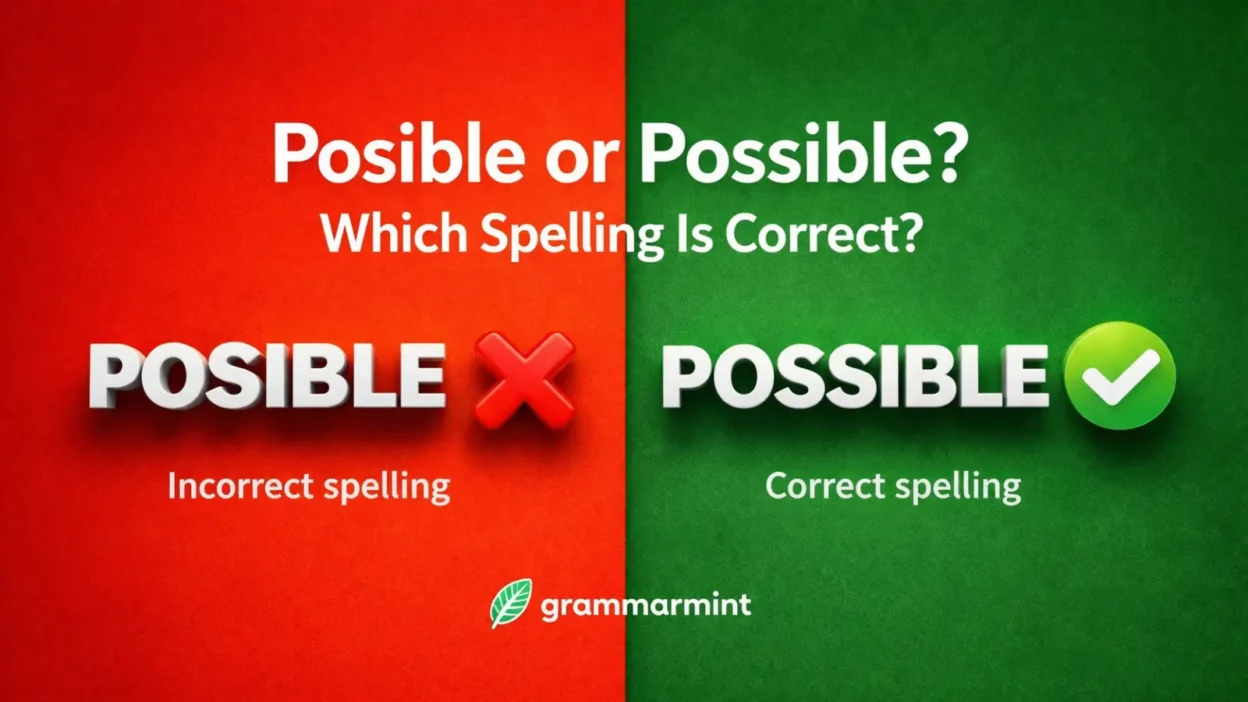
If you’re writing for school, work, or everyday messages, you want the correct form fast.
Posible or Possible is a common spelling question, especially for learners, fast typists, and anyone who has heard the word more often than they’ve seen it written.
In English, the standard spelling is possible, and it means something can happen, exist, or be done.
Dictionaries and current usage pages consistently list possible as the English form, while posible shows up mainly as Spanish or as a name in some non-dictionary uses.
Quick Answer
Possible is the correct English spelling. Posible is usually a misspelling in English, though it can be correct in Spanish or appear as a brand name.
TL;DR
• Possible is correct in English
• Posible is usually wrong in English
• Possible is an adjective
• It means can happen or be done
• Possibly is different from possible
• The double s matters
Posible Or Possible
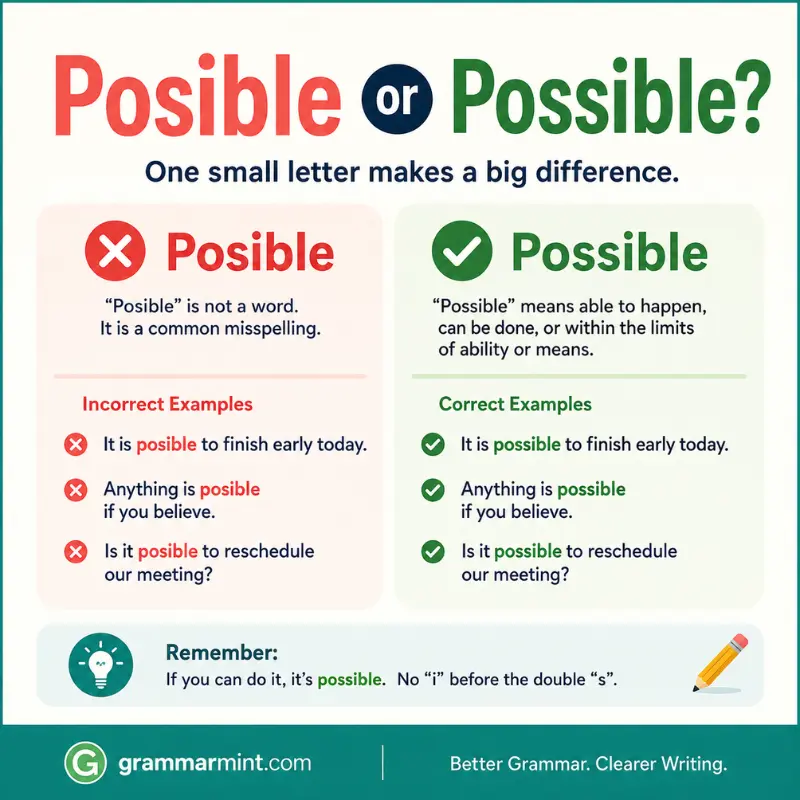
This is the answer most readers want first. In standard English, possible is the right spelling, not posible.
You’ll see this question because the word can sound quick in speech. Still, standard dictionaries list possible with a double s.
• Possible is the correct spelling
• Posible is a common typo
• Use possible in school writing
• Use possible in work emails
• Use possible in captions too
• The double s is required
• One s changes the spelling
• English dictionaries favor possible
• Spellcheck usually flags posible
• Native speakers still mistype it
• Fast typing causes this error
• The safe choice is possible
Is Posible A Word

This part needs one helpful nuance. In English, posible is usually treated as an error, but in Spanish, posible is a real word. Search results also show it as a brand or app name in some cases.
So the answer depends on language and context. For normal English writing, though, you should still choose possible.
• In English, posible is usually wrong
• In Spanish, posible is valid
• Brand names can use unusual spellings
• Context always matters here
• English essays need possible
• English emails need possible
• Text messages still need possible
• Don’t copy Spanish spelling by accident
• Check the language first
• Check the audience too
• Dictionaries guide standard English
• Everyday English uses possible
How To Spell Possible
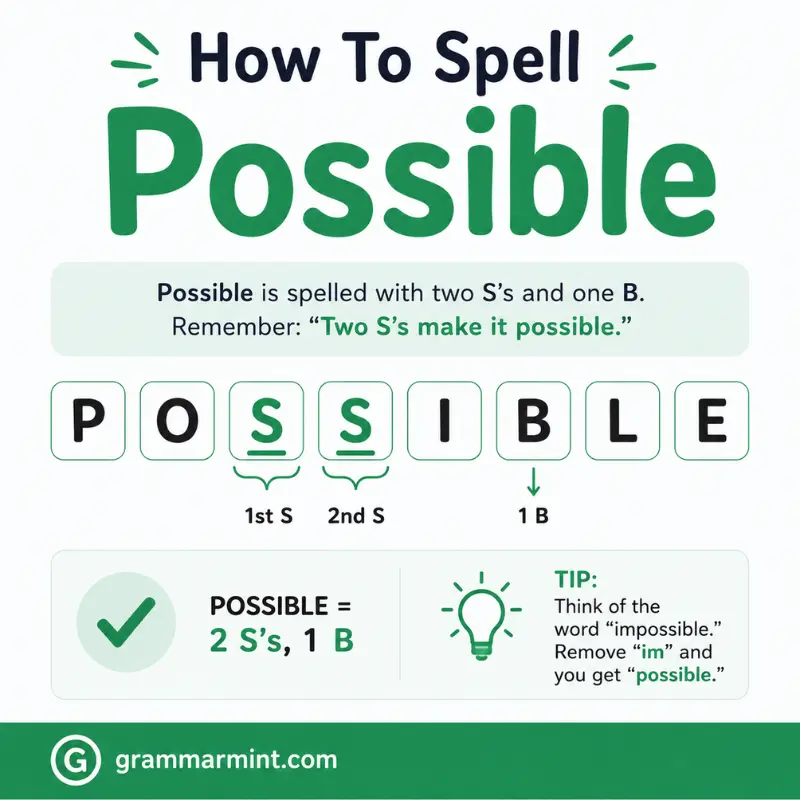
The correct letter pattern is simple once you slow down. Write p-o-s-s-i-b-l-e.
A lot of people drop one s. That’s the mistake to watch for.
• Spell it p-o-s-s-i-b-l-e
• Keep the middle ss together
• End with -ible, not -able
• Say it slowly while typing
• Check the center letters
• Watch for missing s
• Don’t rush the word
• Copy the standard pattern
• Save it in memory early
• Practice it three times
• Use it in real sentences
• Proofread before you send
Possible Meaning
The word possible means something can happen, can exist, or can be done. Major dictionaries define it around ability, likelihood, or feasibility.
It often appears when you’re talking about options, chances, or limits. That makes it useful in both casual and formal English.
• It means something can happen
• It means something can be done
• It can describe a real option
• It can describe a likely chance
• It can describe an allowed outcome
• It often shows uncertainty
• It can soften a statement
• It can suggest opportunity
• It can describe a solution
• It can describe a future event
• It works in daily English
• It works in formal English
Possible Pronunciation
One reason people misspell this word is sound. Cambridge shows possible with three syllables and stress near the start.
In fast speech, the middle sounds can blur. That’s why spelling from memory matters.
• Say it as three syllables
• Stress the first part
• The ending sounds soft
• The middle may sound quick
• Fast speech hides one s
• Clear speech helps memory
• Listen before you repeat
• Repeat it out loud
• Link sound with spelling
• Practice American pronunciation
• Practice careful reading aloud
• Check audio if needed
Possible In A Sentence
The easiest way to learn a word is to use it. Dictionary example pages show possible in many natural sentence patterns.
Most of the time, it fits before a noun or after a form of be.
• It is possible to finish today
• That is one possible answer
• We explored every possible route
• A possible delay was announced
• Is it possible to reschedule?
• Please reply as soon as possible
• That outcome seems possible now
• We need the best possible plan
• A storm is possible tonight
• She offered a possible solution
• This is not possible yet
• Success is still possible
Possible Vs Possibly
This is a nearby confusion worth clearing up. Possible is an adjective, while possibly is an adverb. Collins’ grammar guidance reflects that basic difference.
Use possible to describe a noun or state. Use possibly to modify a verb, adjective, or whole idea.
• Possible describes a thing
• Possibly describes how or maybe
• A possible answer works
• It could possibly work
• Possible fits before nouns
• Possibly often fits before adjectives
• Possible names an option
• Possibly signals uncertainty
• Don’t swap them blindly
• Read the full sentence
• Check what the word modifies
• Grammar changes the choice
Is Possible An Adjective
Yes, possible is mainly an adjective in standard English dictionaries. It describes what may happen, what may be true, or what can be done.
That part-of-speech clue helps you place it correctly in a sentence.
• It is mainly an adjective
• It describes nouns clearly
• It follows forms of be
• It can appear before nouns
• It can describe outcomes
• It can describe actions indirectly
• It can describe solutions
• It can describe plans
• It can describe chances
• It is not usually a verb
• Grammar guides word choice
• Sentence structure matters
Why Possible Has Double S
English spelling is not always fully phonetic. Some pages explain the pattern through the word’s older root and its -ible ending, which helps explain why the double s stays in place.
You do not need to memorize the full history. Still, knowing the double s belongs there helps prevent the typo.
• The word keeps a double s
• The pattern is standard English
• The ending is -ible
• It is not possable
• It is not posible
• History helps explain spelling
• The root pattern stayed stable
• Many learners drop one letter
• Keep both middle s letters
• The full form looks balanced
• Visual memory helps here
• Repetition locks it in
Common Misspellings Related To Possible
Once you know the right form, it becomes easier to catch nearby errors. Some misspellings change the middle letters, and others change the ending.
These mistakes look familiar at a glance. That is why a final proofread matters.
• Posible drops one s
• Possable changes the ending
• Possibel scrambles the ending
• Posibble adds the wrong pattern
• Possibl misses the last letter
• Possibile adds an extra vowel
• Porssible adds a wrong consonant
• Possbile flips letter order
• Poosible doubles the wrong vowel
• Pssible drops the vowel
• Possiblee adds an extra ending
• Possoble swaps a vowel
Common Phrases With Possible
A big reason this word matters is frequency. It appears in common expressions that you’ll use again and again, such as as soon as possible, if possible, and whenever possible. Major dictionaries list these phrases and examples.
These set phrases are worth learning as complete units. They sound natural and polished.
• As soon as possible means quickly
• If possible means if it can happen
• Whenever possible means when you can
• Humanly possible means within limits
• Best possible shows the top outcome
• Worst possible shows the lowest outcome
• Possible solution is very common
• Possible reason fits many contexts
• Possible change sounds natural
• Possible problem is common too
• Possible result works in reports
• Possible answer fits school writing
Using Possible In Formal Writing
This word works very well in professional English. It sounds clear, polite, and measured, which is useful in emails, reports, and academic work.
It also helps you avoid sounding too absolute. That softer tone is often better in formal situations.
• It sounds polite in emails
• It softens direct claims
• It fits reports well
• It fits meeting notes
• It works in proposals
• It works in updates
• It supports careful wording
• It avoids overpromising
• It sounds professional
• It fits academic writing
• It helps express uncertainty
• It keeps tone balanced
Possible Vs Probable
These two words are related, but they are not the same. Grammarly’s usage note makes the key idea clear: possible means something can happen, while probable suggests it is more likely.
That distinction helps you choose the stronger or softer word.
• Possible means it can happen
• Probable means it likely will
• Possible is broader
• Probable is narrower
• Not all possible things are likely
• Probable suggests stronger expectation
• Choose based on certainty
• Use possible for caution
• Use probable for stronger confidence
• Don’t treat them as identical
• Context decides the better fit
• Precision improves your writing
Words Related To Possible
Building a small word family helps memory. Thesaurus and dictionary pages connect possible with nearby words like feasible, achievable, and potential, though each carries its own shade of meaning.
These related words are useful, but they are not perfect substitutes every time.
• Feasible suggests practical success
• Achievable stresses reachability
• Potential suggests future ability
• Conceivable sounds more abstract
• Viable suggests it can work
• Attainable suggests reachable goals
• Practicable sounds more formal
• Reasonable is not identical
• Probable is not identical
• Certain is much stronger
• Impossible is the direct opposite
• Nuance changes the best choice
Why Writers Mix Up Posible And Possible
The mistake usually comes from speed, sound, or language transfer. Because the word is pronounced smoothly, one s can disappear in a writer’s head.
This also happens when someone knows Spanish or has seen a similar-looking form elsewhere. So the error is common, but easy to fix.
• Fast typing drops one letter
• Speech can blur the middle
• Memory may simplify spelling
• Spanish influence can matter
• Similar words can confuse learners
• Autocorrect is not perfect
• Small screens increase mistakes
• Tired writers miss doubles
• Repetition can hide typos
• Familiarity creates overconfidence
• Reading too fast hurts accuracy
• Final review prevents most errors
Easy Ways To Remember Possible
The best memory tricks are simple. Focus on the double s, the -ible ending, and one or two common phrases.
Once the pattern feels familiar, your hand will start writing it correctly without effort.
• Think po-ss-ible as chunks
• Remember the middle ss
• Pair it with impossible
• Notice both share double s
• Learn as soon as possible
• Write it three times daily
• Save a correct example
• Check it in your notes
• Circle the correct form
• Read it aloud slowly
• Use spellcheck, then verify
• Proofread every important message
FAQs
Is posible or possible correct?
Possible is correct in standard English. Posible is usually a misspelling in English, though it can be correct in Spanish or appear as a brand name.
Is posible a word in English?
In normal English writing, it is usually treated as an error. For standard English, dictionaries and usage sources point to possible instead.
How do you spell possible?
You spell it p-o-s-s-i-b-l-e. The two details people most often miss are the double s and the -ible ending.
Is possible an adjective?
Yes. Possible is an adjective that describes something that may happen, may be true, or can be done.
What is the difference between possible and possibly?
Possible is an adjective, while possibly is an adverb. Use possible to describe a thing or outcome, and possibly to show uncertainty or modify another part of the sentence.
How do you use possible in a sentence?
You can use it after be or before a noun, such as “It is possible to leave early” or “That is one possible answer.” Dictionary sentence pages show both patterns clearly.
Conclusion
If you’re choosing between Posible or Possible, the correct English spelling is possible. Learn the double s, remember the -ible ending, and use one or two common phrases to lock it in.