If you’ve ever typed “thier” and wondered whether it looked right, you’re not alone.
Many learners and native speakers mix up small words like this when writing quickly.
In English, tiny differences in spelling can change whether a word is real or just a typo.
The confusion around “thier” vs. “their” often appears in school work, text messages, blog posts, and social media.
Getting it right matters when you want clear, polished writing, especially in academic or professional notes.
This guide explains which form is right, why that’s the case, everyday examples you can use, common mistakes, and simple ways to remember the correct spelling so you feel confident every time you write.
Quick Answer
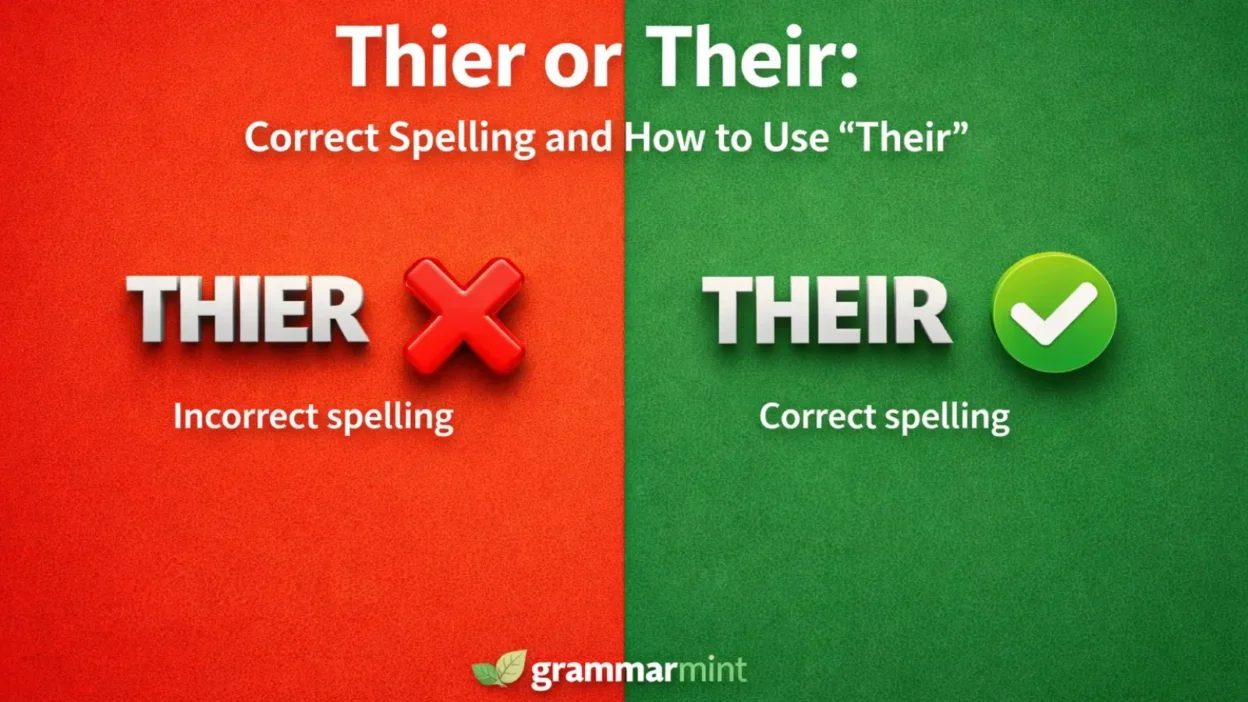
“Thier” is not a correct English word. The correct spelling is their, which is a possessive pronoun showing that something belongs to “them” or is associated with them. You should always use “their,” not “thier.”
Key Differences at a Glance
Feature | “thier” | “their”
• Meaning | None — it’s a mistake | Possessive form of “they”
• Usage | Incorrect | Correct before a noun (“their books”)
• Found in dictionaries? | No | Yes
• Everyday example | Thier idea was good (wrong) | Their idea was good (right)
Why “Their” Is Correct
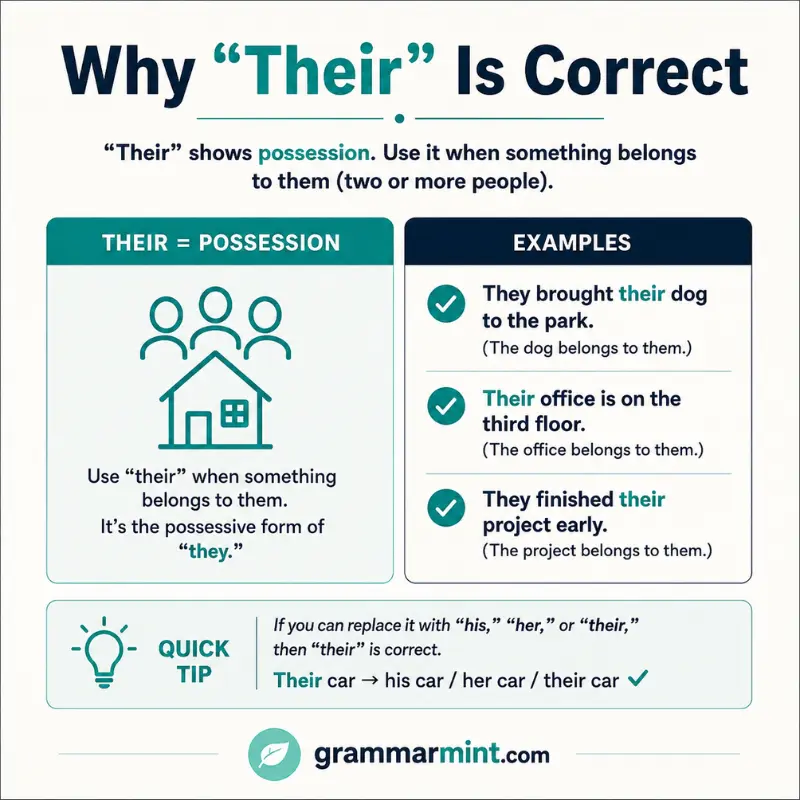
The word their is a third-person plural possessive pronoun. That means it shows that something belongs to or relates to a group of people or things previously mentioned. You can often link it to the pronoun “they.” A simple way to check is to ask: Does this word show ownership? If yes, “their” is the word to use.
“Thier” appears when writers follow the old memory rhyme “I before E except after C.” But since English has many exceptions, that rhyme often leads people wrong. “Their” is one of those exceptions — the correct form is always with E before I after the initial letter T.
American vs Other English
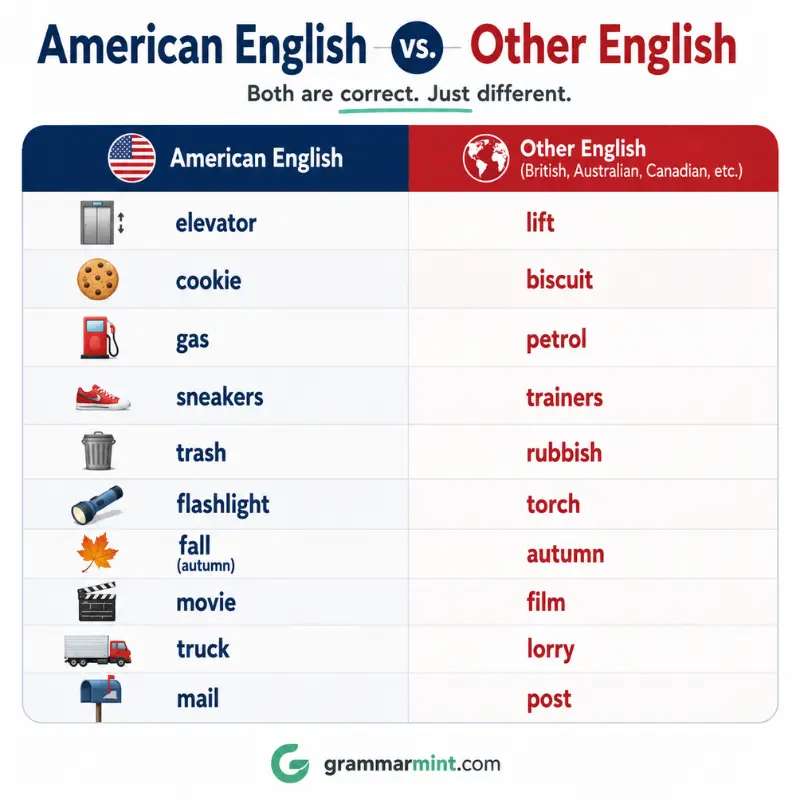
There is no regional difference for “their” vs “thier.” Across American, British, and other major varieties of English, their is the correct possessive form of “they.” Misspelling it as “thier” is a universal anomaly. Sources agree that “thier” has no recognized status in standard English.
Which One Should You Use?
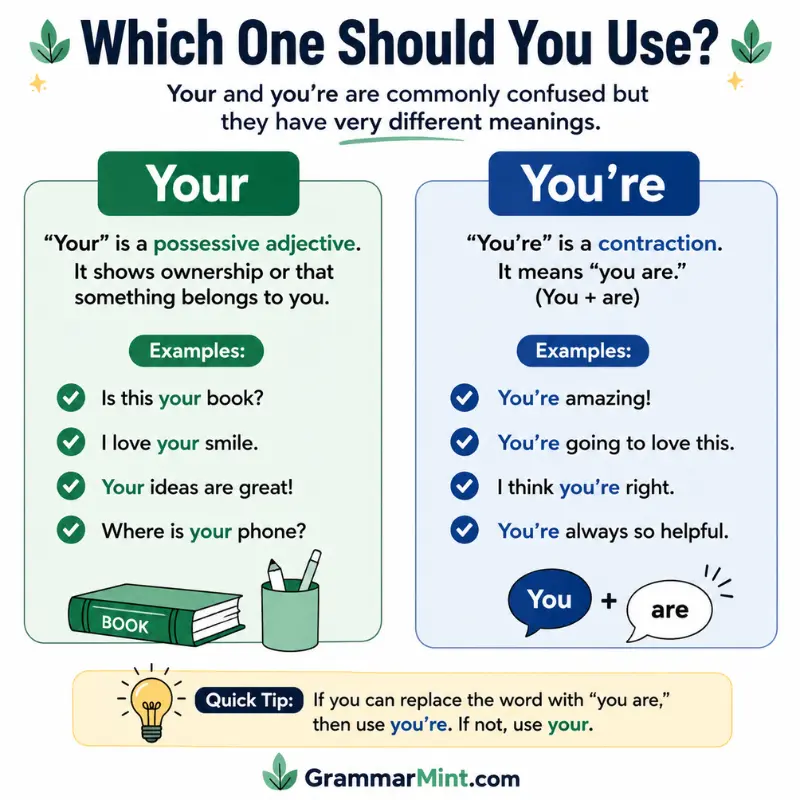
• Casual writing: Always use “their” when showing ownership, even in texts and notes.
• Academic and professional writing: “Their” is appropriate for plural ownership. Avoid “thier” as it will be seen as an error.
• When gender is unknown: Modern American usage accepts “their” for a singular antecedent (“Someone left their bag”) for inclusivity.
Thier or Their: Which Spelling Is Correct?
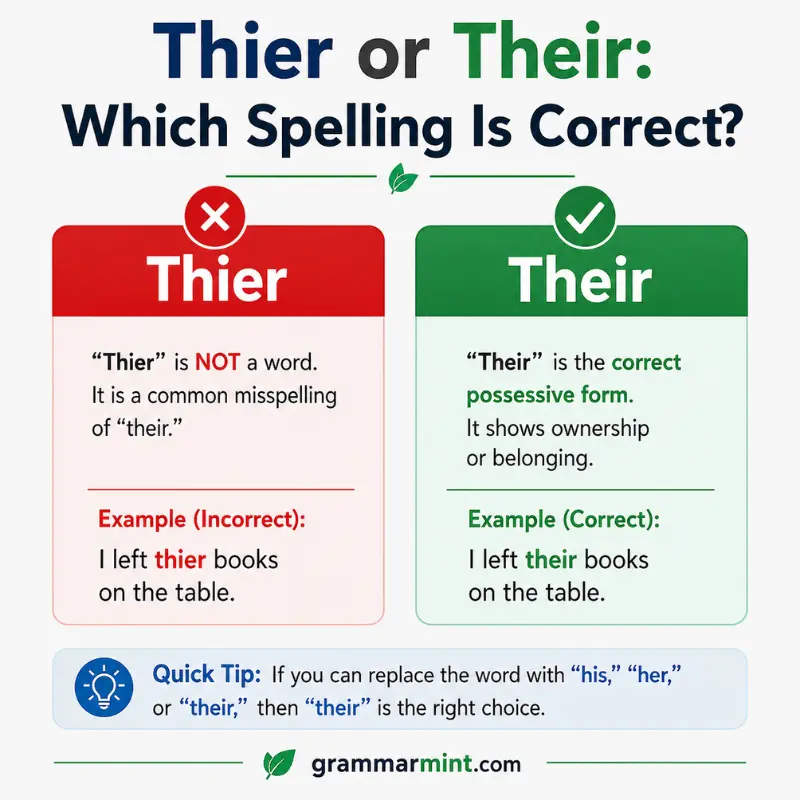
Their is the correct spelling, while thier is a common spelling mistake. The word “their” is a possessive pronoun used to show that something belongs to or is associated with people or things. For example, you can say, “They brought their books to class.” Although “thier” may look correct at first glance, it is not the standard spelling in English.
Common Mistakes (and Quick Fixes)
Remember the rule: Don’t use “I before E” to justify thier.
Better: Think of their as the possessive form related to they.
Mistake: I saw thier report on the desk.
Correct: I saw their report on the desk.
Another common error: Thier schedule changed.
Correct: Their schedule changed.
A frequent spelling mistake: Please check thier homework.
Correct: Please check their homework.
In this sentence, avoid: Everyone should have thier ticket ready.
Correct: Everyone should have their ticket ready.
One spelling to remember: Thier is incorrect.
Correct: Their is the standard spelling.
Thier vs. Their: Understanding the Difference
The main difference between thier and their is that only their is a correct English word. “Their” is used when referring to something that belongs to or is connected with more than one person, or sometimes with a singular person when using gender-neutral language. For example, “The students finished their homework.” In contrast, “thier” has no standard meaning and should not be used in formal or informal writing.
Everyday Examples
Informal text:
• I saw their bikes at the park.
• What’s their plan after school?
Social media:
• Their photos from the trip are amazing!
• Love how their costumes turned out.
Workplace email:
• Please upload their time sheets by Friday.
Professional rewrite: Please submit the team’s time sheets by Friday.
Simple Tips to Remember
• Think of the word they — remove the y, add ir. That leaves you with “their.”
• Link “their” to ownership. If a group owns or shares something, use “their.”
• When in doubt, say the sentence out loud and check if the word shows possession.
Comparison: When “Their” Is Best Choice
| Context | Best Choice | Why |
| Talking about things owned by people | their | Shows that something belongs to them |
| Writing a school report | their | Correct grammar improves clarity and trust |
| Sending a work email | their | Professional language avoids errors |
| Text message to a friend | their | Even in casual writing, correct spelling helps meaning |
| Role of “thier” | avoid | It has no recognized meaning |
FAQs
Is “thier” a real word?
No. “Thier” is a common misspelling of “their.” You should not use “thier” in standard English.
Why do people misspell “their”?
Many people follow the “I before E” rhyme and assume that rule always works. In “their,” the correct order is E then I.
Can “their” be used for one person?
Yes. In modern American usage, “their” is often used as a singular possessive pronoun for gender-neutral contexts.
How can I remember the spelling of “their”?
Start with the word “they,” remove the y, and add ir. That gives you the correct order: “their.”
What’s the difference between “their” and “they’re”?
“Their” shows possession. “They’re” is a contraction of “they are.” Use “they’re” only when you mean “they are.”
Mini Quiz
- Choose the right word: ___ dog is at the door. (Their / Thier)
- ___ going to the game tonight. (Their / They’re)
- Did you see ___ bikes? (Their / There / They’re)
Answers: 1) Their 2) They’re 3) Their
Conclusion
Only their is correct; thier is not a real English word. Use “their” when you want to show that something belongs to “them.” With a few small reminders and real examples, you can stop the mistake and write confidently every time.