
Everyone who writes in English eventually faces a simple spelling question: Is it “referred” or “refered”? The answer matters because even a small spelling mistake can make an email, resume, school paper, report, or professional message look less polished.
The confusion usually comes from the rule for doubling consonants before adding endings such as -ed and -ing. English spelling does not always seem predictable, but in this case, there is a clear rule.
This guide explains why referred is correct, why refered is a misspelling, how the consonant-doubling rule works, and how to use referred naturally in everyday American English. You will also see common mistakes, example sentences, related word forms, a comparison table, FAQs, and a quick quiz.
Quick Answer
Referred is the correct past tense and past participle of refer in American English. Refered is an incorrect spelling and should be avoided in formal, informal, academic, and professional writing.
The correct spelling has two r’s because the final syllable in refer is stressed: re-FER. When -ed is added, the final consonant is doubled:
refer + ed = referred
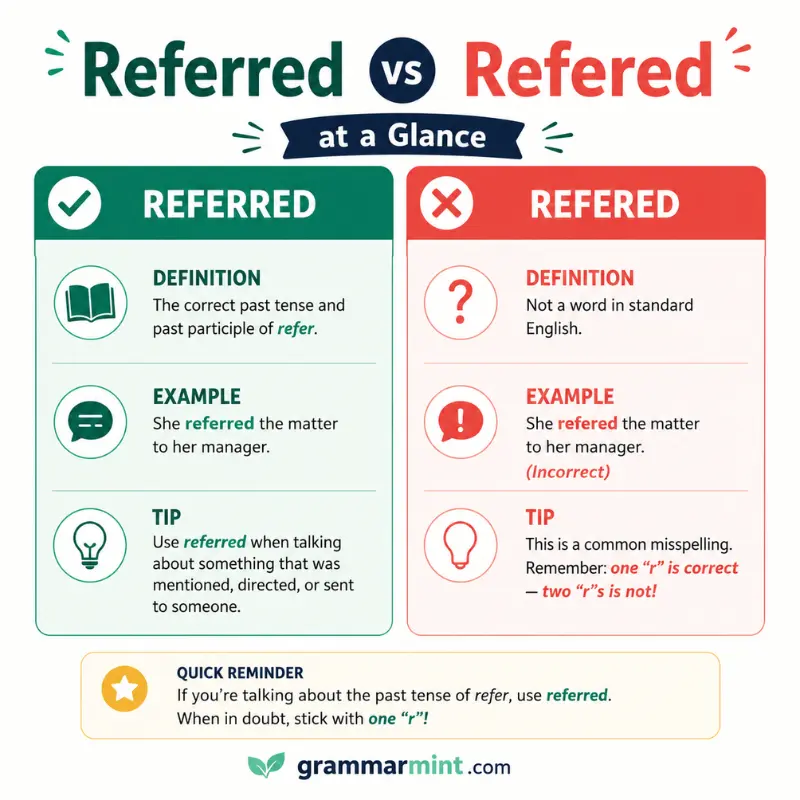
Referred vs Refered at a Glance
| Word | Correct? | Meaning / Use |
|---|---|---|
| Referred | Yes | Correct past tense and past participle of refer |
| Refered | No | Common misspelling of referred |
| Refer | Yes | Base form of the verb |
| Referring | Yes | Present participle form |
The rule is simple for practical writing: choose referred every time when you need the past form of refer.
Why Is Referred the Correct Spelling?
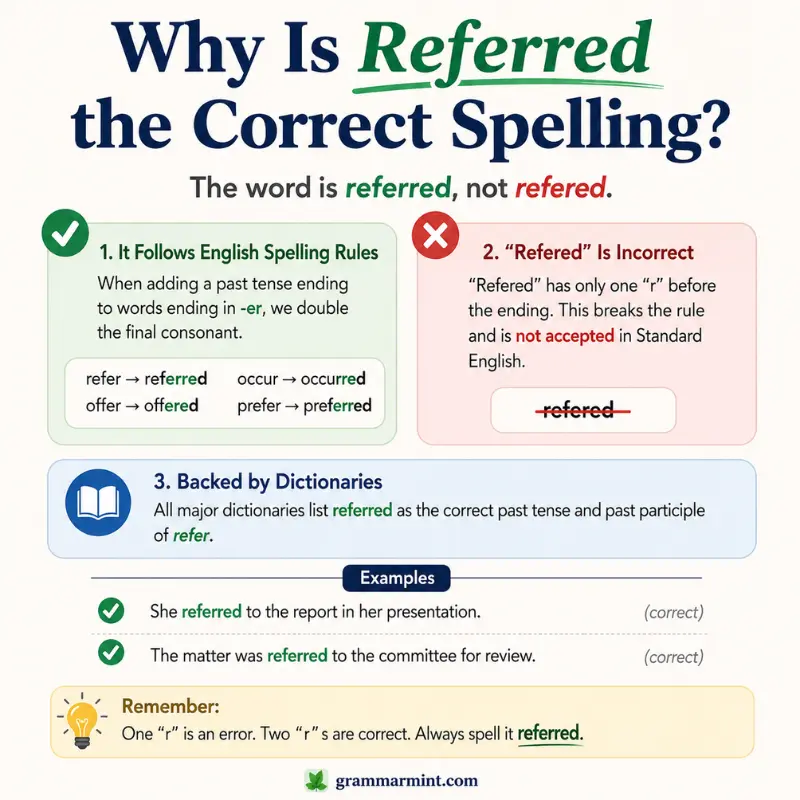
The spelling referred follows an English consonant-doubling pattern.
The verb refer has two syllables:
re-FER
The stress falls on the final syllable, -fer. The word also ends with a single vowel followed by a single consonant: e + r.
When certain suffixes beginning with a vowel, such as -ed or -ing, are added to a word with this pattern and the final syllable is stressed, the final consonant is usually doubled.
Therefore:
refer + ed → referred
refer + ing → referring
The extra r is not optional. It is part of the standard spelling of these forms.
The Consonant-Doubling Rule Explained
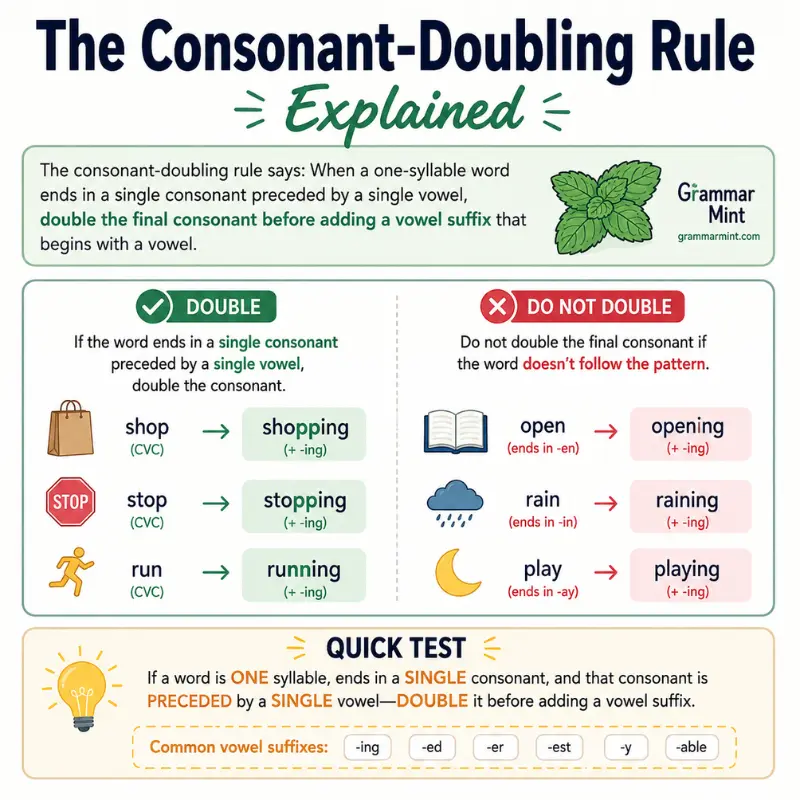
A useful spelling rule is that a final consonant is often doubled when a word:
- ends in a single vowel followed by a single consonant,
- has stress on its final syllable, and
- takes a suffix beginning with a vowel, such as -ed or -ing.
For example:
- refer → referred → referring
- admit → admitted → admitting
- occur → occurred → occurring
- prefer → preferred → preferring
- begin → beginning
The stressed final syllable is especially important.
Compare refer with offer:
- re-FER → referred
- OF-fer → offered
In refer, the final syllable receives the stress, so the r doubles. In offer, the stress is on the first syllable, so the final consonant does not double.
This comparison makes the rule easier to remember.
Why “Refered” Is Incorrect
Refered is a common spelling mistake because writers may assume that forming the past tense simply means adding -ed to the base verb.
That works for many verbs:
- walk → walked
- open → opened
- help → helped
However, refer follows the consonant-doubling pattern, so simply adding -ed produces the incorrect form refered.
The correct transformation is:
refer → referred
The same principle explains why referring has two r’s rather than being spelled refering.
What Does Referred Mean?
Referred is the past tense and past participle of the verb refer. Its exact meaning depends on the sentence.
Most commonly, referred means that someone directed another person to a source, professional, organization, document, or place for additional help or information.
For example:
- The doctor referred me to a specialist.
- My teacher referred me to an online resource.
- The customer was referred to the billing department.
It can also mean mentioned or described something in a particular way.
For example:
- She referred to the report during the meeting.
- He referred to the incident as a misunderstanding.
- The article referred to several earlier studies.
The surrounding words help determine the intended meaning.
Referred as a Past Tense Verb
Use referred when the action happened in the past.
Examples:
- She referred me to a local attorney.
- The manager referred the complaint to customer service.
- My professor referred to that theory during yesterday’s lecture.
- The doctor referred the patient to a cardiologist.
- He referred several applicants to the hiring manager.
In each case, the act of referring has already happened.
Referred as a Past Participle
Referred is also the past participle of refer. It commonly appears with forms of have or in passive constructions.
Examples:
- I have referred several clients to that company.
- She has referred to the issue before.
- The case was referred to another department.
- They had referred the matter to legal counsel.
- He was referred to a specialist for further evaluation.
The spelling remains referred in every case.
Refer, Refers, Referred, and Referring
Understanding the full verb family can make the spelling easier to remember.
| Form | Example |
| Refer | I often refer people to this guide. |
| Refers | She refers new clients to the support team. |
| Referred | He referred me to a specialist yesterday. |
| Referring | I am referring to the earlier email. |
Notice that the r doubles in referred and referring, but not in refer or refers.
A simple pattern is:
refer → referred → referring
Learning these forms together can help prevent both refered and refering.
Referred vs Referring
Writers sometimes understand referred but become unsure about referring.
Use referred for a completed or past action:
- She referred me to the website yesterday.
Use referring for an ongoing action or after certain helping verbs:
- She is referring me to another department.
- I am referring to your previous message.
Both words have two r’s before the suffix:
- refer + ed → referred
- refer + ing → referring
The spellings refered and refering are both incorrect in standard English.
Referred To vs Referred By
The phrases referred to and referred by are both correct, but they express different relationships.
Referred To
Referred to can mean directed toward someone or something.
- I was referred to a specialist.
- The issue was referred to the legal department.
It can also mean mentioned.
- She referred to the report during the meeting.
- He referred to his earlier experience.
Referred By
Referred by identifies the person or source that made the referral.
- I was referred by my family doctor.
- She was referred by a former employee.
- The client was referred by an existing customer.
A simple distinction is:
New York City is often referred to as the Big Apple.This method is sometimes referred to as a shortcut.The condition was previously referred to by another name.
Another common construction is referred to as, which means called, described, or known by a particular name or label.
Examples:
- The city is sometimes referred to as the “Windy City.”
- This process is referred to as photosynthesis.
- The position is often referred to as an entry-level role.
- The condition was previously referred to by another name.
Do not confuse referred to as with simply directing a person somewhere. The meaning depends on context.
American vs British English
There is no spelling difference between standard American and British English for referred.
Both use:
- refer
- referred
- referring
Neither standard variety accepts refered as the normal past-tense spelling.
This makes the choice easier than words such as traveled/travelled, where American and British conventions may differ.
For referred, the doubled r is standard on both sides of the Atlantic.
Which One Should You Use?
Use referred in every standard context where you need the past tense or past participle of refer.
Academic Writing
Correct:
The researcher referred to several previous studies.
Incorrect:
The researcher refered to several previous studies.
Professional Emails
Correct:
I referred your request to our billing team.
Incorrect:
I refered your request to our billing team.
Resumes and Job Applications
Correct:
Referred qualified candidates to the recruitment department.
Incorrect:
Refered qualified candidates to the recruitment department.
School Assignments
Correct:
The author referred to historical events throughout the essay.
Text Messages
Correct:
I referred him to your page.
Even in informal communication, referred remains the correct spelling.
Common Mistakes and Quick Fixes
Mistake 1: Writing “refered”
Incorrect:
I refered the client to you.
Correct:
I referred the client to you.
Quick fix: Remember re-FER. The final syllable is stressed, so double the r.
Mistake 2: Writing “refering”
Incorrect:
I am refering to your email.
Correct:
I am referring to your email.
Quick fix: The same doubling rule applies before -ing.
Mistake 3: Assuming Every Verb Simply Adds -ed
Some verbs do simply add -ed, but refer requires a spelling change.
Compare:
- open → opened
- visit → visited
- refer → referred
Quick fix: Pay attention to stress and the final vowel-consonant pattern.
Mistake 4: Using Referred When Recommended Sounds More Natural
Refer and recommend can overlap, but they are not always interchangeable.
Less natural:
She referred a great book to me.
More natural:
She recommended a great book to me.
Or:
She referred me to a useful book on the subject.
Use refer when someone is being directed toward a source, person, service, or piece of information. Use recommend when expressing approval or suggesting that something is worth choosing.
Mistake 5: Trusting Spell Check Completely
Spell-checking tools are helpful, but they should not replace your understanding of spelling rules.
Quick fix: Memorize the word family:
refer → referred → referring
Everyday Examples of Referred
Text Message
“I referred you to the job posting I mentioned.”
Work Email
“I have referred your request to our legal department for review.”
Medical Context
“My doctor referred me to a specialist.”
School Context
“The teacher referred the student to the school counselor.”
Customer Service
“Your case has been referred to our technical support team.”
Academic Writing
“The author referred to several earlier studies in the discussion.”
Hiring
“A former colleague referred me for the position.”
Conversation
“When I said ‘the earlier version,’ I was referring to the first draft.”
Referred vs Recommended
Referred and recommended are sometimes confused because both can involve directing someone toward another person or thing.
However, they are not identical.
Referred usually means someone was directed to another person, service, source, or department.
Example:
The doctor referred the patient to a dermatologist.
Recommended usually means someone suggested that a person choose, try, read, buy, or use something because it may be suitable.
Example:
The doctor recommended a different treatment.
Another comparison:
She referred me to a career counselor.
She recommended a helpful career book.
Understanding this difference makes your writing more precise.
Words Commonly Used With Referred
Learning common combinations can make the word easier to use naturally.
Common phrases include:
- referred to
- referred by
- referred me to
- referred the case
- referred the matter
- referred the patient
- referred the client
- referred the student
- referred the complaint
- referred to as
- was referred
- has been referred
Examples:
The complaint was referred to management.
I was referred by a friend.
The condition is sometimes referred to as seasonal depression.
How to Remember the Correct Spelling
A useful memory trick is to focus on the stressed sound:
re-FER
Because FER receives the stress, think:
Strong FER needs another R.
So:
refer → referred
You can also memorize the three related forms together:
refer — referred — referring
Seeing rr in both referred and referring reinforces the pattern.
Is “Refered” Ever Correct?
No. Refered is not the standard spelling of the past tense or past participle of refer.
It may appear online because of typing mistakes, informal writing, or misunderstanding of the spelling rule, but frequent appearance does not make it correct.
In school papers, professional documents, websites, emails, resumes, applications, and other edited writing, always use referred.
Why Correct Spelling Matters
A single spelling mistake usually does not prevent readers from understanding your message, but correct spelling still matters.
In professional and academic settings, correct spelling can make writing appear more polished and credible.
Consider these sentences:
I referred your application to our manager.
I refered your application to our manager.
Both are understandable, but the second contains an obvious spelling error. In a resume, business proposal, university assignment, or formal email, errors like this may distract the reader from your message.
Knowing the correct spelling also helps you avoid related errors such as refering.
Referred or Refered Comparison Table
| Context | Best Choice | Why |
| Past tense of refer | Referred | Standard spelling |
| Past participle | Referred | Correct grammatical form |
| Academic writing | Referred | Correct formal usage |
| Professional emails | Referred | Standard spelling expected |
| Resumes | Referred | Shows accurate spelling |
| Informal texts | Referred | Still the correct form |
| British English | Referred | Same spelling |
| American English | Referred | Same spelling |
| Refered | Avoid | Misspelling |
More Example Sentences With Referred
Here are additional examples showing different meanings and contexts:
- The receptionist referred me to the correct department.
- My professor referred to the textbook during the lecture.
- She referred several friends to the company.
- The patient was referred to a neurologist.
- He referred to the previous meeting in his email.
- The complaint has been referred to senior management.
- A friend referred me for the job.
- The report referred to several changes in company policy.
- The lawyer referred the matter to another specialist.
- The term is often referred to by its abbreviation.
- Our teacher referred us to an additional reading resource.
- She was referred by one of our existing customers.
FAQs
Is It “Referred” or “Refered”?
Referred is correct. Refered is a misspelling and should not be used in standard English.
Why Does Referred Have Two R’s?
The final syllable of refer is stressed: re-FER. Because the word ends with a vowel followed by a consonant and takes the suffix -ed, the final r is doubled.
What Does Referred Mean?
Referred can mean directed someone to another person, source, or service. It can also mean mentioned something.
For example:
The doctor referred me to a specialist.
She referred to the report during the discussion.
Is Refered Ever Acceptable?
No. Refered is not the standard past-tense spelling in either American or British English.
Is It Referred or Reffered?
The correct spelling is referred, with one f and two r’s in the middle:
r-e-f-e-r-r-e-d
Reffered is also incorrect.
Is It Referring or Refering?
Referring is correct. Refering is incorrect. The final r is doubled before adding -ing, just as it is before adding -ed.
What Is the Difference Between Referred and Recommended?
Referred usually means directed someone to another person, service, or source. Recommended means suggested something as a good or suitable choice.
The doctor referred me to a specialist.
The doctor recommended a new treatment.
Mini Quiz
1. Choose the correct sentence:
A. She refered me to the manager.
B. She referred me to the manager.
Answer: B — referred
2. True or false: “Refered” is acceptable in casual text messages.
Answer: False. It is still a misspelling.
3. Fill in the blank:
“They have ______ several candidates for the position.”
Answer: referred
4. Choose the correct spelling:
A. refering
B. referring
Answer: B — referring
5. Fill in the blank:
“I was ______ to a specialist.”
Answer: referred
6. Why is the final consonant doubled in referred?
Answer: Because refer has stress on its final syllable and ends with a vowel followed by a consonant before the suffix -ed is added.
Conclusion
When choosing between referred and refered, use referred every time in standard English.
Referred is the correct past tense and past participle of refer, while refered is a common spelling mistake. The easiest way to remember the spelling is to notice the stress in re-FER. Because the final syllable is stressed, the final r doubles before -ed or -ing.
Remember the complete pattern:
refer → referred → referring
Once you know that pattern, avoiding refered and refering becomes much easier. Whether you are writing an email, school assignment, resume, report, or casual message, referred is the correct and professional choice.