
“Kill or be killed” is a strong phrase. It sounds intense, dramatic, and sometimes threatening. That is why people often pause before using it.
You may hear the expression in sports commentary, business discussions, movies, books, news coverage, and everyday conversation. In rare cases, it can describe genuine life-or-death danger. More often, people use it figuratively to describe fierce competition or a situation where failure feels costly.
Because the phrase contains violent imagery, context and tone matter. In some settings, it adds dramatic force. In others, it can sound unnecessarily harsh or exaggerated.
This guide explains what “kill or be killed” means, how the phrase works, what tone it creates, and when a softer alternative works better.
Quick Answer
“Kill or be killed” means facing a situation where you must defeat, overcome, or act against an opponent before they defeat you.
The phrase can describe real physical danger, but people often use it figuratively for intense competition, pressure, or high-stakes situations.
What Does “Kill or Be Killed” Mean?
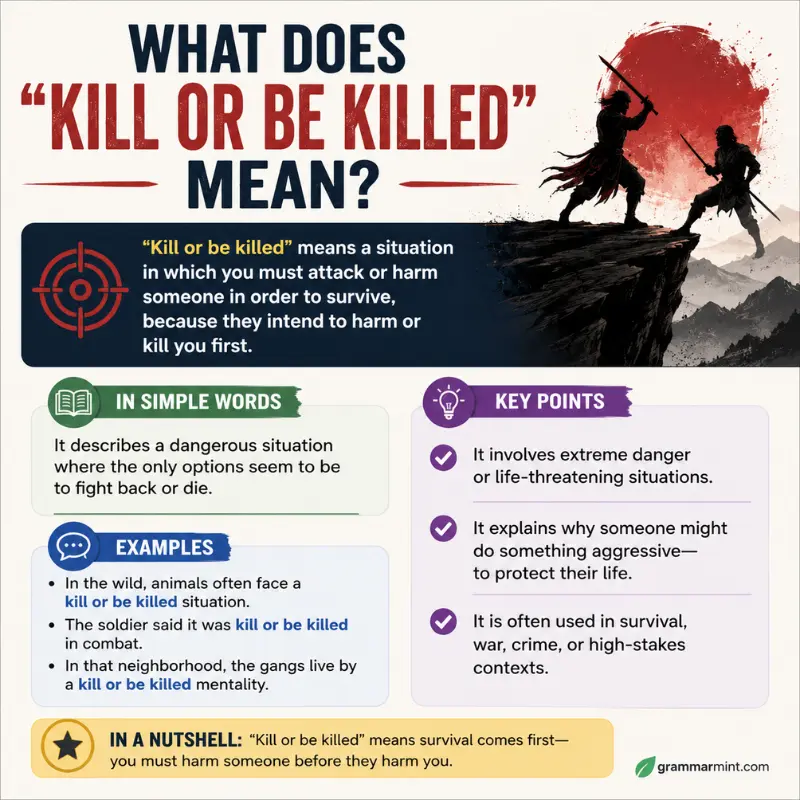
The phrase presents two extreme outcomes: defeat the other side or face defeat yourself.
In its most literal sense, it describes physical survival. A person may believe they must kill an attacker to stay alive.
In figurative speech, however, “kill” does not usually refer to physical harm. Instead, the phrase emphasizes how competitive, unforgiving, or high-pressure a situation feels.
For example:
“The championship round felt like kill or be killed.”
Here, nobody faces actual death. The speaker simply means that the competition feels extremely intense.
Meaning at a Glance
- Literal meaning: A genuine life-or-death survival situation.
- Figurative meaning: Extreme competition or pressure.
- Tone: Harsh, dramatic, forceful, and high-stakes.
- Common settings: Sports, entertainment, casual speech, and competitive environments.
- Formal writing: Neutral wording often works better.
Literal vs. Figurative Meaning
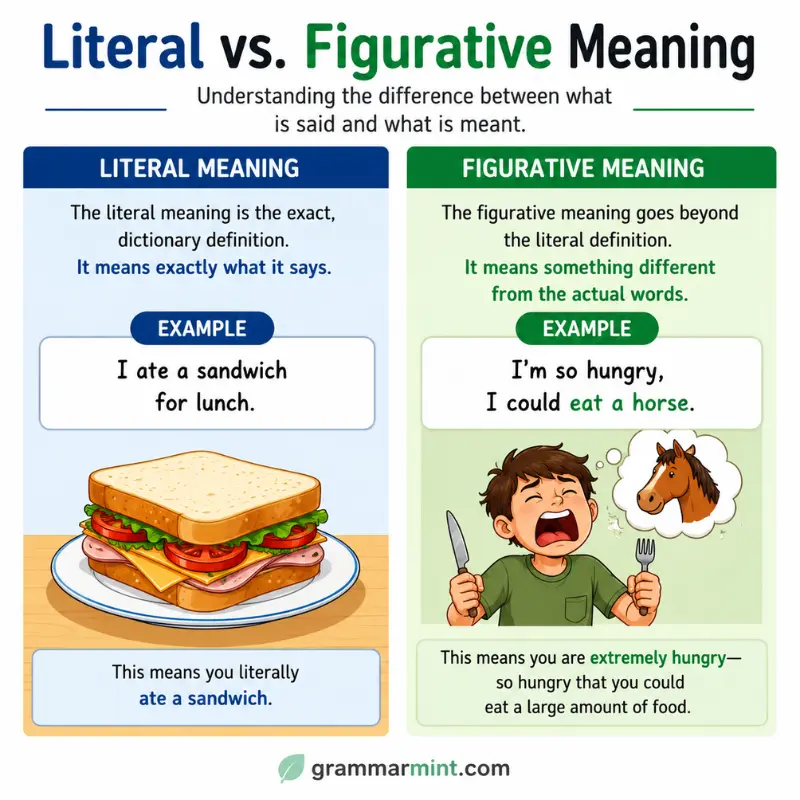
The surrounding context usually tells you whether the speaker means the phrase literally or figuratively.
Literal Meaning
A literal use involves genuine physical danger.
For example:
“During the attack, he believed he had entered a kill-or-be-killed situation.”
Here, the phrase describes actual survival.
Writers should use this meaning carefully when they discuss real violence, war, crime, or tragedy.
Figurative Meaning
The figurative meaning covers a much wider range of situations.
People may use “kill or be killed” to describe:
- competitive sports
- difficult business environments
- political contests
- video games
- fictional battles
- workplace competition
- high-pressure situations
For example:
“In such a competitive industry, some people act as though it is kill or be killed.”
The speaker does not suggest physical violence. Instead, the phrase makes the competition sound extreme.
What Tone Does “Kill or Be Killed” Have?
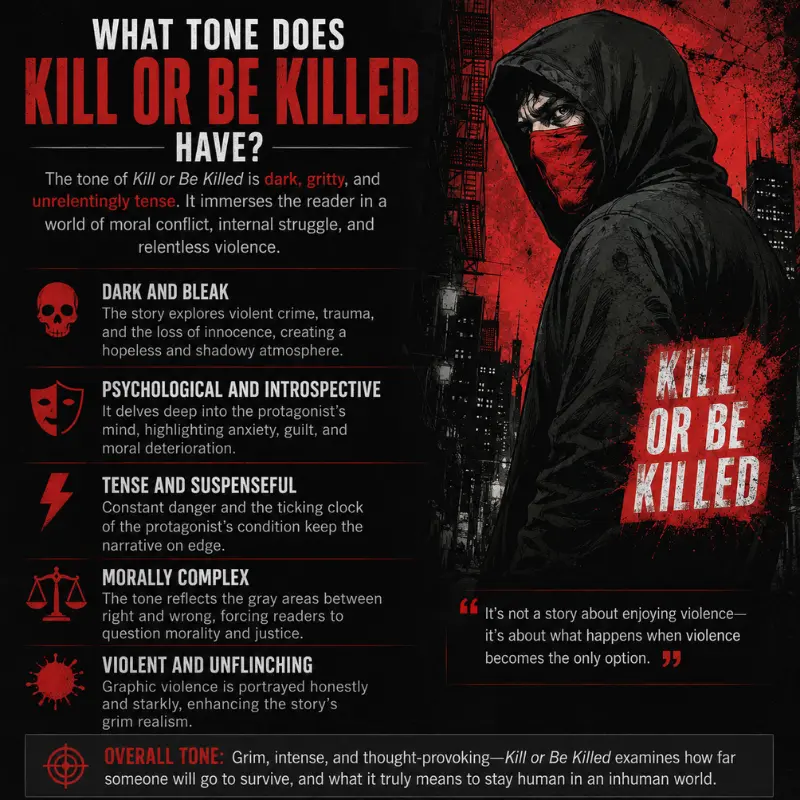
“Kill or be killed” creates a strong and aggressive tone.
It suggests:
- danger
- urgency
- competition
- survival
- conflict
- pressure
- determination
Because the language sounds extreme, it can make an ordinary situation feel much more dramatic.
Compare:
“The market is competitive.”
with:
“The market is kill or be killed.”
The second version creates a harsher image. It suggests that only the strongest competitors will succeed.
That dramatic effect can work well in storytelling or sports commentary. However, it may sound inappropriate in professional, academic, or sensitive situations.
Is “Kill or Be Killed” an Idiom?
Yes. English speakers commonly use “kill or be killed” as a fixed expression or idiomatic phrase.
The phrase can carry a literal meaning, but speakers frequently use it as a metaphor.
It follows a memorable parallel structure:
kill / be killed
The first part presents an action. The second presents the consequence of failing to act.
This balanced structure gives the expression force and makes it easy to remember.
Where Does the Phrase Come From?
The general idea behind “kill or be killed” comes from conflict and survival.
Writers and speakers have long used similar survival-based language to describe warfare, dangerous encounters, and struggles between opponents. However, no single person or moment clearly explains the modern phrase.
Over time, speakers extended the expression beyond physical conflict. They began applying it to sports, business, competition, and other situations where people feel they must succeed before someone else does.
Today, people use the phrase both literally and figuratively.
British vs. American English
British and American English use “kill or be killed” in much the same way.
Speakers in both varieties of English may use the phrase for literal danger or intense competition.
The main concern is not region but context. Because the expression sounds forceful, writers should consider whether its aggressive tone suits the audience and situation.
When Should You Use “Kill or Be Killed”?
The phrase works best when you want to describe a situation as extreme, ruthless, or highly competitive.
Casual Conversation
It can sound natural when speakers exaggerate for effect.
“The tournament gets serious in the final rounds. It’s kill or be killed.”
Sports Commentary
Sports commentators often use dramatic metaphors, so the phrase can fit competitive coverage.
“At this stage of the playoffs, it feels like kill or be killed.”
Fiction and Entertainment
The expression works especially well in action stories, thrillers, games, and dramatic dialogue.
“Out here, the rule was simple: kill or be killed.”
Competitive Situations
People also use the phrase to describe highly competitive environments.
“Some traders describe the industry as a kill-or-be-killed environment.”
Unless the surrounding context involves actual physical danger, readers will usually interpret the phrase metaphorically.
When Should You Avoid the Phrase?
“Kill or be killed” does not fit every audience or situation.
Professional Communication
In workplace emails, presentations, and reports, the phrase may sound overly aggressive.
Instead of:
“Our industry is kill or be killed.”
Write:
“Our industry is extremely competitive.”
Academic Writing
Academic writing usually benefits from precise and neutral language.
Better alternatives include:
- intense competition
- competitive pressure
- high-stakes environment
- fierce rivalry
Sensitive Situations
Avoid casual use when discussing real deaths, violence, war, trauma, or tragedy unless the phrase accurately reflects the situation.
Children’s Content
The violent wording may sound too strong for younger audiences. Phrases such as “highly competitive” or “win-or-lose situation” may work better.
Kill or Be Killed vs. Kill or Get Killed
The standard expression is:
kill or be killed
You may hear people say “kill or get killed” in casual speech. Most listeners will understand it, but the familiar expression remains “kill or be killed.”
For standard writing, choose “kill or be killed.”
Example:
Standard: It was a kill-or-be-killed situation.
Less conventional: It was a kill-or-get-killed situation.
Is It “Kill or Be Killed” or “Kill-or-Be-Killed”?
Both forms can appear, depending on how the phrase works in the sentence.
Write kill or be killed when the expression stands alone:
“Their attitude was simple: kill or be killed.”
Add hyphens when the phrase modifies a noun:
“They developed a kill-or-be-killed mentality.”
“It became a kill-or-be-killed situation.”
The hyphens show readers that the words work together as one modifier.
Better Alternatives to “Kill or Be Killed”
If the original phrase sounds too aggressive, choose an alternative that better fits your audience.
Possible alternatives include:
- highly competitive
- fiercely competitive
- intense competition
- cutthroat environment
- high-stakes situation
- survival mentality
- winner-takes-all
- do-or-die
- sink or swim
- intense rivalry
- every person for themselves
These expressions do not all create the same tone.
For example, “highly competitive” sounds professional and neutral, while “cutthroat” and “do-or-die” still sound dramatic.
Common Mistakes and Quick Fixes
Mistake: Assuming the Phrase Always Has a Literal Meaning
Fix: Check the context. Many speakers use it to describe competition rather than actual violence.
Mistake: Using It in Sensitive Situations
Fix: Consider whether violent imagery suits the subject and audience.
Mistake: Overusing It in Professional Writing
Fix: Choose phrases such as “highly competitive” or “high-pressure environment.”
Mistake: Treating “Kill or Get Killed” as the Standard Expression
Fix: Use “kill or be killed” in standard writing.
Mistake: Ignoring the Tone
Fix: Remember that the phrase sounds much stronger than simply saying something is difficult or competitive.
Mistake: Forgetting Hyphens Before a Noun
Fix: Add hyphens when the phrase modifies a noun:
“a kill-or-be-killed mentality”
Everyday Examples in Real Contexts
Informal Conversation
“This league is kill or be killed. There are no easy wins this year.”
Social Media
“The playoffs feel like kill or be killed now. Every game matters.”
Sports Commentary
“By the final quarter, the match had become a kill-or-be-killed contest.”
Workplace Conversation
“Some people treat this industry as though it is kill or be killed.”
Professional Rewrite
Instead of:
“This industry is kill or be killed right now.”
Write:
“This industry is extremely competitive right now.”
Fiction
“Once the doors closed, he realized that survival meant kill or be killed.”
How Context Changes the Meaning
Context tells readers whether the phrase sounds metaphorical, humorous, dramatic, or genuinely dangerous.
Consider these examples:
Sports:
“The championship is kill or be killed.”
Meaning: The competition feels extremely intense.
Business:
“They operate with a kill-or-be-killed mentality.”
Meaning: They approach competition aggressively.
Action fiction:
“On the battlefield, it was kill or be killed.”
Meaning: The speaker may mean the phrase literally.
Casual exaggeration:
“Getting the last slice of pizza around here is kill or be killed.”
Meaning: The speaker exaggerates for humor.
The surrounding situation helps readers decide how seriously to interpret the expression.
Comparison Table
| Context | Recommended Choice | Why |
|---|---|---|
| Sports commentary | Kill or be killed | Dramatic language can fit the context |
| Casual conversation | Kill or be killed | Works as expressive exaggeration |
| Fiction or action writing | Kill or be killed | Fits dramatic or dangerous scenes |
| Business presentation | Highly competitive | Sounds more professional |
| Academic paper | Intense competition | Keeps the tone neutral and precise |
| Children’s writing | Competitive situation | Uses less violent wording |
| Reporting real conflict | Context-dependent | Requires precision and sensitivity |
FAQs
Is “kill or be killed” an idiom?
Yes. English speakers commonly use it as a fixed expression. Although the phrase can have a literal meaning, people often use it figuratively to describe extreme competition or pressure.
What does “kill or be killed” mean?
It means facing a situation where you must defeat or overcome an opponent before they defeat you. Figuratively, it describes intense competition and high stakes.
Is “kill or be killed” usually literal?
No. It can refer to genuine physical danger, but many everyday uses are metaphorical.
Can “kill or be killed” appear in business writing?
Yes, but it often sounds aggressive. “Highly competitive,” “fierce competition,” or “high-pressure environment” may sound more professional.
Is “kill or get killed” correct?
People may say it informally, but “kill or be killed” is the established expression and works better in standard writing.
Should “kill or be killed” have hyphens?
Use hyphens when the phrase modifies a noun, as in “a kill-or-be-killed mentality.” When the phrase stands alone, leave the hyphens out.
Mini Quiz
1. Is “kill or be killed” always literal?
2. Would it usually work well in a formal research paper?
3. Does the basic meaning change between American and British English?
4. Which is the standard expression: “kill or be killed” or “kill or get killed”?
5. Which sentence uses hyphens correctly?
A. The competition was kill-or-be-killed.
B. They adopted a kill-or-be-killed mentality.
Answer Key
- No. People frequently use it figuratively.
- Usually not. Neutral wording works better.
- No. The basic meaning stays the same.
- Kill or be killed.
- B. The phrase modifies “mentality,” so the hyphens help connect the words.
Conclusion
“Kill or be killed” is a powerful English expression that conveys extreme survival pressure, fierce competition, or a situation where losing feels disastrous.
People sometimes use the phrase literally, but they more often use it metaphorically. Its strongest feature is its tone: dramatic, aggressive, and high-stakes.
Before using “kill or be killed,” consider your audience and setting. The phrase may work perfectly in sports commentary, fiction, or casual conversation. Professional and academic writing, however, often benefits from calmer wording.
Strong writing depends on more than meaning. The right tone also helps your message land clearly.