

If you’ve ever paused over sheath or sheathe, you’re not alone. The two words look almost identical, and their meanings are closely connected. However, they perform different jobs in a sentence.
You may encounter these words in novels, historical writing, fantasy stories, safety instructions, medical discussions, electrical work, or everyday descriptions of knives and tools. Because only one letter separates them, it is easy to use the wrong form.
Fortunately, the distinction is simple once you understand the grammar. Sheath is primarily a noun, while sheathe is a verb. One names a protective covering; the other describes the action of covering something or placing it inside such a covering.
This guide explains the difference between sheath and sheathe, covers pronunciation and usage, identifies common mistakes, and provides practical examples so you can choose the correct word every time.
Quick Answer
Sheath is primarily a noun meaning a protective covering, case, or outer layer.
Sheathe is a verb meaning to put something into a sheath, cover it with a protective layer, or enclose it.
- The knife is in its sheath.
- Please sheathe the knife after using it.
Both are correct words, but they are not interchangeable.
Key Differences at a Glance
| Feature | Sheath | Sheathe |
|---|---|---|
| Part of speech | Primarily a noun | Verb |
| Basic meaning | A protective covering or outer layer | To cover, enclose, or place in a sheath |
| Knife example | The knife remained in its sheath. | Please sheathe the knife. |
| Technical use | A protective layer around a cable or structure | To cover something with a protective material |
| Past tense | Not applicable as a noun | Sheathed |
| Common mistake | Used when a verb is needed | Written when the noun sheath is intended |
The easiest rule to remember is:
Sheath = thing. Sheathe = action.
What Does “Sheath” Mean?
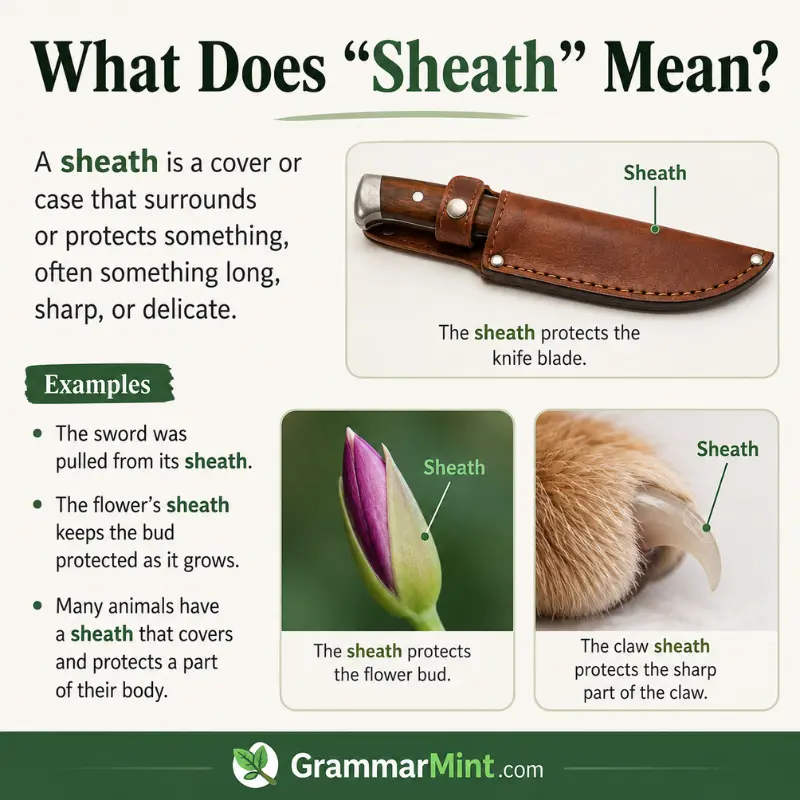
Sheath is most commonly used as a noun. Traditionally, it refers to a close-fitting protective case for the blade of a knife, sword, dagger, or similar object.
For example:
- The hunter returned the knife to its sheath.
- The sword hung in a leather sheath.
- Keep the blade inside its sheath when it is not being used.
However, the word has a broader meaning than just a case for a blade.
A sheath can also refer to a protective outer covering, layer, or structure surrounding something. This meaning appears in technical, scientific, medical, botanical, and industrial contexts.
For example:
- The electrical cable has a protective outer sheath.
- The tissue forms a sheath around the structure.
- The wire’s plastic sheath had been damaged.
- A protective sheath helps shield the component from external damage.
So when sheath names an object, layer, case, or covering, the noun form is usually correct.
What Does “Sheathe” Mean?
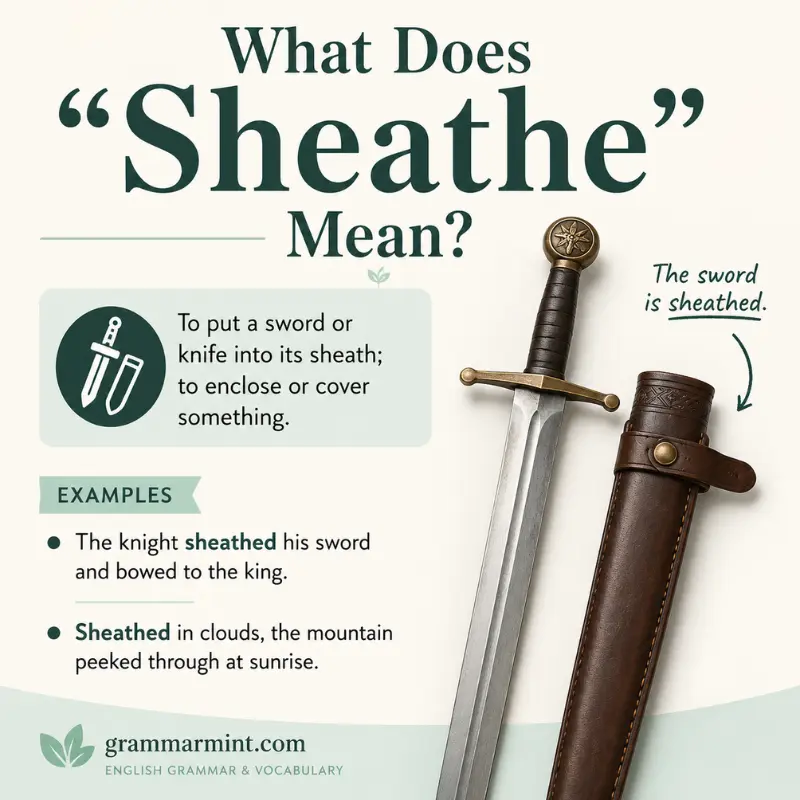
Sheathe is a verb. Its most literal meaning is to put a weapon or blade into its sheath.
For example:
- The soldier sheathed his sword.
- Please sheathe the knife before carrying it.
- She carefully sheathed the dagger.
The verb can also mean to cover, surround, or enclose something with a protective layer or material.
For example:
- The structure was sheathed in metal.
- Workers sheathed the exterior with protective material.
- The cable was sheathed in durable insulation.
This broader meaning is especially useful in technical or construction-related contexts.
The key point is that sheathe describes an action.
Forms of “Sheathe”
The verb changes normally according to tense:
- Base form: sheathe
- Third-person singular: sheathes
- Present participle: sheathing
- Past tense: sheathed
- Past participle: sheathed
Examples:
- He sheathes the knife carefully.
- She is sheathing the cable.
- They sheathed the structure in metal.
Sheath vs Sheathe: The Simple Grammar Rule
The fastest way to choose between the two words is to identify what your sentence needs.
Ask:
Am I naming a covering, or describing an action?
If you are naming the covering, use sheath.
The blade has a leather sheath.
If you are describing the action of covering or enclosing something, use sheathe.
Please sheathe the blade.
This noun-versus-verb distinction solves most cases immediately.
Sheath and Sheathe Are Similar to Breath and Breathe
A useful memory trick is to compare sheath/sheathe with breath/breathe.
- Breath is a noun.
- Breathe is a verb.
- Sheath is primarily a noun.
- Sheathe is a verb.
Compare:
- Take a deep breath.
- Try to breathe slowly.
- The knife has a leather sheath.
- Please sheathe the knife.
In both pairs, the final e helps distinguish the verb from the related noun.
This is not a universal English rule, but it is a useful memory device for these particular word pairs.
How Do You Pronounce Sheath and Sheathe?
The pronunciation difference can also help you remember which word you need.
Sheath is commonly pronounced like “sheeth,” with the final th sound similar to the one in think.
Sheathe is pronounced with a voiced final th, similar to the sound in this or breathe.
The words therefore look very similar but do not have exactly the same pronunciation.
Compare:
- sheath — noun
- sheathe — verb
The distinction is similar to the pronunciation difference between breath and breathe.
Origin and Why Two Forms Exist
Sheath and sheathe are closely related words with a long history in English. The noun developed from Old English forms referring to a case or covering, particularly something used to hold a blade.
The verb sheathe developed from the related noun and came to mean placing something into a sheath or covering it.
This relationship explains why the two words remain so similar in both spelling and meaning.
Modern English preserves the distinction:
- sheath names the covering
- sheathe describes the act of covering or enclosing
Rather than treating the final e as a random spelling difference, think of it as a useful signal that you are dealing with the verb.
American vs British English
There is no major spelling difference between American and British English for this pair.
Both varieties normally use:
- sheath for the noun
- sheathe for the verb
For example, both American and British writers can write:
The knife remained in its sheath.
and:
He sheathed the knife.
The distinction is mainly grammatical, not regional.
That makes this pair different from words that genuinely have competing US and UK spellings.
Which One Should You Use?
Your choice depends on the role the word plays in the sentence.
Use “Sheath” for an Object or Covering
Use sheath when referring to the protective case itself.
Examples:
- The knife came with a leather sheath.
- The blade slipped from its sheath.
- The cable’s outer sheath was torn.
- Inspect the protective sheath before installation.
Use “Sheathe” for an Action
Use sheathe when describing the action of putting something into a sheath or covering it.
Examples:
- Sheathe the knife after use.
- He sheathed his sword.
- Workers sheathed the exterior with protective panels.
- The conductor is sheathed in insulating material.
Sheath or Sheathe With Knives and Swords
Blades provide the clearest examples of the difference.
Consider these two sentences:
The sword rested inside its sheath.
Here, sheath names the object holding the sword.
The warrior sheathed his sword.
Here, sheathed describes an action.
You can even use both words in one sentence:
He sheathed the sword in its leather sheath.
That sentence clearly demonstrates why the two forms are related but cannot simply replace one another.
Sheath and Sheathe in Technical Writing
The words are not limited to fantasy novels or historical descriptions.
Sheath is commonly useful wherever a protective outer layer or covering is being described.
For example:
- cable sheath
- wire sheath
- protective sheath
- insulation sheath
- outer sheath
In these expressions, sheath functions as a noun.
Example:
The technician noticed damage to the cable sheath.
The verb sheathe can be used when describing the process of covering something.
Example:
The conductors are sheathed in protective material.
In technical writing, always check whether you are naming the protective layer or describing what has been done to the object.
Sheath and Sheathe in Medical and Scientific Contexts
Sheath can also refer to a layer, membrane, tube, or structure surrounding another part in biological or medical terminology.
For example:
A protective sheath surrounds the structure.
In such cases, the same basic concept remains: something is enclosed or surrounded by a covering.
The verb sheathe is less common in everyday medical language, but it can still be used generally to describe something that is enclosed or covered.
The grammatical rule does not change:
covering = sheath
action of covering = sheathe
Common Mistakes and How to Fix Them
Mistake 1: Using “Sheath” as the Standard Verb
Incorrect:
He sheath the sword.
Correct:
He sheathed the sword.
When you need the verb, use sheathe and change its tense as necessary.
Mistake 2: Using “Sheathe” for the Object
Incorrect:
The knife has a leather sheathe.
Correct:
The knife has a leather sheath.
The physical case is a sheath.
Mistake 3: Forgetting the Final “E”
Incorrect:
Please sheath the knife.
Better in standard usage:
Please sheathe the knife.
The final e identifies the verb form.
Mistake 4: Confusing “Sheathe” With “Sheathed”
Sheathe is the base form.
Please sheathe the blade.
Sheathed is the past tense and past participle.
He sheathed the blade.
Mistake 5: Assuming the Difference Is American vs British
It is not primarily a regional spelling distinction.
Both forms are used according to their grammatical function in standard American English and British English.
Mistake 6: Using an Overly Dramatic Word in Simple Contexts
Although sheathe is correct, it can sound formal or literary when talking about weapons.
For example:
He sheathed his sword.
sounds natural in historical or fantasy writing.
In casual conversation about a kitchen knife, however, a simpler expression may sound more natural:
Put the knife back in its sheath.
The best word depends not only on grammar but also on context and tone.
Everyday Examples in Real Contexts
Informal Conversation
“I found the old knife still inside its sheath.”
Instruction
“Please sheathe the blade when you finish using it.”
Fiction
“The knight slowly sheathed his sword and stepped away.”
Workplace Safety
“Inspect the cable sheath for cuts or visible damage.”
Technical Writing
“The wires are sheathed in protective insulation.”
Product Description
“The knife includes a durable protective sheath.”
Historical Writing
“The dagger was carried in an ornamented sheath.”
Narrative Writing
“Without another word, she sheathed the blade.”
These examples show that sheath and sheathe can appear in many settings, not just stories about swords.
Sheath vs Sheathe in a Sentence
Here are more examples to make the distinction clear.
Examples With “Sheath”
- The knife remained inside its sheath.
- His sword had an ornate leather sheath.
- The cable’s outer sheath protects the internal wires.
- She bought a replacement sheath for the tool.
- A crack appeared in the protective sheath.
- The dagger came with a decorated sheath.
- Inspect the rubber sheath before using the equipment.
Examples With “Sheathe”
- Please sheathe the knife carefully.
- He sheathed his sword before entering the room.
- The wires were sheathed in protective material.
- Workers are sheathing the exterior surface.
- She quickly sheathed the dagger.
- The cable is sheathed in a durable outer material.
- The knight refused to sheathe his sword.
Can “Sheath” Ever Be Used as a Verb?
This is where careful wording matters.
In ordinary modern English, especially for general readers, sheathe is the standard verb you should use when you mean “to put into a sheath” or “to cover.”
For clear everyday writing:
- Noun: sheath
- Verb: sheathe
Following this distinction will prevent confusion and match the form most readers expect.
Is “Sheathe” an Old-Fashioned Word?
Not exactly.
Sheathe may sound literary when it refers to swords, daggers, or similar weapons because those objects appear frequently in historical and fantasy writing.
For example:
The warrior sheathed his sword.
That sentence has a literary feel because of the subject matter, not because sheathe itself is incorrect or obsolete.
The word also appears naturally in technical contexts involving protective coverings and materials.
So sheathe is still a valid modern English verb.
Is It “Sheathed” or “Sheath”?
Use sheathed when you need the past tense of the verb.
Correct:
He sheathed the knife.
Use sheath when naming the protective covering.
Correct:
He placed the knife in its sheath.
A quick grammar test helps:
Can you replace the word with covered or put away?
If yes, you probably need sheathed.
Can you replace it with case, covering, or protective layer?
If yes, you probably need sheath.
Comparison Table
| Context | Best Choice | Why |
| Talking about a knife cover | Sheath | It names the object |
| Describing putting a sword away | Sheathe | It describes an action |
| Describing a cable’s outer layer | Sheath | It names the covering |
| Telling someone to cover a blade | Sheathe | A verb is required |
| Describing protective material | Sheath | The material or layer is a noun |
| Saying something was covered | Sheathed | Past-tense verb |
| Fantasy novel | Either | Depends on noun or verb function |
| Workplace safety note | Either | Depends on the sentence structure |
Easy Memory Trick
Remember this short formula:
No E = thing
Extra E = action
So:
Sheath = protective thing
Sheathe = action of covering
You can also connect the pair to:
breath → breathe
sheath → sheathe
Both pairs move from a noun to a related verb by adding a final e.
FAQs
Which is correct: sheath or sheathe?
Both are correct, but they have different grammatical roles. Sheath is primarily a noun meaning a protective case or covering. Sheathe is a verb meaning to place something in a sheath or cover it with a protective layer.
What is the difference between sheath and sheathe?
The main difference is part of speech. Sheath names the protective covering, while sheathe describes the action of covering something or putting it into a sheath.
Can sheath be used as a verb?
For standard modern usage, especially in general writing, use sheathe as the verb. For example, write “Sheathe the knife” rather than “Sheath the knife.”
Are sheath and sheathe interchangeable?
No. They are closely related, but they usually perform different grammatical functions. Write “the sword’s sheath” for the object and “sheathe the sword” for the action.
How do you pronounce sheathe?
Sheathe is commonly pronounced with a long ee sound and a voiced th, similar to the ending of breathe. Sheath also has a long ee sound, but its final th is normally unvoiced, similar to the sound in think.
Is sheathe a real word?
Yes. Sheathe is a standard English verb. It means to put something into a sheath or to cover or enclose something with a protective material.
What is the past tense of sheathe?
The past tense of sheathe is sheathed.
Example:
He sheathed the sword before leaving.
Is it sword sheath or sword sheathe?
Use sword sheath when you mean the physical case that holds the sword.
Correct:
The sword’s sheath was made of leather.
Use sheathe when describing an action:
Please sheathe the sword.
Is it knife sheath or knife sheathe?
The protective case is a knife sheath.
Example:
The knife comes with a protective sheath.
If you are describing the action, use sheathe:
Sheathe the knife after use.
Mini Quiz
Choose sheath, sheathe, or sheathed.
- The dagger slipped back into its ______.
- Please ______ the knife after using it.
- The cable’s outer ______ was damaged.
- The warrior ______ his sword.
- The protective ______ helps prevent damage.
- Always ______ the blade before storing it.
Answer Key
- sheath
- sheathe
- sheath
- sheathed
- sheath
- sheathe
Conclusion
The difference between sheath and sheathe becomes easy once you focus on grammar.
Sheath is primarily a noun. It refers to a protective case, covering, or outer layer.
Sheathe is a verb. It means to put something into a sheath or to cover or enclose it.
Remember:
Sheath = object or covering.
Sheathe = action.
If you are still unsure, ask one simple question: Am I naming the covering, or describing what someone is doing?
If you are naming the thing, choose sheath. If you are describing the action, choose sheathe.
That simple check will keep your writing clear, precise, and grammatically correct.