
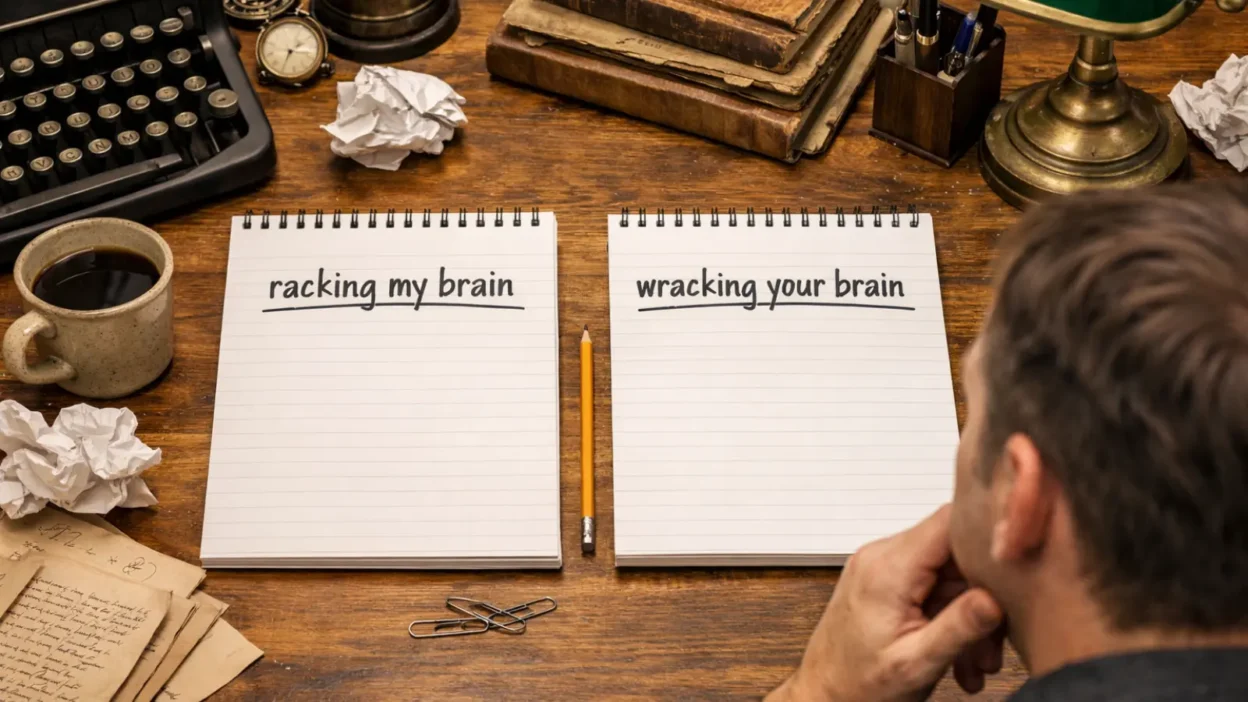
People often wonder whether to spell phrases like racking my brain with an initial r or with wr at the start.
Both forms appear in writing, but they don’t always mean the same thing or fit the same contexts. You might see nerve-wracking online and rack your brain in a book, and that can add to the confusion.
In American English today, one form is usually standard in most contexts, and the other is either an accepted variant or tied to another meaning entirely. Knowing which to choose helps your writing feel confident and clear — whether you’re texting a friend, writing an email, or polishing a report.
This guide walks through the difference, shows real examples, points out common errors, and gives friendly advice about which spelling fits different situations.
Quick Answer
In the United States, “racking” (with r) is the standard spelling in phrases like racking my brain or nerve-racking. The variant “wracking” (with wr) is accepted in some idioms, especially nerve-wracking, but it’s less common for general use.
Key Differences at a Glance
| Feature | Racking | Wracking |
| Common in expressions like racking my brain | ✔️ Standard | ✖️ Not typical |
| Standard in American English | ✔️ Yes | ⚠️ Variant |
| Appears in fixed phrases like nerve-wracking | ⚠️ Possible | ✔️ Common |
| Verb meaning “to torture” or “to strain” | ✔️ Standard | ✖️ Older/less common |
What “Rack” and “Wrack” Mean
• Rack (verb) — to strain, torment, or put to a difficult mental or physical test.
• Wrack (verb) — historically linked to ruin or destruction. In modern idioms, it’s often interchangeable with rack.
The wr spelling shows up in older forms like wrack and ruin, which historically referred to wreckage or destruction, coming from a different root than the furniture rack we commonly think of. Because these forms blended over time in idioms, you see both spellings today.
The bottom line: in most everyday contexts in the U.S., racking is the default choice.
Why Two Spellings Exist
English borrows from many sources, and over time similar words merge or shift. The base words rack and wrack have separate origins — one tied to stretching or torment, the other tied to ruin or debris — but they converged in English idioms centuries ago.
Many phrases with wrack came from older forms that survived in writing, especially classic literature. Writers and editors today often favor the simpler racking in general usage, while wracking lingers in some established expressions.
American vs British Usage
In practical terms, there’s no sharp split where Americans always choose one form and British writers another. Both varieties appear in English around the world. Still, standard references in the U.S. lean toward racking for most expressions. You won’t look out of place using racking my brain in any American context.
When to Use Each
General writing and speech:
• Choose racking.
• Example: I was racking my brain to remember her name.
Idioms with tradition of wrack:
• Nerve-wracking is widely accepted with wr.
• Example: That job interview was nerve-wracking.
Formal or professional writing:
• Stick with racking in most cases unless the phrase is established with wracking.
• Safer rewrite: very stressful instead of nerve-wracking in formal business writing.
Creative or literary writing:
• You can use wracking if it fits tone or echoes classical forms.
Common Mistakes (and Quick Fixes)
• Mistake: I’m wracking my brain to find the address.
Fix: I’m racking my brain to find the address.
• Mistake: That’s such a nerve-racking experience (in a formal report).
Fix: That’s a very stressful experience.
• Mistake: His guilt was wracked and obvious.
Fix: He was racked with guilt.
• Mistake: Using wracking in technical or academic text without a historical reason.
Fix: Use racking or rephrase.
• Mistake: Mixing the two in the same piece.
Fix: Pick one and stay consistent.
• Mistake: Believing wrack always means the same as rack.
Fix: Check the dictionary meaning before using wrack outside idioms.
Everyday Examples
Casual text / message:
• I’m racking my brain to think of a good place for dinner.
• That final was nerve-wracking!
Social media post:
• Racking my brain over what to watch tonight.
• That roller coaster was totally nerve-wracking.
Parenting context:
• We were racking our brains for fun weekend ideas.
• Helping with homework can be nerve-wracking.
Workplace email:
• I’m still racking my brain for a solution to that issue.
• More polished: I’m reviewing options to solve this challenge.
• The project kickoff was nerve-wracking for everyone.
• More formal: The project kickoff felt intense for the team.
Usage Trends
Many modern dictionaries list racking as the standard in most phrases tied to thinking or stress. Wracking hasn’t disappeared — it’s especially common in fixed expressions like nerve-wracking or historical idioms. Writers today tend to choose racking in everyday and professional contexts because it’s familiar and widely accepted.
In casual writing, both forms appear online, which contributes to ongoing confusion. When in doubt for American audiences, default to racking unless the phrase traditionally uses wr.
Comparison by Context
| Context | Best Choice | Why |
| General writing | racking | Most standard and widely accepted |
| Informal speech | racking | Familiar to readers and listeners |
| Traditional idioms (e.g., nerve-wracking) | wracking | Common variant in that phrase |
| Professional writing | racking | Clear and conventional |
| Creative writing | either | Depends on style and tone |
| Historical expressions | wracking | Reflects older usage |
FAQs
Is it “racking my brain” or “wracking my brain”?
Most American usage guides and dictionaries favor racking my brain for that phrase. The wr spelling is less common outside older or established idioms.
Why do some people use “wracking”?
Because older idioms and historical forms used wrack, and that spelling persists in phrases like nerve-wracking and wrack and ruin.
Is “nerve-wracking” correct?
Yes. Nerve-wracking is widely accepted, though some writers simplify to nerve-racking.
Can I use “racking” and “wracking” interchangeably?
Not always. For most modern expressions, use racking. For certain idioms that have historically used wrack, wracking is acceptable.
Is “wracked with guilt” correct?
Yes. Many writers use wracked with guilt, and it is understood. You can also write racked with guilt.
Is one form more formal?
Generally, racking feels more standard and professional. Wracking is fine in certain fixed phrases.
Mini Quiz
- You can’t stop thinking about the problem — you are ____ your brain.
Answer: racking - The haunted house ride was totally _____.
Answer: nerve-wracking - In a business report, choose ____ for clear wording.
Answer: racking - 古いイディオムで“wrack and ruin” uses _____.
Answer: wrack - He was ____ with worry.
Answer: racked
Conclusion
In American English today, racking is the reliable choice for phrases like racking my brain and general use.
Wracking remains acceptable in some well-established idioms like nerve-wracking and in historic expressions.
Your audience and context matter: choose racking for clarity in most situations, and use wracking when a phrase traditionally calls for it.