If you’ve ever typed “winer” and paused, you’re not alone. Many people wonder whether it’s “winner” or “winer,” especially when writing quickly in texts, emails, or school assignments.
The confusion usually comes from spelling patterns in English. Some words double a consonant, and some don’t. It’s easy to second-guess yourself.
You’ll see this mix-up in casual messages, blogs, and even student work. It matters because spelling affects clarity and professionalism. In this guide, you’ll get a clear answer, understand why only one spelling works, and learn how to avoid the mistake for good.
Quick Answer
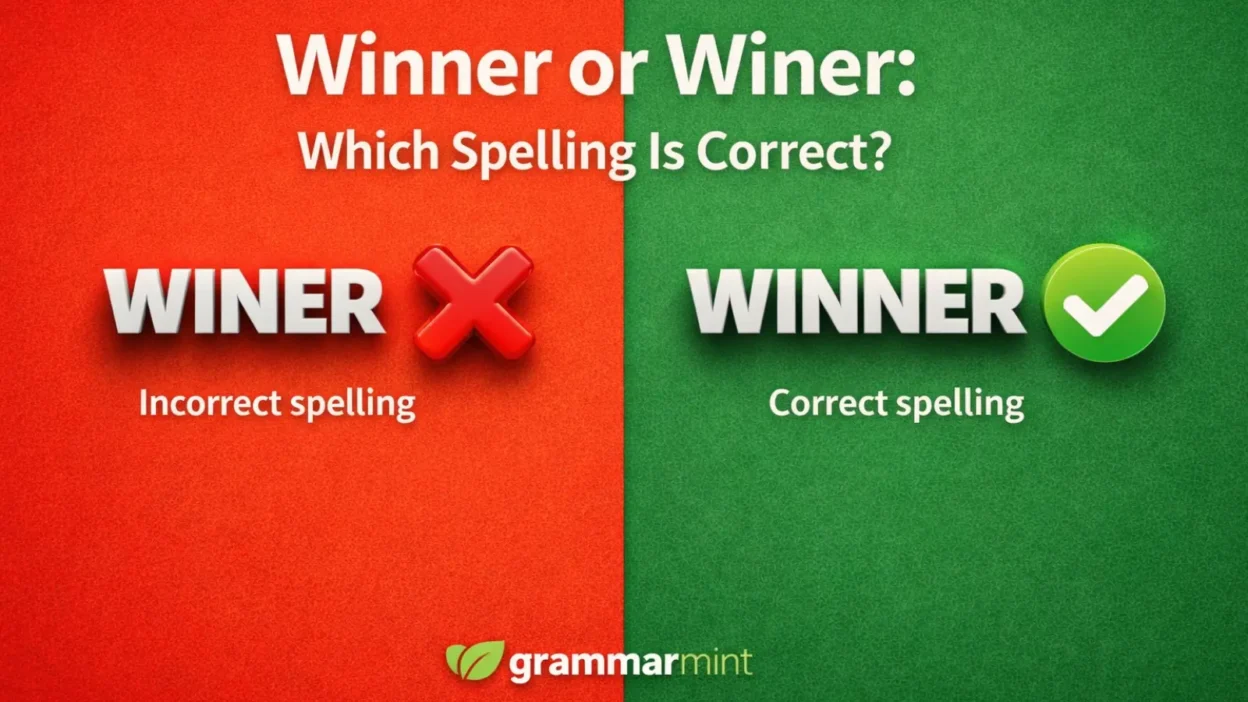
The correct spelling is winner.
“Winer” is not the correct spelling for someone who wins. In standard American English, only winner is accepted as the noun meaning “a person who wins.”
If you’re talking about victory, prizes, or success, always use winner.
Key Differences at a Glance
• Winner = a person or thing that wins
• Winer = not a standard English word for someone who wins
• Winner appears in dictionaries
• Winer does not appear as a valid noun meaning “someone who wins”
Origin and Why Two Forms Exist
The word winner comes from the verb “win.” When forming nouns from short verbs that end in a single vowel and consonant, English often doubles the final consonant before adding “-er.”
Win → win + ner → winner
That double “n” follows a common spelling pattern in English. You see the same rule in words like:
• run → runner
• swim → swimmer
• begin → beginner
“Winer” likely appears because people forget to double the consonant. It’s a simple spelling slip, not a separate word with the same meaning.
There is a surname spelled “Winer,” but that’s unrelated to the common noun winner.
British vs American English
There is no regional difference here.
Both American and British English use winner. “Winer” is not an accepted alternative in either variety.
If you see “winer,” it’s almost always a typo or spelling mistake.
Which One Should You Use?
For everyday writing — texts, social media, school papers — use winner every time.
For professional settings — emails, resumes, reports — correct spelling matters even more. Writing “winer” in a job application or presentation can make your work look rushed or careless.
If you’re unsure, slow down and check the pattern:
• Short verb
• Add “-er”
• Double the final consonant
That simple check will save you.
Common Mistakes (and Quick Fixes)
• Mistake: Writing “She’s the winer of the contest.”
– Fix: Write “She’s the winner of the contest.”
• Mistake: Dropping one “n” when typing quickly.
– Fix: Remember: win → winner (double “n”).
• Mistake: Assuming “winer” is a British spelling.
– Fix: There is no British variant. Use “winner.”
• Mistake: Relying only on autocorrect.
– Fix: Always reread important messages before sending.
• Mistake: Confusing it with similar-looking words.
– Fix: Focus on the base word “win.”
• Mistake: Thinking both spellings are acceptable.
– Fix: Only “winner” is standard English.
Everyday Examples (Real Contexts)
Informal text:
“Congrats! You’re the winner!”
Social media caption:
“And the giveaway winner is… Sarah!”
School context:
“The winner of the science fair received a medal.”
Work email:
“The winner of the sales challenge will be announced Friday.”
More professional rewrite:
“The top performer for this quarter will be recognized at Friday’s meeting.”
Notice how “winner” works in both casual and formal situations. It’s flexible and widely accepted.
Usage and Trends
Online searches show that many people look up “winner or winer” to check the correct spelling. This suggests that “winer” appears mostly as a typo.
Dictionaries and style references consistently list winner as the only correct form for someone who wins.
You’ll rarely see “winer” in edited publications unless it’s a proper name.
Comparison Table
Context | Best Choice | Why
| Context | Best Choice | Why |
| Text message | Winner | Correct standard spelling |
| Instagram caption | Winner | Widely recognized and clear |
| School assignment | Winner | Required for proper grammar |
| Work email | Winner | Maintains professionalism |
| Resume or award list | Winner | Prevents spelling errors |
| Blog post | Winner | Matches dictionary usage |
FAQs
Is “winer” a real word?
Not in standard English as a noun meaning someone who wins. It does not appear in dictionaries with that meaning.
Why does “winner” have two n’s?
Because English spelling rules double the final consonant when adding “-er” to short verbs like “win.”
Is “winer” a British spelling?
No. Both American and British English use “winner.”
Can autocorrect fix this mistake?
Often yes, but not always. It’s still important to proofread.
How can I remember the correct spelling?
Think of similar words like “runner” and “swimmer.” If they double the consonant, so does “winner.”
Mini Quiz
- Which is correct: “She’s the contest winer” or “She’s the contest winner”?
- Does British English use “winer”?
- What rule explains the double “n” in “winner”?
- Is “winer” acceptable in professional writing?
Answer Key:
- “She’s the contest winner.”
- No.
- Doubling the final consonant before adding “-er.”
- No.
Conclusion
When choosing between Winner or Winer winner-or-winer, the answer is simple: use winner.
“Winer” is a spelling mistake in standard English. Context and audience always matter, but in this case, there’s only one correct option.
If you’re ever unsure, remember the rule: win → winner. Double the “n,” and you’re good to go.