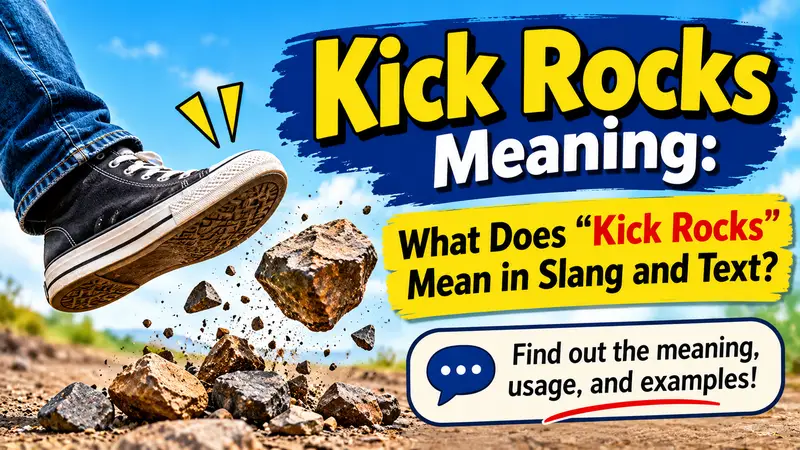
Have you ever seen someone write “kick rocks” in a text message, social media comment, or online conversation? You might wonder whether they are talking about actual rocks or telling someone something else. In American English slang, “kick rocks” means to go away, leave someone alone, or stop bothering them. It is a dismissive expression people use when they are annoyed, frustrated, or unwilling to deal with someone.
For example, if someone says, “If you don’t like my decision, you can kick rocks,” they mean the other person should leave them alone or stop complaining. The expression can sound playful between friends, but it can also be rude or disrespectful depending on the situation.
In this guide, you’ll learn what kick rocks means in texting, how Americans use it in everyday conversations, where the expression comes from, and what you can say instead.
What Does Kick Rocks Mean?
Kick rocks is an informal American English slang expression that means “go away,” “get lost,” or “leave me alone.”
People typically use it when someone is annoying them, making unreasonable demands, criticizing them, or refusing to respect their boundaries.
Here are some simple interpretations:
- Go away.
- Stop bothering me.
- Leave me alone.
- Get out of here.
- Find something else to do.
- I don’t want to deal with you.
For example:
Person A: You should give me your new phone. You don’t need it.
Person B: If you think I’m doing that, you can kick rocks!
In this conversation, Person B is refusing the request and telling the other person to stop bothering them.
The expression is not usually meant literally. Nobody is necessarily asking someone to walk around kicking stones. Instead, it communicates frustration or rejection.
Kick Rocks Meaning in Text Messages
In text messages, kick rocks means “go away” or “stop bothering me.” It is often used during disagreements, arguments, playful exchanges, or conversations where someone wants to end an interaction.
Because texting does not include facial expressions or vocal tone, the phrase can sometimes sound harsher than intended.
For example:
Friend 1: Come on, let me borrow your car again!
Friend 2: You crashed it last time. Go kick rocks!
Here, the sender is expressing frustration and refusing to lend the car again.
Another example:
Person A: Why won’t you answer my messages?
Person B: I’m busy right now. Go kick rocks.
This response suggests that Person B wants some space and does not want to continue the conversation.
Common meanings in texting
| Expression | Intended meaning |
|---|---|
| Kick rocks! | Go away! |
| Go kick rocks. | Leave me alone. |
| You can kick rocks. | I reject your request. |
| Let them kick rocks. | Ignore them or let them go away. |
| He can kick rocks. | I don’t want to deal with him. |
The exact meaning depends on the relationship between the people and the conversation.
What Does Go Kick Rocks Mean?
“Go kick rocks” is a direct and dismissive way of telling someone to leave or stop bothering you.
Adding the word “go” makes the expression sound more like a command.
For example:
- Go kick rocks if you don’t respect my boundaries.
- I told the annoying salesperson to go kick rocks.
- You don’t like my opinion? Then go kick rocks.
In these examples, the speaker is rejecting someone or making it clear that they do not want to continue interacting.
The phrase can also be used humorously among close friends. However, when someone says it seriously during an argument, it usually communicates irritation or disrespect.
Kick Rocks Meaning on Social Media
On social media, kick rocks is commonly understood as a dismissive expression. People may use it in comments, captions, discussions, and online arguments to reject criticism or tell someone to stop interfering.
For example:
Social media comment:
“Anyone who doesn’t support my new business idea can kick rocks.”
This means the person does not care about negative opinions and does not want to hear further criticism.
Other examples include:
- “If you don’t like my pictures, kick rocks.”
- “People spreading rumors can kick rocks.”
- “My haters can kick rocks. I’m focused on myself.”
- “If you’re here to create drama, go kick rocks.”
The phrase can communicate confidence, frustration, sarcasm, or an unwillingness to entertain negative comments.
Is kick rocks used on TikTok and Instagram?
Yes. The expression can appear in short videos, captions, comments, memes, and other informal online conversations.
On platforms such as TikTok and Instagram, it may be used to dismiss negative opinions, respond to unwanted attention, or make a sarcastic statement.
For example:
“To everyone who doubted me, kick rocks. I’m doing just fine!”
The message is that the speaker is moving forward without worrying about criticism.
Is Kick Rocks Rude or Offensive?
Kick rocks is not a profanity, but it can be considered rude, disrespectful, or dismissive.
The expression is generally milder than phrases containing strong swear words, but that does not mean everyone will find it polite.
Its tone depends on three main factors:
1. The relationship between the speakers
Close friends may use kick rocks jokingly without causing offense.
For example:
“You’re not getting the last slice of pizza. Go kick rocks!”
Between friends, this could be playful teasing.
2. The situation
During an argument, the same phrase can sound aggressive.
For example:
“I don’t want your advice. Just kick rocks!”
This communicates anger and rejection.
3. The speaker’s tone
A smiling face, laughing emoji, or playful conversation can make the phrase seem less serious. However, a short message without context may sound harsh.
Usage tip: Avoid using kick rocks with your boss, customers, teachers, or people you do not know well. A more respectful expression will usually be a better choice.
Where Did the Phrase Kick Rocks Come From?
The exact origin of kick rocks is uncertain. There is no firmly established first speaker or confirmed date when the expression was created.
One commonly suggested explanation comes from the image of someone walking away while kicking small stones along the ground. This picture fits the expression’s meaning: a person being dismissed and sent away to occupy themselves elsewhere.
However, this is an explanation of the imagery, not a proven historical origin.
The phrase is documented in American slang references. The Routledge Dictionary of Modern American Slang and Unconventional English records “kick rocks!” as a US expression meaning “go away” in a 2001 reference. This establishes documented usage by that time, not the phrase’s actual first appearance.
The safest explanation is that kick rocks developed as an informal American English dismissal, while its precise history remains unclear.
Kick Rocks Examples in Everyday Conversations
Understanding examples makes it easier to recognize how the expression works in different situations.
Here are some natural examples.
1. Between friends
Friend 1: You’re not invited to our movie night!
Friend 2: Whatever, you can kick rocks!
Meaning: The second friend is responding sarcastically and dismissively.
2. During an argument
Person A: You need to apologize to me right now.
Person B: Stop blaming me for everything and kick rocks.
Meaning: The speaker is frustrated and wants the other person to leave them alone.
3. At work
Employee 1: The manager wants you to work another weekend without extra pay.
Employee 2: They can kick rocks. I already worked two weekends.
Meaning: The employee strongly rejects the request.
4. In a relationship
Person A: Your ex keeps asking you to come back.
Person B: They can kick rocks. I’ve moved on.
Meaning: The speaker does not want to restart the relationship.
5. On social media
User 1: People are criticizing your new video.
User 2: Let them kick rocks. I love what I created.
Meaning: The speaker is choosing not to care about negative comments.
6. In a group chat
Friend 1: Everyone has to pay for my dinner tonight.
Friend 2: Go kick rocks! It’s your birthday, not ours.
Meaning: The second friend is jokingly rejecting the demand.
7. Rejecting an unreasonable request
Person A: Can you lend me another $500?
Person B: After what happened last time, you can kick rocks.
Meaning: The speaker refuses to lend more money.
8. Setting personal boundaries
Person A: Why don’t you want to spend time with me anymore?
Person B: You keep disrespecting my boundaries. Please leave me alone.
Meaning: The speaker wants distance and does not want further unwanted interaction.
Similar Expressions to Kick Rocks
English has many informal expressions that communicate a similar message. Some are playful, while others are more direct or aggressive.
Here are some common alternatives:
| Expression | Meaning | Tone |
|---|---|---|
| Get lost | Go away | Rude or dismissive |
| Beat it | Leave immediately | Direct |
| Take a hike | Go away | Informal |
| Get out of here | Leave or stop bothering me | Context-dependent |
| Leave me alone | Stop bothering me | Direct |
| Buzz off | Go away | Rude |
| Pound sand | Go away or stop bothering me | Dismissive |
| Hit the road | Leave | Informal |
| Move along | Go somewhere else | Neutral to dismissive |
| Give me some space | Stop bothering me for now | Polite |
Kick rocks vs. take a hike
Both expressions can tell someone to go away.
However, take a hike can sound slightly more old-fashioned or playful, while kick rocks often carries a dismissive or frustrated tone.
Example:
- Kick rocks: I don’t want to hear your excuses. Go away.
- Take a hike: I’m busy right now. Take a hike.
The difference is not absolute; context and delivery matter.
Kick rocks vs. pound sand
These expressions are very similar.
Both can be used to reject someone’s request or tell them to stop bothering you.
For example:
- “If you don’t like my decision, kick rocks.”
- “If you don’t like my decision, go pound sand.”
Both communicate that the speaker does not intend to change their mind.
How to Respond When Someone Tells You to Kick Rocks
If someone tells you to kick rocks, your response should depend on the situation.
You do not always need to argue or respond with another insult.
Here are some possible responses:
| Situation | Possible response |
|---|---|
| A friend is joking | “Okay, I’ll find another place to go!” |
| Someone is angry | “I can see you’re upset. Let’s talk later.” |
| Someone is being disrespectful | “There’s no need to speak to me that way.” |
| Someone wants space | “Understood. I’ll leave you alone.” |
| Someone rejects your request | “No problem. I understand.” |
| Someone is provoking you online | “I’m not interested in arguing.” |
Should you respond with another insult?
Usually, no. Responding aggressively can make a small disagreement worse.
If the conversation is becoming disrespectful, it is often better to end it calmly.
For example:
“I understand you don’t want to talk. I’ll respect that.”
This response communicates maturity without escalating the situation.
Common Mistakes When Using Kick Rocks
Although the expression is easy to understand, people sometimes misunderstand its meaning or use it in the wrong situation.
1. Thinking it literally means kicking stones
The expression is usually figurative. When someone tells you to kick rocks, they generally mean go away rather than asking you to perform a physical action.
2. Assuming it is always playful
Kick rocks can be humorous between friends, but it can also be a serious insult or dismissal during an argument.
3. Using it in formal communication
It is an informal slang expression. Avoid using it in professional emails, academic writing, official documents, or customer-service conversations.
4. Confusing kick rocks with kick back
These expressions have different meanings.
- Kick rocks: Go away or leave someone alone.
- Kick back: Relax or spend time comfortably.
Example:
“Let’s kick back and watch a movie.”
This means relax, not go away.
5. Using it without considering the audience
Not everyone understands informal slang. If you are communicating with someone unfamiliar with American expressions, a straightforward phrase such as “please leave me alone” may be clearer.
Quick Tips for Using Kick Rocks Naturally
Keep these points in mind when using the expression:
- Use it when you want to dismiss someone or reject an unreasonable request.
- Remember that it is informal American English slang.
- Consider your relationship with the other person before using it.
- Avoid it in formal or professional situations.
- Understand that it can sound rude even without profanity.
- Use polite alternatives when you want to establish boundaries respectfully.
FAQs
Kick rocks means “go away,” “get lost,” or “leave me alone.” It is an informal slang expression used when someone wants another person to stop bothering them or leave.
In a text message, go kick rocks is a dismissive way of telling someone to leave you alone. It can express frustration, rejection, annoyance, or playful teasing depending on the conversation.
No, kick rocks is not technically a swear word. However, it can sound rude, insulting, or disrespectful because it tells someone to go away.
Yes. Kick rocks is documented in American English slang references. It is an informal expression commonly understood to mean go away or leave someone alone.
Some alternatives include get lost, beat it, take a hike, pound sand, buzz off, and leave me alone. The best alternative depends on whether you want to sound playful, direct, or polite.
It means the person is rejecting your request, opinion, or presence. They are essentially saying they do not want to deal with you or your situation.
Yes. Friends sometimes use kick rocks as playful teasing. However, it can sound insulting if the other person does not understand the joke or if the conversation is already tense.
Conclusion
Now you know that kick rocks means go away, get lost, or leave me alone. It is an informal American English expression that people use to dismiss someone, reject an unreasonable request, or express frustration.
You may encounter it in text messages, social media comments, online discussions, and everyday conversations. Although it can be playful among friends, it may sound rude or disrespectful in serious situations.
Remember that context matters. If someone tells you to kick rocks, they usually want you to stop bothering them or move on. If you want to communicate the same message more politely, you can simply say, “Please leave me alone” or “I need some space.”
Keep exploring our English meaning and slang guides to understand more everyday expressions and use them confidently in your conversations.
SEO Details
Primary keyword: kick rocks
Secondary keywords:
- kick rocks meaning
- what does kick rocks mean
- kick rocks meaning in text
- kick rocks slang
- go kick rocks meaning
- kick rocks definition
- kicking rocks meaning
- kick rocks origin
Long-tail keywords:
- what does it mean when someone tells you to kick rocks
- what does go kick rocks mean in a text
- is kick rocks a rude expression
- how to use kick rocks in a sentence
- what is another way to say kick rocks
SEO Meta Title: Kick Rocks Meaning: Definition, Slang & Examples
Meta Description: Discover what kick rocks means in slang and texting. Explore its origin, examples, tone, and similar expressions in everyday English.
URL Slug: kick-rocks-meaning