If you write for American readers, this spelling question comes up everywhere: school papers, resumes, emails, captions, travel blogs, and website copy. Traveled or travelled looks like a small choice, yet it can affect tone, consistency, and how polished your writing feels. For USA usage, the core issue is American English versus British English, not meaning, tense, or pronunciation. You’ll also see the same split in traveling/travelling, traveler/traveller, and even similar pairs like canceled/cancelled. So, this guide keeps it simple. You’ll get the direct US answer, the reason both forms exist, and easy examples for school, work, and everyday writing.
Quick Answer
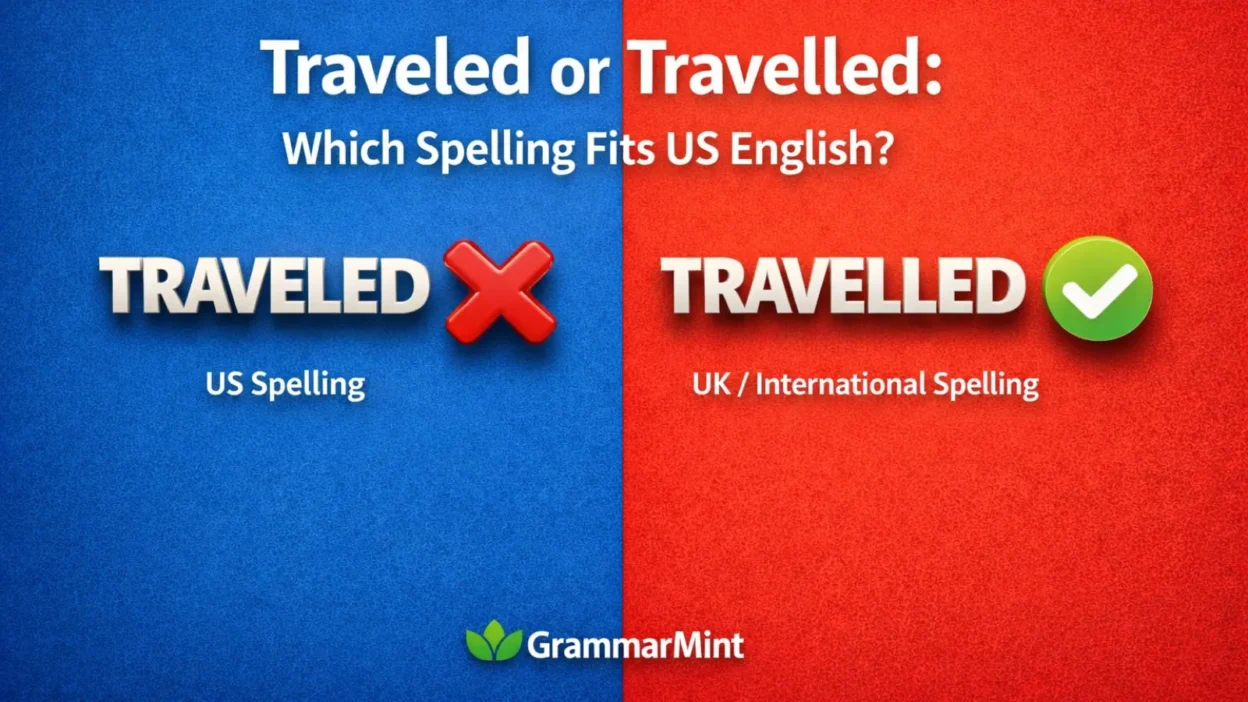
For a USA audience, traveled is the standard spelling. Travelled is correct in British English, but it usually looks off in American writing.
TL;DR
• US readers expect traveled
• UK readers usually expect travelled
• Both forms mean the same thing
• The difference is regional style
• Match related forms too
• Stay consistent in one piece
Traveled or Travelled at a Glance
This is the fast answer most readers want. The meaning stays the same, but the preferred spelling changes by audience.
• US spelling uses traveled
• British spelling uses travelled
• Same meaning in both forms
• Pronunciation does not change
• This is not a tense difference
• This is not a meaning difference
• US schools usually expect one L
• UK outlets usually expect two Ls
• Match the rest of your copy
• Use one style per document
• Readers notice mixed spellings quickly
• Audience matters more than habit
American English vs. British English
This is really a regional English question. American English prefers the one-L form, while British English keeps the doubled-L form.
• American English favors one L here
• British English keeps the doubled L
• Regional spelling is the real issue
• US dictionaries label traveled standard
• British sources use travelled naturally
• Many global readers understand both
• Local readers still prefer local style
• Spellcheck often follows region settings
• Style guides usually pick one form
• International teams should choose early
• Consistency beats personal preference
• Localizing copy makes writing smoother
Is Travelled Wrong in the US?
Not exactly. Still, it usually looks nonstandard to American readers, so it can distract from your point.
• Standard usage in the US is traveled
• Nonstandard look can distract readers
• Meaning stays clear either way
• Teachers may mark it as style
• Editors may switch it quietly
• US spellcheck may flag travelled
• Resumes should usually use traveled
• US websites should usually use traveled
• American ads favor one L
• Captions look cleaner with one style
• Quotes can keep original spelling
• British brand copy is an exception
Why the Spelling Changes
The split comes from regional spelling history. American usage moved toward simpler forms, while British usage kept the doubled-L pattern in words like this.
• Noah Webster pushed some simpler US forms
• Doubling rule differs by region
• Unstressed syllable matters in US spelling
• Travel ends with vowel plus L
• British usage doubles final L
• American usage usually does not
• The split is long-standing
• It is not a new internet fad
• Dictionaries recognize both forms
• House style keeps the rule alive
• Related words follow similar patterns
• The choice is conventional, not random
Past Tense and Past Participle of Travel
Both spellings can work as the past tense and the past participle. The difference is regional, not grammatical.
• Past tense can be traveled
• Past participle can be traveled
• British past tense can be travelled
• British participle can be travelled
• Base verb stays travel
• Third-person form stays travels
• “I traveled yesterday” is US style
• “I have traveled” is US style
• “I travelled yesterday” is UK style
• “I have travelled” is UK style
• Meaning stays exactly the same
• Match the surrounding spelling system
Traveling and Travelling Follow the Same Pattern
The same regional split shows up in the -ing form. So, if you choose traveled, you should almost always choose traveling too.
• Present participle follows the same split
• One L gives traveling
• Two Ls gives travelling
• Pair traveled with traveling
• Pair travelled with travelling
• Mixed pairs look sloppy
• Menus should match body copy
• Headlines should match captions
• Buttons should match page text
• Bios should match article style
• Templates should be checked once
• Brand voice should stay stable
Traveler and Traveller Follow the Same Pattern
The noun works the same way. That is why this question often spreads beyond one word.
• Noun form changes by region too
• Word family should stay aligned
• Consistency matters across all variants
• US form is traveler
• UK form is traveller
• Plurals follow the same split
• Possessives follow the same split
• Bios often use traveler in US copy
• Brochures may use traveller in UK copy
• Travel sites should stay consistent
• Brand guides should list all forms
• One decision fixes several words
Well-Traveled and Well-Travelled
This form often appears as an adjective. It can describe a person, a road, or even an idea that feels widely known.
• Hyphenation is common before nouns
• Compound adjective helps readers scan faster
• Adjective form follows regional spelling too
• US: well-traveled writer
• UK: well-travelled writer
• US: well-traveled road
• UK: well-travelled road
• Same meaning in both forms
• Hyphen helps before a noun
• After a verb, style may vary
• Check your house style first
• Keep nearby forms matched
Usage Over Time
The pattern is not random. American sources favor traveled, while British sources keep travelled, and that split has stayed visible over time.
• Usage trends show a lasting regional split
• Books corpus supports the pattern
• Modern style still repeats the same guidance
• US reference pages prefer traveled
• British-style pages prefer travelled
• Online writing mixes both more often
• Searchers still ask about this often
• Confusion grows in global content
• Meaning has not shifted
• The style split remains stable
• One-L forms feel standard in US copy
• Two-L forms remain normal elsewhere
When to Use Traveled in School and Work
For US readers, this is the safer choice almost every time. It fits American expectations in formal and everyday writing.
• American audience usually wants traveled
• School writing should usually use traveled
• Workplace copy should usually use traveled
• US essays prefer one L
• US resumes prefer one L
• US cover letters prefer one L
• US emails read cleaner with traveled
• US blog posts favor traveled
• US product pages favor traveled
• US headlines usually use traveled
• US captions usually use traveled
• US LinkedIn copy fits one L
When Travelled Fits Better
There are times when the two-L form is the right fit. That usually happens when the audience or house style leans British.
• UK audience may expect travelled
• Localization can justify the two-L form
• House style should lead the choice
• UK school writing uses travelled
• British publications use travelled naturally
• Australian copy may use travelled
• New Zealand copy may use travelled
• Some Canadian copy uses travelled
• Irish usage may lean travelled
• UK client decks may prefer travelled
• British quotes should stay original
• Existing UK style guides should win
Common Mistakes Writers Make
Most errors here are style problems, not meaning problems. A few quick checks can prevent nearly all of them.
• Mixed spelling is the biggest problem
• Style drift happens during revisions
• Proofreading should check the full word family
• Don’t mix traveled and travelling
• Don’t mix traveller and traveled
• Don’t assume one form is always wrong
• Don’t change quoted text carelessly
• Don’t trust spellcheck without region settings
• Don’t fix one form only
• Don’t ignore headings and image text
• Don’t swap styles mid-article
• Don’t overthink the meaning
Example Sentences in American English
These examples fit standard US usage. Notice how the one-L form stays consistent across the set.
• American examples help the pattern stick
• Sample sentences make the choice easier
• One-L form stays steady throughout
• I traveled to Denver last summer
• She traveled alone for work
• We traveled by train to Boston
• He traveled overseas after graduation
• They traveled with two small kids
• My grandparents traveled across Texas
• The team traveled on Friday morning
• I have traveled for conferences before
• She’s one of our best-traveled editors
Example Sentences in British English
These examples fit British-style usage. The meaning stays the same, but the doubled-L spelling is the visible difference.
• British examples show the regional form
• Sample sentences keep the contrast clear
• Two-L form stays steady throughout
• I travelled to Leeds last spring
• She travelled by coach with friends
• We travelled through France by rail
• He travelled abroad for business
• They travelled with heavy luggage
• My aunt has travelled widely
• The squad travelled on Thursday evening
• I have travelled there twice before
• She’s a well-travelled lecturer
Similar Pairs Like Canceled and Cancelled
This spelling split is not unique to travel. Once you see the pattern, related pairs become easier to handle.
• Canceled/cancelled shows the same regional split
• Labeling/labelling follows a similar pattern
• Learned/learnt is related, but not identical
• US copy usually uses canceled
• UK copy usually uses cancelled
• US copy usually uses labeling
• UK copy usually uses labelling
• Travel pairs with traveler too
• Not every word behaves exactly alike
• Check each family before assuming
• House style solves most uncertainty
• One good rule reduces later edits
A Simple Consistency Checklist
If you still feel unsure, use this list. It turns the spelling choice into a fast editing decision.
• Style choice comes before proofreading
• Consistency check should include related words
• Final edit should scan the whole document
• Choose US or UK first
• Set spellcheck to the right region
• Search for traveled and travelled
• Search for traveling and travelling
• Search for traveler and traveller
• Check headings and subheads
• Check captions and graphics
• Leave quotations in original form
• Do one last read for drift
FAQs
Which is correct, traveled or travelled?
Both are correct, but they fit different audiences. For US English, traveled is the standard choice, while travelled is the usual British-style spelling.
Is travelled wrong in American English?
It is not wrong in the sense of meaning or grammar. Still, it usually looks out of place in US writing, so traveled is the better fit for American readers.
What is the past tense of travel?
The past tense can be traveled in American English or travelled in British English. The same regional split applies to the past participle.
Why does British English use two Ls?
British spelling keeps the doubled-L pattern in words like travelled and travelling. American spelling usually drops that extra L when the final syllable is not stressed.
Do traveling and travelling follow the same rule?
Yes. If your copy uses traveled, it should usually use traveling too. If it uses travelled, it should usually use travelling as well.
Should I change quoted text to match my style?
Usually, no. Keep direct quotations as they originally appear, then keep your own narration consistent around them.
Conclusion
For a USA audience, traveled or travelled is mostly a style choice, and traveled is the standard pick.
Choose your audience first, match the whole word family, and keep the spelling consistent from start to finish.