“Quit” and “quite” look almost identical. They differ by just one letter. That tiny difference causes a lot of confusion in texts, school papers, and even work emails.
You might see someone write, “I quite my job,” or “That’s quit interesting.” Both change the meaning completely.
This mix-up matters because one word is a verb. The other is an adverb. Using the wrong one can make your writing look careless or unclear.
This guide explains the difference, shows real examples, and helps you choose the right word every time.
Quick Answer
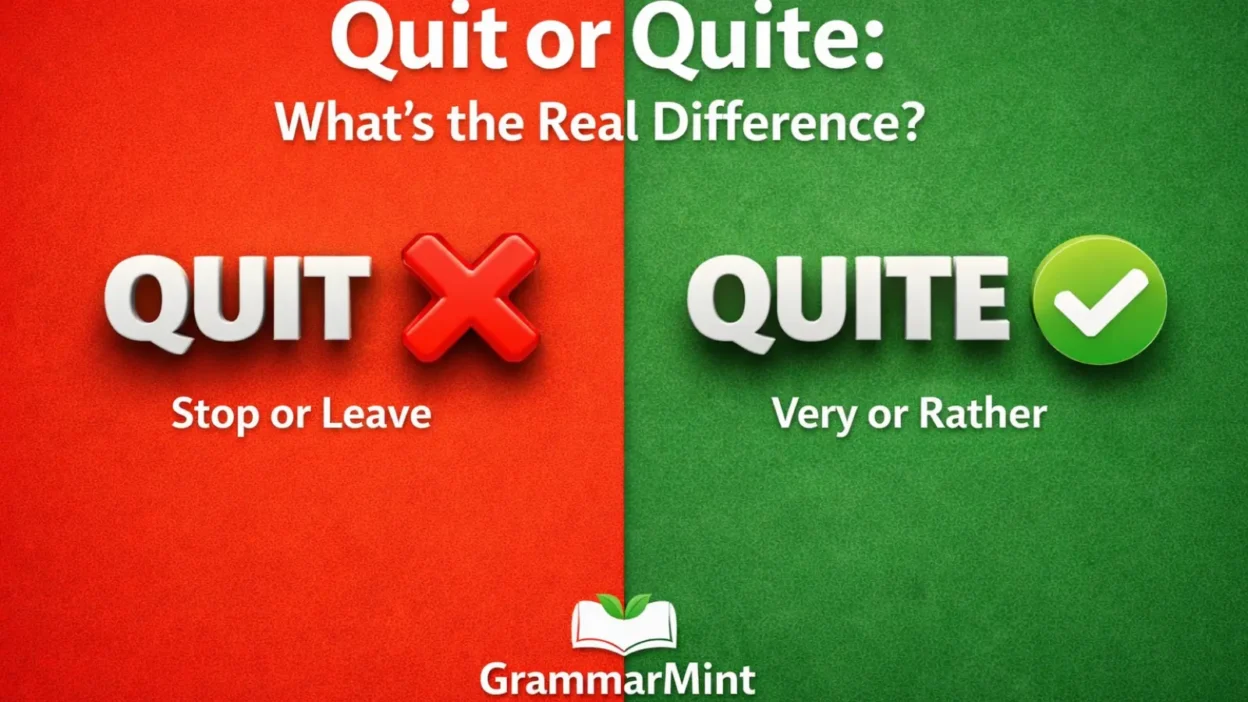
“Quit” is a verb. It means to stop, leave, or give up.
“Quite” is an adverb. It usually means very, completely, or fairly.
They are not interchangeable. If you mix them up, your sentence will not make sense.
Key Differences at a Glance
Feature | Quit | Quite
Meaning | To stop or leave | Very, fairly, completely
Part of Speech | Verb | Adverb
Example | I quit smoking. | That’s quite helpful.
Pronunciation | Sounds like “kwit” | Sounds like “kwite”
Origin and Why Two Forms Exist
“Quit” comes from older French and Latin roots meaning to free or release. Over time, it took on the meaning of stopping or leaving something behind.
“Quite” developed as a modifier. It was used to strengthen or adjust meaning. It now works as an adverb that changes how strong something sounds.
They look similar because of shared spelling patterns in English. But their meanings and grammar roles are very different.
British vs American English
In both the US and the UK, “quit” means to stop. That part is consistent.
“Quite” can feel stronger in British English. In the US, it often means “very” or “pretty.” In the UK, it sometimes means “fairly” or “rather.”
Still, the spelling does not change between regions. The difference is about tone, not spelling.
Which One Should You Use?
• General casual use:
Use “quit” when someone stops something. Use “quite” when you want to describe intensity.
• Child-directed tone:
You might say, “She quit the game.” Or, “That’s quite a big cookie!”
• Professional or academic writing:
“Quit” is fine when talking about employment or stopping an activity.
“Quite” works in formal writing, but be careful. It can sound vague. Sometimes “very” or “significantly” is clearer.
Common Mistakes (and Quick Fixes)
• Mistake: I quite my job last week.
– Fix: I quit my job last week.
• Mistake: That movie was quit funny.
– Fix: That movie was quite funny.
• Mistake: She wants to quite smoking.
– Fix: She wants to quit smoking.
• Mistake: I will quite if this continues.
– Fix: I will quit if this continues.
• Mistake: It’s quit cold outside.
– Fix: It’s quite cold outside.
• Mistake: Mixing them because they sound alike.
– Fix: Remember, “quit” = stop. “Quite” = very.
Everyday Examples (Real Contexts)
• Text message:
“I finally quit soda!”
• Social media post:
“That concert was quite amazing.”
• Parenting moment:
“He quit the game because he was tired.”
• Workplace email:
“I have decided to quit my position effective March 1.”
More professional rewrite:
“I am resigning from my position effective March 1.”
Usage and Trends
Both words are common in everyday English. “Quit” often appears in job-related discussions and personal goals. “Quite” appears in descriptions and opinions.
Search patterns show steady interest in the difference. Many learners look it up during school months. The confusion stays consistent over time.
Comparison Table
Context | Best Choice | Why
Talking about leaving a job | Quit | It means to stop or resign
Describing something impressive | Quite | It adds emphasis
Stopping a habit | Quit | Correct verb form
Saying something is very good | Quite | Works as an adverb
Formal resignation letter | Quit or resign | Quit is correct, resign is more formal
Describing weather intensity | Quite | Modifies adjectives
FAQs
What is the difference between quit and quite?
“Quit” means to stop or leave. “Quite” means very or fairly. One is a verb, the other is an adverb.
Is quit a verb?
Yes. “Quit” is a verb. It describes the action of stopping something.
Is quite an adverb?
Yes. “Quite” modifies adjectives or other adverbs. It changes intensity.
How do you use quit in a sentence?
You use it to show stopping. For example: “She quit her job.”
How do you use quite in a sentence?
You use it to describe degree. For example: “That’s quite interesting.”
Mini Quiz
- I decided to ___ eating junk food.
- That test was ___ difficult.
- She will ___ the team next year.
- The movie was ___ entertaining.
Answer Key:
- quit
- quite
- quit
- quite
Conclusion
“Quit or Quite” is a common spelling confusion. One means to stop. The other adds emphasis.
The right choice depends on grammar and context.
If you remember “quit = stop” and “quite = very,” you’ll avoid the mix-up every time.
Keep practicing, and your writing will feel clearer and more confident.