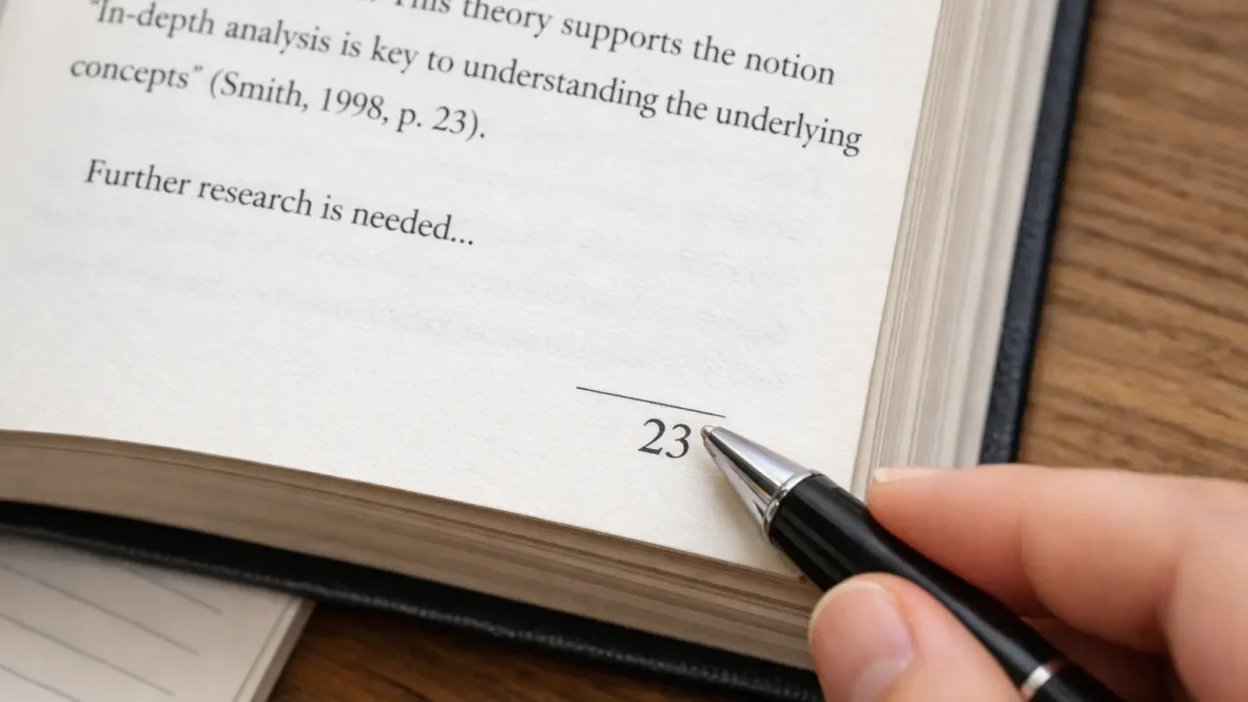
Writing about specific pages in a book, report, or article can feel straightforward — until you see forms like “page/23” or other odd variants. Most people are unsure whether to write the word page, use a slash, capitalize the term, abbreviate it, or treat it like a label. Because page numbers appear in school papers, emails, reports, and messaging, it helps to understand what form is considered standard and why.
This guide explains when to write page 23, why page/23 is not used in standard written English, and how to refer to page numbers clearly in different contexts. You’ll find examples from casual texts to academic settings, common mistakes with easy corrections, and simple rules you can follow every time.
Quick Answer
“page 23” is the correct and natural way to refer to a specific page in written English. The form “page/23” with a slash is not standard in everyday writing or formal styles. Use page followed by a space and the numeral, and capitalize Page only when it begins a sentence or is part of a heading or title.
Key Differences at a Glance
| Form | When to Use | Why |
| page 23 | Everyday prose, academic writing, emails | Clear, standard reference |
| page/23 | Not recommended | Not recognized as a conventional form |
• page 23 uses the word page plus a number to communicate location in a text or document.
• page/23 places a slash between the word and number, which is not a pattern seen in standard writing.
Origin and Why One Form Exists
In English, page numbers are part of how we organize and refer to long texts. Printed books, PDF documents, and articles use numerals at the bottom or top of pages so readers can find information quickly. When you need to mention a specific location in the body of your text — for example, when giving instructions or citing a reference — writers naturally use the full word page followed by the cardinal number.
Publishing conventions, academic styles (like APA, Chicago, and MLA), and general usage guides all agree on this pattern. The slash form (page/23) does not come from any major style guide for prose or academic work. Slashes are sometimes used in coding, URLs, or shorthand notes, but they don’t function as standard punctuation between a label and a number in English sentences.
American vs British English
Both American and British English follow the same basic pattern for citing a specific page: page + number. Neither major variety uses a slash between the word and the number in general writing. There is no regional rule where “page/23” is accepted as correct or standard in published English.
Which One Should You Use?
Your audience and context matter when writing about page numbers:
• Informal writing: In texts, social posts, or quick emails, write “page 23” to be clear and natural.
• Academic papers: Use page 23 when you refer to content, but follow your specific style guide (APA, Chicago, MLA) for formatting. For direct quotes in APA, include the page number after a citation.
• Professional writing: In reports, memos, or instructions, use page 23 or similar clear wording. Avoid slashes or unconventional forms that might confuse readers.
If you are writing a bibliography, footnote, or citation, follow the exact style format required by your instructor or publisher. That often includes punctuation like “p.” or “pp.” before numbers in reference lists, but not in the main prose.
Common Mistakes (and Quick Fixes)
• Mistake: page/23
Fix: page 23
• Mistake: Page23 (no space)
Fix: page 23
• Mistake: pg. 23 in formal writing when your style guide does not allow abbreviations
Fix: page 23 (or follow style guide: p. 23 only in citations if required)
• Mistake: Page 23 in the middle of a sentence where lowercase is preferred
Fix: page 23
• Mistake: on page: 23 with extra punctuation
Fix: on page 23
• Mistake: Pg 23 in casual prose
Fix: page 23 (full word is clearer)
• Mistake: page no. 23
Fix: page 23 (avoid “no.” unless part of specific style)
• Mistake: Putting the number in words (“page twenty-three”) in numeric text
Fix: Use numeric form for clarity: page 23
• Mistake: Using a hyphen instead of a space (page-23)
Fix: Use a space: page 23
• Mistake: Writing page 23rd
Fix: Use the cardinal number: page 23
Everyday Examples (Real Contexts)
Informal message/text
• “I’ll meet you in the study room near page 23 of the textbook.”
• “The answer is on page 23, right after the example problem.”
More professional rewrite:
• “Please refer to page 23 of the report for the key data table.”
Social media
• “Can someone explain the concept on page 23 of The Great Gatsby?”
Professional rewrite:
• “Please review the content on page 23 of the syllabus PDF before class.”
Parenting/child context
• “Read the picture on page 23 before answering question 5.”
Professional rewrite:
• “If your child is on page 23 of the workbook, we’ll focus there tomorrow.”
Workplace/email note
• “See the chart on page 23 for the sales figures.”
Professional rewrite:
• “For details on quarterly results, see the table on page 23 of the attached document.”
Usage/Trends (Qualitative)
Grammar and usage guides emphasize clarity and conventional forms of writing. Using the full word page followed by the number is a pattern readers expect. It aligns with how style manuals and educational resources describe referring to locations in texts. Informal shorthand like slashes may appear in quick notes or digital labels, but they do not translate into standard prose or professional communication.
Context Comparison Table
| Context | Best Choice | Why |
| Everyday writing | page 23 | Clear and widely understood |
| Academic citation in text | page 23 | Complies with style guides |
| Professional document | page 23 | Standard, formal usage |
| Shorthand in notes | avoid page/23 | Can confuse readers |
Frequently Asked Questions
Why is “page 23” correct and not “page/23”?
English convention places the label page before the number with a space. A slash suggests alternative meanings (paths, fractions) and is not used between words and page numbers in standard writing.
Should I write “Page 23” with a capital P?
Capitalize Page only at the start of a sentence or in a heading/title. Within a sentence, use lowercase page unless a style guide instructs otherwise.
Is “p. 23” acceptable?
In academic citations and references, many style guides use p. before a number. In the main prose, write page 23 unless your guide specifies otherwise.
Does this differ in British English?
No. Both American and British usage favor page 23 in general.
Can I say “see page 23”?
Yes. That phrase is standard for directing someone to a location in a text.
What about a page range like “pages 23–25”?
Use a hyphen or en dash between numbers when referring to a range: pages 23–25. Include the plural pages.
Is shorthand like “pg 23” okay?
It’s common in informal notes but not advised in polished writing.
Mini Quiz
- Choose the standard form:
a) page/23
b) page 23
Answer: b - In an email, which is better?
a) See page 23 for details
b) See pg. 23 for details
Answer: a - Which is correct for a range?
a) pages 23-25
b) page/23-page/25
Answer: a - Should page be capitalized in “see page 23”?
Answer: No, unless it starts the sentence. - In a citation, is p. 23 sometimes required?
Answer: Yes, depending on the style guide.
Conclusion
Choosing page 23 over page/23 makes your writing clear, standard, and easy to read.
Whether you’re texting, emailing, or writing academically, the traditional page + numeral pattern keeps your meaning straightforward.
When in doubt, stick with page 23 and follow your style guide for any additional formatting in citations or references.