If you’re trying to choose between Flys or Flies, you probably want a fast answer that also makes sense in real writing. This confusion shows up in emails, school work, captions, grammar checks, search bars, and everyday messages. It also pops up when people write about insects, planes, birds, or the phrase time flies. The good news is that the pattern is simple once you see it clearly. This guide explains the correct spelling, the noun and verb forms, the American and British usage points, the apostrophe trap, and the few rare exceptions that can still confuse careful writers.
Quick Answer
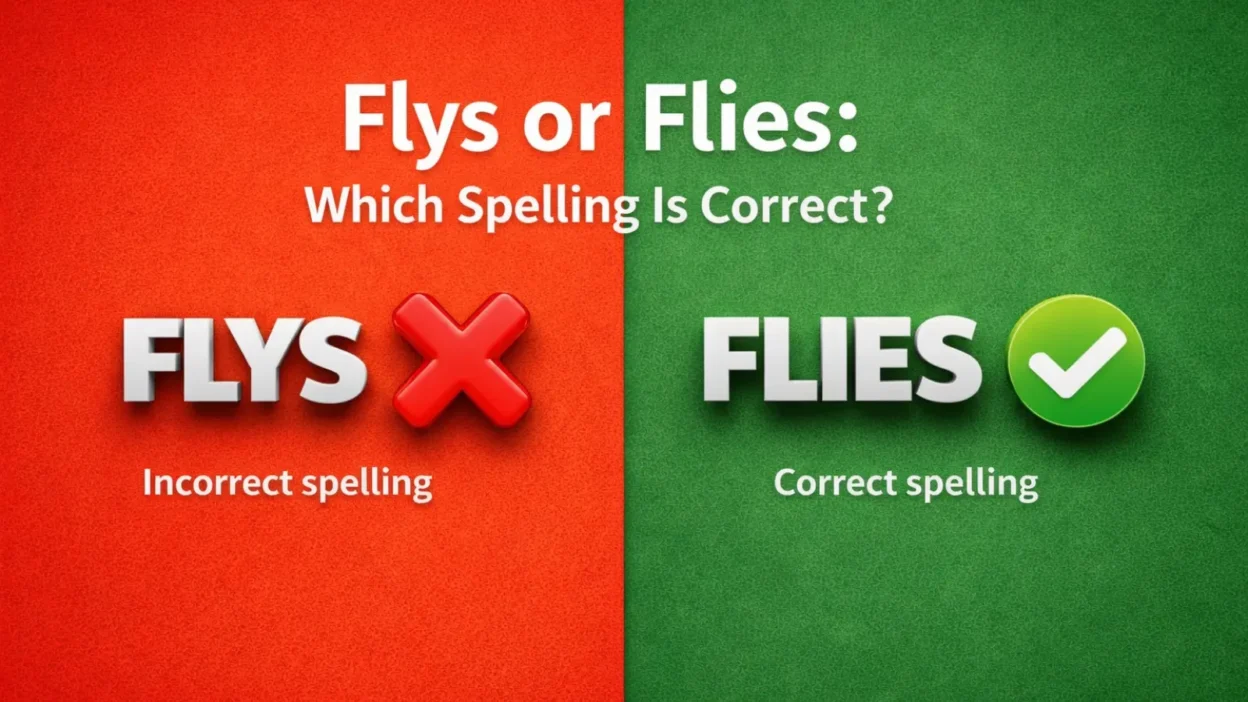
Flys or flies: the correct standard spelling is usually flies. Use flies for the plural of fly and for the third-person singular form of the verb fly. In normal modern writing, flys is treated as a spelling mistake.
TL;DR
• Flies is the normal correct form.
• Use it for insects and verbs.
• Write time flies, never time flys.
• Fly’s shows possession, not plural.
• US and UK both use flies.
• Rare exceptions don’t change the rule.
Is Flys A Word
In standard English, most people should treat flys as a misspelling, not the correct spelling. That is the safest choice for school, work, websites, and everyday messages.
• In modern writing, flys looks wrong.
• Teachers usually mark it incorrect.
• Editors will almost always change it.
• Spell-check often flags it fast.
• Readers expect flies instead.
• It fails in most everyday contexts.
• It weakens polished writing quickly.
• It can distract careful readers.
• It often appears in typos.
• It rarely belongs in normal prose.
• It is not your best choice.
• Use the safer form every time.
What Is The Plural Of Fly
As a plural noun, the insect form becomes flies, not flys. So one fly becomes many house flies, fruit flies, or just flies.
• One fly, two flies.
• The picnic had too many flies.
• Garbage can attract nasty flies.
• Window screens keep flies outside.
• Fruit flies gather near bananas.
• Stable flies bite animals hard.
• House flies love open trash.
• Summer kitchens often get flies.
• Farms can have swarming flies.
• Dead leaves may hide flies.
• Warm weather brings more flies.
• Clean counters discourage flies indoors.
Why Fly Becomes Flies
This happens because of the consonant + y pattern. With that plural rule, English often changes the -ies ending instead of just adding s.
• Fly ends with consonant plus y.
• That pattern usually changes spelling.
• Drop the y before adding.
• Then add ies at the end.
• Baby becomes babies too.
• City turns into cities.
• Lady changes to ladies.
• Fly follows the same pattern.
• So flys breaks the rule.
• The final sound stays familiar.
• The letters change for grammar.
• That’s why flies looks right.
How Flies Works As A Verb
As a third-person singular verb in the present tense, flies follows normal subject-verb agreement. With he, she, or it, you write flies.
• He flies home on Fridays.
• She flies for work often.
• It flies across the yard.
• The drone flies smoothly today.
• That kite flies very high.
• Her model plane flies well.
• This bird flies at dawn.
• The flag flies above town.
• Time flies in busy weeks.
• Smoke flies from fireworks.
• The rumor flies online fast.
• Every singular subject takes flies.
He Flies Or He Flys
With he flies, the verb form follows the simple present pattern. If the subject is singular, he flys is not the form you want.
• He flies coach every month.
• He flies drones on weekends.
• He flies home for birthdays.
• He flies east each spring.
• He flies solo sometimes.
• He flies that route yearly.
• He flies under pressure well.
• He flies private for business.
• He flies faster than before.
• He flies lessons after school.
• He flies to Denver tomorrow.
• He flys is simply incorrect.
She Flies Or She Flys
The same rule works with she flies. This sentence pattern is basic agreement, so she flys will still look wrong.
• She flies out each Monday.
• She flies southwest this afternoon.
• She flies kites with kids.
• She flies frequently for sales.
• She flies home every winter.
• She flies because driving tires her.
• She flies first class rarely.
• She flies commercial, not charter.
• She flies over storms calmly.
• She flies abroad for conferences.
• She flies that aircraft confidently.
• She flys should be avoided.
A Bird Flies Or Bird Flys
In an everyday example, a singular subject needs bird flies, not bird flys. The subject is one bird, so the verb takes the singular form.
• The bird flies above trees.
• A robin flies at sunrise.
• One eagle flies alone.
• My parrot flies indoors carefully.
• That owl flies silently at night.
• Each gull flies toward shore.
• The sparrow flies from branch.
• A crane flies over marshes.
• This hawk flies in circles.
• Her pigeon flies home daily.
• The injured bird barely flies.
• Bird flys is not correct.
Time Flies Or Time Flys
The time flies line is a common idiom and a very common common phrase. Even in casual writing, time flys is not the accepted form.
• Time flies when you’re busy.
• Time flies during vacations.
• Time flies after graduation.
• Time flies in new jobs.
• Time flies with little kids.
• Time flies on road trips.
• Time flies during holidays.
• Time flies in love stories.
• Time flies near deadlines.
• Time flies in college.
• Time flies after thirty.
• Time flys ruins the phrase.
Flies By Or Flys By
When you need flies by in a phrasal use, keep the normal spelling choice. The verb is still flies, even when another word comes after it.
• Summer flies by too fast.
• The week flies by now.
• Childhood flies by quickly.
• Her shift flies by lately.
• The movie flies by pleasantly.
• Practice flies by with friends.
• The semester flies by unexpectedly.
• My lunch break flies by.
• Traffic news flies by online.
• Their anniversary flies by yearly.
• The afternoon flies by indoors.
• Flys by is still wrong.
Flies A Plane Or Flys A Plane
In the phrase flies a plane, the subject is singular, so the pilot uses the normal verb phrase form: flies. That stays true in plain American usage.
• My aunt flies a plane.
• The pilot flies a jet.
• He flies a trainer aircraft.
• She flies a helicopter too.
• Dad flies a crop duster.
• Our neighbor flies a glider.
• The instructor flies a Cessna.
• One captain flies this route.
• The volunteer flies medical supplies.
• The commander flies missions overseas.
• The student flies supervised lessons.
• Flys a plane should be fixed.
Fly Vs Flies
Think of base word fly versus flies as a form choice. One is a singular noun or base verb, and the other can be a plural noun or third-person verb.
• Fly can name one insect.
• Fly can be a verb.
• Flies can name many insects.
• Flies can be one verb.
• I fly, but she flies.
• They fly, but he flies.
• One housefly, many houseflies.
• One fruit fly, many fruit flies.
• Fly stays basic and singular.
• Flies adds number or agreement.
• Context tells you the function.
• The ending changes the job.
Fly’s Vs Flies
This is the possessive trap. An apostrophe shows ownership, so fly’s does not mean more than one fly.
• The fly’s wing was torn.
• The fly’s body looked tiny.
• That fly’s movement seemed strange.
• A fly’s lifespan is short.
• The pilot’s fly suit differs.
• Fly’s marks possession only.
• Flies marks plural or verb.
• Don’t use apostrophes for plurals.
• The child’s toy broke.
• Dogs’ bowls sat outside.
• Ownership and number are separate.
• Fly’s and flies mean different things.
American English: Flies Or Flys
In American English, everyday usage and professional writing strongly favor flies. That is the form you want in emails, schoolwork, websites, and captions.
• American readers expect flies.
• US classrooms teach flies early.
• Business emails need flies.
• News writing uses flies naturally.
• School essays should use flies.
• Website copy should stay with flies.
• Social captions still look better polished.
• Workplace messages need the standard form.
• Resume writing should avoid flys.
• Product copy benefits from consistency.
• US proofreading catches flys fast.
• American usage is not split.
British English: Flies Or Flys
In British English, the main spelling is also flies. The one extra wrinkle is trousers, where British usage can also use flies for the opening at the front.
• UK spelling still prefers flies.
• Insects remain flies in Britain.
• The verb form stays flies.
• Time flies works there too.
• Bird flies stays unchanged.
• Flies can mean trouser openings.
• Your flies are undone sounds British.
• Your fly is undone works too.
• That clothing sense is regional.
• It does not rescue flys.
• The main rule still stands.
• Britain does not switch to flys.
Rare Exceptions And Historical Uses
A rare exception does not change modern writing advice. You may see historical use or brand names, but that still does not make flys the normal choice today.
• Some old texts mention flys.
• That use is historical now.
• It referred to an old carriage.
• Modern readers rarely need it.
• Brand names may keep Flys.
• Quoted titles can preserve spellings.
• Proper names follow original styling.
• Niche labels may look unusual.
• Those cases are not grammar models.
• Standard prose still wants flies.
• Rare uses deserve clear context.
• Don’t generalize from exceptions.
Common Mistakes And Easy Memory Tricks
A simple memory trick helps while editing and proofreading. If you see flys, pause and ask whether you really meant plural, verb, or possession.
• Think baby becomes babies.
• Think city becomes cities.
• Then remember fly becomes flies.
• Match singular subjects with flies.
• Ignore the sound for a moment.
• Check the letters, not intuition.
• Separate fly’s from flies clearly.
• Read the sentence out loud.
• Scan captions before posting.
• Reread emails before sending.
• Fix repeated typos in drafts.
• Save flies in your muscle memory.
FAQs
Is “flys” ever correct?
In normal modern writing, treat flys as wrong. You might still see it in a brand name, a quoted title, or a rare historical reference, but those are exceptions, not the rule.
What is the plural of fly?
The normal plural is flies. That is the form for the insect and for common compounds such as fruit flies and house flies.
Is it “time flies” or “time flys”?
The accepted phrase is time flies. It uses the regular third-person singular verb form, so time flys is not the standard spelling.
Why does fly change to flies?
Because fly ends with a consonant plus y. In that pattern, English usually changes y to ies for the plural and for the third-person singular present form.
Is the rule the same in US and UK English?
Yes, for the main spelling choice. Both varieties use flies for the verb form and the plural insect form, though British English also allows flies for the trouser-opening sense.
Can “flies” be both a noun and a verb?
Yes. It can mean more than one insect, and it can also mean that a singular subject moves through the air or travels by aircraft.
Conclusion
When you’re choosing between Flys or Flies, the safe everyday answer is flies.
Use it for the plural noun, the present-tense verb, and familiar phrases like time flies.
When in doubt, check for the apostrophe trap, then choose the form that looks clean and standard.