If you write emails, essays, reports, or polished web copy, Farther or Further can feel like a tiny choice that suddenly slows everything down. Both words come from the comparative form of far, both can act as an adjective or adverb, and both still overlap in real use. Still, in American English, editors often prefer a cleaner split: physical distance leans toward farther, while abstract meaning, added amount, and the verb sense lean toward further. This guide gives you the fast rule, the gray areas, the phrase-level fixes, and enough examples to make the choice feel easy next time.
Quick Answer
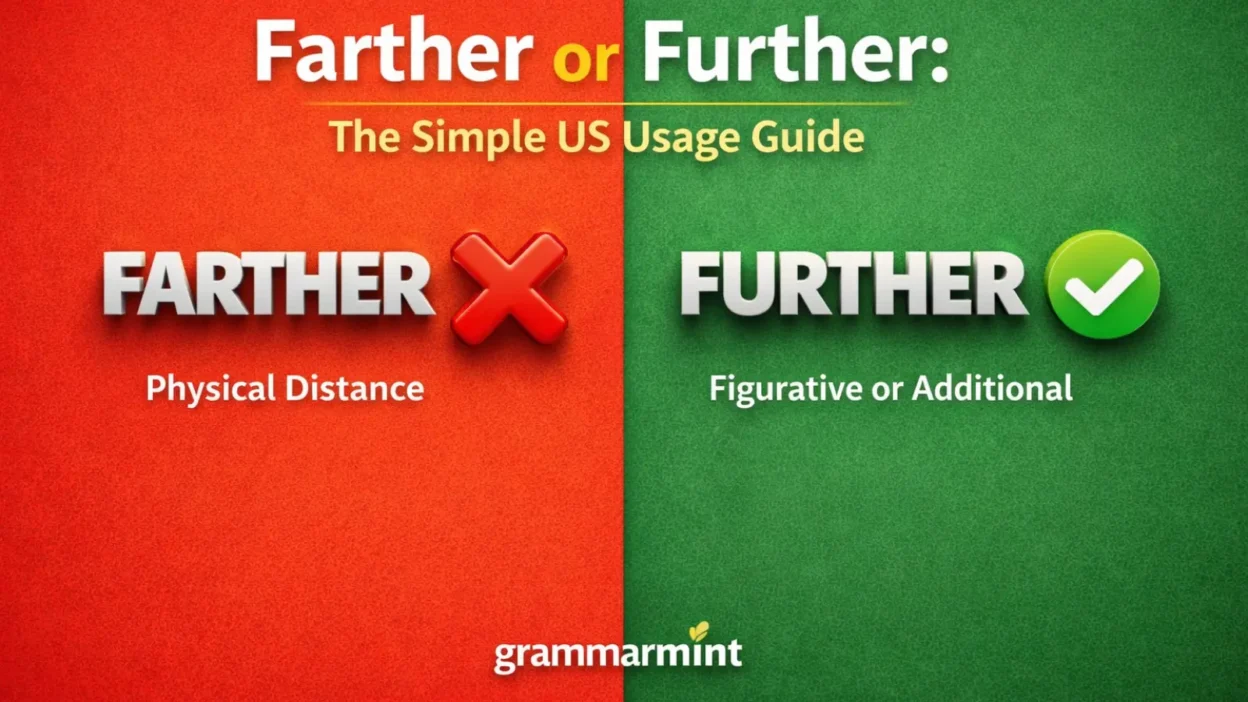
For Farther or Further, the safest US rule is this: use farther for measurable physical distance, and use further for abstract distance, added amount, or the verb meaning advance. Real usage overlaps, but this rule keeps your writing clear.
TL;DR
• Farther is safer for physical distance.
• Further is safer for abstract distance.
• Further also means more or additional.
• Further can work as a verb.
• In gray areas, pick the clearer meaning.
Farther Vs Further Difference
Start with the core difference. In careful US writing, farther usually points to space, while further carries broader meaning. Still, everyday English does not always keep them far apart.
• Both come from the comparative of far
• Both can show greater distance
• US editors often separate the pair
• Farther feels more spatial
• Further feels more flexible
• Further also means more
• Further can act as a verb
• Farther cannot fill every role
• Careful writing favors clean distinction
• Casual speech blurs the boundary
• Readers understand both in overlap
• Precision helps the sentence land
Physical Distance
Begin with physical distance. If you can measure the space, measurable distance makes farther the safer choice. So, roads, miles, yards, and travel all lean that way.
• Choose farther for miles and yards
• Use farther for roads and trails
• Use farther for races and throws
• Measured space leans toward farther
• Farther fits maps and directions
• Farther works well with away
• Farther suits down the street
• Farther sounds natural with numbers
• Farther pairs easily with north
• Farther fits travel questions better
• Literal movement prefers farther first
• Tangible space makes farther safest
Figurative Distance
Now switch to figurative distance. When the idea is about degree or progress, further usually sounds better. Because the gap is abstract, not measurable, readers expect the broader word.
• Choose further for ideas and progress
• Use further for discussion and analysis
• Use further for emotional distance
• Use further for career growth
• Use further for deeper thought
• Use further for policy debate
• Use further for longer inquiry
• Use further for advanced stages
• Further fits time and extent
• Further sounds smooth in abstractions
• Abstract meaning favors further clearly
• Formal commentary often prefers further
Further Means Additional
This is the easiest non-distance rule. When further means additional or extra, farther does not work. So, if you can replace the word with more, choose further.
• Further questions means more questions
• Further notice means later notice
• Further details means extra details
• Further delay means added delay
• Further steps means next steps
• Further changes means more changes
• Further help means added help
• Further explanation means more explanation
• Farther cannot mean additional here
• Notices use this sense constantly
• Business writing uses this sense often
• Remember further equals more
Further As A Verb
Here the rule is firm. Only further can work as a verb that means advance or promote. So, if the word takes an object and means help forward, use further.
• You can further a project
• You can further your education
• You can further research goals
• You can further a cause
• You can further negotiations
• You can further reform efforts
• You can further understanding
• You cannot farther a mission
• Verb use is always further
• This rule has almost no gray area
• It sounds natural in formal prose
• Nonprofit language uses it often
Further As A Transition
There is one more job to learn. As a transition, further can mean additionally or moreover. Because that use links ideas, farther never belongs there.
• Further can start a new point
• Further, the plan needs funding
• Further, we need better data
• Farther never means moreover
• This use fits formal writing
• It links ideas, not locations
• Commas often follow opening further
• It sounds stiff in casual texts
• Use it sparingly for flow
• Plus works in relaxed conversation
• Also works in neutral prose
• Think addition, not distance
Farther Or Further In A Sentence
When you get stuck, use a quick test. Check the context clue, then watch the noun signal. In most cases, the sentence itself tells you which word belongs.
• Ask what distance you mean
• Can the space be measured
• If yes, choose farther first
• If no, test further next
• Check whether you mean additional
• Check whether you mean advancement
• Check whether you need a verb
• Read the line out loud
• Nearby nouns give strong clues
• Context usually solves the choice
• One quick test cuts guesswork
• Meaning matters more than habit
Farther Away Or Further Away
This phrase causes plenty of second-guessing. For literal separation, farther away is the cleaner US choice. But for emotional drift or metaphorical space, further away usually sounds better.
• Farther away suits physical separation
• The store is farther away
• The moon looked farther away
• Further away appears in speech
• US editors may prefer farther away
• Use further away for emotional drift
• They grew further away emotionally
• Literal maps favor farther away
• Metaphors often favor further away
• Both may appear in headlines
• Precision beats blanket rules
• Match the tone to context
Further Along Or Farther Along
This is one of the true gray zones. If the phrase shows progress, further along often wins. If it shows a route or physical position, farther along can feel sharper.
• Farther along fits roads and routes
• Further along fits progress and stages
• Books can take either phrase
• Pregnancy talk usually uses further along
• A trail marker may be farther along
• A semester may be further along
• Project work is further along
• A runner may be farther along
• Mixed contexts can allow both
• Pick the clearer image
• Readers accept both in overlap
• The noun usually tips the choice
Farther From The Truth Or Further From The Truth
This phrase is mostly idiomatic. Since truth is abstract, idiom usually pulls writers toward further from the truth. So, even though you may see farther now and then, further is the smoother choice.
• Further from the truth is very common
• Truth is abstract, not measurable
• The phrase feels idiomatic with further
• Farther from the truth still appears
• Careful US writing usually picks further
• Use further in criticism and debate
• Use it in myth-busting lines
• Use it in opinion columns
• It sounds natural in speech
• It fits academic commentary too
• Farther here can distract readers
• Idiom often beats literal instinct
Further Information Or Farther Information
This one is not a coin flip. In forms, notices, and support pages, further information is a fixed expression. Because the meaning is additional detail, farther information sounds wrong.
• Always write further information
• Always write further details
• Always write further research
• Always write further questions
• Farther information sounds wrong today
• Farther research sounds wrong too
• This is the easiest rule here
• Office memos use it constantly
• Forms and notices use it daily
• Help pages use it often
• Learn this chunk as fixed wording
• It speeds up editing time
Farther North Or Further North
Directional phrases can be tricky. With geography and measurable location, farther north often sounds more exact. Still, further north also appears widely, especially when the line feels less numeric and more general.
• Farther north highlights measurable location
• Further north also appears widely
• News style often varies here
• With miles, farther north feels safer
• Without numbers, either may appear
• Maps encourage farther north
• Regional talk allows further north
• Choose one style and stay consistent
• Geographic prose rewards clarity
• Weather copy may prefer further north
• Technical writing may prefer farther north
• The phrase around it matters
Farthest Or Furthest
The same pattern shows up in the superlatives. Both farthest and furthest are accepted, but superlative choice often follows tone and region. In American writing, farthest often feels more physical.
• Both are accepted superlatives
• Farthest often feels more spatial
• Furthest often feels more general
• American usage commonly favors farthest
• British usage often favors furthest
• Either can appear with distance
• Furthest can sound idiomatic in abstraction
• Farthest fits races and routes
• Furthest fits discussions of degree
• Consistency matters more than dogma
• Match the earlier comparative form
• Avoid switching forms without reason
American Vs British Usage
Regional habits matter here. In American English, schools and editors often teach a stricter split. In British English, the overlap is usually broader, so further can appear more freely with distance.
• American English often separates the pair
• British English mixes them more freely
• US classrooms teach the split more
• UK sources allow broader overlap
• Global readers understand both forms
• House style may settle the choice
• Audience should guide your pick
• US business writing prefers clearer separation
• International copy can stay flexible
• Formal US editing leans conservative
• Conversation stays relaxed everywhere
• Regional habit shapes what sounds natural
Common Mistakes And Quick Fixes
Even small swaps can make a sentence feel off. So, when in doubt, correct the obvious errors first. Then, if a phrase still feels mixed, return to meaning.
• Farther information → further information
• Further the ball → throw farther
• Farther your career → further your career
• Further miles → farther miles
• Farther discussion → further discussion
• Look no farther → look no further
• Farther research → further research
• Further down the highway? check context
• Farther notice is never right
• Further north with mileage? reconsider
• Farther as a verb is wrong
• One wrong swap sounds clunky
Memory Tricks That Actually Help
You do not need a long formula. A few memory tricks tied to meaning work better than rigid myths. So, keep the cues simple and practical.
• Farther has far inside it
• Farther fits far in space
• Further often means more or extra
• Further can further a goal
• Think ruler for farther
• Think progress for further
• Think paperwork for further information
• Think highway sign for farther exit
• Think campaigns: further a cause
• Think idiom for look no further
• Think stages, not miles, for further
• Simple cues beat strict dogma
FAQs
What’s the difference between farther and further?
In careful US writing, farther is the safer choice for measurable physical distance. Further is better for abstract distance, added amount, and the verb meaning advance. Real usage overlaps, but that split keeps your writing clear.
Which is correct: farther or further?
Both can be correct, but not in every sentence. If the meaning is literal space, start with farther; if the meaning is abstract, additional, or verbal, choose further.
Can farther and further be used interchangeably?
Sometimes, yes, especially in everyday speech and some British usage. Still, in polished American writing, readers often expect farther for physical distance and further for broader meanings.
Is it further or farther from the truth?
Further from the truth is usually the better choice. Because truth is abstract, the phrase reads more naturally with further, even though farther does appear sometimes.
Is it look no further or farther?
The standard phrase is look no further. Here, further means something like “no more” or “no beyond this point,” so farther sounds awkward.
Is it further along or farther along?
Both can work, depending on meaning. Use further along for progress or stage, and use farther along for route or physical position when that spatial image matters.
Conclusion
If Farther or Further keeps slowing you down, use the simple US rule first: farther for measurable distance, further for abstract meaning, added amount, and the verb sense.
Then check the phrase, trust the context, and your choice will usually become obvious.