People searching Deep Seeded or Seated usually want a fast, confidence-saving answer before they send an email, turn in a paper, or publish a post. Merriam-Webster, Cambridge Dictionary, Dictionary.com, American Heritage, and Google Books all point the same way: deep-seated is the standard form, a hyphenated adjective used for an ingrained belief, entrenched resentment, lasting fear, underlying problem, or firmly established attitude. Because seated often sounds like seeded in quick speech, the mistake keeps spreading online. So, this guide clears up the choice, explains where the phrase came from, shows how it differs from deep-rooted, and gives clean examples you can use with confidence.
Quick Answer
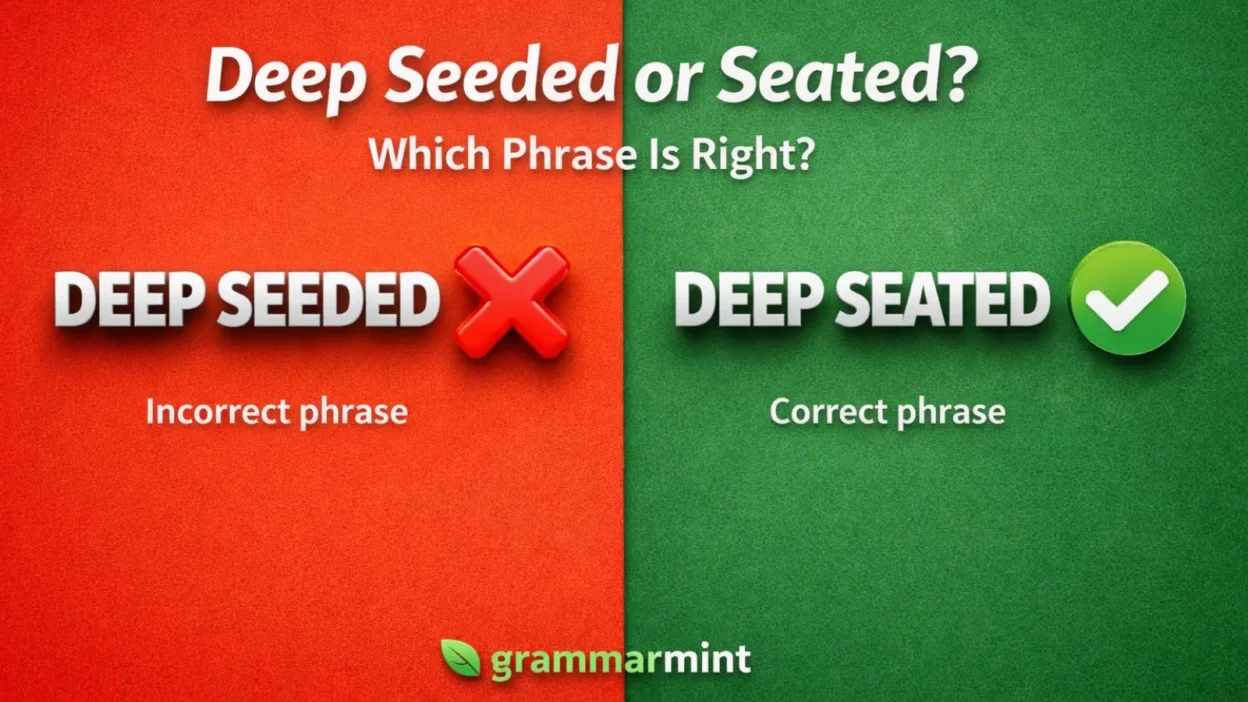
Deep Seeded or Seated? The standard phrase is deep-seated. Use it when you mean a belief, fear, resentment, or problem that feels firmly established or hard to change.
TL;DR
• Deep-seated is the standard phrase.
• Deep-seeded is the common mix-up.
• Pronunciation helps cause the confusion.
• Use deep-seated in polished writing.
• Deep-rooted is similar, not identical.
Deep-Seated Meaning
At its core, this phrase describes something fixed deeply in place. So, it usually points to a lasting belief, emotion, or problem.
• Deep-seated means firmly fixed over time.
• It often points to lasting inner attitudes.
• The phrase can describe emotions and beliefs.
• It also fits stubborn social problems.
• Usually, it suggests change feels difficult.
• The tone is often serious or heavy.
• You’ll see it with fear and resentment.
• It can describe pain below the surface.
• In figurative use, it means entrenched.
• In literal use, it means set deep.
• Most readers hear permanence in it.
• That nuance makes it stronger than simple deep.
Deep-Seeded Meaning
This is where most of the confusion starts. Although it sounds logical, it is not the standard form of the phrase.
• Deep-seeded sounds logical, but misfires.
• Standard dictionaries don’t treat it as the idiom.
• Writers usually mean deep-seated instead.
• Seed imagery makes the error feel natural.
• Even so, edited prose avoids it.
• It shows up in casual speech online.
• Readers may understand it anyway.
• Still, many will flag it immediately.
• It weakens polished, careful writing.
• It can distract from your point.
• Use it only with actual seeding contexts.
• Otherwise, switch to the standard phrase.
Deep-Seated Vs. Deep-Seeded
The comparison sounds bigger than it is. In practice, one form is standard, and the other is the common slip.
• Deep-seated is the accepted fixed expression.
• Deep-seeded is the common mix-up.
• One signals standard usage.
• The other signals a spelling problem.
• Both may sound nearly identical aloud.
• Only one looks right in print.
• Editors nearly always prefer deep-seated.
• Teachers usually correct deep-seeded quickly.
• Searchers often compare them for reassurance.
• This confusion is common, not rare.
• The safe choice stays the same.
• Pick deep-seated for everyday writing.
Why People Say Deep-Seeded
The wrong version survives because it makes emotional sense. Also, spoken English helps blur the spelling in people’s minds.
• Seeded matches a planting image in the mind.
• Seeds feel natural for growth metaphors.
• Spoken English blurs the middle consonant.
• Fast speech makes seated sound like seeded.
• Many learn the phrase by ear.
• So, they rarely see it spelled.
• Online repetition keeps the error alive.
• The wrong form still feels meaningful.
• That makes it stick longer.
• Familiar mistakes often become self-reinforcing.
• The phrase sounds right before it looks right.
• Seeing deep-seated fixes the pattern.
Is Deep-Seeded Ever Correct?
For the idiom, the answer is no. Still, the word seeded can be correct in other contexts, which is why this trips people up.
• In the idiom, deep-seeded is not standard.
• In professional writing, avoid it.
• In school writing, avoid it too.
• In published work, it looks careless.
• In literal farming talk, seeded can be fine.
• A field may be deeply seeded.
• A bracket may be seeded differently.
• But that is another meaning entirely.
• The idiom about beliefs uses seated.
• Context decides whether seeded belongs.
• Most readers expect the standard form.
• So, choose seated unless seeds are real.
Origin Of Deep-Seated
The standard form makes more sense once you know its older meaning. At first, it pointed to something placed far below the surface.
• Deep-seated began with a literal sense.
• Early use placed something far below surfaces.
• Later, the figurative sense expanded.
• Then it described fixed beliefs and feelings.
• That shift feels natural in English.
• The seat is a location or base.
• So, the word suggests settled placement.
• It never needed seed imagery.
• The older form supports modern usage.
• History favors seated, not seeded.
• That background explains the standard spelling.
• It also explains the lasting confusion.
Is Deep-Seated Hyphenated?
Yes, and that’s the safest way to write it. In careful writing, the hyphen keeps the compound clear and stable.
• Deep-seated is usually hyphenated before nouns.
• Write deep-seated fear with the hyphen.
• That form looks clean and standard.
• Many dictionaries list it hyphenated.
• Keep the hyphen in careful writing.
• It helps readers process the compound.
• Deep seated looks less polished to editors.
• The hyphen prevents a momentary stumble.
• Style choices should favor clarity first.
• So, the hyphen is the safest choice.
• It works well in headlines too.
• Hyphenation keeps the phrase visually fixed.
How To Pronounce Deep-Seated
Pronunciation explains a lot of the trouble here. In fast speech, the middle sound softens, so the wrong spelling can feel strangely reasonable.
• Deep-seated sounds like deep SEE-tid in American speech.
• The middle sound softens when spoken quickly.
• That blur invites the wrong spelling.
• Seated does not sound sharply clipped.
• Native speakers often flatten the t.
• So, listeners hear a d-like sound.
• Pronunciation explains the mix-up well.
• Still, spelling follows the standard form.
• Say it slowly when teaching it.
• Hear the seat inside seated.
• That memory cue usually helps.
• Writing it correctly matters more than saying it.
How To Use Deep-Seated In A Sentence
This phrase works best when you want real weight. So, use it for beliefs, emotions, or problems that feel longstanding and hard to move.
• Deep-seated usually comes before the noun.
• It works well with abstract nouns.
• Try it with fear, distrust, or grief.
• It suits formal and neutral tones.
• It also fits clear everyday writing.
• Keep the sentence direct and uncluttered.
• Don’t pile on extra intensifiers.
• One strong modifier is enough.
• Place it near the word it shapes.
• Use it where lasting force matters.
• Avoid it for light, passing moods.
• It sounds strongest with serious subjects.
Deep-Seated Fear, Belief, And Resentment
These are some of the most natural pairings in real English. Because of that, they make useful model phrases for your own writing.
• Deep-seated fear suggests long-lasting anxiety.
• Deep-seated belief suggests strong conviction.
• Deep-seated resentment suggests old emotional hurt.
• These pairings sound natural to readers.
• Each one signals depth and durability.
• They work in personal and social contexts.
• They also fit essays and reports.
• Use them when the cause runs deep.
• Avoid them for tiny irritations.
• The phrase implies more than a moment.
• It points to something hard to shake.
• That emotional weight is the key.
Deep-Seated Problems And Issues
This phrase also works beyond emotions. In fact, it often appears when people discuss conflict, systems, culture, or long-running trouble.
• Deep-seated problems suggest complex underlying causes.
• Deep-seated issues sound slightly more conversational.
• Use it for conflict inside groups.
• Use it for tension inside families.
• It can describe institutional habits too.
• It often hints at slow solutions.
• The phrase frames trouble as layered.
• So, readers expect more than a quick patch.
• It suits analysis better than drama.
• It works well in workplace writing.
• It also fits social commentary.
• Readers hear depth, not a quick fix.
Deep-Seated Vs. Deep-Rooted
These two expressions overlap, but they are not perfect twins. Usually, deep-rooted feels broader, while deep-seated feels more inward or fixed.
• Deep-seated and deep-rooted overlap in meaning.
• Both suggest something lasting and established.
• Deep-rooted leans more organic and historical.
• Deep-seated leans more inward and fixed.
• Deep-rooted suits traditions and social patterns.
• Deep-seated suits feelings and beliefs especially well.
• Sometimes either one works.
• Still, tone can shift slightly.
• Deep-rooted sounds broader and more naturalistic.
• Deep-seated sounds tighter and more psychological.
• Choose by nuance, not panic.
• Never swap either one with deep-seeded.
Deep-Seated Synonyms
You do not need to force this phrase into every sentence. Often, a close synonym gives you a cleaner tone or a more precise shade of meaning.
• Entrenched works for stubborn positions.
• Ingrained works for learned habits.
• Rooted works for long-standing patterns.
• Embedded works for systems and structures.
• Fixed works for plain, simple prose.
• Persistent works when duration matters most.
• Chronic fits some medical contexts.
• Underlying fits hidden causes well.
• Enduring sounds gentler and less heavy.
• Established feels neutral and formal.
• Long-held fits beliefs and opinions.
• Pick the synonym that fits the tone.
British And American English
Some spelling debates really are regional. This one isn’t, so you do not need to wonder whether one version belongs to Britain and the other to America.
• Deep-seated works in American English.
• It also works in British English.
• This is not a US-UK split.
• Both varieties keep the same standard form.
• So, spelling rules do not rescue seeded.
• The confusion crosses regions instead.
• Pronunciation differences don’t change the spelling.
• Formal writing stays consistent here.
• That makes the choice easier.
• You don’t need a regional workaround.
• Use the same form everywhere.
• Deep-seated travels cleanly across audiences.
Common Mistakes And Quick Fixes
Writers usually make the same few mistakes with this phrase. The good news is that each one has a fast fix.
• Mistake: writing deep seeded. Fix: write deep-seated.
• Mistake: dropping the hyphen. Fix: keep it.
• Mistake: using it for mild annoyance. Fix: downgrade.
• Mistake: pairing it with trivial moods. Fix: simplify.
• Mistake: forcing it everywhere. Fix: vary synonyms.
• Mistake: confusing it with deep-rooted. Fix: check nuance.
• Mistake: learning only by sound. Fix: memorize the spelling.
• Mistake: doubling modifiers. Fix: cut very or really.
• Mistake: using seeded metaphorically. Fix: switch to seated.
• Mistake: choosing it for quick problems. Fix: use persistent.
• Mistake: treating it as regional. Fix: don’t.
• Mistake: ignoring audience. Fix: prefer the standard form.
Which One Should You Use?
At the end of the day, this choice is simple. If you want the standard phrase in modern English, choose deep-seated.
• Deep-seated is the clear default choice.
• Use it in emails and reports.
• Use it in essays and articles.
• Use it in captions and scripts.
• Use it when the feeling runs deep.
• Use it when the problem feels entrenched.
• Use it when readers expect polish.
• Skip deep-seeded in formal settings.
• Skip it in job applications too.
• Skip it when clarity matters most.
• When unsure, choose the dictionary form.
• That choice keeps your writing strong.
FAQs
Is it deep-seated or deep-seeded?
The standard phrase is deep-seated. Use deep-seeded only when you are literally talking about seeds or seeding, not the idiom about beliefs, fears, or problems.
What does deep-seated mean?
It means firmly established, deeply ingrained, or hard to change. So, it often describes emotions, opinions, and long-running issues.
Why do people say deep-seeded?
Mostly because it sounds right in fast speech and fits a planting image people already understand. Even so, that intuitive image does not make it the standard phrase.
Is deep-seeded ever correct?
Not as the idiom. Still, seeded can be correct in literal contexts, such as agriculture or tournament seeding.
Is deep-seated hyphenated?
Yes, that is the safest and most standard form. In polished writing, keep the hyphen.
What is the difference between deep-rooted and deep-seated?
They overlap, but deep-rooted often feels broader or more historical, while deep-seated often feels more inward, emotional, or fixed. In many cases, either one can work, but the tone shifts a little.
Conclusion
Deep Seeded or Seated has one standard answer: deep-seated.
Use it when something feels firmly established, deeply ingrained, or hard to change.
When you’re unsure, choose the form readers will recognize instantly.