“Afterward” and “afterwards” look almost identical. That extra “s” at the end causes a lot of doubt. You might see both in blog posts, novels, emails, or social media captions.
In American English, spelling differences can affect tone and professionalism. Choosing the right form shows attention to detail. That matters in school papers, work emails, and published writing.
This guide explains which form is correct, how they differ, and when to use each one. You’ll also see real examples and quick fixes for common mistakes.
Quick Answer
Both “afterward” and “afterwards” are correct.
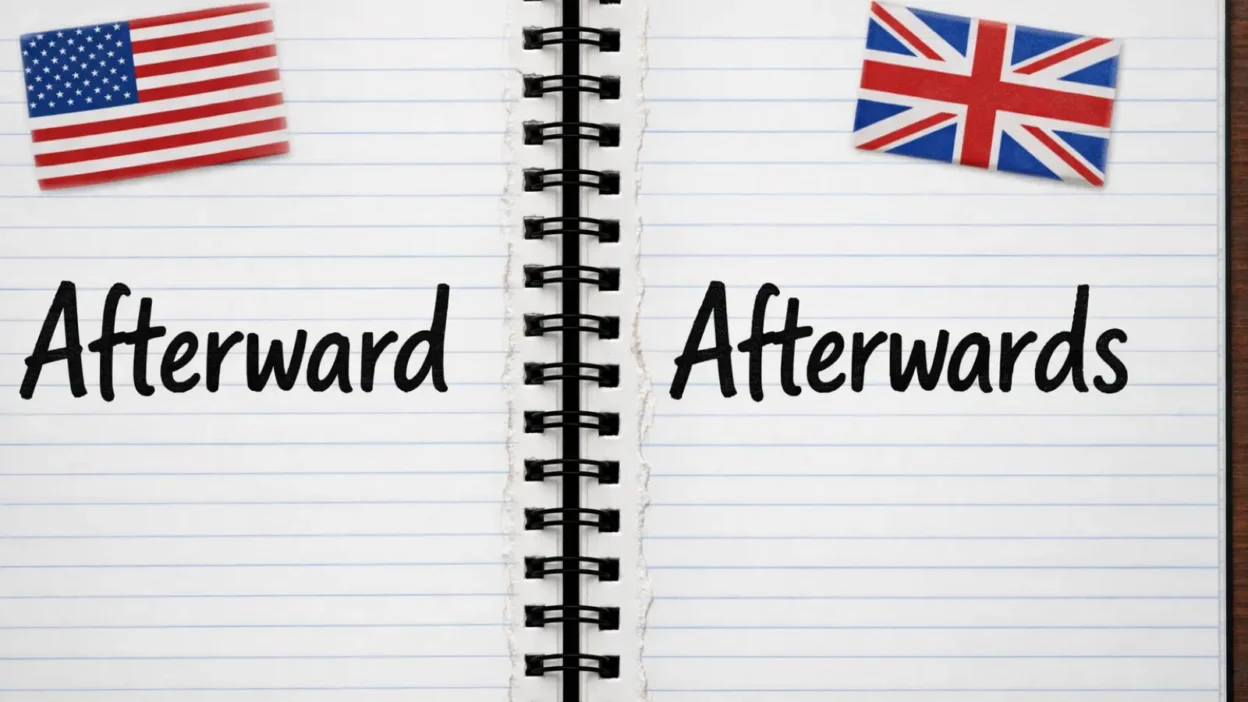
In American English, “afterward” is more common. “Afterwards” appears more often in British English. Neither is wrong, but US writers usually prefer the version without the “s.”
Key Differences at a Glance
• Spelling: “Afterward” has no final “s.” “Afterwards” adds an “s.”
• Region: “Afterward” is standard in the US. “Afterwards” is more common in the UK.
• Meaning: Both mean “later” or “at a later time.”
• Formality: Both work in formal writing, but US style guides favor “afterward.”
Origin and Why Two Forms Exist
Both words come from the same base: “after” plus a directional ending.
English has several pairs like this. For example, “toward” and “towards” follow a similar pattern. American English often drops the final “s,” while British English keeps it.
There is no difference in meaning between the two forms. The variation developed over time as spelling preferences shifted in different regions.
British vs American English
This is mainly a regional difference.
In the United States, “afterward” is standard in newspapers, academic writing, and business communication. In the United Kingdom, “afterwards” is more common.
Americans do use “afterwards,” but it may look slightly British in tone. It is not incorrect, just less typical in US contexts.
Which One Should You Use?
For everyday American writing, choose “afterward.”
In texts, blog posts, and casual emails, “afterward” feels natural and expected in the US.
If you are writing for a British audience, “afterwards” may fit better. Match your audience’s spelling style.
In academic or professional documents in the US, stick with “afterward.” Consistency matters more than personal preference.
If you want a more formal alternative, consider “later,” “subsequently,” or “following that.”
Common Mistakes (and Quick Fixes)
• Mistake: Thinking one form is wrong.
– Fix: Both are correct; choose based on region.
• Mistake: Mixing both forms in one document.
– Fix: Pick one and stay consistent.
• Mistake: Using “afterward” as an adjective.
– Fix: It is an adverb. Use it to describe when something happens.
• Mistake: Writing “after wards.”
– Fix: It is one word, not two.
• Mistake: Adding a comma automatically before “afterward.”
– Fix: Use a comma only if the sentence structure requires it.
• Mistake: Using it when “later” would sound clearer.
– Fix: Choose the simpler word if it improves flow.
Everyday Examples (Real Contexts)
Informal text message:
“Let’s grab coffee afterward.”
Social media caption:
“We went hiking and got pizza afterward.”
Parenting context:
“Finish your homework. You can watch TV afterward.”
Workplace email:
“We will review the proposal and discuss feedback afterward.”
More professional rewrite:
“We will review the proposal and discuss feedback at a later time.”
Usage/Trends (Qualitative)
Search trends show “afterward” is more common in US searches. “Afterwards” appears more often in UK searches.
In American publications and style guides, “afterward” is the usual choice. The difference has remained stable over time. It is a preference issue, not a rule change.
Comparison Table
Context | Best Choice | Why
US business email | Afterward | Matches American spelling norms
UK blog post | Afterwards | Fits British spelling preference
US academic paper | Afterward | Preferred in US formal writing
Text message in the US | Afterward | Most natural for American readers
International audience | Either (be consistent) | Both are correct
British school essay | Afterwards | Standard in UK English
FAQs
Is it afterward or afterwards in the US?
In the US, “afterward” is more common. “Afterwards” is still correct but less typical.
Which is correct, afterward or afterwards?
Both are correct. The difference is mainly regional.
Is afterwards British English?
“Afterwards” is more common in British English. American writers usually drop the final “s.”
Do Americans say afterwards?
Yes, some do. It is understood everywhere, but “afterward” is more standard in the US.
Is afterward formal or informal?
It works in both formal and informal writing. In US professional settings, it is fully acceptable.
Mini Quiz
- We went to dinner and saw a movie _____.
- In US academic writing, which form is preferred?
- Is “after wards” correct?
Answer Key:
- afterward (in US English)
- afterward
- No, it should be one word.
Conclusion
When choosing between Afterward or Afterwards, context and audience matter most.
In American English, “afterward” is the standard choice. In British English, “afterwards” is more common.
Both mean the same thing. Pick the version that fits your audience, and stay consistent.