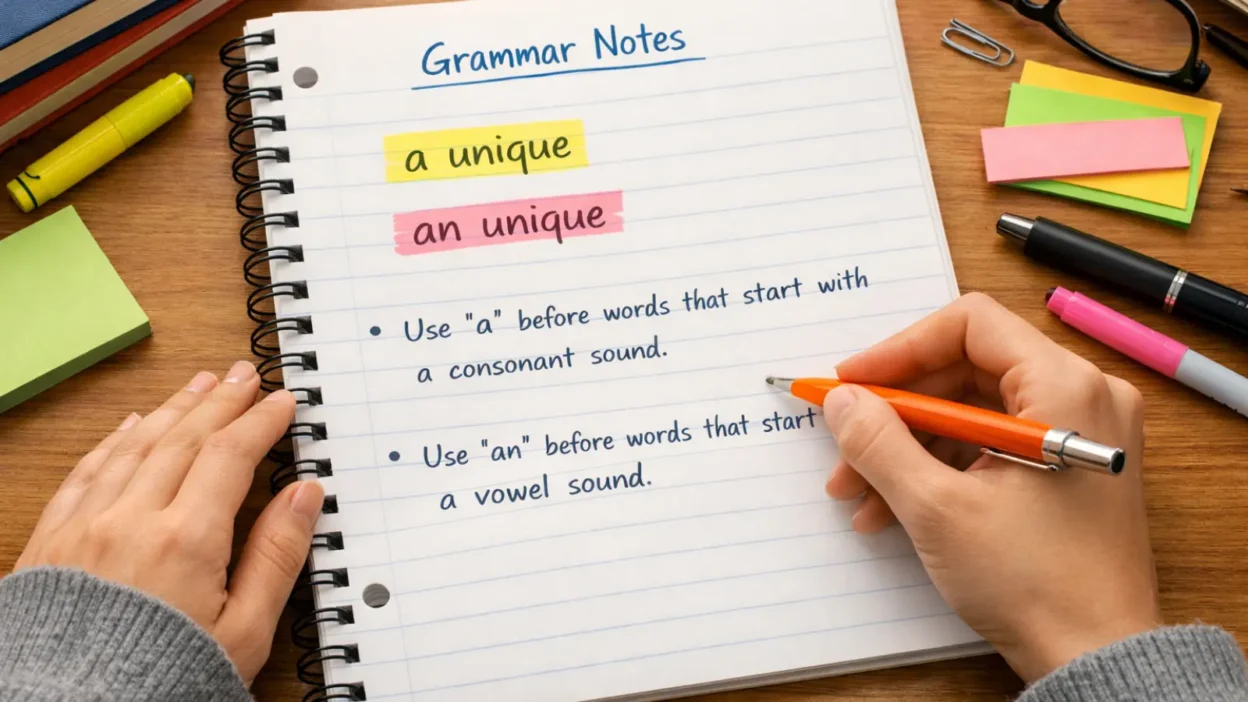
Many English learners and even native speakers pause when they reach the phrase “a unique.” Should it be a unique or an unique?
You’ve probably seen both versions online, in essays, or in messages from friends. The source of the confusion is simple: the letter “u” in unique looks like a vowel, but the word doesn’t start with a true vowel sound in English.
Getting this right helps your writing sound natural and confident in school, work emails, and everyday conversation.
This guide explains which article to use, why the rule works this way, how native US English speakers apply it, and how to fix common mistakes with clear examples.
Quick Answer
Use a unique. Since unique starts with a consonant sound (/juː/ like “you”), the indefinite article a comes before it. An unique is considered incorrect in modern US English.
Key Differences at a Glance
Feature | a unique | an unique
• Based on sound | ✅ begins with consonant sound (/yu/) | ❌ assumes vowel sound
• Standard US usage | ✅ used by most writers/speakers | ❌ rare and generally wrong
• Formal writing | ✅ correct choice | ❌ incorrect in formal contexts
• Learner confusion | may still be questioned | seen as error
Why Article Choice Depends on Sound
In English, whether you use a or an depends not on the spelling of the next word but on how it sounds when spoken. Words that begin with a vowel sound (like apple /ˈæpəl/) take an, while those that begin with a consonant sound take a.
Even though unique begins with the vowel letter “u,” its pronunciation starts with a consonant-like yoo sound (/juː/). Because that first sound is not a pure vowel, a unique is the correct choice.
Why Some People Get It Wrong
The confusion comes from early learning rules that tell students “use an before vowels.” Without explaining “vowel sound,” students may think any word beginning with a vowel letter needs an. That’s not the case once you focus on actual pronunciation.
US vs. UK English
There is no strong, reliable difference where British English consistently prefers an unique in formal writing. Most modern dictionaries and style recommendations in both US and UK contexts base article choice on sound, not spelling. While you might spot older texts that use an unique due to historical habits, this isn’t standard today.
When to Use Which
• Everyday informal speech: a unique — “That’s a unique idea.”
• School essays and formal writing: a unique — “This report offers a unique perspective.”
• Professional emails: a unique — “We have a unique opportunity to collaborate.”
• Avoid an unique — It reads as an error to most educated readers.
Common Mistakes (and Quick Fixes)
• Mistake: “She has an unique skill.”
Fix: “She has a unique skill.”
• Mistake: “It’s an unique challenge.”
Fix: “It’s a unique challenge.”
• Mistake: Learning “vowel letters always take an.”
Fix: Learn that it’s vowel sounds that take an.
• Mistake: Using an before university or useful as well.
Fix: Use a university, a useful tool for the same pronunciation reason.
• Mistake: Mimicking old examples like an historic and applying to unique.
Fix: Treat each word by its sound; unique begins with /y/ so takes a.
Everyday Examples
Texting/friends:
• “That’s a unique playlist you made.”
• “I found a unique recipe for dinner.”
Social media caption:
• “Sharing a unique moment from our road trip.”
Workplace/email:
• “We’re exploring a unique strategy for next quarter.”
Professional rewrite: “Our team has identified a unique opportunity to expand market reach.”
Context | Best Choice | Why
• General rule for English indefinite articles | a unique | based on pronunciation, not spelling
• Formal writing | a unique | standardized grammar rule
• Informal conversation | a unique | most natural and common
• Learning/teaching English | a unique | reinforces correct phonetics
• Avoiding errors on tests/papers | a unique | marks attention to detail
FAQs
Which is correct, “a unique” or “an unique”?
Answer: Use a unique because unique begins with a consonant-like sound, even though it starts with a vowel letter.
Do we pick the article based on spelling or sound?
Answer: You pick the article based on sound. If the following word starts with a vowel sound, use an; otherwise, use a.
Can “unique” ever take “an” in any dialect?
Answer: You might see an unique in very old texts or non-standard writing, but it’s not standard in modern US English.
What’s a similar example?
Answer: Words like a university and a useful tool begin with the same /y/ sound and take a too.
Why do learners still get this wrong?
Answer: Because early grammar lessons often oversimplify the “a vs. an” rule without emphasizing pronunciation.
Mini Quiz
- Choose the correct article: ___ unique advantage.
Answer: a unique advantage - Choose the correct article: ___ hour of practice.
Answer: an hour of practice - Choose the correct article: ___ university event.
Answer: a university event
Conclusion
In modern US English, always use a unique because unique starts with a consonant sound (/yoo/).
The simple rule is: listen to the sound that begins the next word — that’s what decides whether you use a or an.
With that in mind, you’ll write confidently and correctly. If you’re ever in doubt, say the phrase out loud and choose the article that sounds most natural.