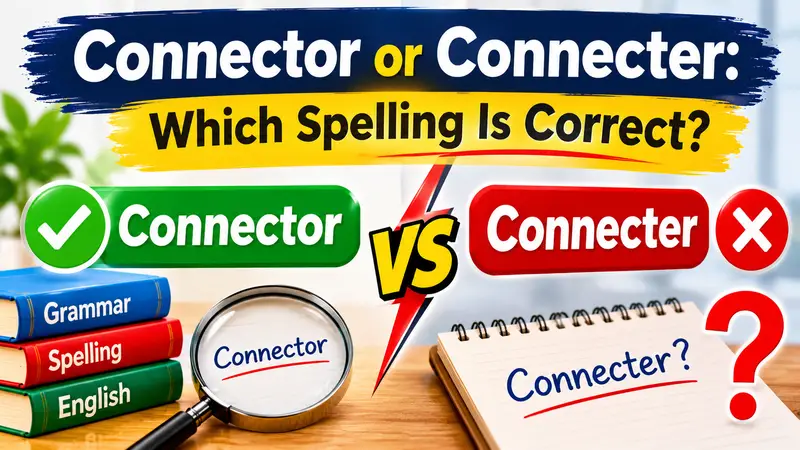
Have you ever wondered whether the correct spelling is connector or connecter? These two words look almost identical, and both follow recognizable English spelling patterns. However, one is much more common in modern writing.
Connector is the preferred and standard spelling in American English. It refers to a person, object, or device that connects two or more things. Connecter is also a recognized English word, but it is a much less common alternative. Merriam-Webster lists connecter as a less-common variant of connector.
If you are writing an email, school assignment, professional document, technical guide, or everyday message, connector is the spelling you should generally choose.
Let’s explore the difference, meanings, examples, and spelling rules to help you use both forms correctly.
Connector or Connecter: Which Is Correct?
The correct choice for most situations is connector.
Although connecter is not necessarily a spelling error, it is considerably less common. Both words refer to someone or something that connects separate things.
Here is the basic difference:
- Connector: The standard, widely preferred spelling.
- Connecter: A recognized but less-common alternative spelling.
For example:
Correct and preferred: The USB connector is damaged.
Less common: The USB connecter is damaged.
The first sentence uses the spelling most readers expect, especially in American English.
According to Merriam-Webster, connector is the main form, with connecter listed as a less-common variant. Dictionary.com also recognizes both spellings.
The safest approach is to use connector unless you have a specific reason to preserve the alternative spelling.
What Does Connector Mean?
A connector is a person, object, or device that joins, links, or brings two or more things together.
The word comes from the verb connect, which means to join or establish a relationship between separate things.
A connector can have several meanings depending on the context.
1. Connector as a Physical Device
In technology and engineering, a connector is a component that joins electrical wires, cables, or equipment.
Examples include:
- USB connector
- HDMI connector
- Audio connector
- Cable connector
- Electrical connector
Example: I need a new USB connector for my computer.
2. Connector as a Person
A connector can also describe someone who brings people together or helps them establish relationships.
Example: Sarah is a natural connector who introduces people with similar interests.
In this context, the word is often used in networking, business, and social situations.
3. Connector as a Linking Element
A connector can describe something that joins separate places, ideas, systems, or sections.
Example: This hallway acts as a connector between the two buildings.
The meaning remains similar in all three situations: something creates a connection.
Is Connecter a Real Word?
Yes, connecter is a recognized English word, but it is much less common than connector.
Some writers assume that connecter must be incorrect because the word connect naturally seems to take the suffix -er.
That reasoning is understandable. English frequently forms nouns by adding -er to verbs.
For example:
- Teach → Teacher
- Write → Writer
- Drive → Driver
- Work → Worker
- Paint → Painter
Following this pattern, connecter may appear to be the obvious choice.
However, English also uses the suffix -or to form nouns referring to people or things that perform an action.
Examples include:
- Collect → Collector
- Direct → Director
- Operate → Operator
- Project → Projector
The established modern spelling is connector.
Dictionary.com recognizes connecter and defines it as another form of connector. Merriam-Webster likewise identifies it as a less-common variant.
Therefore, saying that connecter is always wrong would be inaccurate. It is better described as an accepted but uncommon spelling.
Connector vs. Connecter: Main Differences
The primary difference between these words is their frequency and preferred usage, not their basic meaning.
| Feature | Connector | Connecter |
|---|---|---|
| Word status | Standard spelling | Recognized variant |
| Basic meaning | Something or someone that connects | Same meaning |
| Common usage | Very common | Much less common |
| American English | Preferred | Less preferred |
| Technical writing | Recommended | Generally avoided |
| Business writing | Recommended | Less common |
| Academic writing | Recommended | Less common |
| Best choice | Yes | Usually no |
Both spellings can communicate the same idea, but connector is the more natural choice for most modern readers.
Examples of Connector in Sentences
Understanding how a word works in everyday sentences makes it easier to remember the correct spelling.
Here are some natural examples.
Everyday Examples
- I bought a new connector for my phone charger.
- This small connector joins the two plastic pieces.
- The cable connector is loose and needs replacing.
- We need a stronger connector to hold these parts together.
- The bridge serves as an important connector between the neighborhoods.
Technology Examples
- The HDMI connector allows the laptop to connect to the television.
- Check whether the USB connector is compatible with your device.
- The technician replaced the damaged electrical connector.
- This audio connector provides a secure connection.
- The computer has several ports and connectors.
Business and Social Examples
- Michael is a great connector who brings talented people together.
- A good business connector can help you build valuable relationships.
- She became an important connector between the two organizations.
- Networking events help professionals meet new connectors.
- His role as a community connector helped bring local groups together.
These examples demonstrate that connector can describe both physical objects and people who establish connections.
Examples of Connecter in Sentences
Although connecter is less common, it can appear in sentences as an alternative spelling of connector.
Here are a few examples:
- The connecter joins the two separate components.
- He replaced the damaged cable connecter.
- The connecter allows the two devices to communicate.
- She is a natural connecter who introduces people to one another.
- The equipment requires a compatible connecter.
These examples illustrate the alternative spelling. However, for professional writing and everyday American English, it is better to replace connecter with connector.
For example:
Less common: The connecter joins the two cables.
Preferred: The connector joins the two cables.
Why Is Connector the Preferred Spelling?
There are several reasons why connector is the better choice.
1. It Is the Established Modern Form
Connector is the spelling most commonly found in modern dictionaries, technical documents, product descriptions, and everyday writing.
Oxford Learner’s Dictionaries defines a connector as something that links two or more things together.
2. It Is Common in Technical Language
Technology and engineering regularly use the spelling connector.
Consider these familiar terms:
- USB connector
- HDMI connector
- Ethernet connector
- Power connector
- Audio connector
Using connector makes technical instructions and product descriptions easier for readers to recognize.
3. It Is the Safer Choice in Professional Writing
When writing an academic assignment, business email, report, or article, consistency and familiarity matter.
Because connector is the established form, it is the better option when you want your writing to sound natural and professional.
4. Major Dictionaries Recognize It as the Main Form
Dictionary evidence supports the preference for connector.
Merriam-Webster lists connecter as a less-common variant, while Dictionary.com recognizes both spellings.
This distinction is important: a less-common variant is not automatically an incorrect word.
Connector in Different Contexts
The word connector appears in several areas of English. Understanding these uses can help you recognize it more easily.
Connector in Technology
In technology, a connector is a physical component that allows two devices, cables, or electrical parts to join.
Examples include:
- USB connector
- HDMI connector
- Ethernet connector
- Audio connector
- Power connector
Example: Make sure the connector fits the charging port before plugging in the cable.
Connector in Grammar and Writing
In grammar, connectors are words or phrases that link sentences, clauses, and ideas.
They help readers understand how different parts of a paragraph relate to one another.
Common examples include:
| Connector | Purpose | Example |
|---|---|---|
| However | Shows contrast | It was raining; however, we continued walking. |
| Therefore | Shows a result | She studied hard; therefore, she passed. |
| Moreover | Adds information | The course is affordable; moreover, it is flexible. |
| Furthermore | Adds another point | The plan is practical; furthermore, it saves time. |
| Although | Shows contrast | Although it was late, we continued working. |
| Consequently | Shows a result | He missed the bus; consequently, he arrived late. |
| In addition | Adds information | In addition, the school offers free tutoring. |
| Meanwhile | Shows simultaneous events | I prepared dinner; meanwhile, she cleaned the kitchen. |
These words are also called linking words, transitional expressions, or connecting words, depending on their grammatical function.
Connector in Business
In business, a connector is someone who helps individuals, teams, or organizations establish useful professional relationships.
Example: Our marketing director is a strong connector who regularly introduces potential business partners.
The word can also describe something that links departments, services, or systems.
Common Mistakes When Using Connector and Connecter
Even experienced writers can become confused by similar-looking words.
Here are some mistakes to avoid.
Mistake 1: Assuming Connecter Is Always Incorrect
This is not completely accurate.
Dictionaries recognize connecter as a variant, although it is much less common.
Better understanding: Connector is preferred; connecter is an uncommon alternative.
Mistake 2: Using Connecter in Technical Documents
Technical writing generally uses connector.
For example:
Incorrect choice for standard technical usage: The HDMI connecter is damaged.
Preferred: The HDMI connector is damaged.
Mistake 3: Confusing Connector With Connection
These words are related but have different meanings.
- Connector: Something or someone that joins things together.
- Connection: The relationship, link, or state of being connected.
Example:
The connector creates a connection between the two devices.
Mistake 4: Changing the Spelling Throughout an Article
Choose one spelling and use it consistently.
For standard American English, use connector throughout your writing.
Easy Tricks to Remember the Correct Spelling
If you frequently confuse these spellings, try these simple memory techniques.
Remember CONNECT + OR
Think of the word this way:
CONNECT + OR = CONNECTOR
This simple pattern can help you remember the preferred spelling.
Remember What a Connector Does
A connector connects things.
For example, a cable connector joins a cable to a device.
Associating the spelling with its meaning makes it easier to remember.
Associate It With Familiar Words
Think about other common words ending in -or:
- Director
- Operator
- Collector
- Projector
These examples can remind you that English sometimes uses -or rather than -er when forming nouns.
Remember that this is a memory trick, not a universal spelling rule.
FAQs
Connector is the preferred spelling in modern American English. Connecter is also recognized as a less-common variant, but connector is the better choice for everyday and professional writing.
Yes. Connecter is a recognized English spelling that means the same thing as connector. However, it is much less frequently used.
A connector is a person, object, or device that joins two or more things together. Examples include cable connectors, electrical connectors, and people who bring others together.
Connector is the established spelling that developed through English word formation. Although connecter follows a recognizable spelling pattern, connector became the preferred modern form.
Connector is used in both American and British English. It is the standard spelling in modern usage across both varieties.
The plural of connector is connectors.
Example: The computer has several connectors for external devices
A connector is something that creates a link between separate things. A connection is the actual link, relationship, or state of being connected.
Example: The cable connector establishes a connection between the computer and the monitor.
Conclusion
When choosing between connector or connecter, the best option for most writing situations is connector.
Although connecter is a recognized alternative spelling, it is much less common. Connector is the established form used in everyday American English, technical writing, business communication, and educational materials.
Remember the simple distinction: connector is preferred, while connecter is a less-common variant.
The next time you write about a cable, electrical component, linking word, or person who brings people together, choose connector to keep your writing clear and consistent.
If you found this spelling guide helpful, explore more of our grammar and commonly confused word guides to improve your everyday English.