English learners, students, writers, and even native speakers often mix up lie down or lay down. These two phrases sound similar, yet they follow different grammar rules. Still, everyday conversation, social media, and casual texting make the confusion even bigger.
You’ll hear these phrases in schools, offices, movies, podcasts, and daily American speech. Whether you’re writing emails, speaking professionally, or helping kids with homework, understanding the difference makes communication clearer and more confident.
Quick Answer
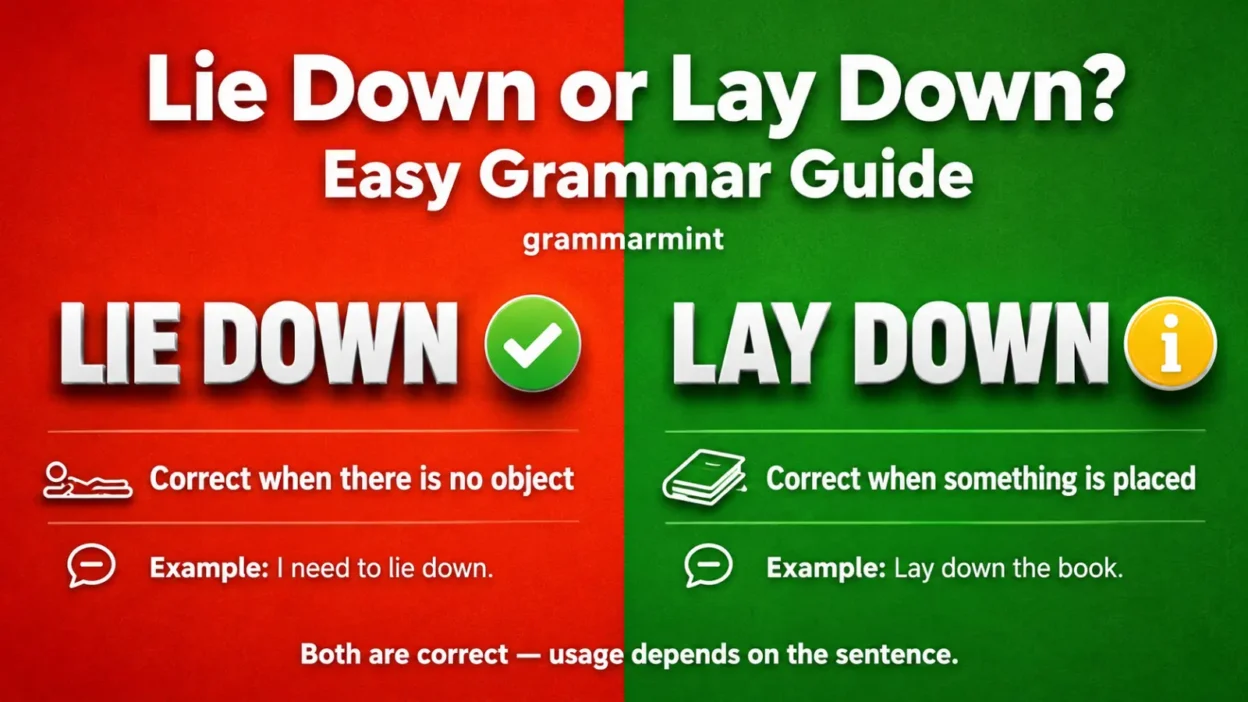
Use “lie down” when someone reclines or rests. Use “lay down” when placing something somewhere. “Lie down” has no direct object, while “lay down” always acts on something.
TL;DR
• “Lie down” means recline or rest
• “Lay down” means place something somewhere
• “Lay” is the past tense of “lie”
• “Laid” is the past tense of “lay”
• Native speakers often mix them casually
• Formal writing still follows grammar rules
Difference Between Lay And Lie
These two verbs confuse almost everyone at some point. However, one small detail makes the difference much easier to spot.
The key is whether the sentence has an object.
• Direct object changes the entire sentence meaning
• Transitive verb needs something receiving the action
• Intransitive verb acts without an object
• “Lie” means recline or remain resting
• “Lay” means place something carefully somewhere
• “Lie down” describes your own movement
• “Lay down” affects another object nearby
• “Please lie down” is grammatically correct
• “Lay the blanket down” uses an object
• “Lie” never directly controls another noun
• “Lay” always transfers action outward
• Grammar confusion increases during past tense use
Lie Down Vs Lay Down
Many people hear both phrases daily. Still, only one fits certain situations correctly.
American conversation often blurs the grammar difference.
• Recline describes resting your own body
• Place something involves moving another item
• Horizontal position helps identify correct usage
• “I need to lie down” sounds correct
• “Lay down the keys” uses an object
• One phrase involves self-action only
• The other phrase affects outside objects
• Native speakers still mix both casually
• Formal writing prefers traditional grammar rules
• Spoken English changes faster than textbooks
• Context usually makes meaning obvious
• Confusion grows because “lay” sounds natural
What Lie Down Really Means
“Lie down” focuses on resting or reclining. Nobody else receives the action.
This phrase describes personal movement and comfort.
• Rest often follows a long day
• Relax works as a helpful synonym
• Lying down appears in medical instructions
• Kids lie down during quiet time
• Patients lie down before examinations
• Travelers lie down during long flights
• Dogs lie down beside fireplaces
• Athletes lie down after training sessions
• Babies lie down inside cribs safely
• Tired workers lie down briefly midday
• Many Americans say this professionally
• It commonly appears in health advice
What Lay Down Really Means
“Lay down” means placing something somewhere. Therefore, the sentence always includes another object.
Without an object, the phrase sounds incomplete in formal writing.
• Put down explains the meaning clearly
• Set down works in similar situations
• Laid appears in past tense examples
• Lay down the backpack gently
• Lay down your phone carefully
• Lay down the groceries slowly
• Parents lay down blankets outdoors
• Workers lay down flooring materials daily
• Teachers lay down classroom rules
• Musicians lay down new tracks
• Judges lay down legal decisions
• Writers lay down story outlines
Lay Vs Lie Grammar Basics
Grammar rules become easier when simplified. Most learners overthink the problem.
Fortunately, one quick question usually solves it.
• Verb tense creates the biggest confusion
• Grammar rule depends on sentence objects
• Sentence structure helps identify mistakes quickly
• Ask “what is receiving action?”
• No object usually means “lie”
• Objects usually require the word “lay”
• “Lie” describes independent movement only
• “Lay” controls another noun nearby
• Grammar charts simplify tense patterns
• Informal speech ignores rules sometimes
• Schools still teach traditional distinctions
• Professional writing follows stricter standards
Past Tense Of Lie Explained
This section confuses almost everyone first. Surprisingly, “lay” becomes the past tense of “lie.”
That overlap creates years of grammar mistakes.
• Lay becomes past tense for “lie”
• Lain appears in perfect tense forms
• Past tense confusion affects native speakers too
• Yesterday, I lay on the couch
• She lay awake all night
• They had lain quietly before sunrise
• “Lay” changes meaning across tenses
• Present tense returns to “lie”
• Many students memorize tense charts
• Context helps prevent misunderstandings quickly
• Spoken English often skips “lain” entirely
• Formal writing still uses “lain” correctly
Past Tense Of Lay Explained
Unlike “lie,” this verb stays more predictable. Still, learners sometimes accidentally invent “layed.”
That spelling is incorrect.
• Laid works for simple past tense
• Past participle also remains “laid”
• Verb forms stay regular here
• She laid the notebook down
• He laid the dishes carefully
• Workers laid bricks outside yesterday
• The chef laid towels nearby
• Parents laid gifts under trees
• “Layed” is never standard spelling
• Regular verbs feel easier remembering
• Grammar books repeat this distinction often
• Professional editors catch this mistake quickly
Laying Down Or Lying Down
Continuous tense forms create another layer of confusion. Yet the same grammar rule still applies.
Objects continue determining the correct choice.
• Present participle forms change spelling slightly
• Continuous tense describes ongoing action
• Speaking English casually causes frequent mix-ups
• “I’m lying down” sounds correct
• “I’m laying down pillows” works properly
• One phrase lacks an object entirely
• The other phrase moves something physically
• Social media captions ignore rules often
• Casual texting shortens grammar patterns
• Formal essays avoid incorrect mixing
• Native speakers still debate usage online
• Listening practice improves natural understanding
Common Lie Down Sentences
Real examples make grammar easier to remember. These sentences appear naturally in daily American life.
Most involve rest, comfort, or physical movement.
• Daily speech uses these examples frequently
• Bed appears in many practice sentences
• Nap helps explain natural usage
• Please lie down for awhile
• I need to lie down now
• The cat lies down quietly
• Kids lie down after lunch
• Patients lie down before surgery
• Travelers lie down during delays
• He lay down after dinner yesterday
• They had lain there silently
• Doctors say lying down reduces dizziness
Common Lay Down Sentences
This phrase always affects another object nearby. Therefore, the object remains essential.
Without it, the sentence feels incomplete formally.
• Object always receives the action
• Book examples help beginners memorize rules
• Phone examples sound modern and relatable
• Lay down your jacket here
• Please lay down the papers
• She laid the phone carefully
• They lay down fresh carpet weekly
• Workers lay down concrete daily
• Parents lay down strict boundaries
• Musicians lay down guitar tracks
• He laid the keys beside me
• Teachers lay down classroom expectations
• We’re laying down protective mats today
Lie Down Grammar Rule
This rule stays simple once you notice sentence movement. The subject performs the action independently.
No outside receiver exists.
• Formal English strongly prefers correct distinction
• Subject controls the action alone
• Movement happens without another object
• Lie down after your workout
• Dogs lie down beside owners
• Travelers lie down during turbulence
• Babies lie down naturally exhausted
• Athletes lie down after races
• Patients lie down before scans
• “Lie” emphasizes self-positioning only
• No direct object appears afterward
• Grammar teachers repeat this constantly
• Correct usage sounds polished professionally
Lay Down Grammar Rule
This rule requires a receiver. Something else experiences the action.
That one detail changes everything.
• Action verb transfers movement outward
• Receiver identifies the affected object
• Placement defines the sentence meaning
• Lay down the remote gently
• Lay down the sleeping baby carefully
• Workers lay down fresh paint coverings
• She laid the menu beside me
• They laid the tools outside
• Always identify the sentence object
• Missing objects create grammar mistakes
• Professional editors watch for this issue
• Spoken English bends the rules often
• Grammar charts simplify these distinctions visually
Everyday Examples You’ll Hear
Daily conversation rarely sounds perfectly grammatical. Americans often blend both phrases naturally.
Still, context usually prevents confusion.
• Native speakers mix these phrases regularly
• Casual speech changes faster than textbooks
• Conversation often favors simpler sounding phrases
• “I’m gonna lay down” sounds common
• “Go lie down” sounds more formal
• Movies frequently ignore strict grammar
• Podcasts use casual phrasing naturally
• Friends rarely correct each other
• Teachers usually teach formal standards
• Text messages shorten grammar heavily
• Regional dialects affect usage patterns
• Context keeps meaning understandable anyway
Is “Lay Down” Wrong?
The answer depends on context and tone. Formal grammar still separates both phrases clearly.
However, casual American speech tells another story.
• Spoken English accepts many informal patterns
• Grammar experts still prefer traditional rules
• Common usage shapes language over time
• “Lay down” appears widely in conversation
• Formal essays prefer “lie down” correctly
• Casual speech values comfort and rhythm
• Younger speakers simplify grammar naturally
• Language evolves across generations continually
• Dictionaries note informal acceptance sometimes
• Context matters more during conversations
• Professional settings still expect correctness
• Understanding both versions improves communication
Easy Tricks To Remember
Simple memory tricks reduce confusion quickly. Most learners improve with one clear shortcut.
Try these every time you feel unsure.
• Memory trick links “lay” with objects
• Mnemonic phrases improve fast recall
• Quick tip prevents common grammar errors
• “Lay” means place something somewhere
• “Lie” means recline by yourself
• Ask “what receives the action?”
• No object means choose “lie”
• Object present means choose “lay”
• “Laid” never becomes “layed”
• Practice short sentences every day
• Read examples aloud repeatedly
• Daily repetition strengthens grammar confidence
Quick Reference Chart
Quick charts help during writing or homework. Many learners save these for fast review later.
Use this section as a simple cheat sheet.
• Cheat sheet summaries speed up learning
• Grammar chart formats improve memory retention
• Verb table helps compare tense forms
• Lie → lay → lain
• Lay → laid → laid
• Lie down = recline yourself
• Lay down = place something somewhere
• “I lie down” uses no object
• “I lay the bag down” works
• “Yesterday I lay down” stays correct
• “I had lain there” sounds formal
• “She laid the blanket down” works
FAQs
Is it correct to say “I need to lay down”?
In casual American speech, many people say it naturally. However, formal grammar prefers “I need to lie down” because no object receives the action.
Why is “lay” the past tense of “lie”?
English includes many irregular verbs. “Lie” changes to “lay” in the past tense, which creates confusion with the separate verb “lay.”
Is “lay down” always wrong?
No. “Lay down” is correct when placing something somewhere. For example, “Lay down the notebook” follows standard grammar rules.
What is the easiest way to remember lie vs lay?
Ask whether the sentence includes an object. If nothing receives the action, use “lie.” If something receives the action, use “lay.”
Why do native speakers still say “lay down”?
Casual spoken English changes over time. Many Americans use “lay down” conversationally even though formal grammar still prefers “lie down.”
Is “lying down” correct?
Yes. “Lying down” correctly describes reclining or resting. “Laying down” only works when placing something else down.
Conclusion
Understanding lie down or lay down becomes much easier once you focus on the object in the sentence. “Lie” describes reclining, while “lay” means placing something somewhere.