If you’ve ever typed fast and paused at loosing or losing, you’re in the right place. This guide explains the correct spelling, common mistake, everyday English, lose vs loose, misplacing, defeat, and release difference in plain words. You’ll also see how the words work in emails, texts, essays, reports, captions, and quick replies.
Here’s the key idea: “losing” is the word most people need. “Loosing” is real, but it has a narrow meaning. Once you learn the simple test, the choice becomes easy.
Quick Answer
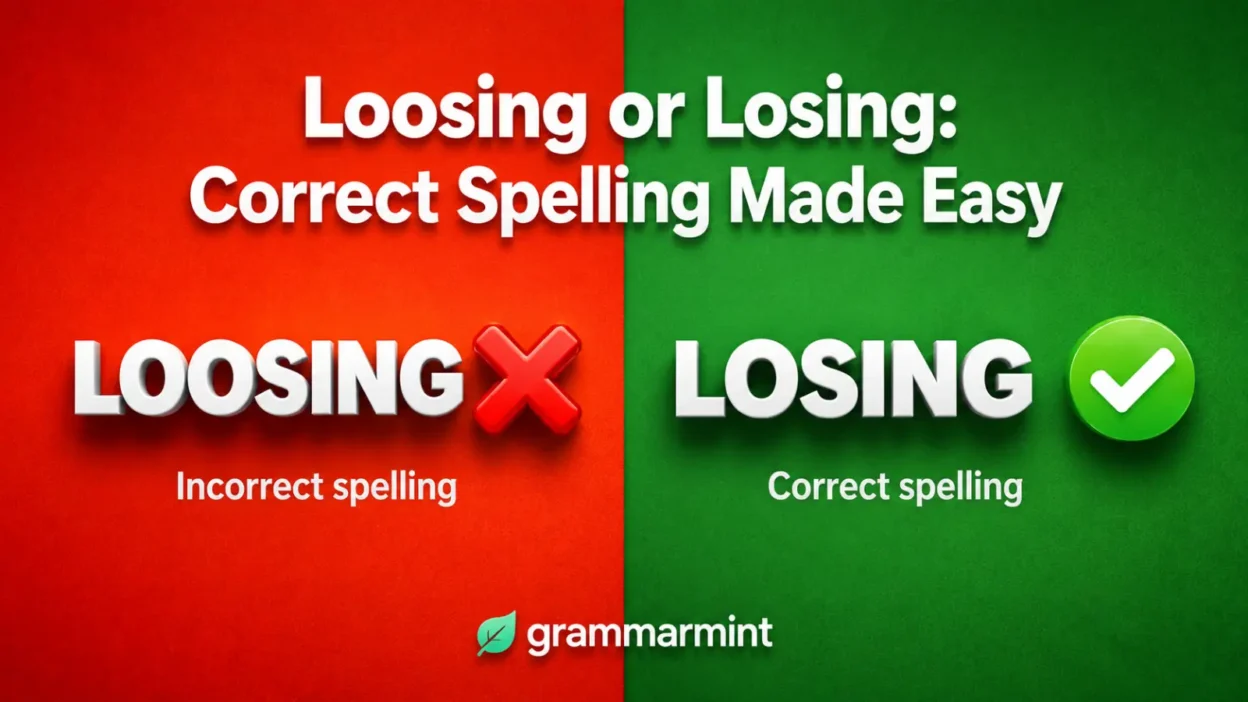
Loosing or losing comes down to meaning: use “losing” for not winning, misplacing, or no longer keeping something. Use “loosing” only when something is being released or set free.
TL;DR
• Losing is correct in most daily writing.
• Loosing means releasing or setting free.
• Use losing for money, games, and keys.
• Use loosing for arrows, ropes, or animals.
• Lose has one “o,” like losing.
• Loose has two “o’s,” like loosing.
Losing Or Loosing
Most writers need “losing,” not “loosing.” However, both words exist, so the real trick is meaning.
Use this section as your fast filter. Then, check the examples when a sentence feels close.
• Correct spelling depends on the sentence meaning.
• Common mistake: “I am loosing keys.”
• Everyday English usually needs “losing.”
• Losing means something is slipping away.
• Loosing means something is being released.
• Write “losing” for not winning.
• Write “losing” for misplacing items.
• Write “losing” for money or customers.
• Write “loosing” for freeing something bound.
• “Loosing” sounds formal and uncommon.
• “Losing” fits most school assignments.
• “Losing” fits most work emails.
• “Loosing” rarely fits casual texts.
• When unsure, test the verb “release.”
• If “release” fails, choose losing.
Lose Or Loose
“Lose” and “loose” cause the larger confusion. Therefore, fixing those roots fixes “losing” and “loosing.”
Think of “lose” as action. Meanwhile, think of “loose” as not tight.
• Verb “lose” means fail to keep.
• Adjective “loose” means not tight.
• Pronunciation changes the final sound.
• Lose rhymes with “choose.”
• Loose rhymes with “moose.”
• You lose a wallet.
• You wear loose pants.
• You lose a race.
• A loose screw needs tightening.
• You lose patience during delays.
• A loose knot may slip.
• “Lose” takes one “o.”
• “Loose” takes two “o’s.”
• “Losing” follows “lose.”
• “Loosing” follows “loose.”
Lose Vs Loose
The fastest way to separate them is context. If the sentence is about defeat or missing something, use “lose.”
However, if the sentence describes something not tight, “loose” may fit. If it means releasing, the verb form may be “loose.”
• Misplace connects with lose.
• Not tight connects with loose.
• Defeat connects with lose.
• Lose your keys after lunch.
• Lose the match by one point.
• Lose your balance on ice.
• Loose sleeves can catch handles.
• Loose change sits in pockets.
• Loose wires need repair.
• Lose confidence after harsh feedback.
• Lose service in rural areas.
• Loose soil shifts after rain.
• Lose means no longer have.
• Loose means not firmly held.
• The extra “o” changes everything.
Loosing Meaning
“Loosing” is not the same as “losing.” It means releasing, freeing, or letting something go.
Still, it sounds old-fashioned in many modern sentences. Most people use “releasing” instead.
• Release is the key meaning.
• Set free is another match.
• Untie often points to loosing.
• Loosing a rope means freeing it.
• Loosing a bird means releasing it.
• Loosing arrows means shooting them.
• Loosing prisoners means setting them free.
• Loosing hounds sounds historical.
• Loosing emotion sounds very formal.
• Loosing does not mean misplacing.
• Loosing does not mean defeat.
• Loosing does not mean weight loss.
• Use it when freedom is literal.
• Replace it with “releasing” to test.
• If “releasing” works, loosing may fit.
Losing Meaning
“Losing” is the present form of “lose.” It covers most daily meanings people search for.
So, when something is gone, fading, missing, or failing, “losing” is usually correct.
• Not winning means losing.
• Misplacing something means losing it.
• Failing to keep something means losing.
• Losing keys feels frustrating.
• Losing a game hurts.
• Losing money worries businesses.
• Losing focus slows work.
• Losing signal interrupts calls.
• Losing patience changes your tone.
• Losing sleep affects energy.
• Losing friends can feel painful.
• Losing time creates pressure.
• Losing ground means falling behind.
• Losing control means slipping command.
• Losing is common and natural.
Loosing Weight Or Losing Weight
The correct phrase is “losing weight.” “Loosing weight” would suggest freeing weight, which is not the intended meaning.
However, “loose clothes” can appear after weight loss. That may be why the mistake feels tempting.
• Lose weight is the correct phrase.
• Loose clothes may follow weight loss.
• Body weight is something reduced.
• Write “I’m losing weight.”
• Avoid “I’m loosing weight.”
• Weight is not being untied.
• Pounds are not being released.
• Health goals use “losing.”
• Fitness captions use “losing.”
• Doctor notes use “losing.”
• Diet updates use “losing.”
• Loose jeans describe fit.
• Losing pounds describes change.
• “Loose weight” is also incorrect.
• Pair “lose” with weight goals.
Loosing My Mind Or Losing My Mind
The correct phrase is “losing my mind.” It means feeling overwhelmed, confused, shocked, or emotionally stretched.
Still, use the phrase with care. It can sound dramatic in serious settings.
• Losing my mind is correct.
• Stress often drives the phrase.
• Expression matters more than literal meaning.
• Write “I’m losing my mind.”
• Avoid “I’m loosing my mind.”
• The mind is not being released.
• The phrase means feeling overwhelmed.
• It can also mean disbelief.
• Friends use it casually.
• Work emails need softer wording.
• Try “I’m overwhelmed” professionally.
• Try “This is confusing” clearly.
• The spelling stays “losing.”
• The idiom uses one “o.”
• Context decides the tone.
Loosing Money Or Losing Money
The correct phrase is “losing money.” It means spending more than you earn, taking a loss, or no longer having funds.
Because this phrase appears in reports and emails, the spelling matters. A small typo can weaken trust.
• Losing money is the right phrase.
• Revenue may fall during losses.
• Expenses may rise too quickly.
• Write “The store is losing money.”
• Avoid “The store is loosing money.”
• Money is not being untied.
• Investors expect clean wording.
• Reports should use “losing.”
• Budgets can show losing trends.
• Startups may lose money early.
• Customers may cost more to keep.
• A deal can lose money.
• A campaign can lose money.
• A typo may look careless.
• Proofread financial sentences twice.
Losing Hope Or Loosing Hope
The correct phrase is “losing hope.” It means hope is fading or becoming weaker.
Use it for emotional writing, stories, speeches, and personal messages. However, choose a gentler phrase when the topic is sensitive.
• Losing hope describes fading belief.
• Confidence can fade the same way.
• Morale can fall during setbacks.
• Write “She is losing hope.”
• Avoid “She is loosing hope.”
• Hope is not being released.
• Hope can weaken over time.
• Hope can return with support.
• Stories often use this phrase.
• Speeches may use it carefully.
• Texts can sound heartfelt.
• Formal writing can use “declining confidence.”
• “Losing faith” follows the same pattern.
• “Losing courage” also uses one “o.”
• Emotional loss still uses losing.
Losing Game Or Loosing Game
The correct phrase is “losing a game.” It means a person or team is being beaten.
Meanwhile, “loosing a game” does not fit normal sports meaning. A game is not being released from a rope.
• Losing a game is correct.
• Score shows who is behind.
• Competition often uses losing.
• Write “They’re losing the game.”
• Avoid “They’re loosing the game.”
• Teams lose, win, or tie.
• Players may lose by one point.
• Coaches hate losing momentum.
• Fans notice losing streaks.
• Sports recaps use “losing.”
• Game captions use “losing.”
• Live updates use “losing.”
• “Loosing” sounds wrong here.
• Defeat always points to losing.
• One “o” keeps it correct.
Losing Track Or Loosing Track
The correct phrase is “losing track.” It means you stop following time, details, numbers, or progress.
This phrase is common in work, school, and daily life. Therefore, it is worth spelling correctly.
• Losing track means losing awareness.
• Time is often the object.
• Focus can slip during tasks.
• Write “I’m losing track.”
• Avoid “I’m loosing track.”
• You can lose track of time.
• You can lose track of receipts.
• You can lose track of names.
• You can lose track of progress.
• Meetings can make details blur.
• Notes help prevent confusion.
• Calendars help protect focus.
• “Track” is not being released.
• Awareness is slipping away.
• That meaning needs losing.
Loosing Arrows Meaning
“Loosing arrows” is a classic correct use of “loosing.” It means releasing arrows from a bow.
Because the phrase sounds historical, it often appears in fiction, fantasy, or older-style writing. Modern writers may choose “shooting arrows.”
• Loosing arrows means releasing arrows.
• Releasing matches the action exactly.
• Old-fashioned style often uses it.
• Archers may loose arrows.
• Soldiers may loose arrows.
• Fantasy scenes may use loosing.
• Historical novels may use loosing.
• The arrow is being set free.
• The bowstring is being released.
• This is not about losing arrows.
• Losing arrows means misplacing them.
• Loosing arrows means shooting them.
• One extra “o” changes the scene.
• Use “shooting” for modern clarity.
• Use “loosing” for period flavor.
Losing Vs Loss
“Losing” is an action. “Loss” is a thing, result, or state.
This pair matters because people often mix the word family. Once you know the role, the spelling becomes easier.
• Loss is usually a noun.
• Lose is usually a verb.
• Losing shows ongoing action.
• Losing money creates a loss.
• Losing a game brings a loss.
• Losing data causes data loss.
• Loss can feel personal.
• Loss can be financial.
• Loss can be temporary.
• Lose becomes losing with “ing.”
• Lost is the past form.
• A loss is not “a losing.”
• “At a loss” means unsure.
• “Losses” means more than one.
• Word roles guide spelling.
Lose, Losing, And Lost
“Lose” changes form depending on time. That is why “losing” and “lost” both belong to the same verb.
The spelling stays simple once you remember the base word. “Lose” has one “o,” so “losing” keeps one “o.”
• Present participle form is losing.
• Past tense form is lost.
• Grammar follows the verb “lose.”
• Today, I lose patience.
• Right now, I am losing patience.
• Yesterday, I lost patience.
• We lose games sometimes.
• We are losing badly today.
• We lost yesterday’s game.
• She loses her keys often.
• She is losing them again.
• She lost them this morning.
• “Loseing” is not correct.
• Drop the silent “e.”
• Then add “ing.”
Loose, Loosen, And Loosening
“Loose,” “loosen,” and “loosening” are related, but they are not the same as “lose.” They deal with tightness, freedom, or release.
This is where many writers slip. Often, the word you want is “loosening,” not “loosing.”
• Loose means not tight.
• Loosen means make less tight.
• Loosening means becoming less tight.
• A loose lid may leak.
• Loosen the lid slowly.
• The lid is loosening now.
• A loose belt hangs low.
• Loosen your belt after dinner.
• The knot is loosening.
• Loosing means releasing something.
• Loosening means reducing tightness.
• Losing means failing to keep.
• Three words, three meanings.
• The sentence action decides.
• Read the whole phrase first.
Common Mistakes With Loosing And Losing
Most mistakes happen because “loose” looks close to “lose.” Also, spellcheck may not catch every wrong word.
So, proofread by meaning instead of shape. Ask what the sentence is doing.
• Proofreading starts with the sentence meaning.
• Examples make the rule stick.
• Clear writing avoids reader confusion.
• Wrong: “I’m loosing my keys.”
• Right: “I’m losing my keys.”
• Wrong: “We’re loosing customers.”
• Right: “We’re losing customers.”
• Wrong: “She is loosing confidence.”
• Right: “She is losing confidence.”
• Wrong: “They are loosing weight.”
• Right: “They are losing weight.”
• Wrong: “He is losing the rope.”
• Right: “He is loosing the rope.”
• Check whether “release” fits.
• When it does not, use losing.
FAQs
Is It Losing Or Loosing?
Use “losing” when you mean not winning, misplacing, declining, or failing to keep something. Use “loosing” only when something is being released or set free.
Is Loosing A Real Word?
Yes, “loosing” is a real word. However, it is rare in modern everyday writing and usually means releasing, freeing, or letting something go.
Is It Loose Weight Or Lose Weight?
The correct phrase is “lose weight.” “Loose weight” is wrong, though your clothes may become loose after weight loss.
How Do You Spell Losing My Mind?
The correct spelling is “losing my mind.” The phrase means feeling overwhelmed, confused, shocked, or close to emotional overload.
Is It Losing Money Or Loosing Money?
The correct phrase is “losing money.” It means money is being lost, not released or untied.
What Is The Difference Between Lose And Loose?
“Lose” is usually a verb about no longer having something. “Loose” usually means not tight, though it can also mean to release.
Conclusion
Loosing or losing is easy once you ask one question: does the sentence mean losing something or releasing something? Most of the time, “losing” is the clear, correct choice.
So, before you send that text, caption, email, or report, check the meaning. One small “o” can change the whole sentence.